Why Data Validation Testing Is Critical for AI and Analytics Platforms
 KiwiQA
Table of Contents
AI and analytics platforms in today’s data-driven world mostly depend on precise, consistent, and high-quality data to produce insightful analysis and trustworthy forecasts. Testing for data validation is essential to guarantee that the information passing through these systems is reliable, clean, and organized. Even the most advanced AI models may cause false findings without adequate validation, which could result in poor decision-making and commercial concerns.
Data validation testing ensures data meets quality standards across collection, transformation, and storage, helping detect errors like missing values and duplicates early; with poor data costing businesses $12.9 million annually, it is crucial for AI systems to prevent bias, errors, and model drift.
Furthermore, authenticated data improves reporting accuracy and fosters stakeholder confidence in analytics solutions. When organizations have faith in the accuracy of their data, they can make data-driven decisions more quickly. By guaranteeing that data complies with industry standards and governance guidelines, it also promotes regulatory compliance.
In the end, data validation testing services aren’t a strategic choice but a tech necessity. It allows companies to maximize performance, reduce risks, and get genuine value from their data.
Prior to use, importation, and processing, data validation examines the correctness and dependability of the data. It assists companies in ensuring that the data they utilize to make decisions and accomplish their objectives is clear, accurate, and trustworthy. Among its varieties are:
• Testing for data integrity
• Testing for data migration
• Testing for data uniqueness
• Testing for data consistency, etc.
In the overall setting, validation of data becomes even more important. Testing for data validation guarantees that the information gathered is appropriately converted and loaded from the source to the destination. At each pipeline level, teams may validate the accuracy, performance, and consistency of data. Incomplete and incorrect data may lead to lost income, regulatory issues, and poor analytics for firms.
Data Validation Testing is a rigorous quality assurance process that verifies the accuracy, integrity, and cleanliness of data before it is used for processing, migration, or model training. It is the gatekeeper of your data ecosystem, ensuring that every byte of information entering your system meets predefined standards and business logic.
In the context of modern QA, the data validation testing process is far more than a simple “null check.” It encompasses several critical testing categories:
➩ Data Integrity Testing: Ensures that data remains unchanged and accurate throughout its entire lifecycle, maintaining its relationships and referential integrity across databases.
➩ Data Migration Testing: Specifically used when moving data through a legacy platform to a cloud platform, guaranteeing zero data leaks throughout the transition.
➩ Data Uniqueness Testing: Identifies and eliminates duplicate records that could skew analytics or lead to redundant AI training inputs.
➩ Data Consistency Testing: Validates that data points are uniform across different systems (e.g., a customer’s address is the same in the CRM as it is in the billing system).
➩ Format and Range Validation: Confirms that data follows expected patterns (e.g., YYYY-MM-DD) and falls within logical boundaries (e.g., a “Temperature” field shouldn’t show 500°C for a weather app).
This is because it guarantees high-quality inputs, avoids inaccuracies or problems, and preserves model correctness, dependability, and security. Data validation testing is essential for AI and analytics systems. It prevents major cash leakage, legal noncompliance, and brand damage by proactively identifying anomalies such as values that are absent, data drifts, or formatting discrepancies.
» Machine learning models use input data to identify patterns; erroneous, biased, or unreliable predictions result from inconsistent or corrupted data.
When real-time data is swift, AI models may deteriorate over time. To identify this “data drift” before it affects production systems, data validation offers ongoing monitoring.
» Accurate data is essential for BI dashboards and reports. Validation guarantees correctness, completeness, and consistency, resulting in reliable business judgments.
» Validating data guarantees adherence, lowering the risk of fines as regulatory bodies tighten regulations.
» Early mistake detection during an ingestion or ETL process is far less expensive than repairing malfunctioning models during production.
Every step during the Extract, Transform, Loading (ETL) process has to be validated for AI and analytics. QA teams may identify the precise location of issues by checking data at the point of origin, during the conversion, and after it reaches the destination warehouse. By taking a proactive stance, “garbage in, and the garbage out” (GIGO) situations that result in lost income and noncompliance with regulations are avoided.
Also Read: Top Accessibility Testing Tools Should Use in 2026 to Improve Customer Experience
Data quality is crucial in the current AI landscape. Because the correctness, consistency, and dependability of the data AI models are trained to greatly influence their efficacy, ensuring excellent information is a difficult but essential undertaking. In order to fully realize the potential of AI technologies, we will examine the several obstacles to assuring data quality for AI in this section and talk about how these might be overcome.
These days, businesses combine data from hundreds of sources, including social media, old SQL databases, IoT devices, and SaaS apps. Dates may be recorded as DD/MM/YYYY in one source and MM-DD-YY in another. These can result in integration problems or, worse, silent database issues if they are not validated.
The invisible killers of AI efficiency are “null” values. If 20% of the total “The final Login Date” data are missing, an AI model attempting to forecast customer attrition would produce distorted results. Early detection of these gaps enables teams to either ignore the records or fill them using sophisticated imputation techniques.
Duplicates frequently arise during customer database mergers or system migrations. They cause “overfitting” in AI models, when the system becomes overly fixated on a certain, recurring pattern that doesn’t represent reality, in addition to wasting storage.
During the “Transformation” stage, data frequently breaks. A straightforward code mistake in an ETL script might truncate a lengthy string or compute a currency conversion incorrectly, making the data unusable for downstream analytics.
The accuracy of AI models is greatly enhanced with high-quality, verified data. Data validation guarantees that machine learning models are trained on trustworthy datasets by removing mistakes, inconsistencies, and unnecessary inputs. Better pattern detection, less bias, and more accurate forecasts result from this. Because AI systems produce reliable and consistent results, businesses are able to improve overall performance across analytics and automation processes and make wiser decisions.
Every investment in the executive suite is built on data. Minor duplication or formatting mistakes might cause BI dashboards supplied by invalid pipelines to unintentionally conceal losses or understate growth numbers. Data validation offers nothing but accuracy. Stakeholders may make bold choices without worrying about being caught off guard by core data corruption thanks to verified analytics. It gives them confidence that the patterns they see in their reports are an accurate representation of the market.
By spotting mistakes, irregularities, and inconsistencies before they affect business processes, data validation dramatically lowers operational risks. Inaccurate analytics, system malfunctions, and expensive decision-making errors can result from low-quality data. Organizations can stop erroneous data from accessing vital systems by putting robust validation checks in place. This guarantees dependable system performance, precise reporting, and more efficient operations.
Validation also helps in maintaining adherence to corporate data standards and industry laws. Managing data quality proactively reduces interruptions, safeguards the company’s reputation, and guarantees that operations function effectively, safely, and with increased confidence in data-driven results. This protects your brand’s reputation and avoids the expensive operational solutions that happen when a manufacturing system starts to malfunction.
Although it may seem complicated, increasing the amount of testing actually accelerates your release cycle. You may remove the human bottleneck of “cleaning data” prior to each release by incorporating automatic data validation straight into your CI/CD workflows. This enables you to update models and add new features quickly without sacrificing the level of quality your customers need.
The capacity for clarifying “why” an AI model made a certain conclusion is becoming a legal necessity as global AI rules become stricter. By recording each check, improvement, or quality score at data validation testing services, automated data validation generates a digital paper trail. By ensuring that you have the proof necessary to demonstrate the integrity and fairness of your system in the event that a regulatory authority wants an audit of your data history or model training inputs, this proactive documentation streamlines the compliance process.
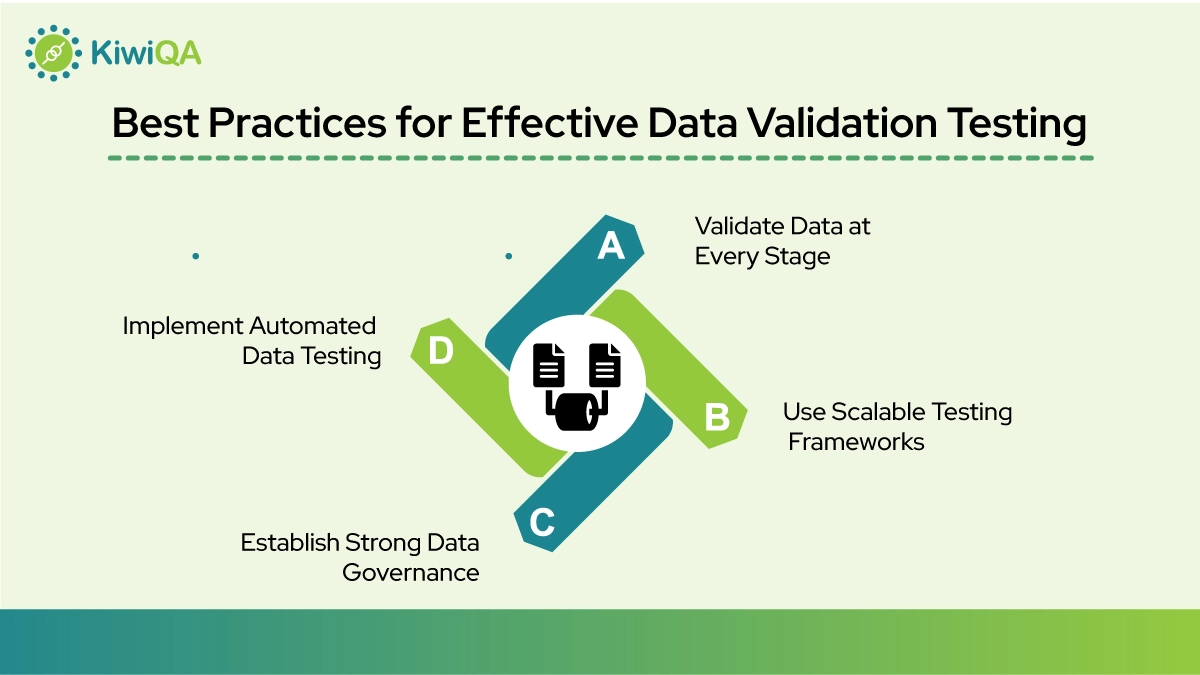
In the tech world of “Big Data,” the huge volume of data is rendering it impossible to run manual testing for validation. When dealing with millions of records generated every minute, human intervention becomes a bottleneck that introduces more errors than it solves. Automated data testing acts as a high-speed digital filter, capable of scanning vast datasets in seconds to identify anomalies that would be invisible to the naked eye.
The true power of data validation testing platform automation lies in its integration; these tools should be embedded directly into your data pipelines. By doing so, you move from “reactive” cleaning to “proactive” monitoring. This setup provides real-time feedback loops, allowing data engineers to catch issues at the moment of entry. When validation is automated, it ensures that your quality checks are consistent, repeatable, and capable of running 24/7 without fatigue.
A Data Contract serves as a foundational pillar for organizational data governance. It is a formal approach to focus on both producers & consumers. This contract explicitly defines the expected schema, data types, required fields, and acceptable value ranges.
Think of it as a quality-of-service guarantee. By implementing a validation layer that enforces this contract, you create a fail-safe for your architecture. If incoming data fails to meet the agreed-upon standards, the system should automatically “quarantine” that data. This prevents the “poisoning” of the downstream database, ensuring that only “contract-compliant” information ever reaches your AI models, while the rejected data is sent to a side-stream for manual or automated remediation.
Data quality can degrade at any point throughout the process of transfer. To combat this, a multi-layered validation strategy is required, treating the data pipeline like a multi-stage filtration system:
➞ The Ingestion Layer: This is called the crucial layer of safety. As data enters the system, validation should focus on structural integrity, checking for basic schema mismatches, incorrect data types (e.g., text in a date field), and mandatory field presence.
➞ The Transformation Layer: Data is rarely used in its raw form; it is aggregated, joined, and calculated. During this phase, validation must shift to verifying complex business logic. This includes checking that currency conversions are accurate, mathematical aggregations are consistent, and that the data still makes logical sense after being manipulated.
➞ The Storage and Load Layer: Before data is finalized in a warehouse or fed into an AI model, a final round of “sanity checks” is essential. This involves validating referential integrity, ensuring that relationships between tables remain intact. This helps perform cross-system reconciliations to confirm that no data was lost or corrupted during the move.
A common pitfall for growing enterprises is building a validation system that works for gigabytes of data but breaks when faced with terabytes. As data volume expands, your testing infrastructure must be able to scale horizontally. This is where cloud-native testing frameworks become indispensable.
By leveraging the elastic nature of the cloud, these frameworks can distribute validation tasks across multiple computing nodes simultaneously. This ensures that even when processing petabytes of information, your quality checks do not become a bottleneck that delays your release cycle or slows down real-time analytics. Scalability ensures that as your business grows and your AI models become more data-hungry, your commitment to data quality remains uncompromised by technical limitations.
Organizations can quickly and accurately validate massive amounts of data with the aid of automated data testing solutions. Teams can establish validation rules, identify abnormalities, and automate testing processes with well-known tools like Soda SQL, Great Expectations, and Apache Gryphon.
Continuous validation during data input and transformation is made possible by these technologies’ smooth integration with contemporary data pipelines. Additionally, they facilitate the early detection of problems by supporting features like data profiling, schema validation, and real-time warnings.
Automated technologies ensure high standards for data quality while increasing productivity and consistency by minimizing manual intervention. These solutions are essential for preserving trustworthy datasets for AI models and analytics platforms as data ecosystems get more complex, ultimately improving operational performance and decision-making.
Data integration and validation platforms ensure that data from multiple sources is accurately combined, transformed, and validated before use. Solutions like Informatica Data Quality, Talend Data Fabric, and Microsoft Azure Data Factory provide robust capabilities for data cleansing, transformation, and validation across distributed systems.
These platforms support rule-based and pattern-based validation, ensuring data consistency across databases, applications, and cloud environments. They also enable real-time data monitoring and governance, which is crucial for maintaining data accuracy in dynamic environments. By unifying data workflows and enforcing validation rules, these platforms help organizations build reliable data pipelines that support analytics and AI initiatives while ensuring compliance with industry standards.
Frameworks for AI and analytics validation are made to guarantee the precision, equity, and dependability of machine learning models and analytical results. Frameworks like Evidently AI, Deequ, and TensorFlow Data Validation aid in data drift or anomaly detection, model performance monitoring, and training data validation.
To make sure data follows expected patterns, these frameworks offer statistical analysis, schema checks, and distribution comparisons. Additionally, they facilitate ongoing validation in production settings, allowing businesses to sustain model correctness over time. Businesses may lessen bias, increase model transparency, and guarantee that analytics outputs are dependable and useful in practical situations by incorporating these frameworks into AI pipelines.
Also Read: Top Functional Testing Services That Boost Confidence in Every Release
To find gaps, inconsistencies, and other hazards, start by assessing your existing data pipelines. Examine the methods used for data collection, processing, and system storage. Examine sources for dependability, correctness, and completeness. Businesses can create targeted changes and guarantee data integrity from the very beginning of the pipeline by identifying weak points in current workflows where validation is lacking or ineffective.
Establish a systematic framework for data validation that outlines guidelines, requirements, and procedures to guarantee data accuracy. Setting validation tests like format, range, consistency, and duplicate controls is part of this. Incorporate automated tools to instantly enforce these regulations. A well-thought-out framework lowers human error, guarantees consistency across systems, and creates a solid basis for preserving accurate, high-quality data.
Data validation necessitates continuous monitoring; it is not a one-time operation. Use dashboards and real-time tracking tools to find abnormalities, mistakes, or inconsistencies as they happen. Frequent audits and alerts enable teams to address problems promptly. In order to promote better decision-making and sustain overall system performance and business efficiency over time, continuous monitoring guarantees that data remains accurate, relevant, and reliable.

The data precision is necessary for the success of any AI and analytics projects. You can’t afford to build your approach on unreliable, subpar information in a market that is becoming more and more competitive. You can make sure that your platform is safe, compliant, and, most importantly, trusted by implementing strong data validation testing techniques. The specialty at KiwiQA is assisting businesses in avoiding the errors related to data quality. The team of skilled testers is here to make sure your data is perfect, whether you are optimizing a global BI platform or developing a generative AI model.

Join the like-minded community & get the latest updates and insights on software testing technological transformation around the globe. Don't miss out.