Why AI-Driven Testing Is the Future of Quality Engineering?
 KiwiQA
Table of Contents
Based on the report by Fortune Business, the worldwide AI-enabled testing market is expected to grow to $2,746.6 million by the next 4 to 5 years. The complications in modern software solutions increase, so it’s necessary for the business to make sure its AI system runs flawlessly and efficiently. While traditional software testing techniques are still in use, modern complications require rigorous AI-driven testing approaches.
In the current landscape, organizations are under immense pressure to deliver quality software. Traditional manual testing methodologies can’t keep up with the modern development cycles & bugs. As applications evolve to advanced technologies, IoT, AI, and cloud-native architectures, it ensures reliability, security & performance. This is when AI testing services step in. This testing revolutionizes how enterprises approach software QA. By implementing AI & ML into testing lifecycles, businesses can automate repetitive tasks, monitor defects, and optimize test coverage.
Based on another report, in 2026, 40% of businesses will spend their budget on AI testing apps. As digital innovations accelerate, AI is upscaling the process accuracy & establishes new product/service excellence standards. In the rapidly growing virtual space, it becomes a necessity to integrate AI in QE to revolutionize data into valuable insights.
Research revealed that 80% of software will be designed on AI by the end of 2026, so if you are not using AI testing services as a QE, then you need to adopt it. It keeps you competitive in every aspect of SDLC, business operations, and customer experience. In the following blog, we’ll explore what AI-driven testing is and how it is shaping the future of quality engineering.
AI is revolutionizing quality engineering by uplifting testing abilities & streamlining the process. AI-based software testing services allow the QA engineering team to focus on necessary areas and enhance the reliability & accuracy of software testing. The AI-driven tools optimize test result analysis and enable engineers to opt for comprehensive QA coverage.
In cloud computing, QE is necessary because of the unique features of cloud-based apps. These apps must be reliable to maintain uninterrupted services and limit downtime errors. With AI testing, you can upscale automated test generation and execution. Quality engineering supports the establishment of QA environments for testing embedded software across various devices. AI optimizes this process by facilitating accurate & faster QA testing. Additionally, AI has the potential to mimic real-time user behavior & patterns to run large-scale performance testing under various scenarios.
Manual testing takes more time & is prone to errors in agile development environments. Thanks to AI tools, which allow automating recurring testing tasks, including generation and execution. When businesses implement tools, they can free the QE engineers. AI-based software testing services drive test coverage and minimize human error. The tools enable running thousands of tests against various environments in a single instance, which isn’t possible in manual testing. AI can seamlessly integrate with CI/CD, which ultimately offers faster development without hampering quality.
ML is the foundation of AI-based software testing services, allowing systems to learn from historical test data & improve time without explicit programming. It assists in identifying patterns, predicting defects, and optimizing test execution by focusing on high-risk areas. ML has the potential to create test cases, detect anomalies & drive decision-making in the testing process.
By continuously learning from previous outcomes, ML improves accuracy & efficiency in quality engineering. It will result in smart automation, minimize manual effort & fast delivery cycles. It enables businesses to maintain quality standards in frequently evolving software environments.
NLP enables AI tools to understand & interpret human language, make test creation accessible & intuitive. Additionally, it supports analyzing user requirements, bug reports, and documentation to generate relevant test scenarios. NLP enhances collaboration between technical & non-technical teams by bridging communication gaps. In addition, it drives test coverage by addressing missing scenarios from textual data. It ensures comprehensive testing & minimizes chances of errors.
Computer vision also plays an important role in AI system testing services by allowing systems to visually measure & interpret the user interface. It enables tools to recognize UI elements, validate layouts, and track visual inconsistencies. Unlike traditional methods, where quality engineers rely on code-based locators, computer vision interacts with apps like humans. It makes tests more resilient. It significantly minimizes maintenance efforts & drive test reliability. By ensuring accurate visual validation across devices & platforms, the tool drives user experience & product quality.
Predictive analytics leverage AI & statistical models to forecast potential defects & testing outcomes before they occur. By measuring historical data, changes in code, and earlier testing results, it identifies high-risk areas that demand focused testing. It allows the team to make proactive approaches and limit the chances of crucial failures in production. It supports resource optimization, allocation & test planning by ranking tasks depending on the level of risks. This is how business can enhance efficiency, minimize cost, & serve reliable software.
AI system testing services effectively speed up test execution by enabling numerous test cases to execute concurrently across environments. This guarantees quicker feedback cycles and cuts down on overall testing time. Additionally, by creating test cases based on application behavior and historical data, AI-powered automated test generation reduces the need for manual scripting. Teams are able to complete more tests in less time as a result, allowing for faster releases. It allows preserving high software reliability and excellence in dynamic development contexts.
AI is used by self-healing test automation to automatically identify modifications to the application’s code. This greatly reduces maintenance effort by removing the requirement for ongoing manual intervention when elements change. To guarantee testing continuity, AI algorithms find failed test cases, examine the underlying cause, and modify scripts.
Test suites eventually become more dependable and stable as a result. Organizations may maintain consistent testing workflows, decrease downtime, and boost productivity. AI-enabled testing services will increase the resilience and efficiency of the overall quality engineering process.
By proactively creating test cases that exceed traditional manual methods, AI improves test coverage. AI creates intelligent test cases by examining application operations, user behavior, and previous errors to find important test scenarios. By concentrating on high-impact and high-risk application domains, risk-based testing further prioritizes these situations. This guarantees that testing activities are both thorough and focused. As a result, teams may efficiently manage time and resources while achieving deeper coverage. It helps to find hidden flaws and produce software that is more reliable.
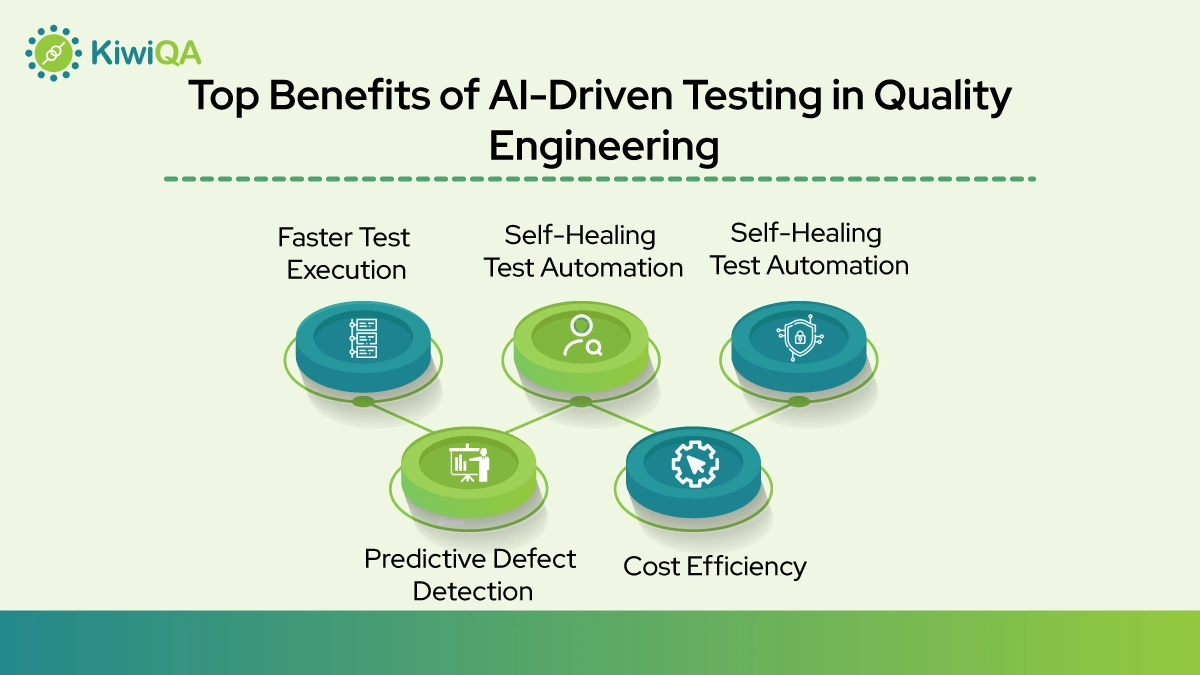
By examining past data, code modifications, and testing trends to spot possible problems before they arise, AI-driven testing makes predictive defect detection possible. Early problem detection lowers the cost and complexity of solutions by assisting teams in addressing flaws early. AI-powered risk analysis also identifies application vulnerabilities that demand targeted testing. This proactive strategy reduces the likelihood of significant manufacturing failures. Organizations can guarantee more consistent and reliable releases. They can increase software quality and improve user experience by anticipating faults rather than responding to them.
By drastically lowering manual labor and maximizing resource use, AI-driven testing increases cost-effectiveness. Teams can concentrate on more important work by using automation to manage repetitive operations. Faster release cycles reduce delays and cut time-to-market, which further reduces costs. Early fault discovery also reduces the need for improvement in SDLC. AI helps businesses reduce operating expenses while upholding high standards by optimizing the entire testing lifecycle. This improves ROI and makes scalable, effective quality engineering techniques possible.
Also Read : Top AI Testing Company in the USA for Scalable AI Solutions
UI testing frequently uses AI-driven testing to make sure programs provide reliable and aesthetically correct user experiences. AI uses visual validation to find even the smallest errors in design, colors, fonts, and objects by comparing current UI screens with baseline images. By spotting positional changes, missing elements, or abnormal user interface behavior across devices and browsers, it also makes layout change detection possible. This minimizes human mistakes and does away with the necessity for manual visual checks. Teams can thus promptly detect and resolve UI problems, guaranteeing smooth user interfaces and enhancing overall program quality and user satisfaction.
AI improves API testing in practical applications by automating validation procedures and guaranteeing smooth system connectivity. Without requiring a lot of manual programming, AI can automatically validate API answers, verify endpoints, and check data integrity with the use of AI system testing services. Additionally, it makes intelligent test data production possible by generating dynamic and realistic datasets that enhance test coverage and accuracy.
In order to optimize test scenarios and identify possible failures, AI continuously learns from previous test runs. As a result, API testing becomes quicker and more reliable. AI system testing services assist businesses in maintaining strong integrations and producing high-performing applications.
By mimicking actual user loads and forecasting system behavior under various circumstances, AI-driven testing is essential to performance testing. By using AI algorithms to predict how apps will function during periods of high usage, predictive load testing enables teams to fix bottlenecks before they affect users.
Anomaly detection also helps in identifying unexpected trends in system performance. Proactive optimization is made possible by these insights, which also guarantee that systems stay responsive and stable. Organizations may produce high-performing apps that satisfy users even in the face of tremendous demand by utilizing AI.
AI reduces unnecessary test execution to determine which test cases are most important to execute based on recent code changes. Without spending time on unaffected components, our focused approach guarantees that high-risk areas are properly evaluated. AI also speeds up test cycles by automating execution and improving test suites’ correctness and speed. It continuously learns from past test outcomes to improve testing tactics in the future. Teams are able to swiftly verify upgrades, preserve software stability, and confidently provide new features as a result.
This is one of the main challenges to implementing AI-driven testing. Teams frequently need to comprehend ideas like intelligent automation, data-driven testing, and machine learning models, which demand further training and upskilling. As testers adjust to new workflows and procedures, productivity may temporarily decline. Organizations also need to devote time to fostering trust in AI-based solutions. Teams gain from increased productivity, more intelligent testing procedures, and better overall quality engineering results.
Finding AI-driven testing solutions can be tough. It can be difficult to determine which tool is appropriate for a given set of business requirements because each one offers a distinct set of features, integrations, and degrees of AI power. Companies need to assess things like cost, scalability, usability, and accessibility with existing systems. Low ROI, higher costs, and inefficiencies can result from a bad choice. Therefore, to ensure successful deployment and optimize the value of AI-driven testing solutions, thorough research, pilot testing, and alignment with project goals are crucial.
It can be difficult to incorporate AI-driven testing technologies into current testing and development environments. Seamless integration is challenging since many organizations currently utilize numerous testing frameworks, older systems, and established CI/CD pipelines. During implementation, problems with compatibility, data migration, and workflow disruptions may occur.
Furthermore, technological know-how and customization may be needed to integrate AI tools with existing procedures. These difficulties may cause adoption to be delayed and have a short-term effect on productivity. However, companies may successfully integrate AI-driven testing into their workflows and achieve its full potential. It helps with careful planning, strong integration strategies, and teamwork.
Also Read : Complete List of AI Testing Services for AI-Powered Platforms
Before expanding AI-driven testing throughout the company, start with small pilot projects to assess performance, ROI, and viability. Through pilot projects, teams may better learn how AI technologies operate in real-world settings, spot possible problems, and improve low-risk techniques.
This strategy enables organizations to measure results, test various scenarios, and foster stakeholder confidence. It also offers insightful information about integration demands and resource requirements. Businesses may guarantee a more seamless transition, minimize disruption, and build a solid foundation for wider AI adoption in quality engineering by starting small and increasing gradually.
Selecting the ideal AI-driven testing tool for a quality engineer’s future is necessary for successful implementation. Businesses must evaluate tools depending on their compatibility with the existing systems, ease of use, and scalability. It is necessary to consider factors like multiple testing types, integration with development pipelines & reliability.
Perform thorough research, comparing options, and running trials to monitor the right option. Making wrong choices can cause inefficiencies and increased costs. The well-informed decisions ensure improved performance, smooth workflows, and maximum ROI in AI-powered testing initiatives.
Teams must receive the right training in order to successfully implement AI-driven testing procedures. The operation of AI technologies must be understood by testers, developers, and QA specialists. Workshops, training courses, and practical experiences can all help in developing the necessary abilities and self-assurance.
Teams may stay current with emerging technology by promoting ongoing learning. Teams with proper training can increase productivity, decrease errors, and make better use of AI capabilities. Investing in talent development guarantees the long-term viability and effectiveness of AI-driven testing within the company.
To successfully integrate AI-driven testing methods, AI software testing companies need to be properly trained. Testers, developers, and QA specialists need to understand how AI systems work. Training, organizing seminars, and programs help to build skills and confidence. By encouraging continuous learning, teams can stay up to date with modern tools. With the right training, teams can use AI capabilities more effectively, enhance productivity, and reduce errors. The long-term sustainability and efficacy of AI-driven testing within the organization are ensured by investing in talent building.
Frequent monitoring & optimization are necessary for driving the effectiveness of AI-driven testing. Businesses must frequently address performance metrics, test results & AI model accuracy to track the areas that require improvement. Feedback loops support refining test strategies and drive decision-making.
It is also necessary to upgrade models, manage test cases, and optimize depending on rising demands. Frequent evaluation promises that AI tools remain aligned with organized goals & deliver consistent values. By focusing on ongoing improvement, organizations can manage efficiency, limit risks, and achieve long-term success in QE.
AI-driven testing isn’t a technological advancement but a transformation in how we ensure software quality. By leveraging AI’s predictive abilities, learning algorithms & automation intelligence, businesses can opt for faster release, improve accuracy, & reduction in cost. As we are going towards the AI-driven world, the future of quality engineering is evolving rapidly for addressing error detection to quality prediction.
An enterprise that embraces AI in software testing can lead to a high-performing, future-ready app. We can say that AI-powered testing is slowly becoming the foundation that enables QE to keep pace with continuous change. AI integration & testing isn’t a luxury but a reality, building the future of quality engineering. QE engineers can leverage AI to get a scalable, accurate, and efficient testing process.
It helps them to keep pace with modern AI demands. AI is leveling up the quality of engineering by automating routine tasks, enhancing test coverage & continuous learning. It promises to deliver quality software products faster & seamlessly. It’s high time for AI software testing companies to invest in AI-driven tools & upskill their team to opt for the leading position in their domain.

Join the like-minded community & get the latest updates and insights on software testing technological transformation around the globe. Don't miss out.