SaaS API Testing Strategy for Scalable SaaS Applications
 Niranjan Limbachiya
Table of Contents
Advanced SaaS apps rely on APIs to integrate the frontend interface with backend systems, microservices, 3rd-party platforms, and databases. APIs allow necessary functions like data exchange, authentication, payments, and integration across connected services. As SaaS platforms scale, API reliability becomes necessary because high user traffic and rising integration can expose performance, security, and integration errors. 30% more API demand is noticed, as per the report by Gartner. 82% of firms have relied on an API-first approach, based on research.
An organized SaaS API testing strategy allows firms to identify these risks early by verifying API performance, functionality, integration, security, and scalability through the development cycle. It also supports consistent app quality as new features, users, and services are introduced. Firms can use SaaS Testing Services to strengthen automated testing, improve API readability, validate crucial operations, and detect errors before production. A structured approach allows SaaS firms to manage stable app performance, safeguard sensitive data, reduce disruptions, and deliver a stable digital experience as the platform continues to grow. To learn about a well-organized API SaaS testing strategy, read the following sections.
APIs allow communication and apps to exchange data and execute business functions. In SaaS environments, APIs also integrate 3rd-party platforms, support microservices communications, manage authentication, and allow secure data exchange. Testing these interactions supports requests, responses, integrations, and user management functions operating accurately across the app ecosystem.
API testing allows SaaS firms to identify failures before they impact customers or production environments. SaaS testing company helps validate app stability by validating endpoint functionality, integrations, data exchanges, and performance. Frequent testing also supports identifying errors across connected services and reduces production errors. The structured practice ensures APIs remain stable, secure, responsive, and consistent as SaaS apps evolve.
API testing SaaS strategy describes what, when, and how APIs should be tested throughout the development lifecycle. It establishes testing goals, environments, functional and integration testing, security and performance validation, automation, monitoring, and reporting processes. When integrated with SaaS application testing, the organized practice improves test coverage, identifies risks, and supports reliable SaaS deployment.
APIs must manage growing traffic without experiencing performance problems as SaaS applications bring more users. Finding capacity limits, response-time issues, and possible delays is made easier by testing APIs under increasing workloads. As customer demand rises, regular scalability testing guarantees that crucial endpoints stay responsive and stable.
SaaS apps frequently rely on cloud services, CRM & payment gateways. These integrations are verified for reliable data exchange, authentication, error handling, and compatibility through API testing. This reduces the chance that crucial business processes or customer-facing features will be hampered by integration failures.
SaaS automated testing is crucial for verifying service-to-service communication and dependencies as SaaS platforms grow their microservices architecture. Additionally, it helps in preventing failures that might have an impact on several business processes and application components.
Regular SaaS releases may result in API modifications that impact current integrations and functionality. Validation of new releases, API version modifications, and updated workflows is supported by ongoing API testing. Automated regression testing ensures that current endpoints continue to function properly and allows quick product deployments.
Clearly defined testing requirements are the first step in a successful SaaS API testing strategy. Finding business-critical APIs that facilitate crucial application features and client workflows should be your first step. Describe each endpoint’s expected behavior, including response handling, error conditions, expected outputs, and acceptable inputs.
To create uniform testing standards for development and quality assurance teams, document request and response formats. Based on business requirements, establish performance standards for response times. Early documentation of security requirements, including data protection, access controls, authorization, and authentication, is also important. For functional, performance, integration, security, and scalability testing, well-defined requirements offer a solid basis.
Functional API testing confirms that APIs carry out their goals precisely and reliably. Test PUT or PATCH requests for updates, POST requests for resource creation, and GET requests to verify data retrieval. To guarantee that resources are appropriately deleted when necessary, DELETE requests should also be verified.
Verify that APIs return the proper statuses for successful requests, client errors, and server failures by looking at HTTP response codes. Verify response data by comparing it to the expected formats, structures, and values. The proper content types, authentication details, and other necessary parameters should be checked in headers. Additionally, error messages should be examined to make sure they are consistent, accurate, and helpful.
Also Read : A Complete SaaS Testing Approach for Modern Businesses
Testing for API integration guarantees that APIs interact properly with linked systems and services throughout the SaaS environment. To ensure reliable data exchange and workflow execution, test interactions between internal services. Verify database connectivity to ensure data is updated, retrieved, and stored correctly. It is important to test third-party platform integrations for data consistency, error handling, and compatibility.
Additional validation for transaction accuracy, failures, and secure processing is essential for payment system integrations. To ensure trustworthy identity verification and access control, authentication providers should be put to the test. In order to guarantee that APIs maintain consistent communication across distributed environments, cloud applications should also be included. Failures that could impact entire business workflows can be found with the help of integration testing.
API performance testing evaluates the performance of SaaS APIs under various traffic scenarios. Load testing helps teams assess whether response times are still acceptable by measuring API behavior under expected user and transaction volumes. In order to find breaking points and recovery behavior, stress testing pushes APIs beyond their typical capabilities.
While endurance testing assesses performance over extended workloads, spike testing assesses how APIs react to unexpected spikes in traffic. Response-time testing helps in locating slow endpoints that could compromise user experience. Throughput testing determines how many requests an API can accept for a certain time period. Teams can find performance issues before they affect customers by using these tests.
SaaS apps, client data, and interconnected systems are secured from common threats by API security testing. Verify that only valid users and applications are able to access protected endpoints by testing authentication methods. Testing for authorization guarantees that users can only access resources and functions that are authorized.
Verify input validation, encryption methods, and API tokens to avoid malicious requests and illegal access. To reduce abuse and excessive traffic, rate limiting should be tested. Additionally, teams should examine APIs for sensitive data exposure in error messages, logs, or responses. To find vulnerabilities and improve overall application security, SaaS security testing should be incorporated throughout the API testing lifecycle.
The ability of SaaS APIs to manage growing traffic without experiencing significant performance degradation is ascertained through API scalability testing. Increase API traffic gradually to see how the system responds to an increase in users and requests. To find restrictions on processing power, connections, or shared resources, test concurrent requests.
To find out when performance starts to slow down, measure response times at various traffic levels. It is also necessary to identify infrastructure barriers in servers, databases, networks, and supporting services. Verify auto-scaling behavior to make sure that cloud resources grow in response to demand. As customer usage grows, scalability testing helps SaaS companies maintain consistent API performance.
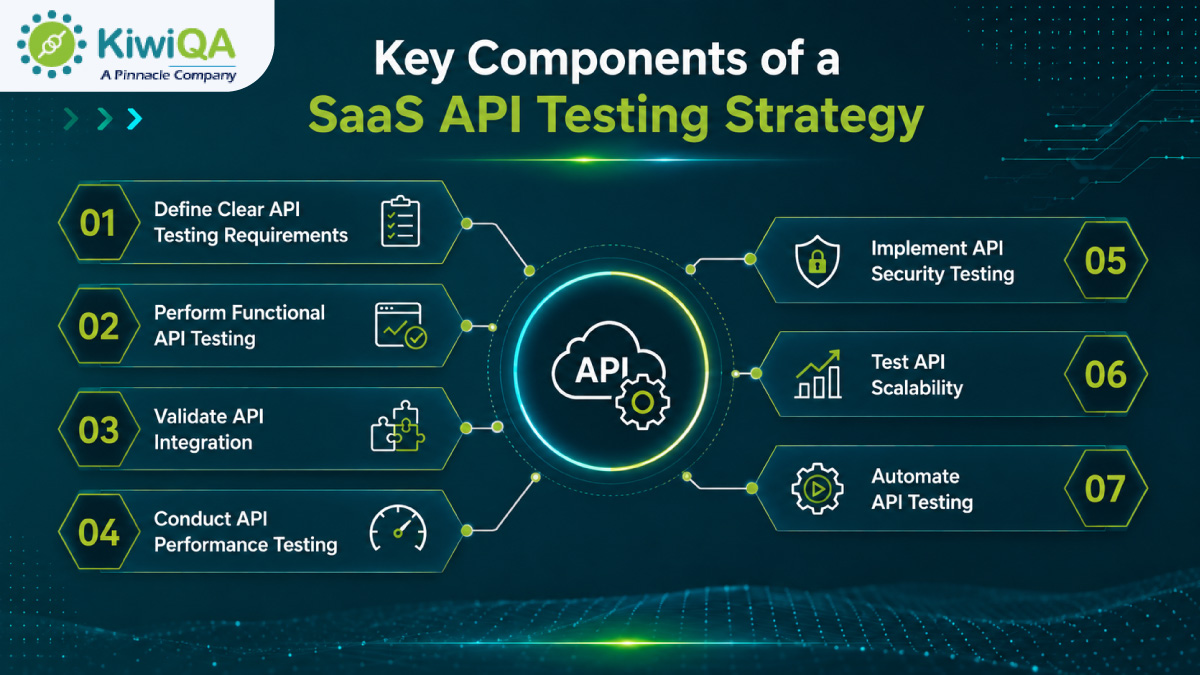
Throughout the SaaS development lifecycle, API test automation increases testing coverage, speed, and consistency. Automate routine functional and validation tests so that QA teams can carry them out effectively without the need for human intervention. To find errors early in the development and deployment process, incorporate API tests into CI/CD pipelines.
When new features, integrations, or code modifications are added, automated regression testing can confirm that the functionality of the API remains the same. To rapidly find unexpected issues, tests should also be conducted following significant code modifications. Automation lowers the possibility of human error and allows for regular testing across development environments. Faster releases are ultimately possible while preserving API quality and reliability thanks to a well-designed automation framework.
To find problems before they progress to later testing stages, API SaaS application testing should start during development. Testing individual endpoints, functions, and validation logic separately is known as unit-level API testing. Schema validation verifies that the specified structure, data types, and necessary fields are followed by API requests and responses.
Early detection of functional defects, inaccurate answers, validation errors, and implementation problems is made possible by developer testing. Defects can be fixed later in the development lifecycle with less expense and effort if testing is performed at this stage. Additionally, it provides developers with instant feedback when API behavior differs from technical specifications. Reliable integrations and later testing activities are strengthened by early testing.
Integration testing confirms that APIs function properly when associated with other platforms, services, and data sources. Service integration testing verifies that requests and responses flow properly between connected services and examines communication between internal application components. Third-party API validation ensures that external integrations correctly manage timeouts, failures, data formats, authentication, and response codes.
Data flow testing confirms that data is accurately transferred between databases, applications, external systems, and APIs. Compatibility problems that might not show up during isolated endpoint testing are found with the help of these tests. Additionally, testing integrations prior to production lowers the possibility of inconsistent data, broken workflows, and failures across dependent SaaS services.
APIs should go through extensive testing to make sure they are prepared for practical use before a SaaS application is released. Regression testing confirms that the functionality of the API has not been impacted by recent changes. Response times, throughput, and behavior under typical and peak workloads are all evaluated through performance testing.
Authentication, authorization, data security, input validation, and other possible weaknesses are all examined during security testing. Complete business workflows across multiple linked services and endpoints are validated through end-to-end API testing. There is more assurance regarding the reliability and stability of the application when these testing tasks are combined. To reduce production risks, any major errors found during this phase should be fixed and retested prior to deployment.
After deployment, API testing should continue to ensure consistency and identify problems that might arise in real-world scenarios. Continuous visibility into endpoint availability, status, traffic patterns, and failures is made possible by API monitoring. Response-time tracking helps in identifying poor performance that may have an impact on linked apps or user experience.
Error monitoring identifies recurrent endpoint issues, server problems, unexpected responses, and unsuccessful requests. Teams can identify unusual behavior and react swiftly to incidents with the help of ongoing monitoring. SaaS companies can maintain stable APIs and resolve production issues before they have a major impact on customers by combining monitoring with continuous validation.
To make sure APIs function properly, functional API testing confirms endpoint behavior, request handling, response validation, business logic, and error handling.
In order to verify secure data exchange, integration API testing verifies communication between databases, third-party platforms, internal services, and APIs.
Regression testing verifies that after code updates, bug fixes, new features, or integration modifications, the functionality of the current API remains stable.
Under various workload scenarios and usage levels, performance testing assesses API response times, throughput, resource consumption, and stability.
To find performance limitations under peak traffic, load testing measures how an API behaves under expected traffic volumes and concurrent requests.
Vulnerabilities related to authentication, authorization, encryption, input validation, rate limiting, and sensitive data exposure are found through SaaS security testing.
API availability, stability, error recovery, fault tolerance, and consistent performance over long operating times are all evaluated by reliability testing.
Testing for compatibility ensures that APIs function consistently across various platforms, technologies, and versions of connected applications.
Contract testing confirms that agreed-upon schemas, formats, fields, and service integration requirements are met by API requests and responses.
To guarantee smooth application functionality, end-to-end SaaS automated testing verifies entire business processes across numerous APIs, services, databases, and integrations.
APIs that allow for crucial SaaS processes, such as user registration, login, payments, subscription management, data processing, and third-party integrations, should be given top priority. Issues that could have a direct impact on customer experience, revenue, security, and business operations can be found by testing these crucial workflows first.
To increase testing consistency and reduce duplication, create reusable test cases. Establish shared validation rules, response checks, common authentication techniques, and standard request templates. Expanding test coverage, maintaining automation scripts, and modifying the framework as APIs and SaaS functionality change are all made easier by reusable components.
For easier maintenance and scaling of the framework, keep test data and testing logic apart. Use reusable datasets and set up environment-specific variables for production and development. This method allows the same tests to run in different environments, streamlines updates, and lowers errors.
Continuous validation during development and deployment can be achieved by incorporating automated API tests into CI/CD pipelines. Code changes, pull requests, staging deployments, and production releases are all possible times for tests to run. As applications change, this helps teams identify API flaws early, avoid unstable releases, and maintain consistent quality.
Organizations must monitor key SaaS API testing metrics to measure reliability, performance, and quality. API response time & latency describe how quickly endpoints respond, whereas API availability calculates accessibility and uptime. Error rate and failed request percentage allow you to identify recurring failures and unstable endpoints.
Request throughput and concurrent user capacity showcase how effectively APIs manage traffic and rising demands. Test coverage measures functionality, whereas error detection rate shows the effectiveness of testing. Mean time to detect API failures allows the team to monitor production errors quickly and respond before they impact users.
Also Read : Best 11 SaaS Testing Companies in India (Edition 2026)
▪ Support growing user bases- SaaS API testing validates that APIs can manage increasing users, transactions, and requests without performance errors.
▪ Maintain API response times– Testing identifies slow endpoints and performance errors before they affect users.
▪ Prevent service disruptions– It identifies capacity errors, failures, and unstable integrations before production release.
▪ Improve system reliability- Test API stability, error handling, and recovery under various conditions.
▪ Handle peak traffic– It evaluates API performance during peak traffic and high-demand periods.
▪ Support microservices expansion– QA ensures the API communicates reliably as businesses add integrations and app components.
▪ Reduce production defects– Automated testing catches integration, functional, security, and performance errors earlier.
▪ Improve customer experience– Reliable & responsive APIs allow delivering smooth application performance and consistency in user interactions.

Reliable API testing services for SaaS applications allow firms to prepare their apps for sustained growth and changing user demands. Identify security, performance, and integration errors before release to reduce production errors and service disruptions. It is good to develop a scalable testing process that aligns with rising SaaS architecture, improving users, integrations, and feature releases. Automated & continuous API testing allows reliability by validating crucial operations throughout development.
Collaboration with a professional SaaS testing company can offer specialized expertise, performance validation, security assessment, and continuous quality assurance. With the following organized approaches, firms can strengthen API stability, support scalability, and deliver consistent app experiences as SaaS platforms expand.

Join the like-minded community & get the latest updates and insights on software testing technological transformation around the globe. Don't miss out.