Best SaaS Testing Platforms Transforming QA Operations in 2026
 KiwiQA
Table of Contents
SaaS testing tools are crucial for a scalable SaaS software QA process. As CI/CD pipelines become widely adopted, cloud-based QA platforms deliver the scalability and intelligence that traditional tools often lack. According to recent market reports, the global SaaS market is projected to grow at a CAGR of over 18% and surpass $1 trillion in value in the coming years.
The major factors behind this growth are increasing cloud adoption, seamless integration, and rising requirements for scalable platforms. SaaS apps are convenient, but developing and maintaining them isn’t easy. A small gap can quickly hamper users. This is why SaaS Testing Services is gaining popularity.
SaaS testing tools are popular for streamlining the performance and balancing various software tests, without requiring on-premises infrastructure. These tools support continuous testing, manual test management & reporting.
Here in this blog, we are going to talk about the importance of SaaS testing tools, their benefits, and overviews. We have discussed a few tools in the section below, along with the use cases. Before you collaborate with any SaaS testing company, have the following information.
The advanced Agile & DevOps environment demands rapid software release and frequent feature updates. SaaS testing platforms support quick release cycles by automating frequent testing tasks, enhancing collaboration, and integrating seamlessly with CI/VD pipelines. It supports the QA team to track errors, limit delays, and manage software quality while driving product delivery in competitive virtual markets.
Continuous QA has become crucial for advanced software development as apps evolve through frequent updates. A SaaS QA platform allows frequent testing by offering scalable automation, real-time reports, and cloud-driven architecture. These abilities support the QA team in performing QA throughout the SDLC. It ensures quick feedback, improved app stability, and reliable software release without slowing down development workflows.
SaaS-driven QA platform offers scalable cloud infrastructure, which enables firms to broaden their testing environment depending on project demands. Team can access various devices, OS, and browsers without investing in physical infrastructure. The flexibility enhances QA efficiency, supports large-scale QA operations, and enables firms to adapt to changing software development and QA demands.
Cloud-driven SaaS application testing platform limits operational expenses by limiting the requirement for expensive hardware, maintenance, and internal device labs. Firms can access advanced QA environments through subscription-based models, lower infrastructure costs, while enhancing software quality. Limited QA costs also enable firms to invest more in automation, quick software delivery, and innovation.
SaaS QA platforms allow remote collaboration by enabling developers, QA, and stakeholders to access the QA tool and reports from any location. The cloud accessibility enhances communication, drives decision-making, and supports a fragmented QA team working across various regions. The flexibility drives productivity and ensures seamless collaboration throughout the software QA and development lifecycle.
SaaS testing platforms enhance error detection through automated testing, real-time analytics, and frequent monitoring capabilities. These tools support the QA team in catching errors earlier in the development process, limiting the risk of crucial production errors. Quick error detection enhances software stability, drives release cycles, and overall user experience across SaaS apps and virtual platforms.
Through smart processes, AI-powered test automation assists QA teams in increasing testing efficiency, speed, and accuracy. Smart test generation features are available in modern SaaS testing platforms, which automatically generate optimized test cases. Self-healing scripts further minimize maintenance requirements while guaranteeing consistent automated testing across changing software environments.
Testing across browsers and devices guarantees that SaaS apps operate reliably. To swiftly find UI and functional problems, modern SaaS testing companies offer browser compatibility checks. Additionally, they facilitate mobile responsiveness testing, which helps firms to offer streamlined user choices. In competitive digital contexts, this functionality is crucial for preserving software quality and raising user happiness.
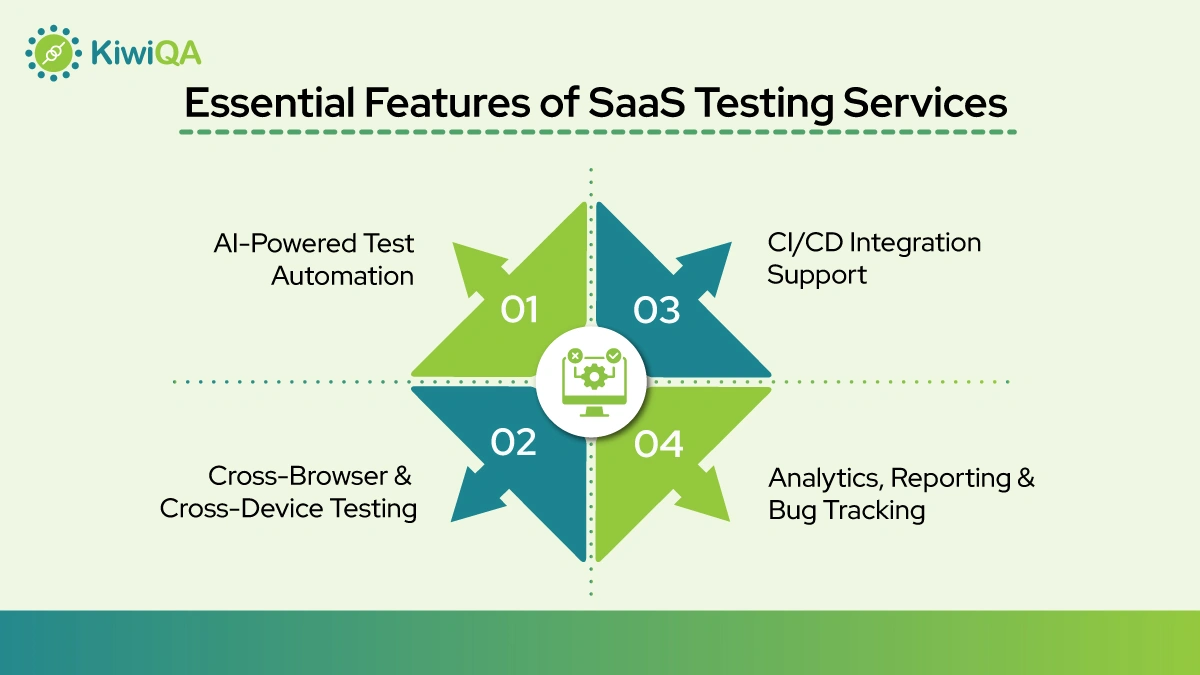
SaaS testing solutions may easily interface with DevOps pipelines and automated deployment procedures thanks to CI/CD integration capabilities. These interfaces improve software quality and shorten release times by enabling QA teams to run tests constantly during development. Real-time testing workflows give developers immediate feedback on application performance, allowing them to find and fix problems more quickly.
QA teams may manage defects, evaluate testing performance, and enhance decision-making processes with the use of advanced analytics and reporting options. SaaS testing solutions offer visual dashboards that show quality insights, execution status, and real-time testing information in a centralized setting. Additionally, they provide performance analytics and bug tracking tools that assist companies in locating testing bottlenecks. The SaaS Testing Services provider should streamline processes and enhance overall software reliability across development and QA operations.
QA teams can do real-time testing across many browsers, devices, and operating systems with the help of BrowserStack, a top cloud-based testing platform. By offering immediate access to actual devices in the cloud, it does away with the need for physical device labs. The technology is appropriate for DevOps and agile organizations since it supports both automated and manual testing operations.
By integrating with well-known automation frameworks like Selenium and Cypress, BrowserStack enables teams to ship software more quickly without sacrificing application quality. For companies committed to providing smooth user experiences across online and mobile platforms, its scalable infrastructure, collaboration features, and precise testing capabilities make it a top choice.
For effective QA execution, BrowserStack provides cross-browser compatibility validation, real device cloud testing, and automation support.
It is Ideal for large-scale application testing workflows managed by agile QA teams and corporations.
LambdaTest is a cloud SaaS automated testing platform with AI capabilities that makes cross-browser and cross-device testing for contemporary SaaS apps easier. Teams may conduct both automated and manual testing using it without having to spend money on costly infrastructure. The technology facilitates parallel testing, which helps companies shorten testing durations and speed up software delivery cycles.
Developer and tester communication is enhanced by LambdaTest’s seamless integration with common automation frameworks and CI/CD pipelines. Organizations can guarantee constant application performance across various devices and operating systems thanks to its scalable cloud environment and broad browser coverage. Fast-growing businesses that want to increase QA efficiency while preserving high-quality digital experiences for users utilize the platform extensively.
For quicker QA procedures, LambdaTest offers comprehensive browser coverage, parallel test execution, and AI-powered testing.
It is Ideal for fast-growing SaaS businesses seeking scalable and cloud-based testing solutions.
Software testing operations can be effectively organized, managed, and tracked by QA teams with the help of TestRail, a comprehensive test management platform. It offers comprehensive test case management, centralized reporting, and communication capabilities that increase project visibility. Teams can maintain consistency and enhance product quality with the platform’s support for both automated and manual testing methods.
TestRail helps businesses optimize QA operations and reporting procedures by integrating with well-known development and issue-tracking technologies. Teams can more easily track testing progress and promptly detect problems thanks to its user-friendly UI and customizable dashboards. In software development environments, companies utilize TestRail to enhance test preparation, teamwork, and overall project management effectiveness.
For well-organized testing workflows, TestRail offers collaborative tools, centralized QA reporting, and test case management.
It is Ideal for QA teams and companies that prioritize organized test administration and reporting.
Web, mobile, desktop, and API testing are all supported in a single environment by Katalon Platform, an all-in-one automated testing solution. Both IT and non-IT professionals can use testing because of its low-code automation features. Additionally, the platform offers AI-driven analytics and reporting capabilities that assist companies in increasing the effectiveness of testing and streamlining QA processes.
Faster software delivery and enhanced team collaboration are made possible by Katalon’s integration with major development tools and CI/CD pipelines. Organizations can optimize automated workflows while preserving software quality thanks to its user-friendly UI and scalable testing infrastructure. Katalon is used by many companies to streamline intricate testing procedures and increase overall testing efficiency across digital applications.
For effective QA operations, Katalon provides low-code automation, multi-platform testing support, and AI-enhanced analytics.
It is perfect for groups looking for a single, user-friendly platform for software testing.
Organizations may conduct automated and real-time SaaS testing on a platform with Sauce Labs, a cloud-based continuous testing platform. Assisting teams in expediting testing cycles and enhancing software release quality helps DevOps and CI/CD workflows. Businesses may conduct tests effectively without maintaining internal testing environments thanks to the platform’s scalable cloud infrastructure.
Developers and QA teams may work together more efficiently thanks to Sauce Labs’ integration with well-known automation frameworks and development tools. Its robust reporting features and dependable testing environment enable businesses to find faults fast and enhance application performance. Sauce Labs is used by businesses to enable continuous software delivery strategies and large-scale testing operations.
Sauce Labs offers scalable cloud-based infrastructure, automated and live testing support, and continuous testing.
It is ideal for enterprise DevOps teams that oversee quick software releases and continuous testing.
Also Read : Top 12 SaaS QA Testing Companies in the USA (Edition 2026)
The enterprise-grade automation testing platform Tricentis Tosca is renowned for its risk-based testing features and scriptless testing methodology. It assists companies in lowering the complexity of testing while enhancing software reliability, speed, and coverage. Within a single environment, the platform facilitates end-to-end testing for business processes, enterprise apps, and APIs.
Tosca helps companies expedite software delivery while reducing maintenance efforts by integrating with DevOps and CI/CD workflows in an efficient manner. It can handle difficult QA settings across large organizations thanks to its advanced automation features and scalable architecture. Tricentis Tosca is used by businesses to increase testing effectiveness, lower operational risks, and guarantee consistent performance across vital business applications and digital systems.
For advanced QA operations, Tricentis Tosca provides enterprise-grade scalability, risk-based testing, and scriptless automation.
Perfect for big businesses managing intricate testing procedures and enterprise software.
Postman is a popular tool for API testing and collaboration that streamlines the processes of developing, testing, monitoring, and automating APIs. It facilitates the creation of automated workflows, API functionality validation, and enhanced cross-project collaboration for developers and QA teams. The user-friendly interface design, testing, and APIs management.
Additionally, Postman offers automated testing and monitoring capabilities that assist companies in guaranteeing the performance and dependability of APIs. Teams may easily exchange collections, documents, and testing environments thanks to its collaborative workspace. Postman helps businesses manage the API lifecycle more effectively, increase development productivity, and keep development and quality assurance teams working on cloud-based and SaaS apps in constant communication.
For effective API management procedures, Postman facilitates teamwork, workflow automation, and API testing.
Ideal for QA teams overseeing contemporary SaaS applications and API-focused development teams.
Predictive defect detection driven by AI assists QA teams in identifying testing risks and possible software problems prior to deployment. AI enhances software stability and lowers crucial production faults by examining past testing data, user behavior, and application patterns. For contemporary SaaS applications in fiercely competitive digital contexts, this proactive strategy facilitates quicker issue resolution, improves testing accuracy, and promotes more dependable software delivery procedures.
AI-powered predictive defect detection helps QA teams find potential software issues and testing hazards before deployment. By analyzing historical testing data, user behavior, and application trends, AI improves software stability and reduces critical production errors. This proactive approach supports faster problem solving, increases testing accuracy, and encourages more reliable software delivery processes for modern SaaS services in highly competitive digital contexts.
AI is used in intelligent test prioritization to concentrate testing resources on high-risk regions and essential business features first. Teams may speed up software release cycles, enhance fault identification, and maximize testing resources with this method. Through the identification of vulnerabilities and the prioritization of security-focused test cases within QA workflows, AI also facilitates enhanced SaaS security testing. Intelligent prioritization reduces testing time and operational complexity while improving software quality as companies implement continuous delivery techniques.
SaaS testing solutions enable QA teams to access tools, results, and testing environments over the cloud from any location. This facilitates flexible processes, enhances remote team engagement, and speeds up testing execution without relying on location-based systems or on-premise equipment.
SaaS testing platforms that are cloud-based can quickly increase resources in response to testing requests and project requirements. Without purchasing new hardware, businesses may increase testing environments, automation capabilities, and device coverage. The load testing for SaaS platforms helps teams handle increasing workloads more effectively and shorten software release cycles.
SaaS testing platforms eliminate the need for costly device labs, physical equipment, and upkeep. Subscription-based models give organizations access to advanced testing environments, which reduce operating costs while enhancing software quality control and testing efficiency.
Standard testing technologies frequently necessitate ongoing infrastructure maintenance, software updates, and hardware upgrades. For companies managing large-scale QA operations, managing physical testing facilities can raise operational complexity, use IT resources, and result in additional expenditures.
Traditional testing systems typically rely on on-premise infrastructure, which makes remote access and cooperation more challenging. This restriction may result in slower testing processes, lower productivity, and a lack of communication between developers, testers, and project stakeholders.
Due to their reliance on human setups and infrastructure management, traditional testing environments can take longer to grow and update. The development and release process for SaaS services may be slowed down, and software deployments may be delayed.
Traditional regression QA often consumes resources & time, especially for the large SaaS apps with frequent updates. Manual QA delays software release and increases the risk of missed errors.
Most of the firms struggle with disconnected QA processes, tools, and reporting systems, which limit team collaboration and visibility. Distributed systems can slow down decision-making and lead to design inconsistencies in QA operations.
Testing apps across various devices, OS, and browsers can be tough without access to a broad infrastructure. Limited device coverage may cause compatibility errors and a poor user experience.
SaaS QA platforms use a SaaS testing strategy like automated QA pipelines to speed up regression QA and limit manual effort. Automation enhances QA accuracy, supports frequent delivery, and enables the team to release software quickly.
Unified dashboards centralize QA reporting, test management, collaboration tools, and analytics in a single platform. It improves workflow visibility, team coordination, and streamlines overall QA operations.
They offer quick accessibility to real devices, browsers, and OS for scalable testing. It supports businesses to perform accurate cross-platform QA without maintaining costly physical infrastructure.
Also Read : Top AI Testing Tools Decision Makers Should Invest in 2026
AI-based autonomous QA is revolutionizing SaaS QA operations by limiting manual intervention and enhancing QA accuracy. The advanced QA platform now utilizes AI to identify errors, generate test cases, measure app behavior, and optimize test execution automatically. These smart systems can adapt to UI modifications, prioritize high-risk areas, and enhance regression QA efficiency.
The AI-driven QA accelerates release cycles by limiting tasks and allowing quick error detection. As SaaS apps become more complicated, autonomous QA plays a crucial role in enhancing software quality, limiting operational costs, and supporting frequent delivery strategies for agile development infrastructure.
Codeless automation is gaining popularity since a large number of firms are seeking quick and accessible QA solutions. Advanced SaaS QA approaches now offer a drag-and-drop interface and visual workflows that enable non-technical users to develop automated QA without extensive coding knowledge.
The following practices limit dependency on specialized automation engineers while enhancing collaboration between the QA team, developers, and business stakeholders. Codeless QA also speeds up test creation, simplifies maintenance, and supports quick release cycles. As firms focus on agility and rapid virtual transformation, the demand for user-friendly automation tools will grow, making codeless QA a key trend, shaping the future of QA.
API and security testing are becoming a necessary component of advanced SaaS QA strategies as apps rely more on interconnected services and cloud infrastructure. Testing platforms are now prioritizing to validate API functionality, reliability, and performance while identifying errors and security risks.
Automated API QA supports firms to ensure seamless communication between systems, while advanced SaaS security testing safeguards user data & avoid cyber crimes. With rising concerns around compliance, app security, and privacy, firms are investing more in integrated QA solutions that combine API, security, and functional QA capabilities. These QA practices are improving software reliability and maintaining user trust in virtual platforms.
This QA practice is reshaping QA workflows by offering instant insights into app performance, software quality, and QA progress. SaaS QA platforms are now using modern dashboards and AI-driven reporting tools to support teams in tracking errors and making faster decisions during development cycles.
These practices enhance visibility across QA workflows and allow proactive error resolutions before release. Real-time tracking supports firms in monitoring release readiness, optimizing resource allocation, and enhancing collaboration between the development and QA teams. As firms adopt frequent delivery practices, real-time QA will become crucial for managing software stability and enhancing user experience.
This is another emerging trend in SaaS QA platforms that combines ML, RPA, and AI to automate end-to-end QA workflows. The following practice allows firms to streamline repetitive QA tasks, enhance efficiency, and limit human errors across the SDLC. Hyperautomation supports frequent QA, automated reporting, and error prediction within a unified ecosystem.
It also supports firms to drive software deployment while managing consistent quality standards. As firms continue to adopt DevOps and agile processes, hyperautomation plays a strong role in scaling QA operations, enhancing productivity, and overall software QA performance.

In 2026, SaaS testing tools will be a necessity and not a standard choice. For a quality-focused development team, a SaaS platform empowers the team to work smarter. Various tools are available for various business needs and sizes. The rise of SaaS app development has brought SaaS automated testing tools to popularity. Businesses can integrate such tools to make testing efficient and accessible. By integrating such tools, businesses can make faster and more reliable solutions.

Join the like-minded community & get the latest updates and insights on software testing technological transformation around the globe. Don't miss out.