Types of ETL Testing and Their Role in Data Quality
 KiwiQA
Table of Contents
Imagine spending significant time and resources migrating data to a new system, only to discover that the information is inaccurate or incomplete. Such errors can increase project costs and lead to poor business decisions. This is a common challenge during the ETL process. Understanding the different types of ETL testing helps businesses validate data accuracy, completeness, transformation logic and system performance. When integrating or migrating data to an advanced platform, ETL testing services are essential for reducing risks and ensuring reliable data.
The global ETL software market is valued at $10.24 billion and is expected to exceed $21 billion within seven years, representing over 105% growth ETL testing ensures data accuracy and reliability. ETL testing services can be challenging because of the data volumes and the layer of complexity they add. However, with the ideal tools, even beginners can get started with ETL testing in no time. This blog presents the information you must know about ETL testing, process, types, and best practices.
ETL testing is the process of validating the reliability & accuracy of information in the ETL process. In software and data engineering, ETL testing services solutions play a critical role in data quality and assurance. It supports decision-making by verifying that data has been accurately transferred and loaded into the target systems.
ETL testing plays a crucial role in managing high-quality data throughout the data integration process. ETL testing tools avoid data loss, enhance data accuracy, & validates that transformations and business rules are accurately applied. Effective ETL testing also ensures reliable BI, supports regulatory compliance, and ensures data governance. It allows firms to make data-driven decisions.
ETL testing guarantees that dashboards and reports are based on reliable, validated, and consistent data. Automating data validation, confirming transformations, and spotting inconsistencies before they affect analytics are all made possible by advanced ETL testing tools.
Making wise business decisions requires high-quality data. Before data is sent to reporting systems, ETL testing confirms that it is correct, complete, and consistent. Organizations may confidently use analytics to promote long-term company growth and strategic planning by removing data inconsistencies.
ETL testing stops incorrect information from impacting crucial business processes by identifying problems with data quality early in the pipeline. Organizations may minimize financial risks, minimize operational disruptions, and avoid expensive repairs once data reaches production environments.
ETL testing reduces errors that could affect service quality by ensuring that customer data is consistent across systems. Organizations may strengthen their relationships with customers and increase customer satisfaction and retention by using reliable data.
ETL testing produces reliable datasets that stakeholders can rely on by verifying data accuracy, consistency, and integrity throughout the pipeline. Improved organizational performance and broader adoption of analytics are supported by increased trust in enterprise data.
Also Read : Business Guide to ETL Testing Tools 2026 for Better Data Accuracy
Throughout the types of ETL testing, data integrity testing guarantees the accuracy of the connections between datasets. After each ETL execution, this testing ensures that business applications, analytics platforms, and reporting systems function with reliable and consistent data across databases.
Data accuracy testing confirms that, following extraction, transformation, and loading, data values stay accurate. It verifies calculations, validates transformation outcomes, and ensures that business rules are implemented appropriately. This procedure finds inaccurate values before they have an impact on reporting or decision-making.
Among the different types of ETL testing, data transformation testing verifies that, during ETL execution, transformation logic functions precisely as expected. This testing validates that the organization’s demands are satisfied. Inconsistencies are reduced, and high-quality, analytics-ready data can be obtained through this.
Every source field is accurately mapped to its proper location in the target system, according to source-to-target mapping tests. It makes sure data is loaded into the right tables and columns, verifies field mappings, and checks data type compatibility. This testing stops mapping errors that can lead to inefficient reports or unsuccessful ETL procedures.
Testing for data completeness guarantees that all necessary records are correctly imported into the target database from the source system. It checks that no data is lost during ETL execution, compares source and target record counts, and finds duplicate or missing records. This testing enhances reporting accuracy and ensures thorough data migration.
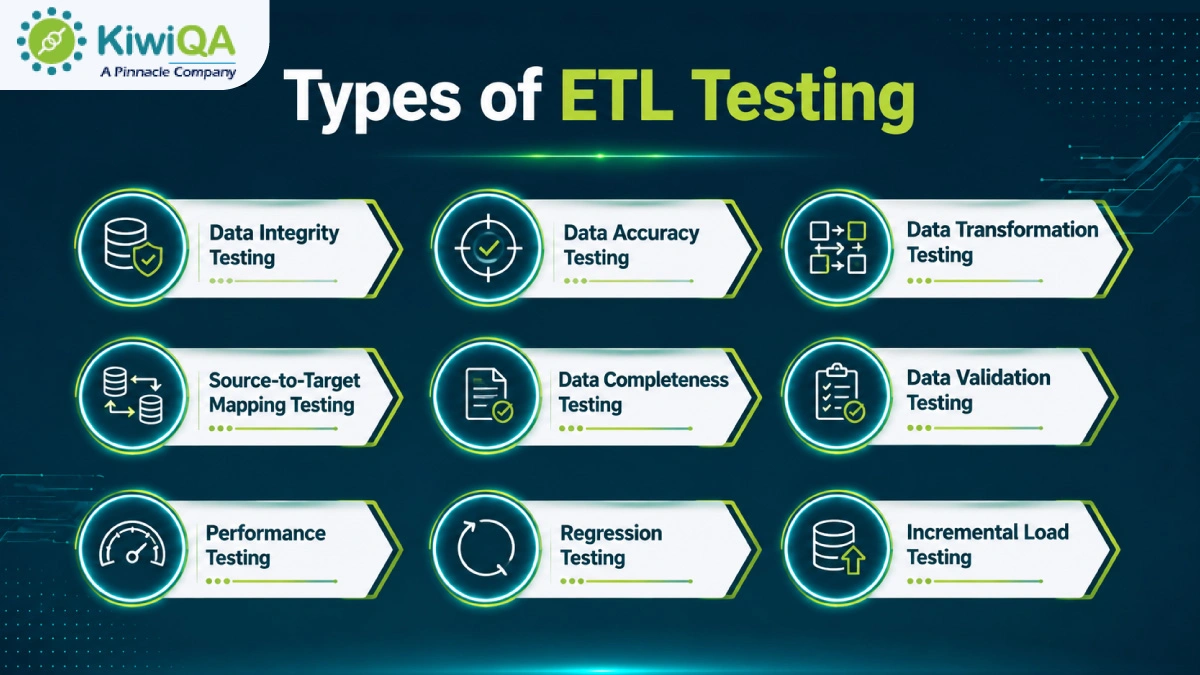
Data validation testing verifies that loaded data conforms with established quality standards and business regulations. It ensures that only correct and useful data enters the target system by confirming required fields, validating formats, and enforcing business restrictions. This testing lowers data quality problems and increases confidence in reports, dashboards, and operational decision-making.
Performance QA measures ETL operations’ scalability and efficiency under various workloads. This testing offers faster reporting and increased operational efficiency. It also helps to optimize ETL pipelines and guarantee consistent performance with rising data volumes.
Regression testing guarantees that improvements, or code modifications, won’t negatively impact current ETL procedures. Frequent regression testing lowers deployment risks, protects against unexpected failures, and guarantees accuracy.
During ETL execution, incremental load testing verifies that only newly created or updated records are processed. It guarantees the accuracy of incremental loads, avoids duplicate records, and confirms that changes are implemented effectively without impacting existing data.
Requirement analysis is the first step in the ETL testing process. In this phase, the testers examine data flow specifications, transformation rules, source-to-target mapping documents, and business needs. This phase confirms that the ETL process satisfies functional and data quality requirements. The process ensures that the testing plan is in line with business objectives.
The testing team establishes the scope, goals, resources, schedule, testing methodology, and necessary tools during test preparation. A well-organized test plan guarantees effective implementation, reduces delays, and offers precise instructions for verifying ETL processes while preserving project quality.
In order to validate data extraction, transformation, loading, validation, and business rules, test case design involves creating comprehensive test scenarios. Test cases that are well-designed enhance error identification, verify expected results, and guarantee that the ETL pipeline operates correctly.
Setting up source systems, target databases, ETL tools, and representative test data creates a dedicated test environment. Accurate validation of ETL workflows is ensured by proper setup, which also reduces configuration-related problems and offers a reliable platform for carrying out thorough testing operations.
Testers run the prepared test cases, verify business rules, compare source and target outcomes, and validate extracted and transformed data. This stage verifies whether the ETL process operates as intended and satisfies the specified performance, accuracy, and quality standards.
Effective defect reporting facilitates the accurate identification and resolution of issues by developers. Clear documentation guarantees that all ETL defects are tracked until they are closed, enhances teamwork, and drives problem-solving.
Validation guarantees that all requirements for data quality, mappings, transformations, and business rules are satisfied. This last stage confirms that the ETL pipeline is stable and prepared for implementation in a production setting.
ETL automation testing services check computations, transformation logic, and business rules for mistakes. ETL automation testing services further increase accuracy by automating validations, minimizing human labor, and guaranteeing accurate results.
Every necessary record is correctly moved from source to target thanks to ETL testing. It creates entire datasets for reporting, analytics, and operational procedures by identifying missing data and ensuring that no important information is lost during extraction, transformation, or loading.
ETL testing removes errors between source and target databases by evaluating data across several systems. It guarantees that departments operate with consistent, correct data and provide reliable reports throughout the company.
By confirming linkages between records, avoiding orphan records, and maintaining referential integrity, ETL testing protects data integrity. In order to produce reliable data that supports business operations, analytics, compliance, and long-term data reliability, it ensures linked datasets stay accurate throughout the ETL process.
Reliable ETL testing lowers the possibility that incomplete or out-of-date data may affect business choices. Organizations gain more trust in analytics, forecasting, and strategic planning by providing validated and high-quality datasets.
Organizations can keep reliable and auditable data along the pipeline with the use of ETL testing. It lowers the risk of reporting errors, audit failures, and regulatory violations while supporting adherence to industry laws and governance standards.
AI-driven ETL testing services prevent expensive errors by identifying problems with data quality early in the pipeline. Early detection minimizes manual corrections, lowers rework, increases workflow efficiency, and speeds up data availability. It allows teams to concentrate on providing crucial insights rather than resolving data issues.
ETL automation testing services guarantee consistent validation across several data loads, increase testing performance, and minimize manual labor. Automated testing reduces human error, drives frequent integration & release. Additionally, it makes it possible for teams to effectively carry out repeating test cases while preserving excellent data quality throughout the ETL lifecycle.
Every field from the source system is accurately mapped to the target database thanks to source-to-target mapping validation. Precise mapping validation guarantees dependable reporting and business intelligence results, removes migration problems, and enhances data consistency.
Validating ETL procedures under practical circumstances is helped by the use of production-like datasets. To find hidden problems, utilize various ETL testing types with big data volumes, various formats, null values, duplicate records, and edge cases. Real-world testing guarantees correct data processing and boosts confidence in ETL performance.
To ensure accuracy, consistency, uniqueness, and integrity, data quality checks should be incorporated throughout the ETL process. Before they affect downstream systems, these validations assist in locating inaccurate records.
ETL execution, task errors, processing time, system resource utilization, and data quality parameters are all monitored continuously. Teams can identify bottlenecks and fix problems before they hamper firm workflows, with the support of proactive assessment.
Regression testing should be carried out following any ETL improvement, bug correction, or configuration modification. It detects unexpected problems brought about by updates and verifies transformations, mappings, and loading procedures. Frequent regression testing preserves overall data quality and pipeline stability.
Test cases, execution outcomes, source-to-target mappings, validation reports, flaws, and fixes should all be included in thorough documentation. Maintaining documentation makes troubleshooting easier, facilitates compliance audits, and enhances development and QA team collaboration.
Also Read : Best 11 SaaS Testing Companies in India (Edition 2026)
ETL testing guarantees consistent and correct data at every stage of extraction, transformation, and loading. Leaders can make quicker, more informed decisions that promote corporate expansion and operational effectiveness when they have access to high-quality data.
Financial losses, business interruptions, and unsatisfactory customer experiences can all be caused by data inaccuracies. ETL testing reduces the need for costly human adjustments and rework by identifying problems before data reaches production systems. Early defect detection reduces business risks and contributes to error-free, seamless data processes.
Clean and verified data is necessary to generate accurate reports. To make sure reports contain accurate business data, ETL testing confirms computations, transformations, and source-to-target mappings. This increases trust in business information, dashboards, and performance measures, allowing stakeholders to rely on data for operational and strategic planning choices.
Strict data governance and regulatory requirements must be met by numerous sectors. Throughout the pipeline, ETL testing helps guarantee that data is correct, comprehensive, traceable, and auditable. Businesses can lower compliance risks, streamline audits, and more confidently comply with industry rules by maintaining excellent data quality.
Only when a data warehouse has reliable and consistent data can it be considered valuable. Every step of data transfer is validated by ETL testing to guarantee that records are loaded and transformed correctly. Reliable testing builds reliable data warehouses that facilitate long-term business intelligence projects, analytics, and enterprise reporting.
ETL testing ensures that pipelines continue to process data correctly and effectively as data quantities increase. It enables businesses to confidently scale analytics platforms by validating performance, data quality, and transformation logic across big datasets.
In the current world, data integrity is necessary to maintain. A single error report can hamper user trust and lead to failure. ETL testing services are not a QA step but a strategic necessity. To verify your data transfers flawlessly, choose an ETL testing services solution.

Join the like-minded community & get the latest updates and insights on software testing technological transformation around the globe. Don't miss out.