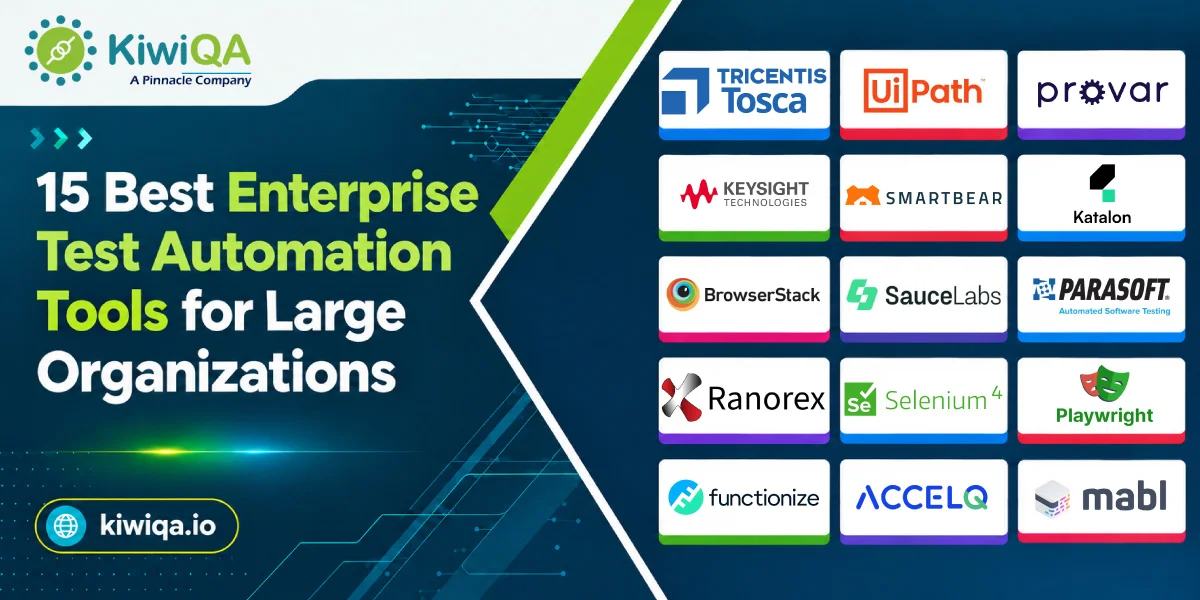
15 Best Enterprise Test Automation Tools for Large Organizations
 Niranjan Limbachiya
Enterprise test automation tools help large organizations streamline complex testing processes, improve test coverage, accelerate software releases, and maintain consistent application quality. This guide explores the 15 best enterprise test automation tools, highlighting their key features, benefits, scalability, integrations, and suitability for different business needs to help teams choose the right solution.
Table of Contents
Enterprise test automation supports businesses in managing complex apps and frequent software releases with improved speed and consistency. However, integrating various systems, scaling tests, managing scripts, and meeting security requirements can challenge QA teams. Reliable automation testing services and ideal tools allow businesses to expand test coverage, monitor errors, streamline release cycles, and improve overall software quality across teams.
According to industry statistics, more than 60% of organizations are increasing their investment in test automation to improve testing efficiency, accelerate software releases, and maintain consistent quality. These trends highlight the growing importance of scalable enterprise test automation solutions for organizations managing complex applications and continuous delivery environments.
Enterprise test automation services validate complicated business procedures, distributed systems, and large-scale applications using automated tools and frameworks. It offers cross-platform testing, scalability, security, and centralized management, in contrast to simple automation. Organizations may maintain software quality, speed up releases, and identify errors early by incorporating automation into CI/CD workflows.
⇾ Cross-platform and cross-browser testing : Validates applications across browsers, devices, and operating systems.
⇾ Integration with CI/CD pipelines : The enterprise test automation platform automates testing throughout software delivery.
⇾ Centralized test management and reporting : Tracks test execution, coverage, and reports.
⇾ Scalability for large testing workloads : Handles large testing workloads efficiently.
⇾ Security, access controls, and compliance support : Supports access controls and audit requirements.
⇾ AI-powered test creation and maintenance : Streamlines test creation, maintenance, and failure analysis.

To cut down on tedious manual testing and free up testers for higher-value tasks, large enterprises require top enterprise test automation tools comparison. These tools increase consistency, speed up release cycles, and produce reliable outcomes. Additionally, they help reduce testing expenses while avoiding production problems, support complicated corporate setups, and increase coverage across platforms and browsers.
Evaluate the tool’s ability to manage increasing test suites, parallel execution, and peak workloads; automation testing consultants can assist with needs assessment.
Verify that the platform does not require a lot of customization work and supports your browsers, OS systems, mobile apps, legacy systems, and corporate applications.
To effectively match current workflows, check integrations with CI/CD tools, version control, test management platforms, bug trackers, and collaboration systems.
Evaluate self-healing scripts, maintenance features, failure analysis, and AI-driven test generation while making sure teams can periodically evaluate any automated decisions.
To continuously adhere to organizational security and governance principles, confirm role-based access, encryption, audit logs, compliance support, and data ownership restrictions.
To calculate overall ownership costs, compare subscription or perpetual license, user limitations, execution expenses, infrastructure requirements, training, and continuing maintenance.
Also Read: Top Salesforce Automation Testing Tools to Consider in 2026

The enterprise test automation tools called Tricentis Tosca created to verify intricate business applications and complete workflows. Model-based, codeless test automation, AI-driven test development, functional and regression testing, API testing, mobile testing, test data management, and risk-based test prioritization are some of its key characteristics. It supports enterprise apps like Salesforce and SAP.

Robotic process automation (RPA) and software testing are combined in UiPath Test Suite to assist businesses in validating automated workflows and applications. It allows the design of both coded and low-code tests, centralized test execution, AI-assisted test generation, test management, and reporting. Teams can coordinate testing across complicated business environments with the use of integrations with application lifecycle management technologies and CI/CD pipelines.

Among the best enterprise automation testing tools, Provar is the best tool for assisting companies in streamlining regression testing and validating CRM processes. Low-code test design, reusable test stages, AI-assisted authoring, and support for Salesforce UI, APIs, and data validation are some of its characteristics. It is helpful for companies handling frequent updates and intricate CRM setups because it offers advanced customization and covers numerous Salesforce clouds.

AI-powered, model-based end-to-end testing for online, desktop, mobile, and legacy apps is supported by Keysight Eggplant, also referred to as Eggplant Test. Instead of depending only on application code, its computer vision technology communicates with programs via their visible interfaces. Additional features include workflow modeling, intelligent test generation, and CI/CD integration for complicated enterprise business process validation.

TestComplete for automated user interface testing is one of the enterprise testing products offered by SmartBear. TestComplete uses customized scripting, AI-assisted object detection, and scriptless record-and-replay to enable online, desktop, and mobile apps. Additionally, teams can make use of CI/CD connectors, parallel execution, reporting, and data-driven testing. Test management and API testing are part of the larger SmartBear product.

Katalon offers a single testing platform for desktop, mobile, web, and API apps. It offers self-healing capabilities, AI-assisted automation, and no-code, low-code, and full-code test generation. Test assets can be reused, tests can be run on different browsers and devices, automation can be incorporated into CI/CD pipelines, and results can be analyzed using centralized test management and reporting tools.

Without having to maintain large in-house device laboratories, BrowserStack allows businesses to run automated tests in a cloud-based environment. With access to actual browsers and mobile devices, its platform supports frameworks like Selenium, Playwright, and Appium. Parallel test execution, cross-browser compatibility testing, mobile application testing, debugging logs, and integrations with current development workflows are some of the key features.

Sauce Labs offers cloud-based testing infrastructure to verify apps on various mobile devices, operating systems, and browsers. Businesses can use well-known frameworks like Selenium and Appium to execute automated tests. Parallel execution, real-device testing, test analytics, debugging tools, and CI/CD connectors are some of its features. Distributed teams can increase test coverage and speed up release cycles with the help of these features.

Automated testing of web services, microservices, and APIs for enterprise environments is the main focus of Parasoft SOAtest. Reusable test assets, data-driven scenarios, codeless and AI-assisted test generation, and CI/CD integration are all supported. Teams may test intricate integrations and mimic unavailable dependencies when paired with Parasoft Virtualize. This helps businesses verify service dependability and cut down on testing delays caused by the environment.

QA teams can automate functional and end-to-end testing for desktop, online, and mobile applications with the help of Ranorex Studio. Visual test recording, object recognition, reusable test modules, and flexible C# or VB.NET scripting are some of its advantages. With or without a lot of programming experience, teams may design tests, run them in various contexts, and produce comprehensive results for regression analysis and troubleshooting.

A popular open-source browser automation platform for creating specialized enterprise testing solutions is called Selenium. Multiple programming languages and browsers are supported by Selenium WebDriver, which manages browsers via native browser automation interfaces. While Selenium IDE provides record-and-playback functionality, Selenium Grid allows concurrent execution across machines. Organizations with committed engineering teams and well-established automation frameworks benefit from its flexibility.

An open-source framework for end-to-end testing of modern online applications is called Playwright. Chromium, Firefox, and WebKit are compatible with Linux, macOS, and Windows. Automatic waiting, parallel execution, mobile emulation, and thorough test results are some of the important features of the following enterprise test automation tools. Enterprise development teams can create consistent cross-browser regression tests and incorporate them into CI/CD pipelines with the help of these features.

Functionize uses AI to make test development, execution, maintenance, and failure analysis easier. Its methodology reduces tedious scripting and allows teams to design tests using natural-language instructions. AI-assisted test diagnostics and maintenance can reduce manual involvement by identifying application changes. Organizations looking for scalable automation across regularly changing applications and regression testing workflows should consider this platform.

ACCELQ is a platform for continuous testing that integrates quality lifecycle management and test automation. Codeless automation is supported for enterprise applications, including mainframes, online, mobile, desktop, and APIs. Reusable test components, integrated API and UI testing, automated test planning, lifecycle management, and business-process-focused test design are some of the key characteristics. Various enterprise needs are supported by both on-premises and cloud deployment solutions.

Teams can build, run, and maintain tests with minimal manual labor thanks to Mabl, an AI-native test automation platform. AI-assisted test writing, auto-healing, cross-browser testing, API testing, and continuous execution are some of its features. Teams can incorporate testing into software delivery, detect regressions early, and maintain coverage as applications change with the use of integrations with CI/CD workflows.
⇾ To create a plan that is in line with your company’s objectives, identify important business processes, evaluate possible risks, and collaborate with a reputable test automation consultancy.
⇾ Reduce human labor and increase testing productivity by automating frequently performed regression tests, repetitive workflows, and business-critical situations.
⇾ Integrate automated tests with CI/CD pipelines to provide quicker, more dependable software releases, continually validate code changes, and identify errors early.
⇾ To make maintenance easier and guarantee uniformity among testing teams, create standardized automation frameworks, reusable test scripts, and explicit coding requirements.
⇾ To generate reliable findings across many applications and configurations, use reliable, secure, and consistent test data while maintaining stable testing environments.
⇾ To find problems and keep improving the quality of automation, monitor test coverage, failure rates, execution time, and flaky tests.
Also Read: Automation Testing for Retail: Best Practices for Seamless Operations
⇾ Teams are using AI technologies to create test cases, find coverage gaps, examine failures, and keep automated tests up to date as applications evolve.
⇾ Businesses are implementing intelligent testing platforms that preserve human oversight while prioritizing test cases, optimizing execution, and minimizing manual involvement.
⇾ Without having to maintain a large number of internal devices, cloud-based systems allow enterprises to expand testing, access a variety of browsers and devices, and perform tests in parallel.
⇾ Teams may find bugs early, get feedback more quickly, and produce software more consistently by including automated tests in CI/CD processes.
⇾ Automated API and microservices testing is becoming crucial for verifying interfaces, service interactions, performance, and dependability as businesses embrace distributed architectures.

The best enterprise test automation strategy improves software quality, QA efficiency, and release confidence. The skilled automation testing company helps businesses identify suitable solutions depending on app architecture, organizational scale, security, and budget. Shortlist tools around priority use cases, then validate their performance through a proof of concept before implementing.

Join the like-minded community & get the latest updates and insights on software testing technological transformation around the globe. Don't miss out.


