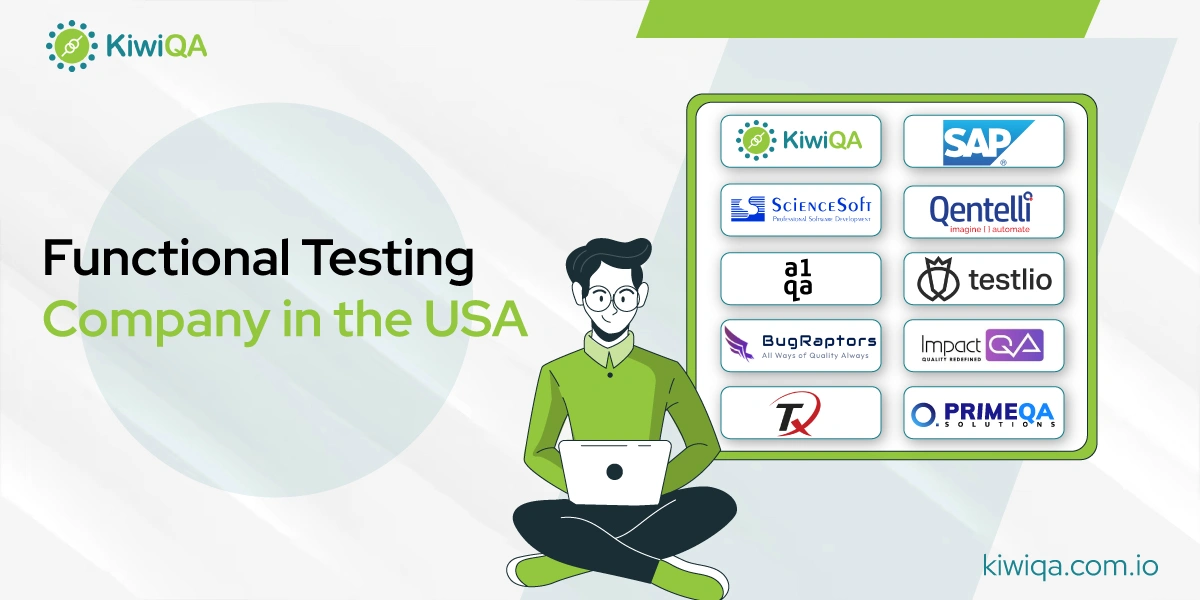
Functional Testing Company in the USA

In this progressive world of SDLC, verifying the delivery of a high-quality product is necessary. This is where functional testing acts as a strong component of QA. Functional testing determines whether the software system verifies that it acts as per the specific requirements. By tracking any potential errors early in the SDLC, it safeguards against future complications and accelerates user satisfaction. The significance of functional testing services can’t be overstated, and it acts as the reason behind the success of the software launch. The worldwide functional testing market was estimated at USD 11,376.8 million by 2030.

The role of functional testing is to address the gaps between the existing and expected conditions of the software product. By testing each element of software, the QA team can address & resolve gaps during the initial days. It is used for avoiding potential gaps in the SDLC process. The proactive approach not only drives the software’s quality but also saves time & cost from post-release bug fixes.

Functional testing services play a powerful role in delivering high-quality software products. In the USA, various companies have specialized in offering exceptional software products. Whether you are aiming to build and release a web, music, or enterprise app, selecting the right partner ensures the software matches all needs and performs flawlessly.

You will be surprised to know the world’s software testing industry is expected to hike with 5% growth each year by 2032. Currently, a wide range of software apps are released to the market, and the importance of software testing companies has become more significant. In this post, we’ll talk about renowned USA functional testing service providers who support every industry to release quality apps.

What is Functional Testing?

Functional testing service plays the necessary role because it safeguards user pleasure and quality. Functional testing is the backbone of SDLC, and it’s an ongoing commitment to drive the quality of software. The comprehensive analysis not only assists in addressing errors but also promotes a positive culture within development. Selection of functional testing results desired consumer expectations and stand out for your app in the crowded market.

Understanding and fulfilling customer demand is necessary, no matter which business you own. By confirming the app matches the needs, functional testing acts as the link between users and developers. It verifies that every component fulfills its primary function in real-world scenarios. Users will only rely on your software when they find it matches their needs accurately. The aim of functional testing is to find mistakes early in the SDLC. Early error detection enables the team to safeguard efforts by locating & overcoming errors prior to them becoming severe errors.

The proactive strategy guarantees a seamless deployment process & minimizes the possibility of post-launch support. Early bug detection makes a program reliable and allows developers to concentrate on new projects rather than stuck in bug fixing. Functional testing is the necessary approach that supports the quality of software and validates user demand. The development team can design solid products that connect with users & succeed in the fast-paced virtual world by embracing functional testing. Now, move down to get a brief of testing types-

➺ Types of Functional Testing

☢ Unit Testing

The worldwide software testing landscape is gearing up for impressive growth, aimed to hit $109.5 billion by 2027. Unit testing is the initial stage of functional testing that focuses on individual components or software units. Developers conduct these tests to validate that each unit functions accurately on its own.

The level of testing is crucial for tracking & resolving gaps prior to the development phase. When you talk with the QA providers, they will deeply research and verify the design standards. With its straightforward approaches, the QA team can validate that each element of code operates as desired prior to it catching major issues.

☢ Integration Testing

This testing is performed after unit testing to check how various software parts function as a cohesive whole. The kind of testing is necessary because errors may occur when elements interact, even if they perform as desired. The goal of integration testing is to detect errors with communication and validate that data moves across modules without any irregularities or complexities. This testing confirms that the integrated system satisfies functional demands.

☢ System Testing

System testing is an approach that is used for testing the whole software application. This is an extensive test that is employed for examining the app’s performance, security, stability, and usability, in addition to its functionality. System testing guarantees the software satisfies user expectations & function successfully under various settings before it is released.

☢ User Acceptance Testing (UAT)

Before you close the testing process, use this testing approach known as user acceptance testing. The real-time users analyze the app to verify that it matches their respective demands and errors. Using real-world app scenarios, the testing gives the user an idea about usability & functionality. It’s a necessary phase that plays an important role in client satisfaction by verifying that the app is user-friendly.

☢ Regression Testing

This testing is necessary for verifying that recent code changes haven’t adversely impacted the existing features. This functional testing type covers re-running the past conducted test to validate that the existing features still function as desired. Regression testing is necessary to balance the performance and stability of the app throughout updates.
View Services

Why Companies in the USA Need Functional Testing Services

➺ High-Quality Standards

In the USA, organizations are expected to deliver software that is reliable, secure, and performs consistently across platforms and devices. Customers in the current days have little tolerance for app failures, slow performance, and broken features. To navigate these complexities, use functional testing. Functional testing is necessary to validate every user workflow.

In addition, industries like healthcare, e-commerce, and finance follow strict regulatory and compliance needs. Collaborating with the professional functional QA testing team to support verifying that the app matches the defined business needs, complies with regulations, and delivers a seamless, error-free user experience before you make it live on the market.

➺ Competitive Market

The USA market is highly competitive, with businesses under constant pressure to release products and updates faster than their competitors. A frequent development cycle drives the risk of functional defects into production. Functional testing assists in identifying issues early, limiting the costly post-release fixing and brand damage.

By partnering with a professional functional testing service provider, businesses can accelerate time to market while managing software quality. By hiring the QA experts, you limit the rework and verify that new features work as intended, giving them a strong competitive edge.

Also Read: Top Functional Testing Services That Boost Confidence in Every Release

Key Features of a Top Functional Testing Company

➺ Expertise and Experience

The top functional testing company should have brief domain knowledge and experience. They must have a successful past record across various industries like healthcare, medical care, retail, etc. A professional QA team understands unique organizational challenges, compliance needs, and user expectations.
The skilled QA team integrates best practices, risk-based testing approaches, and industry demands to identify defects early. Their hands-on knowledge with straightforward testing workflows ensures accurate test coverage, speed issues resolution, and reliable validation of functionalities. With their collaboration, businesses can deliver stable, high-quality software with confidence.

➺ Comprehensive Testing Tools & Frameworks

The leading QA functional testing service provider utilizes a wide range of advanced testing tools & frameworks to validate thorough test coverage. Tools like Selenium and TestComplete support both manual and automated functional testing. In addition, custom automation frameworks are designed to meet specific project requirements, drive reusability, and ensure maintenance. The tool-driven approaches accelerate testing efficiency, limit human error, and allow faster regression testing. With their assistance, businesses can keep their app stable during frequent updates and releases.

➺ Scalability and Flexibility

These are one of the crucial features of a top functional testing company. The ability to quickly scale teams up and down enables businesses to manage large, complex, or time-sensitive projects without compromising quality. The flexible engagement models, such as onshore, offshore, and hybrid support organization, optimize cost while maintaining control & collaboration. The adaptability ensures consistent testing support for the initial development phase, new product launches, or long-term maintenance cycles. Collaboration with QA experts aligns all your testing efforts with evolving organization and project demands.

➺ Transparent Communication and Reporting

The next quality you must look for in a QA team is transparent communication and detailed reporting. The reliable testing company offers clear test strategies, well-defined test plans, and a real-time reporting dashboard. It offers complete visibility into test progress and defect status. Frequent updates, review meetings, and detailed reports support stakeholders in making decisions quickly. Integration with DevOps & Agile ensures frequent continuous feedback, speed error resolution, and seamless collaboration with the development team. Embrace your potential with QA experts and ultimately drive release quality and timelines.

Top Functional Testing Companies in the USA

1. KiwiQA.IO
functional testing


This is the reputable software testing & QA firm delivering comprehensive QA services that cover functional testing to validate that the app performs as desired. They have a qualified, skilled team that uses advanced frameworks to deliver effective & reliable testing across mobile, web, and enterprise solutions. For years, this company has been supporting clients to detect errors from startups to large enterprise businesses. They emphasize flexible engagement models with rapid integration to speed up the development process.

Key Points Services Provided
Founded Year: 2009 Mobile Testing
Number of Employees: 51-200 employees Game Testing
Location: Ahmedabad (Serving USA) Test Automation
LinkedIn: KiwiQA Services Functional Testing
Website: KiwiQA Services Security Testing

2. SAPT Solutions

Functional Testing Company

This is another QA & testing provider in the USA focused on delivering reliable functional testing solutions. The company ensures the software app matches specific functional demands and performs accurately in real-world scenarios. Their testing capabilities involve manual & automated tests, regression testing & validation of core organization workflows. Before deploying your app, they will ensure the app matches user satisfaction and reliability.

Key Points Services Provided
Founded Year: 1993 Functional Testing
Number of Employees:501-1,000 employees Regression Testing
Location: USA QA Consulting Services
LinkedIn: SAPT Solutions Integration Testing

3. ScienceSoft

Functional Testing Company

Anyone looking for an established USA QA & testing company can choose them. Their decades of experience allow them to offer multi-level functional testing services. They have a trained QA team that has access to smart tools and advanced technologies to deal with the complex enterprise business and mobile apps. They are ISTQB-certified QA engineers who follow robust, risk-based testing methods to ensure software meets user expectations and industry standards.

Key Points Services Provided
Founded Year: 1989 Functional Testing
Number of Employees: 501-1,000 employees Integration Testing
Location: USA Regression Testing
LinkedIn: ScienceSoft System Testing

4. Qentelli

Functional Testing Company

As part of more comprehensive digital transformation and quality engineering solutions, Qentelli offers software functional testing services in the USA and quality assurance services. In order to make sure applications are suitable for production, their functional testing services concentrate on verifying software functionality, dependability, and stability throughout the development lifecycle. Additionally, they promote DevOps and continuous delivery methods to drive the performance & timeline of releases.

Key Points Services Provided
Founded Year: 2015 Functional Testing
Number of Employees:1,001-5,000 employees Regression Testing
Location: USA Integration Testing
LinkedIn: Qentelli System Testing

5. A1QA

Functional Testing Company

A1QA is an American software testing business with over 20 years of expertise in automated and functional testing. For sectors including financial, healthcare, and e-commerce, they offer end-to-end QA services on desktop, mobile, and online platforms. Their ISO-certified procedures and committed testing teams assist clients in identifying flaws early and guaranteeing reliable, superior apps.

Key Points Services Provided
Founded Year: 2003 Functional Testing
Number of Employees: 1,001-5,000 employees Regression Testing
Location: USA Integration Testing
LinkedIn: A1QA System Testing

6. Testlio

Functional Testing Company

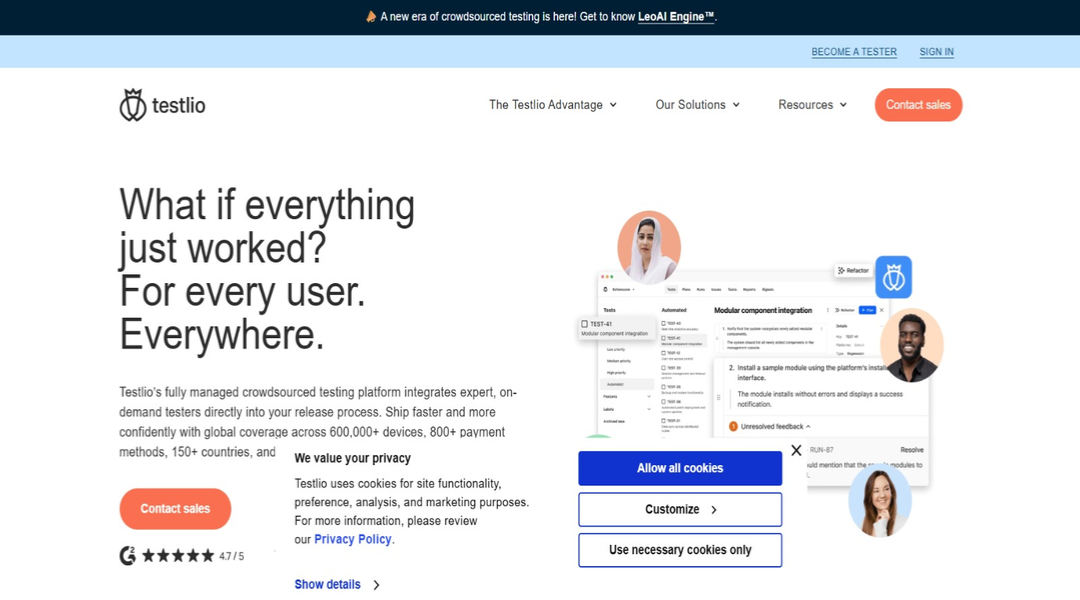
Testilo offers functional testing services in the USA to support digital products across various industries. They focus on blending the manual and automated testing practices, support an AI-powered platform, and a global network. Their functional testing approaches cover a wide range of devices and industries, supporting businesses to ensure software quality and speed up the release cycle.

Their services are designed to limit the risks and accelerate the reliability of the software app. Their main aim is to combine human expertise with machine-driven procedures and deliver impressive outcomes. They integrate with the client system to maintain effective workflows and offer real-time insights into product quality.

Key Points Services Provided
Founded Year: 2012 Functional Testing
Number of Employees: 201-500 employees Mobile & Web Application Testing
Location: USA Regression Testing
LinkedIn: Testlio Integration Testing

7. Bugraptors

Functional Testing Company

Reputable software testing and quality assurance firm BugRaptors has branches throughout the world, including India, the UK, and Australia, in addition to its headquarters in the United States. Functional testing, manual and automated testing, performance and security testing, mobile and web app testing, and specialized QA consulting are just a few of the many QA and testing services that the organization provides. With more than 200 ISTQB-certified testers with ISO 9001:2018 and ISO 27001 certifications, BugRaptors is a reliable partner for guaranteeing software quality and dependability in sectors including banking, healthcare, telecom, and retail.

Key Points Services Provided
Founded Year: 2016 Functional Testing
Number of Employees: 501-1,000 employees Regression Testing
Location: USA System Testing
LinkedIn: Bug Raptors QA Consulting

8. ImpactQA

Functional Testing Company

Impact QA, the renowned QA testing partner of the USA, focuses on offering functional testing for businesses across industries. They take approaches that are combined with traditional testing methodologies and AI-driven automation to support virtual transformation. Functional testing is the core offering, designed to verify the app matches specific needs and deliver consistent outcomes.

The business covers a vast amount of services to the BFSO, the retail and hospitality sector. Their team ensures that apps on mobile & web can be accessed before launch. The business ensures flexible testing modules that integrate seamlessly to support various development cycles and quality demands.

Key Points Services Provided
Founded Year: 2012 Functional Testing
Number of Employees: 201-500 employees Regression Testing
Location: USA Integration Testing
LinkedIn: ImpactQA Mobile & Web Application Testing

9. TestingXperts

Functional Testing Company

This USA software testing & quality engineering partner focuses on functional testing and other software testing practices. They offer digital assurance and straightforward testing approaches by integrating AI into their testing practices. The team ensures that the software app performs exactly how they desired. Their practice prioritizes comprehensive testing throughout the SDLC to deliver quick deployment.

The company serves industries like banking, medical care, retail, and insurance. They serve a range of solutions that align with the client’s business goals. The testing team utilizes advanced tools and frameworks to drive the overall testing efficiency. With the assistance of the QA team, the business can encourage global delivery and resolve defects to deliver reliable software products.

Key Points Services Provided
Founded Year: 2013 Functional Testing
Number of Employees: 1,001-5,000 employees Cloud Testing
Location: USA Agile Testing
LinkedIn: TestingXperts Blockchain Testing

10. PrimeQA Solutions

Functional Testing Company

PrimeQA Solutions is a software functional testing company in the USA that provides a wide range of testing services to clients worldwide, including in the USA, with the goal of ensuring that applications operate accurately, dependably, and provide excellent user experiences. They are experts in functional testing, which helps identify flaws early and enhance software quality before release by verifying each feature against business requirements. PrimeQA offers comprehensive test coverage for online, mobile, and business applications by combining human and automated testing techniques with modern tools like Selenium, Cucumber, Appium, and others.

Key Points Services Provided
Founded Year: 2020 Functional Testing
Number of Employees: 51-200 employees Automation Testing
Location: USA Security Testing
LinkedIn: PrimeQA Solutions Performance Testing

How to Choose the Right Functional Testing Partner

● Evaluate Their Portfolio

When choosing a testing partner, look for the partner’s portfolio first. It assists you in understanding the real-world experience and success across various projects and industries. Go through the relevant case studies and evaluate the workflows they follow to resolve the organizational challenges, managed by complicated apps, and deliver measurable outcomes.

A reliable functional testing service provider clearly showcases projects similar to the needs, along with detailed testing approaches and results. When seeking experts, look for their client reviews and long-term partnerships. By considering these factors, a business can validate the quality, credibility, and consistency. It also verifies that the QA provider has practical expertise and can confidently match your functional testing expectations.

● Assess Technical Capabilities

Before you partner with anyone, measure their technical capabilities. Review the tools, platform & technologies they use for both their manual and automated testing for web, mobile, and cloud environments. When you collaborate with the testing partner, make sure they made the right balance between automated and manual testing approaches to verify accuracy and coverage. Hire the experienced QA team that is proficient in advanced automation frameworks, CI/CD integration, and regression testing approaches, allowing faster releases without hampering the software functionality.

● Consider Budget and Engagement Models

Next is budget & flexibility, which plays an important role in selecting a functional testing agency in the USA. Measure whether the QA provider delivers suitable pricing modules, like fixed price, based on project scope and timelines. Transparent cost structures avoid the unexpected expenses. In addition, you can hire someone who offers a trial period or pilot projects. Before you make a long-term commitment, consider these approaches to limit the risk. Ensure they value your money and build confidence.

Also Read: User Acceptance Testing for Salesforce: Key Steps to Ensure Successful Deployment

Benefits of Partnering with a Functional Testing Company in the USA

● Access to skilled professionals

Collaboration with a functional testing company in the USA allows businesses to directly collaborate with skilled QA professionals. The skilled QA professional has strong technical domain expertise and best practices. They are experts who have specialization in testing complex enterprise systems, SaaS platforms, and customer-facing apps across industries.

They have in-depth business processes, quality standards, and testing methodologies to verify accurate validation of app functionality. With an experienced QA team, a business can limit the error leakage, drive user satisfaction, and maintain consistent software quality. Since they have trained experts, they promise to deliver guaranteed success.

● Better time zone alignment for collaboration

Collaborating with a functional testing company in the USA delivers better time-alignment, allows real-time communication, and faster collaboration. Partnering with experts allows for getting support for faster feedback cycles, effective error resolution, and smoother workflows. The expert companies conduct daily discussions to resolve issues and review meetings to avoid delays. With them, the chances of risk will be limited. Improved collaboration maintains momentum, shortens release cycles, and ensures testing activities are closely aligned with the evolving organization’s demands.

● Strong data security and compliance standards

The functional testing companies in the USA follow strict data security and compliance standards to safeguard sensitive business and client data. The experts are well-aware of the industry regulations such as HIPAA, PCI-DSS, and industry-specific guidelines. The team ensures safe handling of test data and the environment.

They follow the robust security practices that involve access controls, secure infrastructure, and a compliance-driven testing process. It limits the risk of data breaches. They emphasize security and compliance, allowing organizations to meet regulatory demands while maintaining customer trust and brand reputation.

● Support for both legacy and modern applications

The US-based functional testing companies offer comprehensive support for both advanced & existing systems for cloud-native apps. They understand the challenges of maintaining older platforms while managing compatibility with new technologies, integration, and updates.

The modern testers validate the core functionalities, data flows & performance across legacy apps. They integrate modern testing frameworks, APIs, and microservices. The balanced approaches verify organization continuity, smooth digital transformation, and consistent app performance across evolving demands.

Contact us

Ready to Elevate Your Software Quality? Let’s Talk Testing That Delivers

Functional testing plays a pivotal role in SDLC. It supports understanding that the software matches its specific requirements and operates based on real-time expectations. By detecting and resolving errors early, it safeguards time and minimizes cost throughout the SDLC. Additionally, it boosts customer satisfaction by delivering reliable & effective products. A straightforward practice of functional testing will change the overall software development excellence.

Functional testing companies in the USA that we discussed above play a necessary role in assisting organizations to deliver reliable and high-performing software products. By prioritizing their abilities and skills, organizations can collaborate with them based on specific needs. These organizations support vast industries to limit software errors and boost client satisfaction. All of them offer a wide range of services from web & mobile apps testing to complex systems.

The QA experts will ensure that every product they deliver fulfills business demands before reaching the market. Pick the right functional testing partner who contributes to the project’s success. Choose experts serving the following services, combined with the technical excellence, industry expertise, and organized testing approaches to support organizations in managing quality. With the evolving virtual transformation, the requirement for functional testing remains increasing. Hire the best functional testing company and maintain your operational efficiency and customer expectations.
Top Functional Testing Services That Boost Confidence in Every Release

Every business launches an app to grow its business digitally. But what if soon after release, users start complaining about their performance, security, & unexpected crashes? Your happiness can soon be transformed into frustration, leading to negative reviews, customer churn, & financial loss. This is why software functional testing services are a crucial step to development. By 2030, the worldwide functional testing market size is assumed to reach USD 1291.6 million.

Functional testing services are used to discover loopholes before end-users access them. It verifies that the app functions well, and the business can avoid post-launch investments. Without proper testing, a small loophole can impact user experience, security, & organization operations. Functional testing limits the cost of fixing errors & ensures the delivery of error-free software. Here in this blog, we present a comprehensive array of functional testing services that match various organizational needs. Continue to discover more about the services offered by the functional testing company & its role to boost confidence.

What Is Functional Testing?

➺ How Functional Testing Works

Functional testing is carried out in SDLC to focus on the functionality of the app. It ensures the software functions depending on the demands. In functional testing, the functional testing service provider will identify the loopholes by running a series of tests. They test every element from the user interface to system functionality & validate that every individual feature is working as expected. The objective of this testing is to validate that the software matches the customer’s specific requirements.

The functional testing companies demand planning & app understanding. The QA team will first give a thorough understanding of functional requirements. According to that, they identify the functions to test & define the best outcomes. During functional testing, the QA team will document the results. The result covers everything from the identification of bugs to the methodologies followed to navigate them. Further, they will deliver it to the development team for error fixing. After that, retesting will be performed to ensure the final product matches the demands.

➺ Key Benefits

✦ Higher product stability

Functional testing supports the identification & resolution of loopholes early in SDLC. Catching errors at this stage avoids destabilizing the app later in production. In the following testing, the QA team verifies that each feature & function of the software app works accurately. Testing helps to ensure the app will be stable against various traffic conditions.

✦ Fewer production defects

Functional testing allows for the identification & resolution of inconsistencies prior to its deployment. It removes the probability of facing any loopholes after the app is launched. Frequent testing eliminates the probability of making an investment later in production.

✦ Better user satisfaction

By prioritizing functional testing service, businesses can better understand the end users’ perspectives. Functional testing verifies that your app delivers a seamless experience, builds user trust & satisfaction.

✦ Stronger confidence in every release

Businesses can confidently release the apps after performing testing. Functional testing service gives an app better reliability and ensures requirement compliance.

Explore Services

 Top Functional Testing Services You Must Use in Every Release

1. Smoke Testing

Smoke Testing is a software testing approach that assesses whether the delivered software under test is ready/stable for additional testing. It runs before the regression and functional tests. Thus, smoke testing allows the QA team to move forward with further software testing methodologies. Smoke testing consists of a small number of test sets that are executed on each software development to verify program functionality.

Smoke functional QA testing services prepare the software builds for various forms of testing. The primary goal of this software testing approach is to identify flaws early in the STLC. Smoke testing occurs when new functionality is added to software. It is also used to integrate fresh builds into current ones in the QA/Staging environment. Smoke testing is important in software development since it tests the precision of software systems in the early phases. By doing smoke tests, businesses can save time & effort.

2. Sanity Testing

Sanity testing is an effective method in the software testing process, providing a rapid and effective evaluation of the condition of a new software build. Unlike comprehensive testing, sanity testing involves confirming essential operations and user flows. The ultimate purpose of sanity testing is to ensure that the essential functionalities remain effective and have not been disrupted by recent changes.

Ensuring quality after each code update is critical. Comprehensive functional testing services are necessary, but they can be time-demanding. This is where sanity testing shines, providing a quick and fast quality check for new software builds. Sanity testing is a subtype of regression testing that involves running a set of test cases linked to product modifications.

Sanity testing guarantees that the software’s fundamental user journeys continue to perform as intended. Logging in, accessing menus, and performing simple tasks can all help to ensure the build’s general responsiveness and stability. Sanity testing is a simple method that is commonly handled by developers or testers themselves.

3. Regression Testing

When developers replace or modify functionality/features, there is a high potential that these updates will result in unanticipated behavior. Regression testing ensures that a modification or addition doesn’t hamper ongoing features. Its goal is to identify bugs that may have been mistakenly introduced into the present version.

The global marketplace for regression testing services is predicted to expand significantly in the next few years, driven by an increased demand for software testing to ensure application dependability and performance. The Regression Testing Service Industry is anticipated to rise to USD 45.89 billion by 2030.

● Types of regression tests:

✦ Partial regression

Partial regression testing verifies that changes in code don’t hamper the existing functionality. It is especially critical when making minor changes or adding new features to the codebase. Partial regression testing is carried out after new code is applied to existing code and after an impact study.

✦ Complete regression

After making changes to the codebase, run the entire test suite to ensure complete regression testing. This is usually operated prior to product launch to validate that every feature performs as desired. When many modifications are made to an existing code, full regression testing is conducted.

This type of testing is typically performed before launching and can identify whether a new update has an impact on the root code. This accelerates the testing process while preserving or improving test coverage. It optimizes resource allocation, resulting in significant cost savings in the cloud.

✦ Unit regression testing

Unit regression testing examines specific units of source code, like functions and procedures, to ensure that they behave as intended following modifications. These tests are run during coding and provide information on the behavior of individual code components. This targeted strategy shortens testing time, optimizes cloud resources, and guarantees that developers prioritize the most important tests.

4. Integration Testing

After each unit has been extensively tested, it is combined with others to form components that are intended to execute specific functions or activities. The testing is performed to guarantee that all the functionalities of an application operate as intended. These tests are frequently designed around user situations. Integrated tests can be carried out by either designers or independent testers, and they often include a mix of automated functional and manual testing.

● Methods used:

✦ Top-Down

Integration functional testing services India checks how components function together, and the Top-Down method begins testing from the primary modules down, simulating an unbuilt component. It allows early testing of essential features and user interfaces, which assists in discovering major design flaws earlier, despite possible debugging complexity.

✦ Bottom-Up

In the following approaches, the lowest-level modules are tested first. It is followed by higher-level modules until the complete system is tested. This method constructs a system from its basic components upward. Prior to adding complexity, it is critical to ensure that the essential features perform well.

✦ Sandwich/Hybrid

The Sandwich technique, also referred to as Hybrid Integration Testing, combines the benefits of top-down and bottom-up methodologies to provide complete test coverage for large, multilayered software systems.

5. User Acceptance Testing (UAT)

These core functional testing services aim to mimic the end-user experience in order to determine whether the final product achieves the desired result. Automated acceptability testing simulates user interaction. Automated testing can eliminate human mistakes, misconceptions, and inconsistencies while saving a lot of time. It also increases test coverage through established scripts, detailed logs, test reporting, and documentation. UAT is based on user stories and determines whether it matches the objectives.

Who performs UAT:

✦ Clients

Clients are the main executors of User Acceptance Testing (UAT), the critical final stage in which software is validated in real-world settings to ensure it satisfies business requirements and performs properly prior to deployment.

✦ End-users

End-users are the major performers of UAT, ensuring that the system meets real-world requirements; however, they collaborate with Business Analysts and QA teams to oversee and assist the process.

✦ Business stakeholders

Business stakeholders are the major UAT performers because they assess whether the software satisfies real-world business demands and workflows, ensuring that the app is usable and functioning for its intended purpose prior to launch.

6. End-to-End Testing

E2E core functional testing services ensure that programs perform as expected and that data flows properly for all types of client tasks and procedures. This testing approach begins with the end user’s perspective and mimics a real-world scenario. Reviewing the application from the end user’s perspective is critical for ensuring real-world usability and reliability. Instead of testing individual features in isolation, end-to-end testing tools evaluate whole user journeys such as signing up, searching, checking out, or interacting with third-party services to ensure that procedures execute properly from the user’s perspective.

E2E testing verifies the complete user journey, ensuring that all phases from beginning to end perform as intended. E2E testing includes building test scenarios for user interfaces to ensure that applications are responsive and user-friendly, verifying the complete workflow from beginning to end, and assisting in the verification of software functioning from the user’s perspective.

7. Exploratory Testing

Exploratory testing incorporates test design and execution. Testers investigate programs dynamically, following their intuition to uncover unforeseen issues. It’s a popular functional testing tool that supports the QA team to go beyond predefined test cases, discover flaws, and enhance software performance.

However, it requires distinct strategies for following diverse scenarios, conducting exploratory sessions, and documenting discoveries by incorporating them into your Agile workflow. The global software testing industry, including exploratory testing, is expected to reach $109.5 billion by 2027. Exploratory testing is a procedure in which the QA team can discover the program & test it in various ways. During this investigation, the professional notes any faults or odd system reactions.

8. API Testing

API functional software testing is the process of ensuring that API endpoints perform their jobs accurately and in accordance with the specifications. This sort of testing examines the functionality of APIs to ensure that they produce expected outcomes under a variety of scenarios. It entails sending requests via API calls and checking responses against expected results. The primary goal is to validate APIs for dependability, security, and performance. The overall API Testing market is predicted to reach $4 billion by 2030.

This testing is done early in the development cycle to uncover major concerns, which can greatly lower the cost of resolution. It also gives a clear picture of the way various modules collaborate. This form of functional software testing is critical for satisfying regulatory requirements and service-level contracts since it ensures reliable data interchange.

9. Compatibility Testing

Without comprehensive compatibility testing, a corporation may deploy an application that may not operate with some common devices. Compatibility testing checks software across several devices and hardware to ensure that it meets a team’s requirements. Compatibility testing is used to determine how a program will perform in various contexts.

It is used to ensure that your product is compatible with multiple OS, browsers, devices, and resolution configurations. The objective is to guarantee that your software’s operation is consistently maintained across any environment. The Worldwide Compatibility Testing Solution market is expected to reach USD 6.8 billion by 2032.

Also Read : Revolutionizing HRTech: Functional, Automation, and UAT Testing Best Practices

Key Features of a Strong Functional Testing Service Provider

➺ What Makes a Good Partner?

✦ Expertise in automation + manual testing

The functional testing service provider allows automation for speed & reliability. The balanced approaches ensure they offer broader coverage & highest accuracy. The functional testing company offers a balanced approach where both automation & manual practices are followed.

✦ Experience across multiple industries

Hire the functional testing partner who ensures a structured testing process. The QA team must have proficiency in working across all industries. The team must adapt testing strategies for different app types.

✦ Strong test case design

The QA team designs well-defined test cases aligned with the organization’s requirements. It ensures to detect the loopholes early, limit the rework, & verify all the functionalities are working as expected.

✦ Transparent reporting

Choose a QA functional testing company that offers clear, detailed, & transparent testing reports. Make sure the business offers smooth collaboration & faster decision-making.

✦ Scalable testing teams

It is advised to collaborate with the functional testing services in India that have potential & resources to scale in the future with the evolving marketing trends. It ensures your software stays current with market trends.

➺ Tools & Technologies They Should Use

1. Selenium

Selenium is an open-source and free toolset for automated web application testing. Selenium is a collection of libraries that allow you to control browsers through code, rather than a single program. By 2032, the worldwide Selenium Testing Service market is expected to be worth $93.6 billion, with a CAGR of 14.3 percent. Selenium is extremely versatile and configurable.

Users can create scripts that are individually tailored to their testing needs, making it a useful tool for testing complicated web programs. Selenium scales effectively to handle huge numbers of test cases, making it ideal for automating complex web applications. Selenium can pose drawbacks, but the benefits exceed them, making it an appealing investment for many organizations.

2. Cypress

Cypress is a JavaScript-based frontend testing tool designed for current web applications. Its purpose is to reduce the challenges that developers and QA technicians have when testing applications. Cypress is friendly to developers who run directly in the browser and employ a distinct DOM manipulation method.

Cypress offers unique, dynamic testing for executing every command. Cypress is different compared to other tools like Selenium. Cypress enables QA developers to perform every type of functional testing. Cypress gives an error message that is clear and informative, as well as tips to boost the implementation.

3. Playwright

This is an innovative automation testing framework, with its market share increasing among enterprise teams. It is now employed by around 15% of organizations assessing advanced automation tools. Microsoft developed Playwright, an open-source and free automated testing framework. Its framework is extremely useful for developers since it allows them to test web applications from beginning to end using a variety of code styles. This is because Playwright supports a variety of programming languages.

4. Appium

Appium automates native, hybrid, and mobile web apps for all platforms. Appium stands out among mobile testing solutions because of its distinct capabilities, which precisely correspond with the standards of modern software development. Appium enables testers to create a single test script that performs on both Android and iOS, which reduces duplication and upkeep effort.

Appium improves mobile testing by providing a versatile, robust framework that integrates smoothly with Agile workflows. Its cross-platform compatibility, automation features, and integration potential make it an essential tool for testers and developers looking to provide high-quality mobile apps.

5. JMeter

Apache JMeter is a free stress testing tool to measure the app performance. It’s a versatile platform that can analyze web applications, run functional tests, and assess the performance of database servers. JMeter is a Java desktop app with a graphical interface that was created using the graphical API, enabling it to run on any environment. JMeter generates user groups that send queries to networks or servers, then analyzes statistical data using simple visualizations and diagrams.

Also Read : Functional Testing vs. Automation Testing: What’s Best for Your Retail App?

How Functional Testing Boosts Confidence in Every Release

● Catch bugs early & reduce costs

Functional testing solutions are used for the assessment of loopholes in the prior development stage. In this stage, it is easy & affordable to fix the loopholes. The testing avoids expensive rework & production failure, or crashes later in the real world.

● Improve release quality

By performing functional testing solutions, businesses can validate that every feature works as expected. Functional testing practices verify that your application is stable, reliable, & high-quality release with few functional gaps.

● Support faster deployments

When you collaborate with the professional QA team, they follow a well-streamlined approach to functional test practices. It further streamlines the validation cycle & limits the manual effort. In addition, it improves approvals, allowing the team to release updates frequently without hampering quality.

● Reduce post-release incidents

Thorough testing limits the risk of crucial errors. Yes, when you perform testing prior to deployment, it limits the chances of a crash or any other incidents that damage the brand values.

● Improve customer trust and retention

Functional testing is necessary for consistently delivering bug-free apps. It builds customer confidence, strengthens brand reputation, & bonds with customers. It helps to acquire new customers while retaining the existing ones.

Contact us

Ready to Release with Confidence? We Can Help

In the current competitive era, software plays a powerful role in shaping our lives. Now, business demands apps that ensure the functionality, reliability, & scalability with the evolving market. With the ever-evolving complexity of software, the approach to robust testing methodologies has grown rapidly. Among all the practices, functional testing solutions have emerged as the key to ensuring quality.

The functional testing company is approaching delivering software that matches consumer demands. If you want to leverage your app with future-proof solutions, hire an expert testing partner today. With the necessary skills, expertise, and efficiency, they will help you to launch robust software in the market.

User Acceptance Testing for Salesforce: Key Steps to Ensure Successful Deployment

Salesforce is the biggest investment for any company’s success. It’s not a tool for managing clients but for the growth of your firm’s success. The ideal salesforce ecosystem enhances sales effectiveness, boosts employee productivity & minimizes the time to close deals. Salesforce delivers vast features that boost organizational growth.

The key to achieving success is robust adoption by the end business users. Based on the report, 70% of CRM projects fail during implementation, and that’s why testing is necessary before implementation. Salesforce is a robust CRM platform delivering unique features that keep it different from the CRM tools.

UAT is similar to functional testing services involved in SDLC, where the clients and end users test the application to make sure it’s ready for release. This is also popular as end-user or beta testing. UAT is the final step in SDLC prior to deployment. The aim is to verify that the software matches all requirements & all functions are expected.

UAT aims to track validation of business process & needs rather than spotting the design errors & system functionality errors. In the following blog, you can learn about various types of Salesforce UAT, along with real-world examples. In addition, cover the best practices for the UAT process while implementing Salesforce.

What is User Acceptance Testing (UAT)?

UAT is a procedure that evaluates a product’s usability from the perspective of the user or consumer. Since it’s the last testing phase, your product will have already undergone a bug check. Before a particular version of the CRM is put into production, Salesforce UAT confirms that it satisfies the relevant business requirements.

In order to ensure a successful and seamless deployment, this stage assists in identifying any gaps or problems that need to be fixed. You may interact with the product and assess its functioning through UAT testing, which closely resembles real-world usage scenarios. This testing procedure may be used for software updates, integrations, and modifications in addition to new software creation.

Before deployment, it’s necessary to validate requirements, check functionality, and evaluate usability through UAT testing. To guarantee a successful software launch, UAT also assists in identifying flaws and reducing risks. It will be far more expensive to fix any issues after release if you avoid UAT. So, overall, it will save you a lot of time and money.

Why UAT is Critical for Salesforce Deployments

❖ Ensures business requirements are met

UAT makes sure the implemented solution satisfies user expectations and business objectives prior to going live. UAT verifies that the system is usable, satisfies the demands of actual end users, and operates as anticipated. It assists in finding any problems that may have gone unnoticed and verifies that the Salesforce implementation is prepared for practical application.

❖ Reduces post-deployment issues

By confirming that the system satisfies user expectations and business objectives before going live, UAT greatly lowers post-deployment difficulties in Salesforce installations. UAT reduces the chance of expensive repairs and post-deployment interruptions by incorporating end users in the testing process to help find and correct problems early.

❖ Improves user confidence and adoption

Through direct user participation in the testing process, UAT increases user confidence and adoption, resulting in the identification of usability issues, confirmation of business needs, and a sense of involvement among users. Early problem solving reduces post-launch problems, improves user happiness.

❖ Aligns technical outputs with business expectations

After all technical development and testing stages by a functional testing company, UAT makes sure the program still meets user demands and business objectives. UAT helps create a more seamless and satisfying user experience by verifying the software’s usability and functionality. UAT essentially serves as a vital link between technical development and business objectives, guaranteeing that the end result is both technically perfect and satisfies users’ expectations and needs in the real world.

Also Read : The Importance of Salesforce Integration Testing for Optimized Business Operations

Preparing for a Successful UAT

1. Define Clear Objectives

Setting precise UAT goals is essential to coordinating testing activities with corporate objectives. The goal should make it clear what success looks like and guarantee that the salesforce implementation goes well with the desired business results. Determine the essential features end users depend on and evaluate how well they work.

Setting effective and realistic goals can be facilitated by early stakeholder involvement. Effective resource allocation and testing efforts that stay in line with project goals are guaranteed by a well-defined scope. Create test scenarios using the use case, & flow charts as a guide. These publications guide the development of customized test scenarios that meet the needs of your project.

2. Assemble the Right Team

You may hire functional testing company testers to test the Salesforce solution before implementation. Focus on choosing people who are actual end users of the system or who have in-depth knowledge of Salesforce and the business needs when choosing the ideal team for Salesforce UAT testing. To give thorough feedback and assistance, make sure the team has a variety of jobs and responsibilities, such as software engineers, project managers, testers, and company owners.

3. Create Comprehensive Test Plans

Clear documentation must be established before user acceptability testing begins in order to guarantee stakeholder alignment. UAT documentations that are well-structured offer a road map for the testing procedure, outlining goals, roles, and expectations. Maintaining everyone’s alignment with the same goals and vision may be achieved by developing a UAT test strategy.

It contains all the details on what will be examined, by whom, and how, because it is the primary document. You must describe the testing approach and entry/exit criteria in detail in order to cover all organizational and procedural components of UAT. The Salesforce testing strategies must include testing type, outcomes, testing objective & scopes, etc.

Key Steps in Executing Salesforce UAT

1. Set Up a Dedicated UAT Environment

UAT for the Salesforce solution requires a specific test environment. Before moving forward, it’s crucial to confirm that Salesforce’s license agreements allow for the creation of testing sandboxes. After creating a sandbox and adding test data, assign the proper user roles and permissions. For testing to be successful, the sandbox environment must closely resemble the production configuration.

When the sandbox is not correctly linked with production, for example, some organizations may initially experience problems with data integrity or configuration incompatibilities in their Salesforce solution. Teams may reduce the chance of problems after launch by doing more accurate and efficient testing by adjusting the sandbox parameters to more closely resemble the real-world environment.

2. Develop Detailed Test Scripts

Create test cases with explicit procedures after identifying test scenarios from business procedures. Focus your UAT testing on UI/UX and/or functional issues. Verify that all of the components, drop-down menus, and buttons work as intended. Make sure scrolling isn’t hampered by any overlapping components. Verify that every CSS style renders properly and doesn’t make it difficult for users to navigate the application.

3. Train UAT Participants

Focus on offering thorough training materials, practical sessions, and continuous assistance in order to prepare UAT participants for Salesforce. This refers to choosing representative users, providing accurate training, creating open lines of communication, and precisely outlining the objectives and scope of the UAT.

4. Conduct UAT Sessions

Analyzing business needs and goals, developing a thorough UAT strategy, establishing test scenarios and cases, generating realistic test data, carrying out tests and monitoring outcomes, and verifying that company objectives are fulfilled are the first steps in conducting Salesforce UAT sessions successfully.

After that, a feedback loop will be created between developers and testers to resolve any problems found throughout the UAT phase. This entails establishing a test environment, defining the scope, educating users, and recording every step of the procedure.

5. Capture and Track Feedback

Encourage end users to take an active part in testing and provide their opinions on usability and functionality. Ask users to run the test cases and record any problems or inconsistencies. Defects will be found and fixed using this data. Establish a conduit for testers to communicate with developers so that problems may be found and fixed quickly. All feedback, including problems, bugs, and recommendations, should be recorded using a UAT tracking tool, such as a third-party program or the built-in features in Salesforce.

6. Prioritize and Resolve Defects

The primary goal of any functional testing service provider is to identify problems and their underlying causes that could hamper Salesforce CRM’s ability to operate effectively. Tests can identify setup problems or broken lines of code that testers must promptly fix. Prioritizing and fixing bugs is part of Salesforce UAT (User Acceptance Testing), which makes sure the platform satisfies business needs prior to deployment.

7. Re-Test and Validate Fixes

Make sure that the fixes fulfil the business requirements and address the issues that have been reported. To make sure the problems are fixed, retest the components where changes were applied. Get final user feedback to move forward with the deployment once all problems have been fixed and the remedies have been verified. Give end users thorough training and documentation so they can utilize Salesforce efficiently.

Also Read : The Future of QA Outsourcing: Meeting Industry-Specific Needs with KiwiQA Expertise  

Best Practices for Salesforce UAT

❖ Start UAT early in the project lifecycle

If QAs from a functional testing company are involved early in the SDLC, they will have more time to test the Salesforce platform. As a result, testers will have more time to conduct testing, which will increase the variety and coverage of Salesforce tests carried out. The influence on a project’s final outcome decreases with the amount of time needed to detect the issue.

Testing is only guaranteed during the development stage, not after deployment. Frequent testing also guarantees continuous system integrity during Salesforce customization cycles and updates. It will be beneficial to test early & frequently in order to detect integration problems, workflow disruptions, and configuration errors before experiencing any errors.

❖ Involve real end-users, not just testers

To make sure the UAT procedure is as realistic as feasible, including end users who will use the system on a regular basis. End users should actively engage in testing real-world scenarios and offer insightful feedback as part of a collaborative effort. This guarantees that the solution satisfies their real requirements and detects any possible usability problems before implementation.

❖ Keep communication channels open

Create frequent lines of communication and plan updates to give information to every party and address any problems that may arise. Using daily stand-up meetings during UAT is one of the best practices to make sure that any problems are discussed and resolved quickly, keeping the project on schedule. To monitor UAT progress, test outcomes, and problem-solving, use standardized reporting formats. Plan frequent meetings and provide progress reports to everyone involved.

❖ Document everything (issues, approvals, changes)

Documentation is essential to the effectiveness of Salesforce UAT. To guarantee accountability and traceability, record test cases, data, expected & real results. To record concerns, set priorities, and keep an eye on the resolution process, use a defect tracking system. Effective problem solving and knowledge transfer are made possible by thoroughly documenting every step of the process, from test designs and models to test data and outcomes.

❖ Celebrate UAT completion to encourage adoption

Thorough UAT should be prioritized, and its completion should be celebrated, in order to effectively deploy Salesforce and promote user acceptance. Real end users should be included in UAT, actual test data should be used, and automation should be used wherever feasible.

By adhering to these best practices, businesses can guarantee a successful UAT process, which will improve their Salesforce deployment results and increase user acceptance.

Ready to Launch? Let’s Ensure Your Salesforce Deployment is a Success

To make sure that your customized Salesforce functional testing service provider fits the particular requirements of your company, Salesforce UAT is crucial. The UAT procedure needs to be carefully done in order to succeed. Your process may be streamlined by following best practices, which include using the appropriate testing tools, prioritizing fixing bugs, and incorporating actual end users. You may streamline your UAT procedure and make sure that your Salesforce deployment satisfies the requirements of your business users by adhering to these best practices.