Complete List of AI Testing Services for AI-Powered Platforms

The potential of AI is advancing frequently, and firms must adopt it to stay on top. As software becomes increasingly complicated & frequent updates are coming out, traditional testing methodologies sometimes fail. Manual testing is slow, and it usually fails to work on critical edge cases. It causes delays, performance gaps, and bug production, which later hamper user experience.

AI testing services are aimed at pointing out manual testing challenges. The AI experts automate the testing process and ensure the software is frequently verified with every update. The AI testing team generates test cases and runs them in different environments to validate the product’s performance. The AI-powered testing market is expected to hike by 2034 at USD 4.64 billion.

The AI-powered solutions combine innovative AI testing services with human intelligence to ensure speed, quality & accuracy. The AI-powered solutions frequently monitor & analyze defects, optimize test strategies, and offer real-time insights. It empowers your team to solely focus on innovation.

Firms can unleash the potential of automation to offer robust & data-driven results. Your AI solutions can deliver 5X faster time to market when they are properly tested. It empowers businesses to serve quality, unmatched reliability, scalability, and user experience. With the increasing AI adoption, staying current demands more than implementation.

To keep your business future-ready with AI, read the following blog where we have mentioned various AI testing types offered by an AI testing services provider.

What Is AI Testing

🢣 Definition of AI Testing

AI-powered testing goes beyond traditional methods by serving features such as self-healing capabilities, predictive analytics & no-code test automation. The AI-powered advanced testing tool leverages AI to automate test creation, maintenance & execution. It makes software testing reliable & efficient. The AI testing companies support team manages test maintenance, which is time-consuming in the automated testing process.

AI testing companies can minimize testing cycle time by up to 50%, allow faster release, and minimize QA by 50-70%. AI testing involves generating test cases, identifying flaky tests and broken scripts, and prioritizing tests & high-risk areas based on code changes or user behavior. AI testing is used to enhance test coverage, limiting the manual effort that supports remaining tests effectively.
Ready to Explore End-to-End AI Testing Services

How AI Testing Differs from Traditional Software Testing

❑ Non-deterministic outputs

Because of statistical models, AI systems can generate diverse answers for the same input, which complicates validation and necessitates assertions based on tolerance rather than predetermined outcomes.

❑ Continuous learning models

AI models, in contrast to static software, develop through continuous training, necessitating constant testing, monitoring, and validation. It guarantees performance consistency and stops behavior changes over time.

❑ Data dependency

AI models, in contrast to static software, develop through continuous training, necessitating constant testing, monitoring, and validation to guarantee performance consistency and stop inadvertent behavior changes over time.

❑ Model drift and retraining cycles

Data validation, bias detection, and preprocessing checks are crucial components of the testing lifecycle since AI performance is highly dependent on data quality, diversity, and labelling accuracy.

Also Read: How to Choose the Right AI Testing Tools for Your Business?

Core Components of AI Systems That Require Testing

➥ Training datasets

To guarantee reliable model training and to prevent biased predictions or unjust results in real-world situations, datasets must be evaluated for quality, completeness, bias, and accuracy.

➥ Machine learning models

In order to ensure that models function dependably under various circumstances and edge situations, they must be validated for accuracy, robustness, and scalability over a variety of inputs.

➥ Data pipelines

To guarantee that data flows smoothly from collection to processing without loss, corruption, or transformation mistakes, data pipelines must be validated for integrity, consistency, and dependability.

➥ APIs and integrations

This is an essential part of AI systems, and testing these components guarantees accurate, safe, and smooth data transfer between all linked systems. Any API malfunction has the potential to impair model performance, produce inaccurate forecasts, or result in system outages. Validating JSON/XML, authentication procedures, and error handling are the main goals of API testing.

➥ User interaction layers

To guarantee that users obtain relevant, intelligible, and consistent replies in a variety of interaction settings, interfaces must be evaluated for usability, responsiveness, and accuracy of AI outputs.

Why AI Testing Is Critical for AI-Powered Platforms

⟹ Ensuring Model Accuracy

By verifying predictions against actual situations, lowering mistakes, and enhancing overall system efficacy across a variety of datasets and use cases. The AI testing company guarantees models provide accurate, consistent, and pertinent outputs.

⟹ Preventing Bias and Ethical Issues

By identifying biased data patterns, ensuring fairness, and validating ethical AI behavior, working with an AI testing service provider reduces the likelihood of prejudice and encourages responsible, open decision-making.

⟹ Maintaining Reliability and Performance

AI testing assists in confirming that models function well in a variety of workloads, data sizes, and real-world situations. Particularly in real-time applications like chatbots, recommendation engines, or fraud detection systems, it guarantees that reaction times stay at their best. Gaps in data processing and system integrations are also found through performance testing.

⟹ Regulatory Compliance

By verifying data utilization, model choices, and system transparency, proper AI testing lowers legal risks and guarantees adherence to changing international standards while also assuring compliance with industry rules and data protection legislation.

Complete List of AI Testing Services
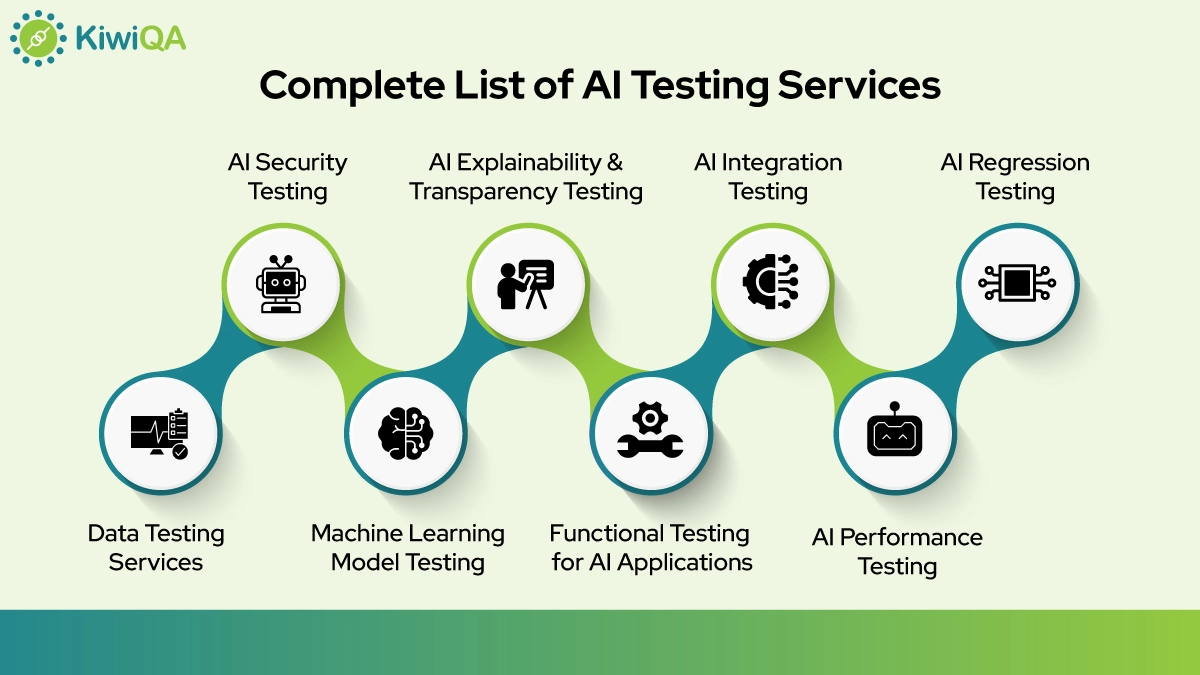
Complete List of AI Testing Services

☛ Data Testing Services

The datasets’ correctness used in AI systems is guaranteed by data AI testing services. They involve verifying the quality of the data by finding abnormalities, missing values, and inconsistencies that can have an impact on model performance. In order to guarantee that all necessary inputs are available and accessible, these services often incorporate data completeness checks.

Validating data labels guarantees accurate and consistent annotations, which are essential for supervised learning. Furthermore, bias identification guarantees results are fair, and data drift detection assists in identifying changes in data patterns over time. Reliable and trustworthy AI systems are supported by dataset version control validation, which preserves consistency throughout development cycles.

For supervised learning models, data labelling validation verifies the consistency of annotations. Furthermore, data drift detection assists in identifying shifts in data patterns over time that may affect the quality of the model. To find any unfair or imbalanced data distributions that might provide discriminatory results, bias detection is carried out.

By ensuring that teams are using the most recent and accurate versions of datasets, dataset version control validation helps to maintain consistency throughout development cycles. All things considered, by guaranteeing the integrity of the underlying data, data testing services are essential to developing reliable and high-performing AI systems.

☛ Machine Learning Model Testing

The goal of machine learning model testing is to verify the resilience, performance, and dependability of AI models prior to their implementation. This procedure guarantees that models produce precise and reliable forecasts for a range of situations and datasets. While precision and recall analysis offer deeper insights into classification performance, particularly in skewed datasets, model accuracy testing assesses how well the model performs against known outcomes. Confusion matrix validation provides a thorough knowledge of model behavior by visualizing true positives, false positives, true negatives, and false negatives.

By training and testing the model on several data subsets, cross-validation testing evaluates the ability of the model to generate new data. Testing for model explainability guarantees that the model’s conclusions are clear and understandable, which is essential for compliance. The agentic AI testing services also assess the model’s reaction to manipulated or unexpected inputs in order to find any weaknesses. When combined, these testing techniques help guarantee that machine learning models are trustworthy, safe, and prepared for practical use.

☛ Functional Testing for AI Applications

When integrating AI-driven components, functional testing for AI applications guarantees that all system functions and workflows function as intended. Functional validation is more difficult since AI systems, in contrast to traditional applications, must manage dynamic inputs and provide outputs that could differ. This kind of testing confirms that AI replies, business logic, and user interactions match specified criteria and anticipated behavior.

It involves verifying that AI-powered features like recommendations, predictions, or automated tasks operate successfully within the application, testing input-output flows, and ensuring that APIs handle data appropriately. In order to ensure that the system manages edge situations and uncommon inputs without malfunctioning, they are also tested.

A functional AI testing services also ensures smooth platform integration by examining how AI components interact with other modules. To provide a seamless user experience, error management, backup plans, and response consistency are also assessed. Businesses may make sure that their systems not only operate technically but also produce useful, dependable, and user-friendly results in real-world circumstances by extensively verifying the operation of AI applications.

☛ AI Performance Testing

The goal of a performance AI testing services is to assess how well and consistently AI systems function under various circumstances and workloads. It guarantees that models maintain accuracy and consistency while producing results in a reasonable amount of time. When processing massive amounts of data or managing several user requests at once, this kind of testing looks at response time, throughput, scalability, and resource consumption.

Additionally, performance testing evaluates how AI models function in real-time settings where delays might have a detrimental effect on user experience, such as chatbots, recommendation engines, or predictive systems. To ascertain system limitations and spot any bottlenecks or malfunctions under harsh circumstances, stress testing is carried out.

Furthermore, load AI testing services guarantees that the system can manage anticipated user traffic without experiencing performance deterioration. Monitoring tools are frequently used to track performance parameters over time and identify problems early. AI performance testing also assesses the impact of data volume and model complexity on system efficiency and processing speed. Organizations can make sure their AI-powered systems continue to be quick, scalable, and dependable, producing consistent results even as demand and data quantities increase, by carrying out thorough performance testing.

☛ AI Security Testing

In order to defend AI systems from malevolent assaults, data breaches, and unauthorized access, AI security testing focuses on finding and fixing vulnerabilities inside AI systems. AI models are vulnerable to threats like adversarial attacks, data corruption, and model inversion since they rely so largely on data and advanced algorithms. This kind of testing by an AI testing services provider assesses the system’s resistance to altered inputs intended to deceive. It also entails evaluating data security protocols to guarantee that private data is appropriately encrypted and safeguarded during transmission and storage.

Access control mechanisms are validated to prevent unauthorized users from interacting with the model or underlying datasets. Additionally, the API security AI testing services ensures that external connections don’t cause gaps. AI security testing also examines how models handle unexpected or harmful inputs, ensuring safe and controlled outputs.

Frequent monitoring & error monitoring strategies are implemented to identify risks in real time. By conducting comprehensive AI security testing, organizations can safeguard their systems, maintain user trust, and ensure compliance with data protection and cybersecurity standards.

Also Read: Top Accessibility Testing Tools Should Use in 2026 to Improve Customer Experience

☛ AI Explainability & Transparency Testing

AI explainability and transparency testing guarantee that machine learning models generate outputs that stakeholders and consumers can comprehend, analyze, and rely on. It is crucial to provide a clear explanation of how models arrive at particular predictions as AI systems are employed more and more in key decision-making. This test determines if methods like feature importance, decision trees, and model-agnostic tools can be used to analyze the reasoning behind model decisions. Additionally, it guarantees consistent and traceable results, enabling teams to audit choices as necessary.

Transparency testing by an AI testing services provider confirms that consumers are aware of and comprehend the limits of AI systems. By offering insightful explanations in addition to forecasts, it also determines whether the system avoids “black box” behavior. This procedure also supports the discovery of latent prejudices, guaranteeing just and moral results. Organizations may increase responsibility, foster trust, and adhere to regulatory requirements that demand clarity in automated decision-making processes by increasing interpretability and transparency.

☛ AI Integration Testing

The goal of AI integration testing is to make sure that AI components interact with databases, APIs, third-party services, and user interfaces in a smooth manner. It is crucial to verify how well AI systems interact with the whole software ecosystem because they seldom function in isolation.

By verifying that inputs are appropriately processed and outputs are accurately distributed across systems, this testing confirms that data flows across components. Additionally, it verifies answer consistency, data interchange formats, and API functioning when including AI-driven services like chatbots, recommendations, and predictive analytics.

Integration testing assesses the effectiveness of the system’s error-handling procedures and fallback systems. Additionally, it looks at compatibility with various platforms, devices, and surroundings. Another crucial factor is performance during integration, which ensures that the speed and dependability of the system are not adversely affected by the inclusion of AI components. Organizations may guarantee seamless operations, enhanced user experience, and dependable end-to-end system functionality by carrying out comprehensive AI integration testing.

☛ AI Regression Testing

Regression testing for AI ensures that changes or upgrades to machine learning models don’t adversely affect current functionality or performance. It is crucial to confirm that previously functional features continue to function as intended since AI models change over time due to fresh data and algorithm advancements. In order to identify any unintentional modifications or accuracy erosion, this testing compares the outputs of the present model with those of earlier iterations. In order to ensure balanced model performance, it also assesses if advancements in one area have led to problems in another.

Validating important metrics, including accuracy, precision, recall, and consistency across several datasets, is part of regression testing. This procedure is frequently streamlined by the use of automated testing frameworks, particularly in continuous development settings. It also guarantees that dependent systems, integration points, and APIs continue to operate properly following upgrades. Even while models are regularly developed over time, AI regression testing helps preserve system stability, dependability, and user confidence by spotting problems early.

☛ Continuous AI Testing (MLOps Testing)

Continuous AI system testing services, also known as MLOps testing, are the process of continuously validating AI systems at every stage of their development, deployment, and beyond. In contrast to traditional testing, this method incorporates testing CI/CD, allowing for quick response and real-time monitoring. As fresh data is added, it guarantees that models stay current, accurate, and dependable. Automated validation of data quality, model performance, and system behavior at every level is part of continuous testing.

Additionally, an AI testing services provider keeps an eye out for performance decline, model drift, and data drift in production settings. When problems are found, alerts and feedback loops are utilized to initiate updates. It also guarantees that new model versions don’t interfere with current systems and that deployment procedures go smoothly. A crucial component of MLOps testing is cooperation between teams. Organizations can maintain robust, scalable, and high-performing AI systems that successfully adjust to evolving data and business needs by using continuous AI testing.

Ready to Connect with AI Testing Experts Now

Ready to Ensure the Quality and Reliability of Your AI-Powered Platform?

AI system testing services aren’t a requirement but a necessity for improving quality. If your vision is to automate stable web flows, manage readable tests, & keep QA predictable under CI/CD pressure, choose the AI testing team. The upcoming era of software testing will depend on AI-human collaboration. While AI accelerates & optimizes testing, human expertise remains necessary for strategic thinking, creativity, and decision-making. Businesses that successfully integrate AI into their testing witness better efficiency, enhanced test coverage & faster release.

Your AI system can fail when there is a glitch in testing. The strong AI testing services by an AI testing service provider makes a structured approach. The team verifies data quality prior to model training & document performance over the production baseline. The best AI testing company combines AI-powered verification with real-time testing on live devices. With them, businesses can make a 50% faster release cycle and scale their business without QA overhead.
Why Data Validation Testing Is Critical for AI and Analytics Platforms

AI and analytics platforms in today’s data-driven world mostly depend on precise, consistent, and high-quality data to produce insightful analysis and trustworthy forecasts. Testing for data validation is essential to guarantee that the information passing through these systems is reliable, clean, and organized. Even the most advanced AI models may cause false findings without adequate validation, which could result in poor decision-making and commercial concerns.

Data validation testing ensures data meets quality standards across collection, transformation, and storage, helping detect errors like missing values and duplicates early; with poor data costing businesses $12.9 million annually, it is crucial for AI systems to prevent bias, errors, and model drift.

Furthermore, authenticated data improves reporting accuracy and fosters stakeholder confidence in analytics solutions. When organizations have faith in the accuracy of their data, they can make data-driven decisions more quickly. By guaranteeing that data complies with industry standards and governance guidelines, it also promotes regulatory compliance.

In the end, data validation testing services aren’t a strategic choice but a tech necessity. It allows companies to maximize performance, reduce risks, and get genuine value from their data.

Complete Overview of Data Validation Testing in AI and Analytics

➥ What is Data Validation Testing?

Prior to use, importation, and processing, data validation examines the correctness and dependability of the data. It assists companies in ensuring that the data they utilize to make decisions and accomplish their objectives is clear, accurate, and trustworthy. Among its varieties are:

• Testing for data integrity
• Testing for data migration
• Testing for data uniqueness
• Testing for data consistency, etc.

In the overall setting, validation of data becomes even more important. Testing for data validation guarantees that the information gathered is appropriately converted and loaded from the source to the destination. At each pipeline level, teams may validate the accuracy, performance, and consistency of data. Incomplete and incorrect data may lead to lost income, regulatory issues, and poor analytics for firms.

Data Validation Testing is a rigorous quality assurance process that verifies the accuracy, integrity, and cleanliness of data before it is used for processing, migration, or model training. It is the gatekeeper of your data ecosystem, ensuring that every byte of information entering your system meets predefined standards and business logic.

In the context of modern QA, the data validation testing process is far more than a simple “null check.” It encompasses several critical testing categories:

➩ Data Integrity Testing: Ensures that data remains unchanged and accurate throughout its entire lifecycle, maintaining its relationships and referential integrity across databases.

➩ Data Migration Testing: Specifically used when moving data through a legacy platform to a cloud platform, guaranteeing zero data leaks throughout the transition.

➩ Data Uniqueness Testing: Identifies and eliminates duplicate records that could skew analytics or lead to redundant AI training inputs.

➩ Data Consistency Testing: Validates that data points are uniform across different systems (e.g., a customer’s address is the same in the CRM as it is in the billing system).

➩ Format and Range Validation: Confirms that data follows expected patterns (e.g., YYYY-MM-DD) and falls within logical boundaries (e.g., a “Temperature” field shouldn’t show 500°C for a weather app).

Ready to Improve AI Accuracy with Data Validation

Why It Matters for AI and Analytics Platforms

This is because it guarantees high-quality inputs, avoids inaccuracies or problems, and preserves model correctness, dependability, and security. Data validation testing is essential for AI and analytics systems. It prevents major cash leakage, legal noncompliance, and brand damage by proactively identifying anomalies such as values that are absent, data drifts, or formatting discrepancies.

» Machine learning models use input data to identify patterns; erroneous, biased, or unreliable predictions result from inconsistent or corrupted data.

When real-time data is swift, AI models may deteriorate over time. To identify this “data drift” before it affects production systems, data validation offers ongoing monitoring.

» Accurate data is essential for BI dashboards and reports. Validation guarantees correctness, completeness, and consistency, resulting in reliable business judgments.

» Validating data guarantees adherence, lowering the risk of fines as regulatory bodies tighten regulations.

» Early mistake detection during an ingestion or ETL process is far less expensive than repairing malfunctioning models during production.

Every step during the Extract, Transform, Loading (ETL) process has to be validated for AI and analytics. QA teams may identify the precise location of issues by checking data at the point of origin, during the conversion, and after it reaches the destination warehouse. By taking a proactive stance, “garbage in, and the garbage out” (GIGO) situations that result in lost income and noncompliance with regulations are avoided.

Also Read: Top Accessibility Testing Tools Should Use in 2026 to Improve Customer Experience

Common Data Quality Challenges in AI and Analytics Systems

❏ Inconsistent Data Formats

Data quality is crucial in the current AI landscape. Because the correctness, consistency, and dependability of the data AI models are trained to greatly influence their efficacy, ensuring excellent information is a difficult but essential undertaking. In order to fully realize the potential of AI technologies, we will examine the several obstacles to assuring data quality for AI in this section and talk about how these might be overcome.

These days, businesses combine data from hundreds of sources, including social media, old SQL databases, IoT devices, and SaaS apps. Dates may be recorded as DD/MM/YYYY in one source and MM-DD-YY in another. These can result in integration problems or, worse, silent database issues if they are not validated.

❏ Missing or Incomplete Data

The invisible killers of AI efficiency are “null” values. If 20% of the total “The final Login Date” data are missing, an AI model attempting to forecast customer attrition would produce distorted results. Early detection of these gaps enables teams to either ignore the records or fill them using sophisticated imputation techniques.

❏ Duplicate Data Issues

Duplicates frequently arise during customer database mergers or system migrations. They cause “overfitting” in AI models, when the system becomes overly fixated on a certain, recurring pattern that doesn’t represent reality, in addition to wasting storage.

❏ Data Integration Errors

During the “Transformation” stage, data frequently breaks. A straightforward code mistake in an ETL script might truncate a lengthy string or compute a currency conversion incorrectly, making the data unusable for downstream analytics.

Benefits of Data Validation Testing for AI and Analytics Platforms

❏ Improved AI Model Accuracy

The accuracy of AI models is greatly enhanced with high-quality, verified data. Data validation guarantees that machine learning models are trained on trustworthy datasets by removing mistakes, inconsistencies, and unnecessary inputs. Better pattern detection, less bias, and more accurate forecasts result from this. Because AI systems produce reliable and consistent results, businesses are able to improve overall performance across analytics and automation processes and make wiser decisions.

❏ Reliable Business Insights

Every investment in the executive suite is built on data. Minor duplication or formatting mistakes might cause BI dashboards supplied by invalid pipelines to unintentionally conceal losses or understate growth numbers. Data validation offers nothing but accuracy. Stakeholders may make bold choices without worrying about being caught off guard by core data corruption thanks to verified analytics. It gives them confidence that the patterns they see in their reports are an accurate representation of the market.

❏ Reduced Operational Risks

By spotting mistakes, irregularities, and inconsistencies before they affect business processes, data validation dramatically lowers operational risks. Inaccurate analytics, system malfunctions, and expensive decision-making errors can result from low-quality data. Organizations can stop erroneous data from accessing vital systems by putting robust validation checks in place. This guarantees dependable system performance, precise reporting, and more efficient operations.

Validation also helps in maintaining adherence to corporate data standards and industry laws. Managing data quality proactively reduces interruptions, safeguards the company’s reputation, and guarantees that operations function effectively, safely, and with increased confidence in data-driven results. This protects your brand’s reputation and avoids the expensive operational solutions that happen when a manufacturing system starts to malfunction.

Although it may seem complicated, increasing the amount of testing actually accelerates your release cycle. You may remove the human bottleneck of “cleaning data” prior to each release by incorporating automatic data validation straight into your CI/CD workflows. This enables you to update models and add new features quickly without sacrificing the level of quality your customers need.

❏ Enhanced Regulatory Compliance

The capacity for clarifying “why” an AI model made a certain conclusion is becoming a legal necessity as global AI rules become stricter. By recording each check, improvement, or quality score at data validation testing services, automated data validation generates a digital paper trail. By ensuring that you have the proof necessary to demonstrate the integrity and fairness of your system in the event that a regulatory authority wants an audit of your data history or model training inputs, this proactive documentation streamlines the compliance process.

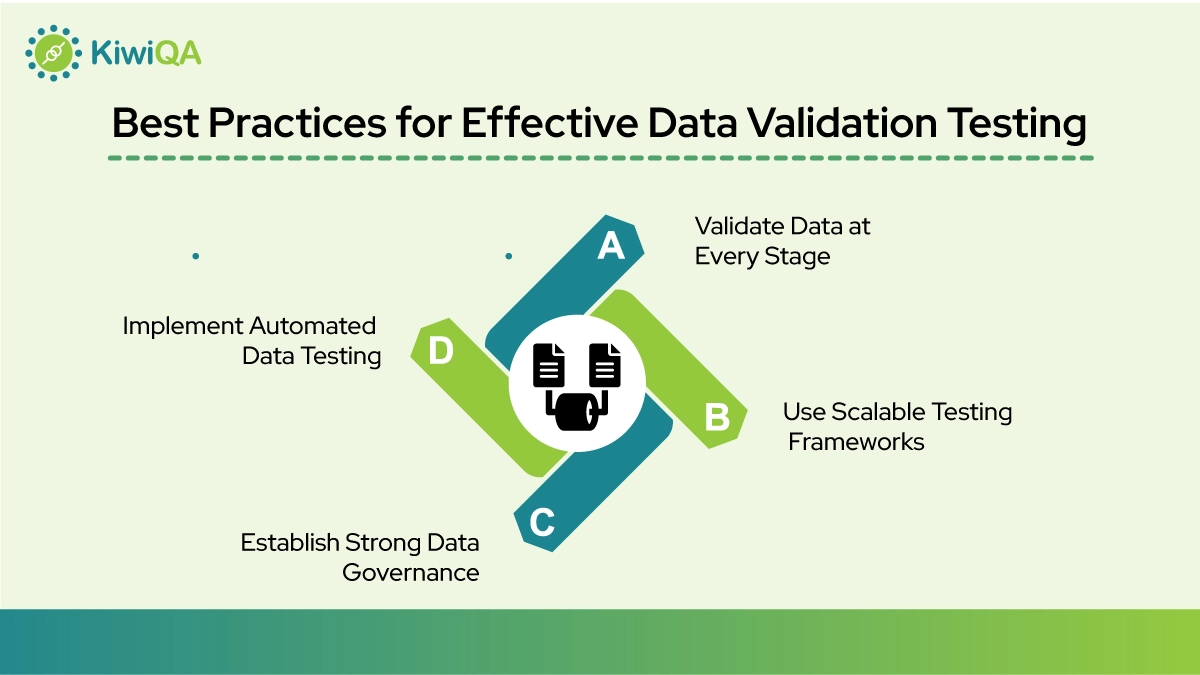
Best Practices for Effective Data Validation Testing

Best Practices for Effective Data Validation Testing

❏ Implement Automated Data Testing

In the tech world of “Big Data,” the huge volume of data is rendering it impossible to run manual testing for validation. When dealing with millions of records generated every minute, human intervention becomes a bottleneck that introduces more errors than it solves. Automated data testing acts as a high-speed digital filter, capable of scanning vast datasets in seconds to identify anomalies that would be invisible to the naked eye.

The true power of data validation testing platform automation lies in its integration; these tools should be embedded directly into your data pipelines. By doing so, you move from “reactive” cleaning to “proactive” monitoring. This setup provides real-time feedback loops, allowing data engineers to catch issues at the moment of entry. When validation is automated, it ensures that your quality checks are consistent, repeatable, and capable of running 24/7 without fatigue.

❏ Establish Strong Data Governance

A Data Contract serves as a foundational pillar for organizational data governance. It is a formal approach to focus on both producers & consumers. This contract explicitly defines the expected schema, data types, required fields, and acceptable value ranges.

Think of it as a quality-of-service guarantee. By implementing a validation layer that enforces this contract, you create a fail-safe for your architecture. If incoming data fails to meet the agreed-upon standards, the system should automatically “quarantine” that data. This prevents the “poisoning” of the downstream database, ensuring that only “contract-compliant” information ever reaches your AI models, while the rejected data is sent to a side-stream for manual or automated remediation.

❏ Validate Data at Every Stage

Data quality can degrade at any point throughout the process of transfer. To combat this, a multi-layered validation strategy is required, treating the data pipeline like a multi-stage filtration system:

➞ The Ingestion Layer: This is called the crucial layer of safety. As data enters the system, validation should focus on structural integrity, checking for basic schema mismatches, incorrect data types (e.g., text in a date field), and mandatory field presence.

➞ The Transformation Layer: Data is rarely used in its raw form; it is aggregated, joined, and calculated. During this phase, validation must shift to verifying complex business logic. This includes checking that currency conversions are accurate, mathematical aggregations are consistent, and that the data still makes logical sense after being manipulated.

➞ The Storage and Load Layer: Before data is finalized in a warehouse or fed into an AI model, a final round of “sanity checks” is essential. This involves validating referential integrity, ensuring that relationships between tables remain intact. This helps perform cross-system reconciliations to confirm that no data was lost or corrupted during the move.

❏ Use Scalable Testing Frameworks

A common pitfall for growing enterprises is building a validation system that works for gigabytes of data but breaks when faced with terabytes. As data volume expands, your testing infrastructure must be able to scale horizontally. This is where cloud-native testing frameworks become indispensable.

By leveraging the elastic nature of the cloud, these frameworks can distribute validation tasks across multiple computing nodes simultaneously. This ensures that even when processing petabytes of information, your quality checks do not become a bottleneck that delays your release cycle or slows down real-time analytics. Scalability ensures that as your business grows and your AI models become more data-hungry, your commitment to data quality remains uncompromised by technical limitations.

Tools and Technologies Used in Data Validation Testing

❏ Automated Data Testing Tools

Organizations can quickly and accurately validate massive amounts of data with the aid of automated data testing solutions. Teams can establish validation rules, identify abnormalities, and automate testing processes with well-known tools like Soda SQL, Great Expectations, and Apache Gryphon.

Continuous validation during data input and transformation is made possible by these technologies’ smooth integration with contemporary data pipelines. Additionally, they facilitate the early detection of problems by supporting features like data profiling, schema validation, and real-time warnings.

Automated technologies ensure high standards for data quality while increasing productivity and consistency by minimizing manual intervention. These solutions are essential for preserving trustworthy datasets for AI models and analytics platforms as data ecosystems get more complex, ultimately improving operational performance and decision-making.

❏ Data Integration & Validation Platforms

Data integration and validation platforms ensure that data from multiple sources is accurately combined, transformed, and validated before use. Solutions like Informatica Data Quality, Talend Data Fabric, and Microsoft Azure Data Factory provide robust capabilities for data cleansing, transformation, and validation across distributed systems.

These platforms support rule-based and pattern-based validation, ensuring data consistency across databases, applications, and cloud environments. They also enable real-time data monitoring and governance, which is crucial for maintaining data accuracy in dynamic environments. By unifying data workflows and enforcing validation rules, these platforms help organizations build reliable data pipelines that support analytics and AI initiatives while ensuring compliance with industry standards.

❏ AI and Analytics Validation Frameworks

Frameworks for AI and analytics validation are made to guarantee the precision, equity, and dependability of machine learning models and analytical results. Frameworks like Evidently AI, Deequ, and TensorFlow Data Validation aid in data drift or anomaly detection, model performance monitoring, and training data validation.

To make sure data follows expected patterns, these frameworks offer statistical analysis, schema checks, and distribution comparisons. Additionally, they facilitate ongoing validation in production settings, allowing businesses to sustain model correctness over time. Businesses may lessen bias, increase model transparency, and guarantee that analytics outputs are dependable and useful in practical situations by incorporating these frameworks into AI pipelines.

Also Read: Top Functional Testing Services That Boost Confidence in Every Release

How Businesses Can Implement a Strong Data Validation Strategy

➥ Assess Existing Data Pipelines

To find gaps, inconsistencies, and other hazards, start by assessing your existing data pipelines. Examine the methods used for data collection, processing, and system storage. Examine sources for dependability, correctness, and completeness. Businesses can create targeted changes and guarantee data integrity from the very beginning of the pipeline by identifying weak points in current workflows where validation is lacking or ineffective.

➥ Build a Data Validation Framework

Establish a systematic framework for data validation that outlines guidelines, requirements, and procedures to guarantee data accuracy. Setting validation tests like format, range, consistency, and duplicate controls is part of this. Incorporate automated tools to instantly enforce these regulations. A well-thought-out framework lowers human error, guarantees consistency across systems, and creates a solid basis for preserving accurate, high-quality data.

➥ Continuously Monitor Data Quality

Data validation necessitates continuous monitoring; it is not a one-time operation. Use dashboards and real-time tracking tools to find abnormalities, mistakes, or inconsistencies as they happen. Frequent audits and alerts enable teams to address problems promptly. In order to promote better decision-making and sustain overall system performance and business efficiency over time, continuous monitoring guarantees that data remains accurate, relevant, and reliable.

Ready to Talk to Data Validation Experts Today

Ready to Eliminate Data Risks in Your AI and Analytics Systems?

The data precision is necessary for the success of any AI and analytics projects. You can’t afford to build your approach on unreliable, subpar information in a market that is becoming more and more competitive. You can make sure that your platform is safe, compliant, and, most importantly, trusted by implementing strong data validation testing techniques. The specialty at KiwiQA is assisting businesses in avoiding the errors related to data quality. The team of skilled testers is here to make sure your data is perfect, whether you are optimizing a global BI platform or developing a generative AI model.