Top AI Testing Tools Decision Makers Should Invest in 2026

In the current time, advancements in AI and app development have changed the way QA teams verify software quality. Traditional approaches of manual & automation testing are now getting outdated. With the rising challenges in software development, traditional QA approaches lack coverage, speed, and adaptability. This is when AI testing tools play a strong role in software testing. AI smoothly arrived in the world of QA, and it’s a game-changer. The tasks that took hours for scripting and debugging can now be done in seconds thanks to smart systems.

AI testing services tools offer smart test case generation, predictive analytics, visual validation, and self-healing scripts. A survey found that 81% of teams utilize AI tools for testing workflows. There are a number of testing tools that have emerged recently and significantly improved the accuracy and speed.

The decision-makers in 2026 are choosing an AI testing service provider to obtain visual AI potential, NLP scripting, and autonomous self-healing, etc. In 2026, quality at speed isn’t considered a luxury but a necessity to stay in the market landscape. By leveraging ML and Gen AI, these tools are supporting teams to drive efficiency by 85% while reducing maintenance costs. AI testing tools are used to perform some impressive tasks, such as spotting errors, generating test cases, retesting when UI changes, etc.

This blog presents a review of free and paid tools for AI testing services, along with their features and benefits. We’ll discuss the steps to choose the ideal tools, their role in software deployment, and future trends. So, no need to be fed up with the endless test maintenance and flaky tests from now on. Read this post to get some quick ideas.

Why AI Testing Tools Are Becoming Essential

➥ Faster Test Execution

AI testing tools significantly limit the time needed for QA testing by automating repetitive & complicated test scenarios. They limit manual QA efforts, enabling the QA team to prioritize strategic tasks rather than routine validation. With smart automation, firms can boost development workflows & drive release cycles without compromising software quality. AI-based QA supports frequent integration & CI/CD, allowing quick release and improved productivity across agile development environments.

➥ Improved Test Accuracy

The generative AI testing tools drive software quality by detecting errors and inconsistencies with improved precision. They can measure a large volume of test data, inspect gaps early in SDLC, while minimizing the risks of crucial failures after release. By limiting human errors related to manual QA, AI testing enhances reliability & consistencies. These tools utilize predictive analytics & pattern recognition to reveal hidden errors and verify accurate and effective app validation.

➥ Smarter Test Maintenance

Advanced AI testing company streamlines test maintenance through smart automation capabilities. When app interfaces or workflow changes occur, AI tools can automatically obtain test cases without heavy manual updates. This limits maintenance costs and avoids failed test cases due to system changes. Adaptive automated workflows enhance long-term QA efficiency by learning from previous executions to optimize test coverage. It verifies stable performance across evolving software apps.

 Ready to Upgrade Your AI Testing Strategy Today?

Key Features to Look for in AI Testing Tools

◈ AI-Powered Test Automation

The most crucial feature of an advanced AI testing tool is smart automation. These AI software testing companies can automatically create test cases depending on user behavior, app changes, and historical data, limiting the requirement for manual scripting. The AI-based tools support smart test execution by focusing on high-risk test scenarios and test coverage optimization. It helps firms enhance testing speed, limit operational costs, and validate software quality throughout the SDLC.

◈ Cross-Platform Testing Support

The reliable AI consulting services for a QA provider must offer seamless cross-platform compatibility for mobile, web, and desktop apps. Firms today demand QA tools that can validate performance across various devices, browsers, and OS without additional challenges. Cloud-drive QA support drives flexibility by allowing remote testing environments and scalable infrastructure. These potential supports, the QA team verifies consistent user experiences while limiting infrastructure cost and streamlining the QA process across vast virtual platforms.

◈ Easy Integration

AI testing tools must integrate smoothly with current development ecosystems, involve DevOps workflows, and CI/CD pipelines. Ease integration allows frequent testing throughout the SDLC, and the support team detects and resolves errors quickly. Compatibility with popular development, collaboration, and automation platforms drives operational efficiency while navigating implementation challenges. AI testing tools support agile & DevOps methodologies to drive release and collaboration between teams while assuring software quality.

◈ Real-Time Analytics & Reporting

The smart AI testing tools used by AI testing companies aim to offer analytics and reporting features that serve valuable metrics for software quality and performance. Visual dashboards support the QA team to track execution status, error trends, and overall app health in a unified interface. Performance insight generated by experts allows for measuring gaps, optimizing QA strategies, and making data-driven decisions. Real-time reporting drives transparency, supports stakeholders in monitoring progress, and manages software reliability.

Also Read : Why AI-Driven Testing Is the Future of Quality Engineering?

Top AI Testing Tools Decision Makers Should Invest In

1. Testim

Testim

Testim, driven by an AI software testing platform, helps development teams speed up automated testing and simplify maintenance. The platform generates reliable, self-healing test scripts that automatically adjust to changes in the application by using machine learning. Testim is appropriate for agile and DevOps contexts since it facilitates online application testing, cross-browser validation, and smooth CI/CD integration.

Anyone can write automated tests because of its low-code interface. Companies invest in Testim because it increases software quality, speeds up releases, and minimizes flaky tests. Additionally, the platform offers scalable automation capabilities, comprehensive reporting, and collaboration features that efficiently enable enterprise-grade testing procedures across contemporary digital applications globally.

2. Functionize

Functionize


Functionize is a cutting-edge AI automation testing tool that assists businesses in more accurately and efficiently automating software quality assurance procedures. The software creates advanced automated tests with straightforward English commands by utilizing machine learning and natural language processing. Functionize facilitates cloud execution, end-to-end web application testing, and self-healing automated features that minimize maintenance.

Continuous testing is made possible throughout the software development lifecycle by its seamless integration with DevOps workflows and CI/CD pipelines. Companies utilize Functionize because it streamlines complicated automation operations, speeds up release cycles, and enhances fault detection. Its scalable cloud infrastructure, visual testing capabilities, and predictive analytics make it appropriate for businesses operating sizable and quickly changing digital applications throughout the globe.

3. Mabl


Mabl

Designed to facilitate continuous testing in agile and DevOps-driven software development settings, Mabl is a cloud-native AI software testing tool. Functional, visual, accessibility, and performance testing are all integrated into a single automation solution by the platform. Mabl reduces test maintenance, increases software reliability, and detects problems fast with intelligent automation and machine learning.

It helps teams speed up development and deployment processes by integrating with well-known CI/CD solutions. Because of Mabl’s user-friendly interface, scalable cloud architecture, and robust development and quality assurance team communication capabilities, businesses invest in the platform. In order to increase testing productivity and guarantee consistent application performance across all contexts and devices, the platform also offers comprehensive analytics, intelligent fault identification, and flexible testing workflows.

4. Applitools

Applitools

Leading AI-powered visual testing solution Applitools assists companies in guaranteeing uniform UI quality for mobile and web applications. Its Visual AI engine can accurately identify UI regressions, layout inconsistencies, and visual flaws in a variety of browsers, devices, and screen resolutions. The platform enhances current testing methods without significantly disrupting workflow by integrating with well-known automation frameworks like Selenium, Cypress, and Playwright.

Companies invest in Applitools because it improves customer experience, speeds up visual inspection, and lowers false positives. Additionally, the platform facilitates scalable cloud execution, measures cause and support. These features make Applitools perfect for businesses that prioritize high-quality digital user experiences and visual consistency on a worldwide scale.

5. ACCELQ

ACCELQ

ACCELQ is a codeless automation testing platform driven by AI, designed to make end-to-end quality assurance procedures easier for contemporary businesses. From a centralized setting, the platform facilitates testing of desktop, mobile, online, API, and packaged applications. ACCELQ reduces manual scripting labor and speeds up the adoption of automation through the use of intelligent automation, predictive analytics, and natural language-based processes.

Because ACCELQ enhances testing scalability, lowers maintenance costs, and facilitates continuous testing across agile and DevOps pipelines, businesses favor it. Additionally, the platform provides lifecycle management, automated test generation, and real-time reporting tools that improve operational visibility. Because of its cloud-based design and enterprise-grade capabilities, ACCELQ can effectively manage complex application ecosystems and large-scale digital transformation for businesses all over the world.

6. Katalon Platform

Katalon Platform

Katalon Platform is an all-inclusive AI-powered testing solution for desktop, mobile, online, and API automation testing. The platform integrates advanced AI features like intelligent object detection, self-healing scripts, Smart Wait functionality, and automated analytics with low-code automation. Katalon facilitates continuous testing and quicker software delivery by integrating easily with DevOps tools, cloud environments, and CI/CD pipelines.

Companies utilize Katalon because it makes automation easier for both technical and non-technical users while increasing the scalability and efficiency of testing. Additionally, the platform has integrated reporting, communication tools, and performance monitoring features that improve processes related to quality assurance. Because of its adaptable design, Katalon can handle a wide range of testing needs for startups, mid-sized companies, and major corporations worldwide.

7. Tricentis Tosca

Tricentis Tosca

An enterprise-grade AI testing platform called Tricentis Tosca was created to assist in extensive software quality assurance and ongoing testing projects. The platform enhances test coverage across business applications and streamlines complicated testing procedures with model-based, scriptless automation. Tosca is incredibly flexible for digital transformation initiatives, supporting web, mobile, API, SAP, Oracle, and packaged application testing.

Because Tricentis Tosca speeds up release cycles, lowers maintenance costs, and improves risk-based testing techniques, companies invest in it. Additionally, the platform interfaces with CI/CD environments and DevOps pipelines, facilitating enhanced collaboration and quicker defect identification. Today, Tosca is the perfect choice for businesses managing enterprise processes and mission-critical applications worldwide because of its scalability, compliance support, and advanced analytics.

8. Selenium With AI Extensions

Selenium With AI Extensions

The popular open-source Selenium framework’s versatility is combined with artificial intelligence-powered intelligent automation capabilities in Selenium with AI extensions. AI-driven add-ons increase the overall stability and effectiveness of testing by offering self-healing locators, predictive maintenance, intelligent test production, and automated defect analysis. This improved method reduces human maintenance work and helps lower failures brought on by changes to the application’s user interface.

Because Selenium with AI extensions provides freedom in customization, broad community support, and interoperability with a variety of browsers, frameworks, and cloud testing environments, businesses invest in it. Additionally, the framework successfully interfaces with DevOps workflows and CI/CD pipelines, allowing for scalable automation. Because of these features, Selenium is a good choice for firms seeking the ideal testing solutions.

9. testRigor

testRigor

An AI-powered tool called testRigor makes automation easier by letting users write tests with simple English instructions rather than intricate coding scripts. In addition to providing intelligent self-healing capabilities that lower maintenance costs, the platform offers online, mobile, desktop, and API testing. Throughout the SDLC, testRigor analyses user behavior, finds flaws, and increases testing accuracy using artificial intelligence.

Because testRigor increases testing speed, speeds up automation adoption, and lessens reliance on highly technical QA resources, businesses invest in it. Additionally, the platform connects with CI/CD pipelines, facilitating faster product releases and continuous testing. testRigor is the perfect choice because of its scalable architecture, low-code methodology, and effective automation workflows.

10. Virtuoso QA

Virtuoso QA

A cloud-based AI testing platform called Virtuoso QA was created to make end-to-end software automation easier for DevOps and agile teams. Without requiring a deep understanding of scripting, the platform creates, runs, and maintains test cases using intelligent automation and natural language processing. Functional testing, visual validation, regression testing, and continuous testing workflows for contemporary apps are all supported by Virtuoso QA.

Companies invest in Virtuoso QA because it lowers testing complexity and maintenance requirements while enhancing cooperation between developers, testers, and business stakeholders. Additionally, the platform offers scalable cloud infrastructure, adaptive automation, and comprehensive reporting that improve software quality assurance processes. Today’s expanding businesses around the world can benefit from Virtuoso QA’s cognitive testing capabilities, user-friendliness, and automation scalability.

Benefits Of Investing in AI Testing Tools

❏ Better Software Quality

AI testing tools support firms to obtain improved software quality by improving the overall test coverage and app stability. These tools can measure workflows, execute frequent test cases, and track hidden errors before releasing. With frequent monitoring and smart automation, the QA team verifies consistent performance across vast environments. Enhanced testing accuracy limits the chances of crucial failures and supports firms in delivering reliable apps that drive user satisfaction and experience.

❏ Reduced Operational Costs

Investing in AI testing tools significantly minimizes the operational excellence by limiting reliance on an extensive manual QA process. Automated QA limits repetitive human efforts, enabling the team to prioritize high-value tasks such as strategic planning and innovation. AI-based systems also drive error detection and quick resolutions, and avoid costly production breakdowns. Over time, firms benefit from enhanced resource utilization, minimize maintenance costs, and effective QA operations that contribute to long-term financial savings.

❏ Faster Time-To-Market

AI assessment tools allow faster software delivery by supporting continuous QA throughout the development cycles. Automated workflows support team to smartly track and navigate errors, limit delays during development and release stages. CI/CD integration pipeline further streamlines the QA process and provides rapid feedback for developers. With quick product release and short QA cycles, firms can respond quickly to market demands. Businesses can launch new features effectively and manage competitive benefits in quickly moving virtual industries.

❏ Scalability For Growing Businesses

Advanced AI testing tools are designed to support scalability as firms expand their apps and virtual infrastructure. They can effectively manage large-scale QA demands across multiple platforms, environments, and devices without hampering performance. Enterprise-grade workflows enable firms to manage rising testing complexity while managing speed & accuracy. The following tools also support distributed teams and cloud environments, making them ideal for rising business requirements.

Challenges Businesses Should Consider

➩ Initial Implementation Cost

Integrating AI testing tools demands a significant investment. Firms may require allocating budgets for tool setup, customization, licensing, and the onboarding process. QA team training effectively utilizes AI-based platforms that require time & resources. While these investments might improve initial costs, firms that plan strategically can obtain long-term savings. It also drives efficiency and software quality through modern automated QA capabilities.

➩ Integration Complexity

Integration of AI QA tools into the current development environment can be challenging for firms using legacy systems and complicated infrastructures. Compatibility errors might arise when connecting the AI platform with existing workflows, apps, and testing frameworks. Firms often need to adjust operational methods and DevOps practices to drive automation efficiency. Appropriate planning and specialized support are crucial to ensure smooth implementation.

➩ Choosing The Right Tool

Selection of ideal AI testing solutions can be tough because every firm has unique QA demands, workflows, and scalability goals. Firms must carefully determine features, automation potential, long-term performance, and integration support prior to decision-making. Future scalability and budget imitation features play a strong role when comparing available tools. Selection of AI consulting services for QA aligns with firm objectives and can drive QA efficiency, limit operational challenges, and support sustainable software development growth.

Also Read : Top AI Testing Company in the USA for Scalable AI Solutions

How To Choose the Right AI Testing Tool

☢ Define Testing Goals

Businesses should specify their testing goals and automation needs before choosing an AI testing tool. Finding appropriate solutions is made easier by knowing whether the emphasis is on end-to-end automation, security validation, performance testing, or regression testing. Businesses should evaluate the technical proficiency of their staff to implement AI-driven workflows. Clear testing objectives enable companies to select technologies that complement long-term software quality initiatives, boost return on investment, and guarantee better deployment planning.

☢ Compare Features & Pricing

To choose the best AI testing tools, businesses should evaluate them according to features, cost structures, and scalability. While startups frequently place a higher priority on price and flexibility, enterprise organizations may need enhanced automation, analytics, and multi-platform compatibility. Careful consideration should also be given to subscription fees, licensing arrangements, and customization choices. Organizations may ensure that the chosen tool can effectively support future growth and increasing software testing demands while balancing performance and price requirements by comparing multiple providers.

☢ Evaluate Ease of Use

Businesses should assess AI penetration testing tools based on features, pricing structures, and scalability in order to select the best choice. Enterprise businesses may require improved automation, analytics, and multi-platform compatibility, but startups usually prioritize pricing and flexibility. Subscription costs, licensing agreements, and customization options should also be carefully considered. By comparing several suppliers, organizations can make sure that the selected tool can balance performance and cost requirements while successfully supporting future growth and rising software testing demands.

☢ Check Scalability & Security

Investing in AI-based testing tools for long-term business growth requires careful consideration of scalability and security. Businesses should make sure the platform can manage growing workloads, a variety of apps, and growing testing needs without compromising performance. In order to safeguard private company and client information during testing procedures, robust security measures are equally crucial. To make sure the solution supports both operational scalability and trustworthy data security policies, businesses should assess compliance standards. AI testing companies must evaluate data encryption capabilities and access controls.

Future Trends in AI Software Testing

☛ Autonomous Testing

Autonomous QA is transforming software QA by allowing smart systems to execute tests with minimal human intervention. The AI-driven platforms can automatically track app changes, generate test scenarios, and optimize execution practices without constant manual input. Smart error prediction potential also supports the team to measure potential gaps prior to release. As automation becomes advanced, testing will enhance efficiency, limit testing cycles, and support quick, reliable software delivery across industries.

☛ Generative AI In QA

Gen AI is becoming a major innovation in software QA by crafting a smart & adaptive testing process. Gen AI is becoming a crucial innovation in software testing by designing a smart & scalable testing process. The AI-generated test cases can automatically cover various user scenarios, drive testing efficiency, and minimize manual scripting efforts. The tools support smart gap detection by detecting patterns, tool cause, and recurring errors effectively. As Gen AI evolves, the QA team will benefit from quick test development, enhanced software quality, and decision-making throughout the testing lifecycle.

☛ Predictive Analytics

This future trend is supporting firms in making advanced testing decisions by measuring historical and real-time testing data. AI-based systems can track high-risk areas within the app and offer risk-based QA insights that enhance error detection and resource allocation. These capabilities allow the QA team to focus on crucial test cases and limit unnecessary QA efforts. Quick decision-making is supported by predictive analytics, enhancing release planning and operational efficiency. It supports firms in managing consistent software performance.

☛ Continuous AI Optimization

The following trend will transform the future of testing through self-improving test models and adaptive learning capabilities. AI systems can measure previous test execution, user behavior, and app performance to redefine QA strategies automatically over time. Real-time performance learning enables QA tools to adapt quickly to software updates and changing environments. The frequent improvement drives QA accuracy, limits maintenance efforts, and supports long-term efficiency in advanced agile & DevOps development processes.

Ready to Discuss the Right AI Testing Tool?

Ready To Transform Your QA Strategy with AI Testing Tools?

AI-driven QA tools are changing the testing landscape for firms & QA teams to drive their QA cycle and increase rapid release. Choosing the best AI-driven testing tools can drive software quality while enhancing accuracy and reliability. Currently, AI in QA has shifted. AI QA tools are no longer about evaluating errors but about speed and reliability.

It is necessary for modern businesses to stay current with the ongoing environment. By embracing these tools, firms can bridge the gap between frequent delivery and quality. Whether you are seeking open-source flexibility or enterprise-grade solutions, hire AI software testing companies to build future-ready QA workflows.

Why AI-Driven Testing Is the Future of Quality Engineering?

Based on the report by Fortune Business, the worldwide AI-enabled testing market is expected to grow to $2,746.6 million by the next 4 to 5 years. The complications in modern software solutions increase, so it’s necessary for the business to make sure its AI system runs flawlessly and efficiently. While traditional software testing techniques are still in use, modern complications require rigorous AI-driven testing approaches.

In the current landscape, organizations are under immense pressure to deliver quality software. Traditional manual testing methodologies can’t keep up with the modern development cycles & bugs. As applications evolve to advanced technologies, IoT, AI, and cloud-native architectures, it ensures reliability, security & performance. This is when AI testing services step in. This testing revolutionizes how enterprises approach software QA. By implementing AI & ML into testing lifecycles, businesses can automate repetitive tasks, monitor defects, and optimize test coverage.

Based on another report, in 2026, 40% of businesses will spend their budget on AI testing apps. As digital innovations accelerate, AI is upscaling the process accuracy & establishes new product/service excellence standards. In the rapidly growing virtual space, it becomes a necessity to integrate AI in QE to revolutionize data into valuable insights.

Research revealed that 80% of software will be designed on AI by the end of 2026, so if you are not using AI testing services as a QE, then you need to adopt it. It keeps you competitive in every aspect of SDLC, business operations, and customer experience. In the following blog, we’ll explore what AI-driven testing is and how it is shaping the future of quality engineering.

What is AI-Driven Testing?

◈ Definition of AI-Driven Testing

AI is revolutionizing quality engineering by uplifting testing abilities & streamlining the process. AI-based software testing services allow the QA engineering team to focus on necessary areas and enhance the reliability & accuracy of software testing. The AI-driven tools optimize test result analysis and enable engineers to opt for comprehensive QA coverage.

In cloud computing, QE is necessary because of the unique features of cloud-based apps. These apps must be reliable to maintain uninterrupted services and limit downtime errors. With AI testing, you can upscale automated test generation and execution. Quality engineering supports the establishment of QA environments for testing embedded software across various devices. AI optimizes this process by facilitating accurate & faster QA testing. Additionally, AI has the potential to mimic real-time user behavior & patterns to run large-scale performance testing under various scenarios.

Manual testing takes more time & is prone to errors in agile development environments. Thanks to AI tools, which allow automating recurring testing tasks, including generation and execution. When businesses implement tools, they can free the QE engineers. AI-based software testing services drive test coverage and minimize human error. The tools enable running thousands of tests against various environments in a single instance, which isn’t possible in manual testing. AI can seamlessly integrate with CI/CD, which ultimately offers faster development without hampering quality.

◈ Core Technologies Behind AI Testing

➥ Machine Learning

ML is the foundation of AI-based software testing services, allowing systems to learn from historical test data & improve time without explicit programming. It assists in identifying patterns, predicting defects, and optimizing test execution by focusing on high-risk areas. ML has the potential to create test cases, detect anomalies & drive decision-making in the testing process.

By continuously learning from previous outcomes, ML improves accuracy & efficiency in quality engineering. It will result in smart automation, minimize manual effort & fast delivery cycles. It enables businesses to maintain quality standards in frequently evolving software environments.

➥ Natural Language Processing

NLP enables AI tools to understand & interpret human language, make test creation accessible & intuitive. Additionally, it supports analyzing user requirements, bug reports, and documentation to generate relevant test scenarios. NLP enhances collaboration between technical & non-technical teams by bridging communication gaps. In addition, it drives test coverage by addressing missing scenarios from textual data. It ensures comprehensive testing & minimizes chances of errors.

➥ Computer Vision

Computer vision also plays an important role in AI system testing services by allowing systems to visually measure & interpret the user interface. It enables tools to recognize UI elements, validate layouts, and track visual inconsistencies. Unlike traditional methods, where quality engineers rely on code-based locators, computer vision interacts with apps like humans. It makes tests more resilient. It significantly minimizes maintenance efforts & drive test reliability. By ensuring accurate visual validation across devices & platforms, the tool drives user experience & product quality.

➥ Predictive Analytics

Predictive analytics leverage AI & statistical models to forecast potential defects & testing outcomes before they occur. By measuring historical data, changes in code, and earlier testing results, it identifies high-risk areas that demand focused testing. It allows the team to make proactive approaches and limit the chances of crucial failures in production. It supports resource optimization, allocation & test planning by ranking tasks depending on the level of risks. This is how business can enhance efficiency, minimize cost, & serve reliable software.

Ready to Transform QA with AI-Driven Testing? Explore Now

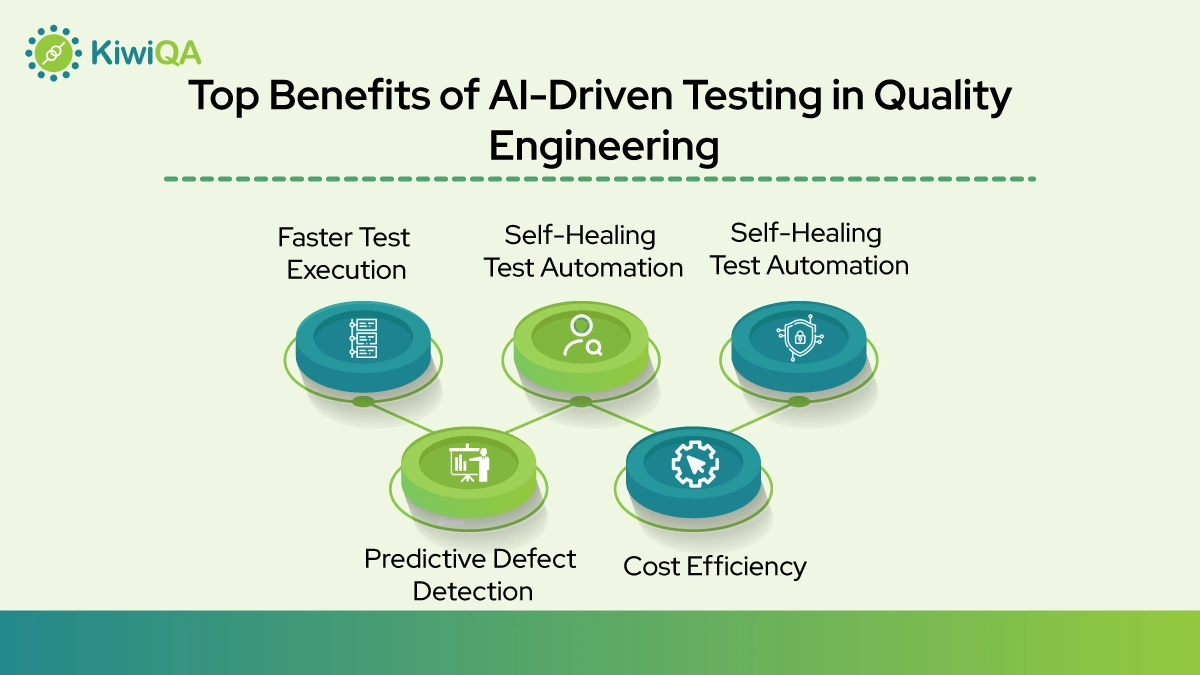
Top Benefits of AI-Driven Testing in Quality Engineering

❏ Faster Test Execution

AI system testing services effectively speed up test execution by enabling numerous test cases to execute concurrently across environments. This guarantees quicker feedback cycles and cuts down on overall testing time. Additionally, by creating test cases based on application behavior and historical data, AI-powered automated test generation reduces the need for manual scripting. Teams are able to complete more tests in less time as a result, allowing for faster releases. It allows preserving high software reliability and excellence in dynamic development contexts.

❏ Self-Healing Test Automation

AI is used by self-healing test automation to automatically identify modifications to the application’s code. This greatly reduces maintenance effort by removing the requirement for ongoing manual intervention when elements change. To guarantee testing continuity, AI algorithms find failed test cases, examine the underlying cause, and modify scripts.

Test suites eventually become more dependable and stable as a result. Organizations may maintain consistent testing workflows, decrease downtime, and boost productivity. AI-enabled testing services will increase the resilience and efficiency of the overall quality engineering process.

❏ Improved Test Coverage

By proactively creating test cases that exceed traditional manual methods, AI improves test coverage. AI creates intelligent test cases by examining application operations, user behavior, and previous errors to find important test scenarios. By concentrating on high-impact and high-risk application domains, risk-based testing further prioritizes these situations. This guarantees that testing activities are both thorough and focused. As a result, teams may efficiently manage time and resources while achieving deeper coverage. It helps to find hidden flaws and produce software that is more reliable.

Top Benefits of AI-Driven Testing in Quality Engineering

❏ Predictive Defect Detection

By examining past data, code modifications, and testing trends to spot possible problems before they arise, AI-driven testing makes predictive defect detection possible. Early problem detection lowers the cost and complexity of solutions by assisting teams in addressing flaws early. AI-powered risk analysis also identifies application vulnerabilities that demand targeted testing. This proactive strategy reduces the likelihood of significant manufacturing failures. Organizations can guarantee more consistent and reliable releases. They can increase software quality and improve user experience by anticipating faults rather than responding to them.

❏ Cost Efficiency

By drastically lowering manual labor and maximizing resource use, AI-driven testing increases cost-effectiveness. Teams can concentrate on more important work by using automation to manage repetitive operations. Faster release cycles reduce delays and cut time-to-market, which further reduces costs. Early fault discovery also reduces the need for improvement in SDLC. AI helps businesses reduce operating expenses while upholding high standards by optimizing the entire testing lifecycle. This improves ROI and makes scalable, effective quality engineering techniques possible.

Also Read : Top AI Testing Company in the USA for Scalable AI Solutions

How AI-Driven Testing is Used in Real-World Scenarios

🢣 UI Testing

UI testing frequently uses AI-driven testing to make sure programs provide reliable and aesthetically correct user experiences. AI uses visual validation to find even the smallest errors in design, colors, fonts, and objects by comparing current UI screens with baseline images. By spotting positional changes, missing elements, or abnormal user interface behavior across devices and browsers, it also makes layout change detection possible. This minimizes human mistakes and does away with the necessity for manual visual checks. Teams can thus promptly detect and resolve UI problems, guaranteeing smooth user interfaces and enhancing overall program quality and user satisfaction.

🢣 API Testing

AI improves API testing in practical applications by automating validation procedures and guaranteeing smooth system connectivity. Without requiring a lot of manual programming, AI can automatically validate API answers, verify endpoints, and check data integrity with the use of AI system testing services. Additionally, it makes intelligent test data production possible by generating dynamic and realistic datasets that enhance test coverage and accuracy.

In order to optimize test scenarios and identify possible failures, AI continuously learns from previous test runs. As a result, API testing becomes quicker and more reliable. AI system testing services assist businesses in maintaining strong integrations and producing high-performing applications.

🢣 Performance Testing

By mimicking actual user loads and forecasting system behavior under various circumstances, AI-driven testing is essential to performance testing. By using AI algorithms to predict how apps will function during periods of high usage, predictive load testing enables teams to fix bottlenecks before they affect users.

Anomaly detection also helps in identifying unexpected trends in system performance. Proactive optimization is made possible by these insights, which also guarantee that systems stay responsive and stable. Organizations may produce high-performing apps that satisfy users even in the face of tremendous demand by utilizing AI.

🢣 Regression Testing

AI reduces unnecessary test execution to determine which test cases are most important to execute based on recent code changes. Without spending time on unaffected components, our focused approach guarantees that high-risk areas are properly evaluated. AI also speeds up test cycles by automating execution and improving test suites’ correctness and speed. It continuously learns from past test outcomes to improve testing tactics in the future. Teams are able to swiftly verify upgrades, preserve software stability, and confidently provide new features as a result.

Key Challenges in Implementing AI-Driven Testing

☛ Initial Learning Curve

This is one of the main challenges to implementing AI-driven testing. Teams frequently need to comprehend ideas like intelligent automation, data-driven testing, and machine learning models, which demand further training and upskilling. As testers adjust to new workflows and procedures, productivity may temporarily decline. Organizations also need to devote time to fostering trust in AI-based solutions. Teams gain from increased productivity, more intelligent testing procedures, and better overall quality engineering results.

☛ Tool Selection Complexity

Finding AI-driven testing solutions can be tough. It can be difficult to determine which tool is appropriate for a given set of business requirements because each one offers a distinct set of features, integrations, and degrees of AI power. Companies need to assess things like cost, scalability, usability, and accessibility with existing systems. Low ROI, higher costs, and inefficiencies can result from a bad choice. Therefore, to ensure successful deployment and optimize the value of AI-driven testing solutions, thorough research, pilot testing, and alignment with project goals are crucial.

☛ Integration Challenges

It can be difficult to incorporate AI-driven testing technologies into current testing and development environments. Seamless integration is challenging since many organizations currently utilize numerous testing frameworks, older systems, and established CI/CD pipelines. During implementation, problems with compatibility, data migration, and workflow disruptions may occur.

Furthermore, technological know-how and customization may be needed to integrate AI tools with existing procedures. These difficulties may cause adoption to be delayed and have a short-term effect on productivity. However, companies may successfully integrate AI-driven testing into their workflows and achieve its full potential. It helps with careful planning, strong integration strategies, and teamwork.

Also Read : Complete List of AI Testing Services for AI-Powered Platforms

Best Practices for Implementing AI-Driven Testing

➩ Start with pilot projects

Before expanding AI-driven testing throughout the company, start with small pilot projects to assess performance, ROI, and viability. Through pilot projects, teams may better learn how AI technologies operate in real-world settings, spot possible problems, and improve low-risk techniques.

This strategy enables organizations to measure results, test various scenarios, and foster stakeholder confidence. It also offers insightful information about integration demands and resource requirements. Businesses may guarantee a more seamless transition, minimize disruption, and build a solid foundation for wider AI adoption in quality engineering by starting small and increasing gradually.

➩ Choose the right tools

Selecting the ideal AI-driven testing tool for a quality engineer’s future is necessary for successful implementation. Businesses must evaluate tools depending on their compatibility with the existing systems, ease of use, and scalability. It is necessary to consider factors like multiple testing types, integration with development pipelines & reliability.

Perform thorough research, comparing options, and running trials to monitor the right option. Making wrong choices can cause inefficiencies and increased costs. The well-informed decisions ensure improved performance, smooth workflows, and maximum ROI in AI-powered testing initiatives.

➩ Train teams

Teams must receive the right training in order to successfully implement AI-driven testing procedures. The operation of AI technologies must be understood by testers, developers, and QA specialists. Workshops, training courses, and practical experiences can all help in developing the necessary abilities and self-assurance.

Teams may stay current with emerging technology by promoting ongoing learning. Teams with proper training can increase productivity, decrease errors, and make better use of AI capabilities. Investing in talent development guarantees the long-term viability and effectiveness of AI-driven testing within the company.

➩ Integrate with CI/CD

To successfully integrate AI-driven testing methods, AI software testing companies need to be properly trained. Testers, developers, and QA specialists need to understand how AI systems work. Training, organizing seminars, and programs help to build skills and confidence. By encouraging continuous learning, teams can stay up to date with modern tools. With the right training, teams can use AI capabilities more effectively, enhance productivity, and reduce errors. The long-term sustainability and efficacy of AI-driven testing within the organization are ensured by investing in talent building.

➩ Monitor and optimize

Frequent monitoring & optimization are necessary for driving the effectiveness of AI-driven testing. Businesses must frequently address performance metrics, test results & AI model accuracy to track the areas that require improvement. Feedback loops support refining test strategies and drive decision-making.

It is also necessary to upgrade models, manage test cases, and optimize depending on rising demands. Frequent evaluation promises that AI tools remain aligned with organized goals & deliver consistent values. By focusing on ongoing improvement, organizations can manage efficiency, limit risks, and achieve long-term success in QE.

Ready to Bring AI-Driven Testing to Your QA? Talk to Us

Ready to Transform Quality Engineering with AI-Driven Testing?

AI-driven testing isn’t a technological advancement but a transformation in how we ensure software quality. By leveraging AI’s predictive abilities, learning algorithms & automation intelligence, businesses can opt for faster release, improve accuracy, & reduction in cost. As we are going towards the AI-driven world, the future of quality engineering is evolving rapidly for addressing error detection to quality prediction.

An enterprise that embraces AI in software testing can lead to a high-performing, future-ready app. We can say that AI-powered testing is slowly becoming the foundation that enables QE to keep pace with continuous change. AI integration & testing isn’t a luxury but a reality, building the future of quality engineering. QE engineers can leverage AI to get a scalable, accurate, and efficient testing process.

It helps them to keep pace with modern AI demands. AI is leveling up the quality of engineering by automating routine tasks, enhancing test coverage & continuous learning. It promises to deliver quality software products faster & seamlessly. It’s high time for AI software testing companies to invest in AI-driven tools & upskill their team to opt for the leading position in their domain.

Top AI Testing Company in the USA for Scalable AI Solutions

Artificial intelligence is already altering how businesses function, compete, and offer value to clients; it is no longer merely a vision for the future. AI adoption through chatbots, recommendation engines, predictive analytics, and automation tools is increasing rapidly across industries. Still, building AI systems is only one part of the journey. The challenge really starts when you ensure that they operate accurately, ethically, and at a large scale.

That’s why AI testing services have become an integral part of contemporary AI development. The demand for reputable AI testing company in the USA and reliable AI testing partners in the USA is rapidly increasing. Besides complexity, companies require agentic AI testing companies that can work in advanced, autonomous testing environments.

Businesses increasingly rely on AI testing companies to validate models before deployment, as poor testing can lead to bias, system failures, and data risks; in fact, nearly 78% of AI systems show bias while only 31% of companies test for it, and 70–85% of AI projects fail to meet expectations, making robust AI testing essential for success.

This article aims to unveil the significance of AI testing and provide tips for selecting the best AI testing companies that can facilitate the development of scalable, efficient, and reliable AI solutions.

Why AI Testing Is Critical for AI-Powered Solutions

◈ Ensures Model Accuracy and Reliability

Data is the backbone of AI systems. And what if the data is of poor quality or there is even a minimal glitch in it? The outcomes may then be misleading. Hence, testing a model is unavoidable.

AI testing unveils some problems with data, such as biases, a lack of sufficient training data, or even the inconsistency of the model’s response. All these issues affect the making of decisions in real applications.

▪ Identifies different forms of data bias and model inconsistency
▪ Enhances prediction accuracy and output stability
▪ Ensures trustworthiness of models in changing contexts
▪ Confirms expected behaviors of the model in varying inputs

Top AI testing companies use complex validation techniques to make sure models yield correct and reliable outputs. Engaging a reputable AI testing company enables businesses to roll out AI solutions that perform up to their expectations.

◈ Enhances AI System Performance

Another significant criterion to decide on the success of AI systems is the ability to execute. A model that is highly precise can still go wrong if it cannot perform under operational circumstances efficiently.

AI testing is an assessment of how things would be affected if a system ever came into contact with large amounts of data, a lot of users, or unexpected situations. These scenarios require the expertise of leading AI testing companies in the USA.

▪ Performance measurement of systems under the exposure of real-world bits of work
▪ Detecting lags and other waiting times for the delivery of responses
▪ Unveiling of problems related to the scalability in large environments
▪ Decreasing resource consumption and speeding up processing

A trusted AI testing company in the USA makes sure that, irrespective of the fact that AI models may be found to be correct, they also need to be rapid, efficient, and even scalable. Currently, several agentic AI testing companies are dedicating much of their efforts to performance optimization through intelligent automation.

◈ Strengthens Security and Compliance

Both security and compliance are two aspects that can be rated as among the most critical ones of any solution that is powered by AI. Usually, AI systems handle a lot of data that is very sensitive, which means that they can be the target of cyber-attacks or the misuse of the data.

Professional AI testing partners in the USA can lend a hand to organizations by means of implementing security validation strictly, while at the same time, they are cooperating closely with these organizations.

▪ Guarantees that AI is applied morally and that judgments are made fairly
▪ Protects sensitive data by making it difficult for it to be hacked or by fixing vulnerabilities
▪ Checks AI systems’ ability to work within the data privacy and protection laws internationally
▪ Scans AI models and pipelines for any security loopholes

A reliable AI testing service provider is capable of providing AI systems with all the necessary compliance standards, aside from high levels of security. It’s particularly very significant for sectors that deal with secret information.

◈ Reduces Deployment Risks

Launching AI systems without proper checks might result in significant financial and operational hazards. A small mistake has the potential to cause system breakdowns, dissatisfaction of customers, or loss of reputation.

For these reasons, companies put their trust in skilled AI testing companies, so as to keep the deployment risks to a minimum.

▪ Averts very expensive failures after the system has been rolled out
▪ Tests AI models before the massive rollout
▪ Make sure that the integration with the existing systems is good

Minimizes the times when the system is not available and the interruptions of operations.

The functions of top AI testing company in the USA include focusing on comprehensive pre-deployment testing so that the systems can handle even the most realistic scenarios. Collaborating with the right AI testing company may greatly lessen risks and even raise the level of success.

Ready to scale AI testing with expert solutions

Essential Features of a Top AI Testing Company in the USA

➥ What Makes an AI Testing Partner Reliable

Must-have criteria for selecting the right AI testing company in terms of expertise would normally look like this. The partner that is trustworthy should possess a solid background in AI technologies and testing methodologies.

▪ AI, machine learning, and data engineering skills
▪ Familiarity with enterprise AI platforms
▪ Possession of advanced AI testing frameworks and automation tools
▪ Strict commitment to security and compliance rules
▪ Scalable cloud-based testing infrastructure

The greatest top AI testing companies also tailor their solutions to suit their clients’ business requirements correspondingly.

➥ Technology Expertise

Technology can be seen as the higher factor that determines the success of AI testing.

The use of programming languages such as Python for AI model development

▪ TensorFlow and PyTorch-based training
▪ Comprehensive testing of the AI model lifecycle
▪ Verification and validation of data pipelines
▪ Using MLOps testing frameworks for continuous integration

Top AI testing companies and agentic AI testing companies make use of these kinds of technology to provide effective and scalable testing solutions. Their deep understanding helps to validate AI systems thoroughly at all stages.

Also Read: Top Retail Software Testing Companies in the USA for Modern Retail Platforms

Factors to Consider When Choosing an AI Testing Company

❑ Industry Expertise in AI and Machine Learning

Understandably, selecting an AI-enabled testing services company that possesses the right industry experience comes first and foremost.

▪ In-depth knowledge of AI models and algorithms
▪ Exposed to working with multiple industries
▪ Can handle domain-specific challenges
▪ Highly skilled in AI frameworks and platforms

The best AI testing company in the USA have teamed up in the past, and from their collaborative efforts, they have gained valuable insight.

❑ Testing Tools and Technologies

What really defines the quality of testing is the kind of testing tools and technologies that you happen to use.

▪ AI-driven test automation tools
▪ Platforms for model monitoring and verification
▪ Continuous testing and integration pipelines
▪ Tools for performance and load testing

❑ Scalability and Customization

AI systems are sophisticated and often need personalized testing methods.

▪ Capacity to handle large data sets and highly sophisticated models
▪ The ability to customize testing methods according to business requirements
▪ Infrastructure capable of scaling with AI system growth
▪ Provision for support of AI development and changes

Best AI testing firms in the USA craft highly scalable and versatile solutions that fit business expansion.

❑ Security and Compliance Knowledge

Security remains a huge concern for AI testing.

▪ Compliance with worldwide regulations governing data protection
▪ Use of safe and secure testing labs
▪ Strategic planning of measures for risk evaluation and control
▪ Verification of compliance of AI with ethics

Leading AI testing companies guarantee the security, compliance, and dependability of AI technologies.

❑ Client Portfolio and Case Studies

A good history of success is a mirror of the credibility of an AI testing company

▪ Lots of successful AI testing implementations in different sectors
▪ Good client relationships have led to positive reviews and testimonials
▪ Extensive case studies have been published to demonstrate expertise
▪ Demonstrable capacity to generate outcomes

Best AI testing company in the USA confirm their results through practical success stories.

Top AI Testing Companies in the USA for Scalable AI Solutions

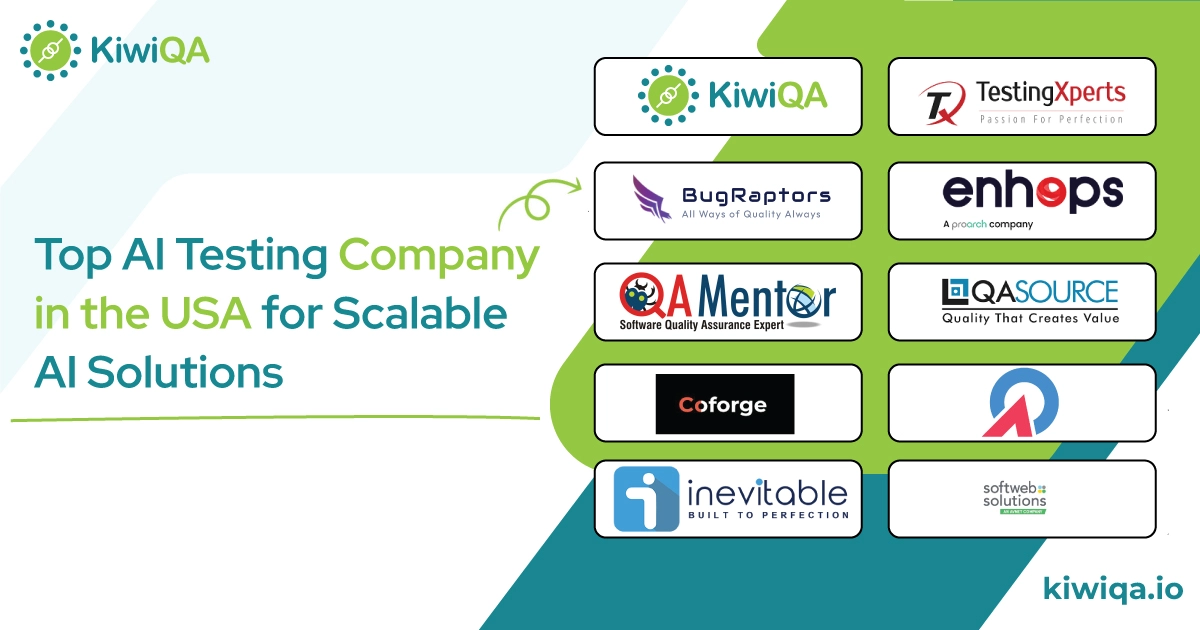
1. KiwiQA_IO

KiwiQA_IO

Recognized as one of the top AI testing companies, KiwiQA_IO is known for providing trustworthy and scalable AI testing services that meet current business needs. The company strives to keep AI systems secure, reliable, and compliant with real-world applications.

KiwiQA_IO, which places great emphasis on engineering quality, provides AI testing services from start to finish, including model validation, data testing, and performance evaluation. As a reliable company for AI testing, it guides businesses in risk reduction and AI improvement through well-planned testing. Its skill also makes it one of the reliable AI testing company in the USA for organizations that want to extend their implementation of AI solutions.

SR. No. Key Points Services Provided
1 Founded Year: 2009 AI Testing
2 Number of Employees: 51-200 Mobile Testing
3 Location: India (Serving USA) Security Testing
4 LinkedIn: View Profile Functional Testing
5 Website: KiwiQA_IO Performance Testing

2. TestingXperts

TestingXperts

TestingXperts is a reputable AI testing service company known for its cutting-edge testing techniques and reliance on automation. It offers a full range of AI testing services aimed at helping AI models perform better and scale more effectively.

TestingXperts’ expertise lies in testing AI systems, and it does so by performance optimization, data checking, and testing the entire AI lifecycle. It is a prominent AI testing company in the USA and assists clients in making durable AI models that can work efficiently even in real scenarios. Strong technical skills have also made it one of the agentic AI testing companies.

SR. No. Key Points Services Provided
1 Founded Year: 2013 AI Testing
2 Number of Employees: 1001-5000 Automation Testing
3 Location: USA Mobile Testing
4 LinkedIn: View Profile Blockchain Testing

3. BugRaptors

BugRaptors

BugRaptors is a trusted AI testing company offering reliable and innovative testing solutions for AI-powered applications. The company is well regarded for its quality assurance skills, delivering AI testing services worldwide at scalable levels.

BugRaptors, which is principally an AI testing service provider, dedicates itself to making sure AI systems are accurate, performant, and secure. Its offerings include AI system testing, automated testing, and AI model validation. Furthermore, this company appears among AI testing companies with a long history of delivering consistent and excellent results.

SR. No. Key Points Services Provided
1 Founded Year: 2016 AI testing
2 Number of Employees: 501-1000 Performance Testing
3 Location: USA Cloud Testing
4 LinkedIn: View Profile Manual Testing

4. Enhops

Enhops

Enhops is among the fastest-growing AI testing companies in the USA, recognized for the kind of testing its solutions provide, which are flexible and highly scalable. Besides innovative testing services, the company supports its clients in building frameworks that prove to be trustworthy and efficient in the AI sphere.

Enhops focuses on improving company performance and scaling positive outcomes by actively delivering advanced AI system testing solutions tailored to meet the specific needs of large enterprises. Newly minted as an AI-enabled testing services company, it is at the service of enterprises willing to raise AI throughput and enhance system performance. Its skills have raised it to the level of the most promising AI testing company in the USA.

SR. No. Key Points Services Provided
1 Founded Year: 2015 AI Testing
2 Number of Employees: 501-1000 Performance Testing
3 Location: USA Security Testing
4 LinkedIn: View Profile Test Automation

5. QA Mentor

QA Mentor

QA Mentor operates as a well-known AI-enabled testing services company that provides a wide range of AI testing solutions to businesses of all sizes. The company centers its efforts on producing high-quality AI testing services and, at the same time, makes use of automation and innovation as its main weapons.

QA Mentor is a dependable AI testing company that offers comprehensive AI system testing services such as functional testing, performance testing, and data validation. Besides this, it finds its place among the top AI testing companies due to its capability to deliver scalable and efficient testing solutions.

SR. No. Key Points Services Provided
1 Founded Year: 2010 Integration Testing
2 Number of Employees: 201-500 Performance Testing
3 Location: USA Automation Testing
4 LinkedIn: View Profile Agile Testing

6. QASource

QASource

A major AI testing company in the USA, recognized for its excellence in delivering enterprise-grade AI testing solutions, is none other than QASource. This company also covers a wide range of AI testing services, guaranteeing accuracy, performance, and scalability of the tested AI systems.

QASource, being a trustworthy provider of AI testing, offers services such as model validation, automation testing, and performance optimization. It is backed by a strong industry presence, placing it as one of the most reliable AI testing company in the USA.

SR. No. Key Points Services Provided
1 Founded Year: 2000 AI Testing
2 Number of Employees: 1001-5000 API testing
3 Location: USA Salesforce Testing
4 LinkedIn: View Profile Security Testing

7. Coforge

Coforge

Coforge is a globally recognized AI testing firm that offers a complete range of AI testing solutions for large enterprises. It has a strong emphasis on providing scalable and effective AI testing services that support corporate expansion.

With a good grasp of the technology advancements, Coforge provides detailed AI system testing services, and it is considered among the top AI testing company in the USA. Apart from this, Coforge also features among the agentic AI testing companies on account of intelligent automation and AI-driven testing strategies.

SR. No. Key Points Services Provided
1 Founded Year: 2005 Artificial Intelligence
2 Number of Employees: 10000+ Data & Analytics
3 Location: USA Data Science
4 LinkedIn: View Profile Digital Services

8. QualiZeal

QualiZeal

QualiZeal is famous for providing top-notch AI testing services by leveraging the best modern testing frameworks and state-of-the-art tools. The major focus of the company is to enable businesses to develop AI systems that are both dependable and scalable.

QualiZeal, a professional AI testing service company, maintains a strong portfolio of AI system testing services, including automation, performance testing, and AI validation.

SR. No. Key Points Services Provided
1 Founded Year: 2015 Software Testing
2 Number of Employees: 501-1000 Test Automation
3 Location: USA Security Testing
4 LinkedIn: View Profile Functional Testing

9. Inevitable Infotech

Inevitable Infotech

Inevitable Infotech is a trustworthy AI testing company offering AI Testing Services that are customized according to the needs of diverse industries. The company primarily aims to roll out flexible and scalable AI testing services that are able to satisfy the distinct requirements of various clients. In line with its rapid growth as an AI testing service provider, the company offers a wide range of AI system testing services that focus on testing accuracy, performance, and security.

SR. No. Key Points Services Provided
1 Founded Year: 2019  SaaS QA Services
2 Number of Employees: 51-200 Functional Testing
3 Location: USA Software Testing
4 LinkedIn: View Profile Cloud Migration Testing

10. Softweb Solutions

Softweb Solutions

Softweb Solutions is a well-established AI testing company in the USA whose major strength lies in the technical expertise the company possesses and its solutions that are enterprise-level. Softweb Solutions, known as a reliable AI-enabled testing services company, offers various AI system testing services such as performance testing, data validation, and testing the whole lifecycle of AI. It is also one of those AI testing partners in the USA that are leading because of their ability to deliver reliable and scalable solutions.

SR. No. Key Points Services Provided
1 Founded Year: 2006 Data Analytics
2 Number of Employees: 501-1000 Artificial Intelligence
3 Location: USA Data Engineering
4 LinkedIn: View Profile Generative AI

Benefits of Hiring an AI Testing Company

If you are in favor of AI testing companies offering the service, here is why you should consider them.

▪ Enhances the precision and dependability of the AI model
▪ Speeds up the introduction of AI goods into the market
▪ Helps to lessen the risks that come with running a business and financial ones as well
▪ May allow the AI systems to be scaled up
▪ Can help to make the overall experience of a user better

Premier AI testing company in the USA serve as a bridge between incurring minimum risks and achieving superior results, leading to long-term success.

Also Read: Complete List of AI Testing Services for AI-Powered Platforms

Industries Using AI Testing for Scalable AI Platforms

❑ Major Industries Adopting AI Testing

AI is revolutionizing various industries, so conducting tests is a must to succeed.

▪ Healthcare & Life Sciences for improving patient treatment and scientific discovery
▪ Banking & Financial Services for recognizing scams and unauthorized transactions
▪ Retail & E-commerce for showing users relevant ads
▪ Automotive & Manufacturing for human-machine interaction and safety systems
▪ Insurance & Risk Management for decision support and claims handling
▪ Media & Digital Platforms for marketing and subscription optimization

These sectors heavily depend on AI testing services and their trusted AI testing company in the USA to constantly deliver high-quality performance and accuracy.

❑ Why These Industries Require AI Testing

AI tools have become an indispensable aid to human decision-making and are integrated into operations.

▪ Not only that, but it also makes adherence to regulations straightforward
▪ Able to effortlessly handle massive volumes of data
▪ Provides a reliable communication channel between AI and human decision makers
▪ Through the use of automation, it improves customer experience

Leading agentic AI testing companies and top AI testing companies provide these industries with the support they need to stay efficient and reliable.

Ready to discuss your AI testing needs

Ready to Choose the Right AI Testing Company for Scalable AI Solutions?

AI testing is necessary for the creation of dependable, scalable, and secure AI solutions. Companies should collaborate with expert AI testing companies if they want their software to comply with industry standards and perform well. Collaborating with trusted AI testing companies in the USA gives firms an opportunity to minimize their risks, enhance their efficiency, and scale up with confidence. Besides ensuring that your AI systems are accurate, secure, and ready for the future, the right AI testing company in the USA or AI testing service provider will also provide the following benefits.

Procurement of a professional AI-enabled testing services company is a veritable tool to enhance the function of one’s system, and it is a catalyst for innovation. By working with reliable AI testing partners in the USA alongside advanced agentic AI testing companies, organizations are able to fully realize the potential currently locked within AI.

AI is changing the commercial landscape, but it won’t succeed without scalability and dependability. Having a good set of AI testing companies to choose from guarantees that your AI systems will be adequately tested, validated, and made ready to meet everyday challenges.

Going with the right AI testing company is a great way for firms to have much better accuracy, more gains in performance, and growth in the long run; all of this turns AI into a genuine edge over the competition.

Complete List of AI Testing Services for AI-Powered Platforms

The potential of AI is advancing frequently, and firms must adopt it to stay on top. As software becomes increasingly complicated & frequent updates are coming out, traditional testing methodologies sometimes fail. Manual testing is slow, and it usually fails to work on critical edge cases. It causes delays, performance gaps, and bug production, which later hamper user experience.

AI testing services are aimed at pointing out manual testing challenges. The AI experts automate the testing process and ensure the software is frequently verified with every update. The AI testing team generates test cases and runs them in different environments to validate the product’s performance. The AI-powered testing market is expected to hike by 2034 at USD 4.64 billion.

The AI-powered solutions combine innovative AI testing services with human intelligence to ensure speed, quality & accuracy. The AI-powered solutions frequently monitor & analyze defects, optimize test strategies, and offer real-time insights. It empowers your team to solely focus on innovation.

Firms can unleash the potential of automation to offer robust & data-driven results. Your AI solutions can deliver 5X faster time to market when they are properly tested. It empowers businesses to serve quality, unmatched reliability, scalability, and user experience. With the increasing AI adoption, staying current demands more than implementation.

To keep your business future-ready with AI, read the following blog where we have mentioned various AI testing types offered by an AI testing services provider.

What Is AI Testing

🢣 Definition of AI Testing

AI-powered testing goes beyond traditional methods by serving features such as self-healing capabilities, predictive analytics & no-code test automation. The AI-powered advanced testing tool leverages AI to automate test creation, maintenance & execution. It makes software testing reliable & efficient. The AI testing companies support team manages test maintenance, which is time-consuming in the automated testing process.

AI testing companies can minimize testing cycle time by up to 50%, allow faster release, and minimize QA by 50-70%. AI testing involves generating test cases, identifying flaky tests and broken scripts, and prioritizing tests & high-risk areas based on code changes or user behavior. AI testing is used to enhance test coverage, limiting the manual effort that supports remaining tests effectively.

Ready to Explore End-to-End AI Testing Services

How AI Testing Differs from Traditional Software Testing

❑ Non-deterministic outputs

Because of statistical models, AI systems can generate diverse answers for the same input, which complicates validation and necessitates assertions based on tolerance rather than predetermined outcomes.

❑ Continuous learning models

AI models, in contrast to static software, develop through continuous training, necessitating constant testing, monitoring, and validation. It guarantees performance consistency and stops behavior changes over time.

❑ Data dependency

AI models, in contrast to static software, develop through continuous training, necessitating constant testing, monitoring, and validation to guarantee performance consistency and stop inadvertent behavior changes over time.

❑ Model drift and retraining cycles

Data validation, bias detection, and preprocessing checks are crucial components of the testing lifecycle since AI performance is highly dependent on data quality, diversity, and labelling accuracy.

Also Read: How to Choose the Right AI Testing Tools for Your Business?

Core Components of AI Systems That Require Testing

➥ Training datasets

To guarantee reliable model training and to prevent biased predictions or unjust results in real-world situations, datasets must be evaluated for quality, completeness, bias, and accuracy.

➥ Machine learning models

In order to ensure that models function dependably under various circumstances and edge situations, they must be validated for accuracy, robustness, and scalability over a variety of inputs.

➥ Data pipelines

To guarantee that data flows smoothly from collection to processing without loss, corruption, or transformation mistakes, data pipelines must be validated for integrity, consistency, and dependability.

➥ APIs and integrations

This is an essential part of AI systems, and testing these components guarantees accurate, safe, and smooth data transfer between all linked systems. Any API malfunction has the potential to impair model performance, produce inaccurate forecasts, or result in system outages. Validating JSON/XML, authentication procedures, and error handling are the main goals of API testing.

➥ User interaction layers

To guarantee that users obtain relevant, intelligible, and consistent replies in a variety of interaction settings, interfaces must be evaluated for usability, responsiveness, and accuracy of AI outputs.

Why AI Testing Is Critical for AI-Powered Platforms

⟹ Ensuring Model Accuracy

By verifying predictions against actual situations, lowering mistakes, and enhancing overall system efficacy across a variety of datasets and use cases. The AI testing company guarantees models provide accurate, consistent, and pertinent outputs.

⟹ Preventing Bias and Ethical Issues

By identifying biased data patterns, ensuring fairness, and validating ethical AI behavior, working with an AI testing service provider reduces the likelihood of prejudice and encourages responsible, open decision-making.

⟹ Maintaining Reliability and Performance

AI testing assists in confirming that models function well in a variety of workloads, data sizes, and real-world situations. Particularly in real-time applications like chatbots, recommendation engines, or fraud detection systems, it guarantees that reaction times stay at their best. Gaps in data processing and system integrations are also found through performance testing.

⟹ Regulatory Compliance

By verifying data utilization, model choices, and system transparency, proper AI testing lowers legal risks and guarantees adherence to changing international standards while also assuring compliance with industry rules and data protection legislation.

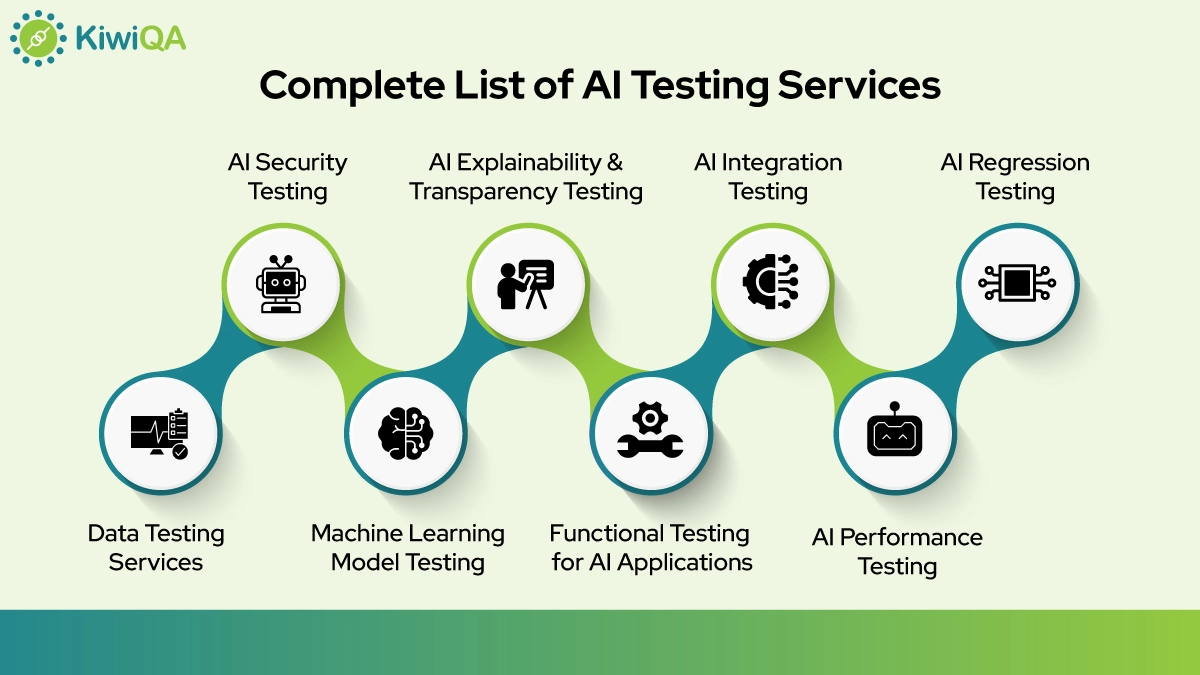
Complete List of AI Testing Services

Complete List of AI Testing Services

☛ Data Testing Services

The datasets’ correctness used in AI systems is guaranteed by data AI testing services. They involve verifying the quality of the data by finding abnormalities, missing values, and inconsistencies that can have an impact on model performance. In order to guarantee that all necessary inputs are available and accessible, these services often incorporate data completeness checks.

Validating data labels guarantees accurate and consistent annotations, which are essential for supervised learning. Furthermore, bias identification guarantees results are fair, and data drift detection assists in identifying changes in data patterns over time. Reliable and trustworthy AI systems are supported by dataset version control validation, which preserves consistency throughout development cycles.

For supervised learning models, data labelling validation verifies the consistency of annotations. Furthermore, data drift detection assists in identifying shifts in data patterns over time that may affect the quality of the model. To find any unfair or imbalanced data distributions that might provide discriminatory results, bias detection is carried out.

By ensuring that teams are using the most recent and accurate versions of datasets, dataset version control validation helps to maintain consistency throughout development cycles. All things considered, by guaranteeing the integrity of the underlying data, data testing services are essential to developing reliable and high-performing AI systems.

☛ Machine Learning Model Testing

The goal of machine learning model testing is to verify the resilience, performance, and dependability of AI models prior to their implementation. This procedure guarantees that models produce precise and reliable forecasts for a range of situations and datasets. While precision and recall analysis offer deeper insights into classification performance, particularly in skewed datasets, model accuracy testing assesses how well the model performs against known outcomes. Confusion matrix validation provides a thorough knowledge of model behavior by visualizing true positives, false positives, true negatives, and false negatives.

By training and testing the model on several data subsets, cross-validation testing evaluates the ability of the model to generate new data. Testing for model explainability guarantees that the model’s conclusions are clear and understandable, which is essential for compliance. The agentic AI testing services also assess the model’s reaction to manipulated or unexpected inputs in order to find any weaknesses. When combined, these testing techniques help guarantee that machine learning models are trustworthy, safe, and prepared for practical use.

☛ Functional Testing for AI Applications

When integrating AI-driven components, functional testing for AI applications guarantees that all system functions and workflows function as intended. Functional validation is more difficult since AI systems, in contrast to traditional applications, must manage dynamic inputs and provide outputs that could differ. This kind of testing confirms that AI replies, business logic, and user interactions match specified criteria and anticipated behavior.

It involves verifying that AI-powered features like recommendations, predictions, or automated tasks operate successfully within the application, testing input-output flows, and ensuring that APIs handle data appropriately. In order to ensure that the system manages edge situations and uncommon inputs without malfunctioning, they are also tested.

A functional AI testing services also ensures smooth platform integration by examining how AI components interact with other modules. To provide a seamless user experience, error management, backup plans, and response consistency are also assessed. Businesses may make sure that their systems not only operate technically but also produce useful, dependable, and user-friendly results in real-world circumstances by extensively verifying the operation of AI applications.

☛ AI Performance Testing

The goal of a performance AI testing services is to assess how well and consistently AI systems function under various circumstances and workloads. It guarantees that models maintain accuracy and consistency while producing results in a reasonable amount of time. When processing massive amounts of data or managing several user requests at once, this kind of testing looks at response time, throughput, scalability, and resource consumption.

Additionally, performance testing evaluates how AI models function in real-time settings where delays might have a detrimental effect on user experience, such as chatbots, recommendation engines, or predictive systems. To ascertain system limitations and spot any bottlenecks or malfunctions under harsh circumstances, stress testing is carried out.

Furthermore, load AI testing services guarantees that the system can manage anticipated user traffic without experiencing performance deterioration. Monitoring tools are frequently used to track performance parameters over time and identify problems early. AI performance testing also assesses the impact of data volume and model complexity on system efficiency and processing speed. Organizations can make sure their AI-powered systems continue to be quick, scalable, and dependable, producing consistent results even as demand and data quantities increase, by carrying out thorough performance testing.

☛ AI Security Testing

In order to defend AI systems from malevolent assaults, data breaches, and unauthorized access, AI security testing focuses on finding and fixing vulnerabilities inside AI systems. AI models are vulnerable to threats like adversarial attacks, data corruption, and model inversion since they rely so largely on data and advanced algorithms. This kind of testing by an AI testing services provider assesses the system’s resistance to altered inputs intended to deceive. It also entails evaluating data security protocols to guarantee that private data is appropriately encrypted and safeguarded during transmission and storage.

Access control mechanisms are validated to prevent unauthorized users from interacting with the model or underlying datasets. Additionally, the API security AI testing services ensures that external connections don’t cause gaps. AI security testing also examines how models handle unexpected or harmful inputs, ensuring safe and controlled outputs.

Frequent monitoring & error monitoring strategies are implemented to identify risks in real time. By conducting comprehensive AI security testing, organizations can safeguard their systems, maintain user trust, and ensure compliance with data protection and cybersecurity standards.

Also Read: Top Accessibility Testing Tools Should Use in 2026 to Improve Customer Experience

☛ AI Explainability & Transparency Testing

AI explainability and transparency testing guarantee that machine learning models generate outputs that stakeholders and consumers can comprehend, analyze, and rely on. It is crucial to provide a clear explanation of how models arrive at particular predictions as AI systems are employed more and more in key decision-making. This test determines if methods like feature importance, decision trees, and model-agnostic tools can be used to analyze the reasoning behind model decisions. Additionally, it guarantees consistent and traceable results, enabling teams to audit choices as necessary.

Transparency testing by an AI testing services provider confirms that consumers are aware of and comprehend the limits of AI systems. By offering insightful explanations in addition to forecasts, it also determines whether the system avoids “black box” behavior. This procedure also supports the discovery of latent prejudices, guaranteeing just and moral results. Organizations may increase responsibility, foster trust, and adhere to regulatory requirements that demand clarity in automated decision-making processes by increasing interpretability and transparency.

☛ AI Integration Testing

The goal of AI integration testing is to make sure that AI components interact with databases, APIs, third-party services, and user interfaces in a smooth manner. It is crucial to verify how well AI systems interact with the whole software ecosystem because they seldom function in isolation.

By verifying that inputs are appropriately processed and outputs are accurately distributed across systems, this testing confirms that data flows across components. Additionally, it verifies answer consistency, data interchange formats, and API functioning when including AI-driven services like chatbots, recommendations, and predictive analytics.

Integration testing assesses the effectiveness of the system’s error-handling procedures and fallback systems. Additionally, it looks at compatibility with various platforms, devices, and surroundings. Another crucial factor is performance during integration, which ensures that the speed and dependability of the system are not adversely affected by the inclusion of AI components. Organizations may guarantee seamless operations, enhanced user experience, and dependable end-to-end system functionality by carrying out comprehensive AI integration testing.

☛ AI Regression Testing

Regression testing for AI ensures that changes or upgrades to machine learning models don’t adversely affect current functionality or performance. It is crucial to confirm that previously functional features continue to function as intended since AI models change over time due to fresh data and algorithm advancements. In order to identify any unintentional modifications or accuracy erosion, this testing compares the outputs of the present model with those of earlier iterations. In order to ensure balanced model performance, it also assesses if advancements in one area have led to problems in another.

Validating important metrics, including accuracy, precision, recall, and consistency across several datasets, is part of regression testing. This procedure is frequently streamlined by the use of automated testing frameworks, particularly in continuous development settings. It also guarantees that dependent systems, integration points, and APIs continue to operate properly following upgrades. Even while models are regularly developed over time, AI regression testing helps preserve system stability, dependability, and user confidence by spotting problems early.

☛ Continuous AI Testing (MLOps Testing)

Continuous AI system testing services, also known as MLOps testing, are the process of continuously validating AI systems at every stage of their development, deployment, and beyond. In contrast to traditional testing, this method incorporates testing CI/CD, allowing for quick response and real-time monitoring. As fresh data is added, it guarantees that models stay current, accurate, and dependable. Automated validation of data quality, model performance, and system behavior at every level is part of continuous testing.

Additionally, an AI testing services provider keeps an eye out for performance decline, model drift, and data drift in production settings. When problems are found, alerts and feedback loops are utilized to initiate updates. It also guarantees that new model versions don’t interfere with current systems and that deployment procedures go smoothly. A crucial component of MLOps testing is cooperation between teams. Organizations can maintain robust, scalable, and high-performing AI systems that successfully adjust to evolving data and business needs by using continuous AI testing.

Ready to Connect with AI Testing Experts Now

Ready to Ensure the Quality and Reliability of Your AI-Powered Platform?

AI system testing services aren’t a requirement but a necessity for improving quality. If your vision is to automate stable web flows, manage readable tests, & keep QA predictable under CI/CD pressure, choose the AI testing team. The upcoming era of software testing will depend on AI-human collaboration. While AI accelerates & optimizes testing, human expertise remains necessary for strategic thinking, creativity, and decision-making. Businesses that successfully integrate AI into their testing witness better efficiency, enhanced test coverage & faster release.

Your AI system can fail when there is a glitch in testing. The strong AI testing services by an AI testing service provider makes a structured approach. The team verifies data quality prior to model training & document performance over the production baseline. The best AI testing company combines AI-powered verification with real-time testing on live devices. With them, businesses can make a 50% faster release cycle and scale their business without QA overhead.