Top AI Testing Tools Decision Makers Should Invest in 2026

In the current time, advancements in AI and app development have changed the way QA teams verify software quality. Traditional approaches of manual & automation testing are now getting outdated. With the rising challenges in software development, traditional QA approaches lack coverage, speed, and adaptability. This is when AI testing tools play a strong role in software testing. AI smoothly arrived in the world of QA, and it’s a game-changer. The tasks that took hours for scripting and debugging can now be done in seconds thanks to smart systems.

AI testing services tools offer smart test case generation, predictive analytics, visual validation, and self-healing scripts. A survey found that 81% of teams utilize AI tools for testing workflows. There are a number of testing tools that have emerged recently and significantly improved the accuracy and speed.

The decision-makers in 2026 are choosing an AI testing service provider to obtain visual AI potential, NLP scripting, and autonomous self-healing, etc. In 2026, quality at speed isn’t considered a luxury but a necessity to stay in the market landscape. By leveraging ML and Gen AI, these tools are supporting teams to drive efficiency by 85% while reducing maintenance costs. AI testing tools are used to perform some impressive tasks, such as spotting errors, generating test cases, retesting when UI changes, etc.

This blog presents a review of free and paid tools for AI testing services, along with their features and benefits. We’ll discuss the steps to choose the ideal tools, their role in software deployment, and future trends. So, no need to be fed up with the endless test maintenance and flaky tests from now on. Read this post to get some quick ideas.

Why AI Testing Tools Are Becoming Essential

➥ Faster Test Execution

AI testing tools significantly limit the time needed for QA testing by automating repetitive & complicated test scenarios. They limit manual QA efforts, enabling the QA team to prioritize strategic tasks rather than routine validation. With smart automation, firms can boost development workflows & drive release cycles without compromising software quality. AI-based QA supports frequent integration & CI/CD, allowing quick release and improved productivity across agile development environments.

➥ Improved Test Accuracy

The generative AI testing tools drive software quality by detecting errors and inconsistencies with improved precision. They can measure a large volume of test data, inspect gaps early in SDLC, while minimizing the risks of crucial failures after release. By limiting human errors related to manual QA, AI testing enhances reliability & consistencies. These tools utilize predictive analytics & pattern recognition to reveal hidden errors and verify accurate and effective app validation.

➥ Smarter Test Maintenance

Advanced AI testing company streamlines test maintenance through smart automation capabilities. When app interfaces or workflow changes occur, AI tools can automatically obtain test cases without heavy manual updates. This limits maintenance costs and avoids failed test cases due to system changes. Adaptive automated workflows enhance long-term QA efficiency by learning from previous executions to optimize test coverage. It verifies stable performance across evolving software apps.

 Ready to Upgrade Your AI Testing Strategy Today?

Key Features to Look for in AI Testing Tools

◈ AI-Powered Test Automation

The most crucial feature of an advanced AI testing tool is smart automation. These AI software testing companies can automatically create test cases depending on user behavior, app changes, and historical data, limiting the requirement for manual scripting. The AI-based tools support smart test execution by focusing on high-risk test scenarios and test coverage optimization. It helps firms enhance testing speed, limit operational costs, and validate software quality throughout the SDLC.

◈ Cross-Platform Testing Support

The reliable AI consulting services for a QA provider must offer seamless cross-platform compatibility for mobile, web, and desktop apps. Firms today demand QA tools that can validate performance across various devices, browsers, and OS without additional challenges. Cloud-drive QA support drives flexibility by allowing remote testing environments and scalable infrastructure. These potential supports, the QA team verifies consistent user experiences while limiting infrastructure cost and streamlining the QA process across vast virtual platforms.

◈ Easy Integration

AI testing tools must integrate smoothly with current development ecosystems, involve DevOps workflows, and CI/CD pipelines. Ease integration allows frequent testing throughout the SDLC, and the support team detects and resolves errors quickly. Compatibility with popular development, collaboration, and automation platforms drives operational efficiency while navigating implementation challenges. AI testing tools support agile & DevOps methodologies to drive release and collaboration between teams while assuring software quality.

◈ Real-Time Analytics & Reporting

The smart AI testing tools used by AI testing companies aim to offer analytics and reporting features that serve valuable metrics for software quality and performance. Visual dashboards support the QA team to track execution status, error trends, and overall app health in a unified interface. Performance insight generated by experts allows for measuring gaps, optimizing QA strategies, and making data-driven decisions. Real-time reporting drives transparency, supports stakeholders in monitoring progress, and manages software reliability.

Also Read : Why AI-Driven Testing Is the Future of Quality Engineering?

Top AI Testing Tools Decision Makers Should Invest In

1. Testim

Testim

Testim, driven by an AI software testing platform, helps development teams speed up automated testing and simplify maintenance. The platform generates reliable, self-healing test scripts that automatically adjust to changes in the application by using machine learning. Testim is appropriate for agile and DevOps contexts since it facilitates online application testing, cross-browser validation, and smooth CI/CD integration.

Anyone can write automated tests because of its low-code interface. Companies invest in Testim because it increases software quality, speeds up releases, and minimizes flaky tests. Additionally, the platform offers scalable automation capabilities, comprehensive reporting, and collaboration features that efficiently enable enterprise-grade testing procedures across contemporary digital applications globally.

2. Functionize

Functionize


Functionize is a cutting-edge AI automation testing tool that assists businesses in more accurately and efficiently automating software quality assurance procedures. The software creates advanced automated tests with straightforward English commands by utilizing machine learning and natural language processing. Functionize facilitates cloud execution, end-to-end web application testing, and self-healing automated features that minimize maintenance.

Continuous testing is made possible throughout the software development lifecycle by its seamless integration with DevOps workflows and CI/CD pipelines. Companies utilize Functionize because it streamlines complicated automation operations, speeds up release cycles, and enhances fault detection. Its scalable cloud infrastructure, visual testing capabilities, and predictive analytics make it appropriate for businesses operating sizable and quickly changing digital applications throughout the globe.

3. Mabl


Mabl

Designed to facilitate continuous testing in agile and DevOps-driven software development settings, Mabl is a cloud-native AI software testing tool. Functional, visual, accessibility, and performance testing are all integrated into a single automation solution by the platform. Mabl reduces test maintenance, increases software reliability, and detects problems fast with intelligent automation and machine learning.

It helps teams speed up development and deployment processes by integrating with well-known CI/CD solutions. Because of Mabl’s user-friendly interface, scalable cloud architecture, and robust development and quality assurance team communication capabilities, businesses invest in the platform. In order to increase testing productivity and guarantee consistent application performance across all contexts and devices, the platform also offers comprehensive analytics, intelligent fault identification, and flexible testing workflows.

4. Applitools

Applitools

Leading AI-powered visual testing solution Applitools assists companies in guaranteeing uniform UI quality for mobile and web applications. Its Visual AI engine can accurately identify UI regressions, layout inconsistencies, and visual flaws in a variety of browsers, devices, and screen resolutions. The platform enhances current testing methods without significantly disrupting workflow by integrating with well-known automation frameworks like Selenium, Cypress, and Playwright.

Companies invest in Applitools because it improves customer experience, speeds up visual inspection, and lowers false positives. Additionally, the platform facilitates scalable cloud execution, measures cause and support. These features make Applitools perfect for businesses that prioritize high-quality digital user experiences and visual consistency on a worldwide scale.

5. ACCELQ

ACCELQ

ACCELQ is a codeless automation testing platform driven by AI, designed to make end-to-end quality assurance procedures easier for contemporary businesses. From a centralized setting, the platform facilitates testing of desktop, mobile, online, API, and packaged applications. ACCELQ reduces manual scripting labor and speeds up the adoption of automation through the use of intelligent automation, predictive analytics, and natural language-based processes.

Because ACCELQ enhances testing scalability, lowers maintenance costs, and facilitates continuous testing across agile and DevOps pipelines, businesses favor it. Additionally, the platform provides lifecycle management, automated test generation, and real-time reporting tools that improve operational visibility. Because of its cloud-based design and enterprise-grade capabilities, ACCELQ can effectively manage complex application ecosystems and large-scale digital transformation for businesses all over the world.

6. Katalon Platform

Katalon Platform

Katalon Platform is an all-inclusive AI-powered testing solution for desktop, mobile, online, and API automation testing. The platform integrates advanced AI features like intelligent object detection, self-healing scripts, Smart Wait functionality, and automated analytics with low-code automation. Katalon facilitates continuous testing and quicker software delivery by integrating easily with DevOps tools, cloud environments, and CI/CD pipelines.

Companies utilize Katalon because it makes automation easier for both technical and non-technical users while increasing the scalability and efficiency of testing. Additionally, the platform has integrated reporting, communication tools, and performance monitoring features that improve processes related to quality assurance. Because of its adaptable design, Katalon can handle a wide range of testing needs for startups, mid-sized companies, and major corporations worldwide.

7. Tricentis Tosca

Tricentis Tosca

An enterprise-grade AI testing platform called Tricentis Tosca was created to assist in extensive software quality assurance and ongoing testing projects. The platform enhances test coverage across business applications and streamlines complicated testing procedures with model-based, scriptless automation. Tosca is incredibly flexible for digital transformation initiatives, supporting web, mobile, API, SAP, Oracle, and packaged application testing.

Because Tricentis Tosca speeds up release cycles, lowers maintenance costs, and improves risk-based testing techniques, companies invest in it. Additionally, the platform interfaces with CI/CD environments and DevOps pipelines, facilitating enhanced collaboration and quicker defect identification. Today, Tosca is the perfect choice for businesses managing enterprise processes and mission-critical applications worldwide because of its scalability, compliance support, and advanced analytics.

8. Selenium With AI Extensions

Selenium With AI Extensions

The popular open-source Selenium framework’s versatility is combined with artificial intelligence-powered intelligent automation capabilities in Selenium with AI extensions. AI-driven add-ons increase the overall stability and effectiveness of testing by offering self-healing locators, predictive maintenance, intelligent test production, and automated defect analysis. This improved method reduces human maintenance work and helps lower failures brought on by changes to the application’s user interface.

Because Selenium with AI extensions provides freedom in customization, broad community support, and interoperability with a variety of browsers, frameworks, and cloud testing environments, businesses invest in it. Additionally, the framework successfully interfaces with DevOps workflows and CI/CD pipelines, allowing for scalable automation. Because of these features, Selenium is a good choice for firms seeking the ideal testing solutions.

9. testRigor

testRigor

An AI-powered tool called testRigor makes automation easier by letting users write tests with simple English instructions rather than intricate coding scripts. In addition to providing intelligent self-healing capabilities that lower maintenance costs, the platform offers online, mobile, desktop, and API testing. Throughout the SDLC, testRigor analyses user behavior, finds flaws, and increases testing accuracy using artificial intelligence.

Because testRigor increases testing speed, speeds up automation adoption, and lessens reliance on highly technical QA resources, businesses invest in it. Additionally, the platform connects with CI/CD pipelines, facilitating faster product releases and continuous testing. testRigor is the perfect choice because of its scalable architecture, low-code methodology, and effective automation workflows.

10. Virtuoso QA

Virtuoso QA

A cloud-based AI testing platform called Virtuoso QA was created to make end-to-end software automation easier for DevOps and agile teams. Without requiring a deep understanding of scripting, the platform creates, runs, and maintains test cases using intelligent automation and natural language processing. Functional testing, visual validation, regression testing, and continuous testing workflows for contemporary apps are all supported by Virtuoso QA.

Companies invest in Virtuoso QA because it lowers testing complexity and maintenance requirements while enhancing cooperation between developers, testers, and business stakeholders. Additionally, the platform offers scalable cloud infrastructure, adaptive automation, and comprehensive reporting that improve software quality assurance processes. Today’s expanding businesses around the world can benefit from Virtuoso QA’s cognitive testing capabilities, user-friendliness, and automation scalability.

Benefits Of Investing in AI Testing Tools

❏ Better Software Quality

AI testing tools support firms to obtain improved software quality by improving the overall test coverage and app stability. These tools can measure workflows, execute frequent test cases, and track hidden errors before releasing. With frequent monitoring and smart automation, the QA team verifies consistent performance across vast environments. Enhanced testing accuracy limits the chances of crucial failures and supports firms in delivering reliable apps that drive user satisfaction and experience.

❏ Reduced Operational Costs

Investing in AI testing tools significantly minimizes the operational excellence by limiting reliance on an extensive manual QA process. Automated QA limits repetitive human efforts, enabling the team to prioritize high-value tasks such as strategic planning and innovation. AI-based systems also drive error detection and quick resolutions, and avoid costly production breakdowns. Over time, firms benefit from enhanced resource utilization, minimize maintenance costs, and effective QA operations that contribute to long-term financial savings.

❏ Faster Time-To-Market

AI assessment tools allow faster software delivery by supporting continuous QA throughout the development cycles. Automated workflows support team to smartly track and navigate errors, limit delays during development and release stages. CI/CD integration pipeline further streamlines the QA process and provides rapid feedback for developers. With quick product release and short QA cycles, firms can respond quickly to market demands. Businesses can launch new features effectively and manage competitive benefits in quickly moving virtual industries.

❏ Scalability For Growing Businesses

Advanced AI testing tools are designed to support scalability as firms expand their apps and virtual infrastructure. They can effectively manage large-scale QA demands across multiple platforms, environments, and devices without hampering performance. Enterprise-grade workflows enable firms to manage rising testing complexity while managing speed & accuracy. The following tools also support distributed teams and cloud environments, making them ideal for rising business requirements.

Challenges Businesses Should Consider

➩ Initial Implementation Cost

Integrating AI testing tools demands a significant investment. Firms may require allocating budgets for tool setup, customization, licensing, and the onboarding process. QA team training effectively utilizes AI-based platforms that require time & resources. While these investments might improve initial costs, firms that plan strategically can obtain long-term savings. It also drives efficiency and software quality through modern automated QA capabilities.

➩ Integration Complexity

Integration of AI QA tools into the current development environment can be challenging for firms using legacy systems and complicated infrastructures. Compatibility errors might arise when connecting the AI platform with existing workflows, apps, and testing frameworks. Firms often need to adjust operational methods and DevOps practices to drive automation efficiency. Appropriate planning and specialized support are crucial to ensure smooth implementation.

➩ Choosing The Right Tool

Selection of ideal AI testing solutions can be tough because every firm has unique QA demands, workflows, and scalability goals. Firms must carefully determine features, automation potential, long-term performance, and integration support prior to decision-making. Future scalability and budget imitation features play a strong role when comparing available tools. Selection of AI consulting services for QA aligns with firm objectives and can drive QA efficiency, limit operational challenges, and support sustainable software development growth.

Also Read : Top AI Testing Company in the USA for Scalable AI Solutions

How To Choose the Right AI Testing Tool

☢ Define Testing Goals

Businesses should specify their testing goals and automation needs before choosing an AI testing tool. Finding appropriate solutions is made easier by knowing whether the emphasis is on end-to-end automation, security validation, performance testing, or regression testing. Businesses should evaluate the technical proficiency of their staff to implement AI-driven workflows. Clear testing objectives enable companies to select technologies that complement long-term software quality initiatives, boost return on investment, and guarantee better deployment planning.

☢ Compare Features & Pricing

To choose the best AI testing tools, businesses should evaluate them according to features, cost structures, and scalability. While startups frequently place a higher priority on price and flexibility, enterprise organizations may need enhanced automation, analytics, and multi-platform compatibility. Careful consideration should also be given to subscription fees, licensing arrangements, and customization choices. Organizations may ensure that the chosen tool can effectively support future growth and increasing software testing demands while balancing performance and price requirements by comparing multiple providers.

☢ Evaluate Ease of Use

Businesses should assess AI penetration testing tools based on features, pricing structures, and scalability in order to select the best choice. Enterprise businesses may require improved automation, analytics, and multi-platform compatibility, but startups usually prioritize pricing and flexibility. Subscription costs, licensing agreements, and customization options should also be carefully considered. By comparing several suppliers, organizations can make sure that the selected tool can balance performance and cost requirements while successfully supporting future growth and rising software testing demands.

☢ Check Scalability & Security

Investing in AI-based testing tools for long-term business growth requires careful consideration of scalability and security. Businesses should make sure the platform can manage growing workloads, a variety of apps, and growing testing needs without compromising performance. In order to safeguard private company and client information during testing procedures, robust security measures are equally crucial. To make sure the solution supports both operational scalability and trustworthy data security policies, businesses should assess compliance standards. AI testing companies must evaluate data encryption capabilities and access controls.

Future Trends in AI Software Testing

☛ Autonomous Testing

Autonomous QA is transforming software QA by allowing smart systems to execute tests with minimal human intervention. The AI-driven platforms can automatically track app changes, generate test scenarios, and optimize execution practices without constant manual input. Smart error prediction potential also supports the team to measure potential gaps prior to release. As automation becomes advanced, testing will enhance efficiency, limit testing cycles, and support quick, reliable software delivery across industries.

☛ Generative AI In QA

Gen AI is becoming a major innovation in software QA by crafting a smart & adaptive testing process. Gen AI is becoming a crucial innovation in software testing by designing a smart & scalable testing process. The AI-generated test cases can automatically cover various user scenarios, drive testing efficiency, and minimize manual scripting efforts. The tools support smart gap detection by detecting patterns, tool cause, and recurring errors effectively. As Gen AI evolves, the QA team will benefit from quick test development, enhanced software quality, and decision-making throughout the testing lifecycle.

☛ Predictive Analytics

This future trend is supporting firms in making advanced testing decisions by measuring historical and real-time testing data. AI-based systems can track high-risk areas within the app and offer risk-based QA insights that enhance error detection and resource allocation. These capabilities allow the QA team to focus on crucial test cases and limit unnecessary QA efforts. Quick decision-making is supported by predictive analytics, enhancing release planning and operational efficiency. It supports firms in managing consistent software performance.

☛ Continuous AI Optimization

The following trend will transform the future of testing through self-improving test models and adaptive learning capabilities. AI systems can measure previous test execution, user behavior, and app performance to redefine QA strategies automatically over time. Real-time performance learning enables QA tools to adapt quickly to software updates and changing environments. The frequent improvement drives QA accuracy, limits maintenance efforts, and supports long-term efficiency in advanced agile & DevOps development processes.

Ready to Discuss the Right AI Testing Tool?

Ready To Transform Your QA Strategy with AI Testing Tools?

AI-driven QA tools are changing the testing landscape for firms & QA teams to drive their QA cycle and increase rapid release. Choosing the best AI-driven testing tools can drive software quality while enhancing accuracy and reliability. Currently, AI in QA has shifted. AI QA tools are no longer about evaluating errors but about speed and reliability.

It is necessary for modern businesses to stay current with the ongoing environment. By embracing these tools, firms can bridge the gap between frequent delivery and quality. Whether you are seeking open-source flexibility or enterprise-grade solutions, hire AI software testing companies to build future-ready QA workflows.

Why AI-Driven Testing Is the Future of Quality Engineering?

Based on the report by Fortune Business, the worldwide AI-enabled testing market is expected to grow to $2,746.6 million by the next 4 to 5 years. The complications in modern software solutions increase, so it’s necessary for the business to make sure its AI system runs flawlessly and efficiently. While traditional software testing techniques are still in use, modern complications require rigorous AI-driven testing approaches.

In the current landscape, organizations are under immense pressure to deliver quality software. Traditional manual testing methodologies can’t keep up with the modern development cycles & bugs. As applications evolve to advanced technologies, IoT, AI, and cloud-native architectures, it ensures reliability, security & performance. This is when AI testing services step in. This testing revolutionizes how enterprises approach software QA. By implementing AI & ML into testing lifecycles, businesses can automate repetitive tasks, monitor defects, and optimize test coverage.

Based on another report, in 2026, 40% of businesses will spend their budget on AI testing apps. As digital innovations accelerate, AI is upscaling the process accuracy & establishes new product/service excellence standards. In the rapidly growing virtual space, it becomes a necessity to integrate AI in QE to revolutionize data into valuable insights.

Research revealed that 80% of software will be designed on AI by the end of 2026, so if you are not using AI testing services as a QE, then you need to adopt it. It keeps you competitive in every aspect of SDLC, business operations, and customer experience. In the following blog, we’ll explore what AI-driven testing is and how it is shaping the future of quality engineering.

What is AI-Driven Testing?

◈ Definition of AI-Driven Testing

AI is revolutionizing quality engineering by uplifting testing abilities & streamlining the process. AI-based software testing services allow the QA engineering team to focus on necessary areas and enhance the reliability & accuracy of software testing. The AI-driven tools optimize test result analysis and enable engineers to opt for comprehensive QA coverage.

In cloud computing, QE is necessary because of the unique features of cloud-based apps. These apps must be reliable to maintain uninterrupted services and limit downtime errors. With AI testing, you can upscale automated test generation and execution. Quality engineering supports the establishment of QA environments for testing embedded software across various devices. AI optimizes this process by facilitating accurate & faster QA testing. Additionally, AI has the potential to mimic real-time user behavior & patterns to run large-scale performance testing under various scenarios.

Manual testing takes more time & is prone to errors in agile development environments. Thanks to AI tools, which allow automating recurring testing tasks, including generation and execution. When businesses implement tools, they can free the QE engineers. AI-based software testing services drive test coverage and minimize human error. The tools enable running thousands of tests against various environments in a single instance, which isn’t possible in manual testing. AI can seamlessly integrate with CI/CD, which ultimately offers faster development without hampering quality.

◈ Core Technologies Behind AI Testing

➥ Machine Learning

ML is the foundation of AI-based software testing services, allowing systems to learn from historical test data & improve time without explicit programming. It assists in identifying patterns, predicting defects, and optimizing test execution by focusing on high-risk areas. ML has the potential to create test cases, detect anomalies & drive decision-making in the testing process.

By continuously learning from previous outcomes, ML improves accuracy & efficiency in quality engineering. It will result in smart automation, minimize manual effort & fast delivery cycles. It enables businesses to maintain quality standards in frequently evolving software environments.

➥ Natural Language Processing

NLP enables AI tools to understand & interpret human language, make test creation accessible & intuitive. Additionally, it supports analyzing user requirements, bug reports, and documentation to generate relevant test scenarios. NLP enhances collaboration between technical & non-technical teams by bridging communication gaps. In addition, it drives test coverage by addressing missing scenarios from textual data. It ensures comprehensive testing & minimizes chances of errors.

➥ Computer Vision

Computer vision also plays an important role in AI system testing services by allowing systems to visually measure & interpret the user interface. It enables tools to recognize UI elements, validate layouts, and track visual inconsistencies. Unlike traditional methods, where quality engineers rely on code-based locators, computer vision interacts with apps like humans. It makes tests more resilient. It significantly minimizes maintenance efforts & drive test reliability. By ensuring accurate visual validation across devices & platforms, the tool drives user experience & product quality.

➥ Predictive Analytics

Predictive analytics leverage AI & statistical models to forecast potential defects & testing outcomes before they occur. By measuring historical data, changes in code, and earlier testing results, it identifies high-risk areas that demand focused testing. It allows the team to make proactive approaches and limit the chances of crucial failures in production. It supports resource optimization, allocation & test planning by ranking tasks depending on the level of risks. This is how business can enhance efficiency, minimize cost, & serve reliable software.

Ready to Transform QA with AI-Driven Testing? Explore Now

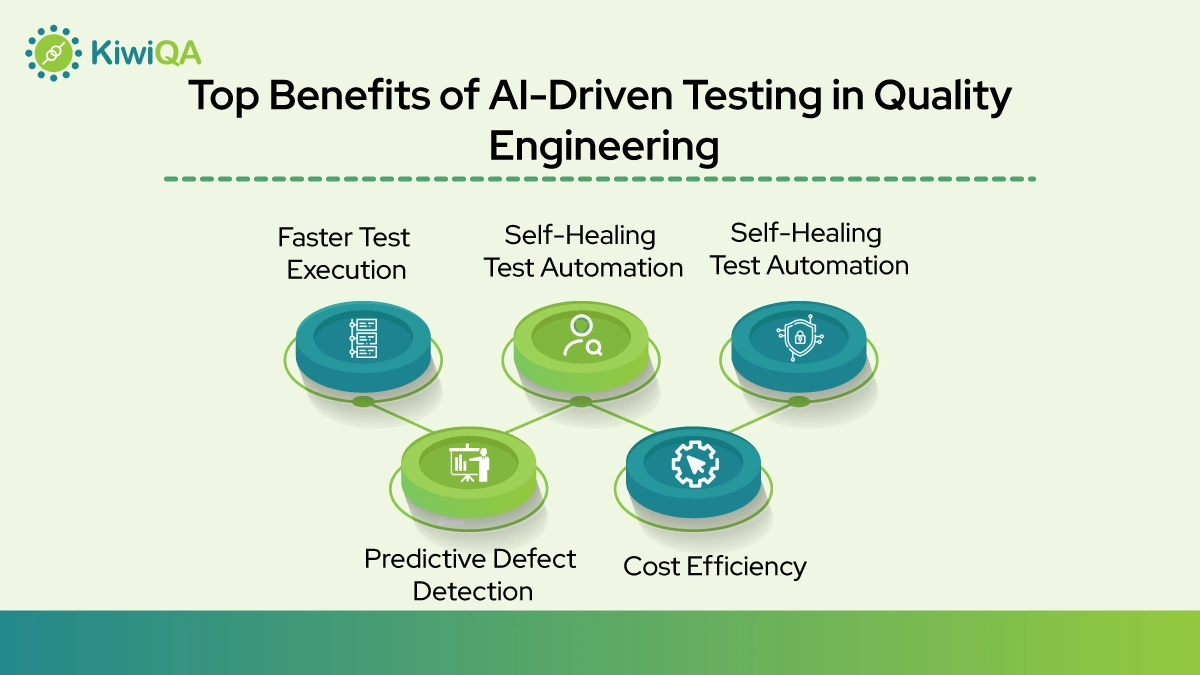
Top Benefits of AI-Driven Testing in Quality Engineering

❏ Faster Test Execution

AI system testing services effectively speed up test execution by enabling numerous test cases to execute concurrently across environments. This guarantees quicker feedback cycles and cuts down on overall testing time. Additionally, by creating test cases based on application behavior and historical data, AI-powered automated test generation reduces the need for manual scripting. Teams are able to complete more tests in less time as a result, allowing for faster releases. It allows preserving high software reliability and excellence in dynamic development contexts.

❏ Self-Healing Test Automation

AI is used by self-healing test automation to automatically identify modifications to the application’s code. This greatly reduces maintenance effort by removing the requirement for ongoing manual intervention when elements change. To guarantee testing continuity, AI algorithms find failed test cases, examine the underlying cause, and modify scripts.

Test suites eventually become more dependable and stable as a result. Organizations may maintain consistent testing workflows, decrease downtime, and boost productivity. AI-enabled testing services will increase the resilience and efficiency of the overall quality engineering process.

❏ Improved Test Coverage

By proactively creating test cases that exceed traditional manual methods, AI improves test coverage. AI creates intelligent test cases by examining application operations, user behavior, and previous errors to find important test scenarios. By concentrating on high-impact and high-risk application domains, risk-based testing further prioritizes these situations. This guarantees that testing activities are both thorough and focused. As a result, teams may efficiently manage time and resources while achieving deeper coverage. It helps to find hidden flaws and produce software that is more reliable.

Top Benefits of AI-Driven Testing in Quality Engineering

❏ Predictive Defect Detection

By examining past data, code modifications, and testing trends to spot possible problems before they arise, AI-driven testing makes predictive defect detection possible. Early problem detection lowers the cost and complexity of solutions by assisting teams in addressing flaws early. AI-powered risk analysis also identifies application vulnerabilities that demand targeted testing. This proactive strategy reduces the likelihood of significant manufacturing failures. Organizations can guarantee more consistent and reliable releases. They can increase software quality and improve user experience by anticipating faults rather than responding to them.

❏ Cost Efficiency

By drastically lowering manual labor and maximizing resource use, AI-driven testing increases cost-effectiveness. Teams can concentrate on more important work by using automation to manage repetitive operations. Faster release cycles reduce delays and cut time-to-market, which further reduces costs. Early fault discovery also reduces the need for improvement in SDLC. AI helps businesses reduce operating expenses while upholding high standards by optimizing the entire testing lifecycle. This improves ROI and makes scalable, effective quality engineering techniques possible.

Also Read : Top AI Testing Company in the USA for Scalable AI Solutions

How AI-Driven Testing is Used in Real-World Scenarios

🢣 UI Testing

UI testing frequently uses AI-driven testing to make sure programs provide reliable and aesthetically correct user experiences. AI uses visual validation to find even the smallest errors in design, colors, fonts, and objects by comparing current UI screens with baseline images. By spotting positional changes, missing elements, or abnormal user interface behavior across devices and browsers, it also makes layout change detection possible. This minimizes human mistakes and does away with the necessity for manual visual checks. Teams can thus promptly detect and resolve UI problems, guaranteeing smooth user interfaces and enhancing overall program quality and user satisfaction.

🢣 API Testing

AI improves API testing in practical applications by automating validation procedures and guaranteeing smooth system connectivity. Without requiring a lot of manual programming, AI can automatically validate API answers, verify endpoints, and check data integrity with the use of AI system testing services. Additionally, it makes intelligent test data production possible by generating dynamic and realistic datasets that enhance test coverage and accuracy.

In order to optimize test scenarios and identify possible failures, AI continuously learns from previous test runs. As a result, API testing becomes quicker and more reliable. AI system testing services assist businesses in maintaining strong integrations and producing high-performing applications.

🢣 Performance Testing

By mimicking actual user loads and forecasting system behavior under various circumstances, AI-driven testing is essential to performance testing. By using AI algorithms to predict how apps will function during periods of high usage, predictive load testing enables teams to fix bottlenecks before they affect users.

Anomaly detection also helps in identifying unexpected trends in system performance. Proactive optimization is made possible by these insights, which also guarantee that systems stay responsive and stable. Organizations may produce high-performing apps that satisfy users even in the face of tremendous demand by utilizing AI.

🢣 Regression Testing

AI reduces unnecessary test execution to determine which test cases are most important to execute based on recent code changes. Without spending time on unaffected components, our focused approach guarantees that high-risk areas are properly evaluated. AI also speeds up test cycles by automating execution and improving test suites’ correctness and speed. It continuously learns from past test outcomes to improve testing tactics in the future. Teams are able to swiftly verify upgrades, preserve software stability, and confidently provide new features as a result.

Key Challenges in Implementing AI-Driven Testing

☛ Initial Learning Curve

This is one of the main challenges to implementing AI-driven testing. Teams frequently need to comprehend ideas like intelligent automation, data-driven testing, and machine learning models, which demand further training and upskilling. As testers adjust to new workflows and procedures, productivity may temporarily decline. Organizations also need to devote time to fostering trust in AI-based solutions. Teams gain from increased productivity, more intelligent testing procedures, and better overall quality engineering results.

☛ Tool Selection Complexity

Finding AI-driven testing solutions can be tough. It can be difficult to determine which tool is appropriate for a given set of business requirements because each one offers a distinct set of features, integrations, and degrees of AI power. Companies need to assess things like cost, scalability, usability, and accessibility with existing systems. Low ROI, higher costs, and inefficiencies can result from a bad choice. Therefore, to ensure successful deployment and optimize the value of AI-driven testing solutions, thorough research, pilot testing, and alignment with project goals are crucial.

☛ Integration Challenges

It can be difficult to incorporate AI-driven testing technologies into current testing and development environments. Seamless integration is challenging since many organizations currently utilize numerous testing frameworks, older systems, and established CI/CD pipelines. During implementation, problems with compatibility, data migration, and workflow disruptions may occur.

Furthermore, technological know-how and customization may be needed to integrate AI tools with existing procedures. These difficulties may cause adoption to be delayed and have a short-term effect on productivity. However, companies may successfully integrate AI-driven testing into their workflows and achieve its full potential. It helps with careful planning, strong integration strategies, and teamwork.

Also Read : Complete List of AI Testing Services for AI-Powered Platforms

Best Practices for Implementing AI-Driven Testing

➩ Start with pilot projects

Before expanding AI-driven testing throughout the company, start with small pilot projects to assess performance, ROI, and viability. Through pilot projects, teams may better learn how AI technologies operate in real-world settings, spot possible problems, and improve low-risk techniques.

This strategy enables organizations to measure results, test various scenarios, and foster stakeholder confidence. It also offers insightful information about integration demands and resource requirements. Businesses may guarantee a more seamless transition, minimize disruption, and build a solid foundation for wider AI adoption in quality engineering by starting small and increasing gradually.

➩ Choose the right tools

Selecting the ideal AI-driven testing tool for a quality engineer’s future is necessary for successful implementation. Businesses must evaluate tools depending on their compatibility with the existing systems, ease of use, and scalability. It is necessary to consider factors like multiple testing types, integration with development pipelines & reliability.

Perform thorough research, comparing options, and running trials to monitor the right option. Making wrong choices can cause inefficiencies and increased costs. The well-informed decisions ensure improved performance, smooth workflows, and maximum ROI in AI-powered testing initiatives.

➩ Train teams

Teams must receive the right training in order to successfully implement AI-driven testing procedures. The operation of AI technologies must be understood by testers, developers, and QA specialists. Workshops, training courses, and practical experiences can all help in developing the necessary abilities and self-assurance.

Teams may stay current with emerging technology by promoting ongoing learning. Teams with proper training can increase productivity, decrease errors, and make better use of AI capabilities. Investing in talent development guarantees the long-term viability and effectiveness of AI-driven testing within the company.

➩ Integrate with CI/CD

To successfully integrate AI-driven testing methods, AI software testing companies need to be properly trained. Testers, developers, and QA specialists need to understand how AI systems work. Training, organizing seminars, and programs help to build skills and confidence. By encouraging continuous learning, teams can stay up to date with modern tools. With the right training, teams can use AI capabilities more effectively, enhance productivity, and reduce errors. The long-term sustainability and efficacy of AI-driven testing within the organization are ensured by investing in talent building.

➩ Monitor and optimize

Frequent monitoring & optimization are necessary for driving the effectiveness of AI-driven testing. Businesses must frequently address performance metrics, test results & AI model accuracy to track the areas that require improvement. Feedback loops support refining test strategies and drive decision-making.

It is also necessary to upgrade models, manage test cases, and optimize depending on rising demands. Frequent evaluation promises that AI tools remain aligned with organized goals & deliver consistent values. By focusing on ongoing improvement, organizations can manage efficiency, limit risks, and achieve long-term success in QE.

Ready to Bring AI-Driven Testing to Your QA? Talk to Us

Ready to Transform Quality Engineering with AI-Driven Testing?

AI-driven testing isn’t a technological advancement but a transformation in how we ensure software quality. By leveraging AI’s predictive abilities, learning algorithms & automation intelligence, businesses can opt for faster release, improve accuracy, & reduction in cost. As we are going towards the AI-driven world, the future of quality engineering is evolving rapidly for addressing error detection to quality prediction.

An enterprise that embraces AI in software testing can lead to a high-performing, future-ready app. We can say that AI-powered testing is slowly becoming the foundation that enables QE to keep pace with continuous change. AI integration & testing isn’t a luxury but a reality, building the future of quality engineering. QE engineers can leverage AI to get a scalable, accurate, and efficient testing process.

It helps them to keep pace with modern AI demands. AI is leveling up the quality of engineering by automating routine tasks, enhancing test coverage & continuous learning. It promises to deliver quality software products faster & seamlessly. It’s high time for AI software testing companies to invest in AI-driven tools & upskill their team to opt for the leading position in their domain.