Top 15 SaaS Testing Tools for Faster and Scalable QA in 2026

It’s difficult to overlook the growth of SaaS. By 2026, the world’s SaaS market is expected to reach $465 billion, with 84% of organizations saying they were spending more on SaaS in 2025. This kind of growth comes with its fair share of demands, and this one is no different: demanding fast, continuous, and scalable quality assurance.

Today’s teams are developing and deploying SaaS inside a CI/CD pipeline, microservices architecture, and distributed remote environments. These environments are not the normal QA environments. When shipping code 5 times a day, you can’t run a regression test every weekend. SaaS testing services should keep up with today’s development speed and complexity. Whether you’re a QA lead evaluating new tools or a startup trying to build a reliable testing pipeline from scratch, this list of 15 tools gives you a clear, practical starting point.

What Are SaaS Testing Tools?

SaaS testing tools are cloud-based platforms that allow teams to test software applications without having to maintain any infrastructure. Access them via a browser, hook them up to your pipelines, and run tests without installing or setting up a server.

The accessibility and scale are what make them different from traditional tools. Traditional testing approaches, such as the early Selenium test frameworks, had teams running local testing grids, manually setting up environments, and manually obtaining devices. All of that is done in the cloud with SaaS Testing Services.

Cloud-based access means your QA engineer in Bangalore and your developer in Berlin work from the same environment. Scalability allows you to perform thousands of parallel tests without having to purchase additional hardware. Pay-as-you-go models, which reduce idle infrastructure, contribute to cost efficiency. Additionally, its integration features ensure it fits seamlessly into your team’s existing GitHub Actions, Jenkins, or other CI/CD pipelines.

Key Features to Look for in SaaS Testing Tools

Not all tools are created equal or are suitable for all teams.

➥ SaaS automated testing forces you to manually write and maintain brittle scripts, which is going to hinder you, rather than help you. Watch out for smart recorders, codeless platforms, or test generation with AI.

➥ For SaaS application testing, cross-browser and cross-device testing are more important than most teams realize. This is because users may be on Safari on an iPhone, Chrome on Windows, or Firefox on Linux, and all need to be covered.

➥ In 2026, CI/CD integration is a must-have. Your testing tool should be able to integrate with your deployment workflow, which means that you should be able to set it up to automatically run your tests on each commit or pull request.

➥ AI-driven testing and self-healing capabilities significantly lower maintenance costs. Live monitoring panels supply instant visibility into quality status for the entire team, including programmers, testers, and merchandise supervisors.

➥ Remote squads remain aligned through cooperative functions. Protection and compliance support ensure the safety and security of your organization’s system as well as its clientele.
 Ready to Scale QA with Smart SaaS Testing Solutions?

Types of SaaS Testing Tools

The best SaaS testing company is the one that your team is using on a regular basis, not the one with the most features on a comparison chart.

🢣 Functional Testing Tools

Verify your application’s performance through user flows, business logic, and UI interactions. These are your workhorses for regression and end-to-end testing.

🢣 Performance Testing Tools

Manage load, stress, and scalability scenarios. They ask things such as: Is your platform able to support 10,000 concurrent users? What breaks first under peak traffic?

🢣 API Testing Tools

Make sure that your APIs deliver the correct information, manage errors effectively, perform authentication correctly, and meet performance standards. With the increasingly API-heavy nature of today’s SaaS applications, this is a feature that should be highlighted separately.

🢣 Visual/UI Testing Tools

Capture layout regressions, rendering inconsistencies, and visual bugs, which functional testing tools completely miss. Users will get frustrated when the button they are pressing is broken, but still “works”.

🢣 Test Management Tools

Manage your QA processes, test cases, runs, results, defects, and more, and keep all of it traceable and audit-ready, which is critical for regulated sectors.

Also Read : Top AI Testing Tools Decision Makers Should Invest in 2026

Top 15 SaaS Testing Tools for 2026

It’s all about size, stack, budget, and velocity of your team. First, identify your largest pain point (flaky tests, slow feedback loop, lack of API coverage, security gaps, etc) and then find a tool that fits that problem. Build from there.

1. Virtuoso QA

Virtuoso QA

Virtuoso QA is an AI-native web testing platform, designed from the ground up for natural language programming instead of an AI overlay on a legacy platform. Tests are written in natural language, and Virtuoso takes care of interactions with the UI, API responses, and database validation all in one composable journey. New tests are automatically adapted when your application changes, instead of waiting for an engineer to update the locators. It supports 2,000+ OS and browser combinations, and is SOC 2 Type 2 certified. Ideal for large enterprise teams requiring a single end-to-end solution, without coding.

2. CloudQA

CloudQA

CloudQA is a codeless cloud regression testing platform that allows you to automate your user flows without coding at all. It supports interactions through its smart browser recorder, and can generate test cases from live URLs and mockups using its AI capabilities. Data-driven testing through CSV uploads provides a much wider coverage. Ideal for agile teams and business analysts who want to scale with the best SaaS testing tools without the infrastructure nightmares.

3. BugBug.io

BugBug.io

BugBug.io is a low-code browser testing tool and a more modern, user-friendly way of testing web-based applications than older model recorder-based tools. It has a sleek Chrome extension recorder and window-based visual test editing. Additionally, it has the ability to schedule tests from the cloud and a flat-rate pricing with unlimited seats, which makes budgeting a breeze. The best software testing tools for SaaS startups are ideal for startups and SMBs that require fast and accurate web regression suites without the complexity.

4. Mabl

Mabl

Mabl is a low-code AI-powered platform designed for continuous delivery. It has a machine learning layer that keeps building intelligence from all test runs, ensuring test stability in the face of an evolving app. All UI interactions and API validation are covered in a single Mabl test, and accessibility checks are performed in conjunction with functional tests for every test run. Moreover, native CI/CD triggers execute test suites automatically for each code commit. Suitable for teams that are developer-focused and prefer automated test maintenance to be part of their deployment pipelines.

5. TestSprite

TestSprite

TestSprite is a completely self-contained AI testing agent that runs directly within the latest code editors through Model Context Protocol (MCP) servers. It generates test cases, writes the code, and creates cloud sandboxes on the fly. Other than that, it also runs tests and makes recommendations for bug fixes without needing a QA engineer to write a single line of test code. Ideal for engineering teams with limited resources who must rapidly test the output of AI-generated code in conjunction with the frontend and backend.

6. SoapUI

SoapUI

SoapUI has become the standard in API testing, as it supports comprehensive API mocking, data-driven API test coverage, and testing for security vulnerabilities on API endpoints. If your SaaS platform is extensively integrated with other systems, payment gateways, 3rd party systems, or internal microservices, then your backend team needs the depth of SoapUI. Ideal for QA engineers who need to deal with complex, layered API ecosystems.

7. Qodex.ai

Qodex.ai

Qodex.ai is an AI-powered automation suite that connects manual exploratory testing and fully automated suites. It automatically infers user behavior, anticipates corner cases, and transforms cumbersome manual workflows into automated scripts across platforms with little to no human intervention. Ideal for SaaS businesses whose growth is accelerating and requires more tests with fewer engineers.

8. Aqua Cloud

Aqua Cloud

Aqua Cloud is a test management platform and enterprise-grade Application Lifecycle Management (ALM) enhanced with AI capabilities. It combines manual testing, an automated framework, and defect tracking in a single location. Additionally, it can automate the creation of test steps from requirements documents or user stories, saving hours on test planning. These SaaS performance testing tools are created for traceability and compliance mapping in heavily regulated sectors such as FinTech and healthcare.

9. BrowserStack

BrowserStack

BrowserStack is a widely adopted testing platform, recognized for its cross-browser and device coverage and a growing investment in AI-powered automation. It has launched AI agents such as the Test Case Generator, the Low-Code Authoring Agent, the Self-Healing Agent, and the Visual Review Agent. It’s an execution environment, not a test creation tool. You simply execute your existing Playwright, Cypress, or Selenium tests on BrowserStack’s infrastructure. It’s the best for cross-platform teams that are concerned about real-world device accuracy.

10. QASource

QASource

QASource combines the skills of expert QA services with custom automation frameworks that cater to your tech stack. It provides you with a specialized engineering team that can quickly ramp up your testing capacity without hiring. Ideal for medium and large companies needing to rapidly ramp up QA without starting their own team from scratch.

11. Cledara

Cledara

Cledara’s mission is to manage an SaaS operational stack, not code-level testing. It offers real-time software usage, software licenses, security permissions, and operational health for all your SaaS applications. It is best suited to IT operations and DevOps leads who struggle with tool sprawl and compliance tracking in large software stacks in their organizations.

12. k6 (by Grafana)

k6 (by Grafana)

K6 should be a DevOps Engineer/SRE’s best friend when dealing with scalable microservices. Using JavaScript to write tests, the developers can easily write realistic performance tests in pipelines to ensure no performance regressions in production. It’s not just about the use of the best testing tools for SaaS products to benchmark the login endpoints with synthetic traffic; it’s about simulating user patterns that actually occur in these systems. This includes browsing, searching, creating records, running reports, and so on.

13. Qase

Qase

Qase is a simple-to-use, cloud-based Test Case Management solution. It has AI-driven test case generation, collaborative test case libraries, live test case run monitoring, and native integrations with Jira, GitHub, and Slack. Perfect for QA leaders seeking one place for all of their manual and automated test strategies from distributed teams.

14. Sauce Labs

Sauce Labs

Sauce Labs released its AI for Insights in November 2025, which includes a range of smarter analytics for test failures, flakiness trends, and test execution trends. It enables massive parallel test execution of real devices, emulators/simulators, and has video logs and root cause analysis for any broken pipelines. It also includes data facilities that are situated in Europe with GDPR compliant staff. Best suited to large-scale continuous integration (CI), in which a large number of tests, typically thousands, are executed simultaneously every day.

15. Applitools

Applitools

Applitools is one of the best SaaS testing tools for businesses looking to improve SaaS application testing with AI-powered visual automation. The platform supports SaaS automated testing by helping teams detect UI inconsistencies, visual bugs, and cross-browser issues with greater accuracy and speed. As part of a strong SaaS testing strategy, Applitools enhances quality assurance workflows for modern cloud applications while supporting scalable SaaS testing services. It is also widely used alongside SaaS performance testing tools and SaaS security testing processes to ensure reliable and seamless user experiences for growing businesses and SaaS startups.

How to Choose the Right SaaS Testing Tool

Choosing the right tool starts with being honest about your team’s actual situation and not its ideal state.

If the startup is 5 people, it is not necessary to have a full traceability workflow in an enterprise ALM platform. For a 200-person engineering organization, a lightweight browser recorder isn’t enough. Find the balance between the intricacy of the tool and your team’s capacity regarding operating plus retaining said software.

The next is the complexity of the project. When your SaaS application is deeply API dependent, is built of microservices, has a multi-tenant architecture, and copiously uses third-party integrations, you need a tool (or a set of tools) that can access all these layers. Do not go with a UI only recorder.

The Budget is real. Most tools have different pricing tiers, but enterprise plans are usually custom-made. Consider not only the cost of the license, but also the hours those personnel must devote to configuring, training, and sustaining operations.

A good SaaS testing strategy also considers integration requirements. A tool that fits into your existing CI/CD pipeline, bug tracker, and communication stack without friction is the best one to use, as it is the one that your team will actually use. Lastly, scalability means can this tool scale with you if your test suite doubles and your user base triples?

Also Read : Best SaaS Testing Platforms Transforming QA Operations in 2026

Benefits of Using SaaS Testing Tools in 2026

The need for investing in dedicated SaaS testing tools, i.e., becoming more and more compelling year after year. Continuous, automated testing that can be integrated into the pipeline can open the door to faster release cycles. This trend is not to be taken lightly, as the automated testing market is projected to reach $55.2 billion by 2030, up from $24.7 billion in 2023.

When it comes to infrastructure, it’s a no-brainer that cloud-based execution will lower the bill, which means no more purchasing server racks or running device labs. More collaboration occurs when dashboards and reports are available to anyone, not sitting on a shared drive inside a QA team. Better test coverage is achieved by parallel execution and AI-driven test generation. Continuous testing support results in quality being integrated throughout the lifecycle and not tacked on at the end.

Common Challenges and How to Overcome Them

The same few issues come up with every team when they’re trying to establish a SaaS testing practice.

❏ Tool Overload : Tool overload creates a scatter plot effect and drives up the cost. The solution is consolidation: review all your team’s tools, look out for overlapping functionality, and strive for one-stop platforms that address multiple requirements.

❏ Learning Curve : Learning curve kills adoption. Teams are overwhelmed with too many new tools at once. People can remain productive during transitions with role-specific training paths, in-app guidance, and a gradual rollout, one automated step at a time.

❏ Integration Issues: SaaS security testing deserves its own continuous pipeline. Multi-tenant architectures allow data to be exposed to multiple customers at once when a vulnerability occurs. Ensure that the static code analysis, dependency scanning, and dynamic application security testing are all built into the CI/CD process, so that the vulnerabilities can be identified during the app’s development, rather than in production. SaaS security testing that takes place periodically rather than continuously will always be one sprint behind.

❏ Data Security Concerns : When tools don’t communicate with one another, integration problems cause delays. Go for the platforms that have well-maintained and documented integrations for your stack. When it comes to data security, it’s best to select platforms that are SOC 2, ISO 27001, or have compliance certification built in, rather than tacked on.

Future Trends in SaaS Testing

AI-powered and self-healing tests are already available; for instance, Virtuoso QA and Mabl will automatically modify tests as the UI changes, reducing maintenance time dramatically. In 2023, more than one-third of large businesses have already begun adopting machine learning in their QA processes to shorten test cycles and catch bugs earlier in the process.

Low-code and no-code automation is making QA accessible to non-developers: product managers, business analysts, and subject matter experts can participate in test coverage without coding. Shift-left and shift-right testing push quality earlier into development and later into production monitoring simultaneously. Security testing has now become a first-class citizen in CI/CD pipelines as opposed to a periodic audit. But autonomous QA systems, those that create, run, analyze, and correct tests with little or no human intervention, are transitioning from experimental to the production stage.

Ready to Discuss Your SaaS Testing Requirements?

Ready to Scale Your QA? Find the Perfect SaaS Testing Solution Today

From $4.07 billion in 2025 to $4.64 billion in 2026, the SaaS testing tools market is projected to grow at 14.1% CAGR, and that growth is more than just hype – it’s a business requirement. A one-man QA team in a startup company is not the same as an enterprise that has a QA team shipping to regulated markets. All teams have one thing in common: They all need speed, reliability, and scalable coverage.

Partnering with a reliable SaaS testing company may help to speed up the evaluation procedure, particularly if you need to establish a testing practice from scratch and are still shipping a product.
Best SaaS Testing Platforms Transforming QA Operations in 2026

SaaS testing tools are crucial for a scalable SaaS software QA process. As CI/CD pipelines become widely adopted, cloud-based QA platforms deliver the scalability and intelligence that traditional tools often lack. According to recent market reports, the global SaaS market is projected to grow at a CAGR of over 18% and surpass $1 trillion in value in the coming years.

The major factors behind this growth are increasing cloud adoption, seamless integration, and rising requirements for scalable platforms. SaaS apps are convenient, but developing and maintaining them isn’t easy. A small gap can quickly hamper users. This is why SaaS Testing Services is gaining popularity.

SaaS testing tools are popular for streamlining the performance and balancing various software tests, without requiring on-premises infrastructure. These tools support continuous testing, manual test management & reporting.

Here in this blog, we are going to talk about the importance of SaaS testing tools, their benefits, and overviews. We have discussed a few tools in the section below, along with the use cases. Before you collaborate with any SaaS testing company, have the following information.

Why SaaS Testing Platforms Are Essential for Modern QA Teams

➥ Shift Toward Agile & DevOps Testing

◈ Faster deployment cycles

The advanced Agile & DevOps environment demands rapid software release and frequent feature updates. SaaS testing platforms support quick release cycles by automating frequent testing tasks, enhancing collaboration, and integrating seamlessly with CI/VD pipelines. It supports the QA team to track errors, limit delays, and manage software quality while driving product delivery in competitive virtual markets.

◈ Continuous testing requirements

Continuous QA has become crucial for advanced software development as apps evolve through frequent updates. A SaaS QA platform allows frequent testing by offering scalable automation, real-time reports, and cloud-driven architecture. These abilities support the QA team in performing QA throughout the SDLC. It ensures quick feedback, improved app stability, and reliable software release without slowing down development workflows.

➥ Benefits of SaaS-Based QA Platforms

◈ Scalable cloud infrastructure

SaaS-driven QA platform offers scalable cloud infrastructure, which enables firms to broaden their testing environment depending on project demands. Team can access various devices, OS, and browsers without investing in physical infrastructure. The flexibility enhances QA efficiency, supports large-scale QA operations, and enables firms to adapt to changing software development and QA demands.

◈ Reduced testing costs

Cloud-driven SaaS application testing platform limits operational expenses by limiting the requirement for expensive hardware, maintenance, and internal device labs. Firms can access advanced QA environments through subscription-based models, lower infrastructure costs, while enhancing software quality. Limited QA costs also enable firms to invest more in automation, quick software delivery, and innovation.

◈ Remote collaboration support

SaaS QA platforms allow remote collaboration by enabling developers, QA, and stakeholders to access the QA tool and reports from any location. The cloud accessibility enhances communication, drives decision-making, and supports a fragmented QA team working across various regions. The flexibility drives productivity and ensures seamless collaboration throughout the software QA and development lifecycle.

◈ Faster bug detection

SaaS testing platforms enhance error detection through automated testing, real-time analytics, and frequent monitoring capabilities. These tools support the QA team in catching errors earlier in the development process, limiting the risk of crucial production errors. Quick error detection enhances software stability, drives release cycles, and overall user experience across SaaS apps and virtual platforms.

 Ready to Upgrade Your QA Testing Process?

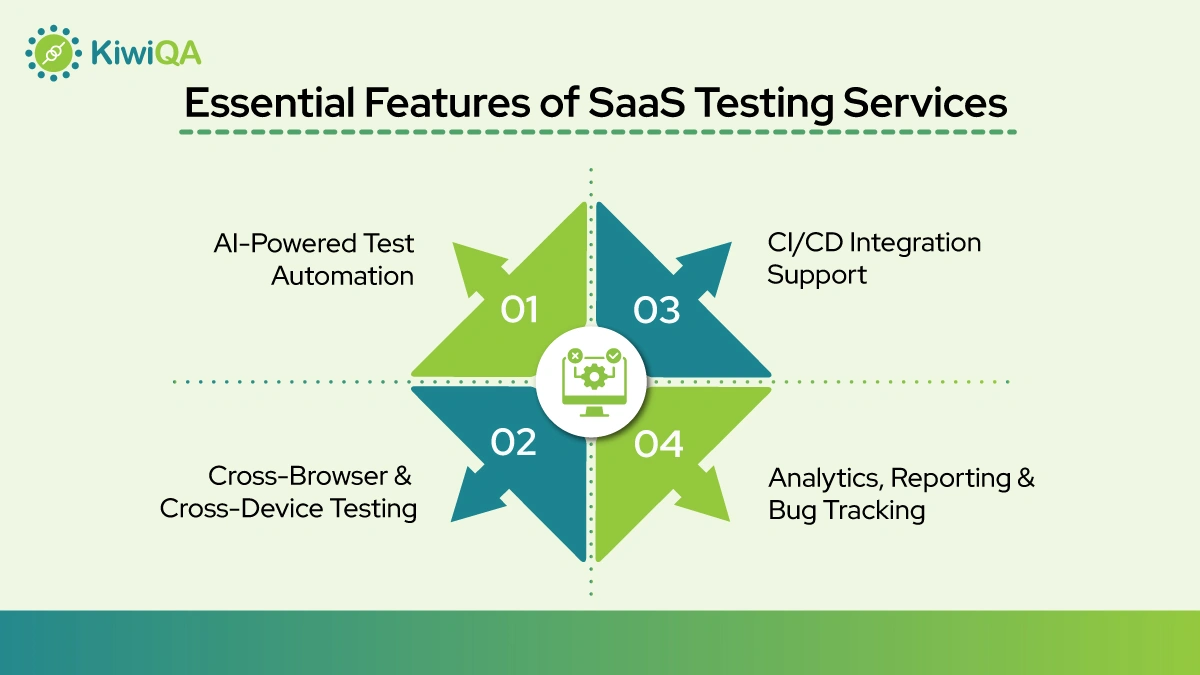
Key Features to Look for in a SaaS Testing Platform

🢣 AI-Powered Test Automation

Through smart processes, AI-powered test automation assists QA teams in increasing testing efficiency, speed, and accuracy. Smart test generation features are available in modern SaaS testing platforms, which automatically generate optimized test cases. Self-healing scripts further minimize maintenance requirements while guaranteeing consistent automated testing across changing software environments.

🢣 Cross-Browser & Cross-Device Testing

Testing across browsers and devices guarantees that SaaS apps operate reliably. To swiftly find UI and functional problems, modern SaaS testing companies offer browser compatibility checks. Additionally, they facilitate mobile responsiveness testing, which helps firms to offer streamlined user choices. In competitive digital contexts, this functionality is crucial for preserving software quality and raising user happiness.

Key Features to Look for in a SaaS Testing Platform

🢣 CI/CD Integration Capabilities

SaaS testing solutions may easily interface with DevOps pipelines and automated deployment procedures thanks to CI/CD integration capabilities. These interfaces improve software quality and shorten release times by enabling QA teams to run tests constantly during development. Real-time testing workflows give developers immediate feedback on application performance, allowing them to find and fix problems more quickly.

🢣 Analytics & Reporting

QA teams may manage defects, evaluate testing performance, and enhance decision-making processes with the use of advanced analytics and reporting options. SaaS testing solutions offer visual dashboards that show quality insights, execution status, and real-time testing information in a centralized setting. Additionally, they provide performance analytics and bug tracking tools that assist companies in locating testing bottlenecks. The SaaS Testing Services provider should streamline processes and enhance overall software reliability across development and QA operations.

Best SaaS Testing Platforms Transforming QA Operations in 2026

1. BrowserStack

QA teams can do real-time testing across many browsers, devices, and operating systems with the help of BrowserStack, a top cloud-based testing platform. By offering immediate access to actual devices in the cloud, it does away with the need for physical device labs. The technology is appropriate for DevOps and agile organizations since it supports both automated and manual testing operations.

By integrating with well-known automation frameworks like Selenium and Cypress, BrowserStack enables teams to ship software more quickly without sacrificing application quality. For companies committed to providing smooth user experiences across online and mobile platforms, its scalable infrastructure, collaboration features, and precise testing capabilities make it a top choice.

➩ Key Highlights

For effective QA execution, BrowserStack provides cross-browser compatibility validation, real device cloud testing, and automation support.

➩ Best For

It is Ideal for large-scale application testing workflows managed by agile QA teams and corporations.

2. LambdaTest

LambdaTest is a cloud SaaS automated testing platform with AI capabilities that makes cross-browser and cross-device testing for contemporary SaaS apps easier. Teams may conduct both automated and manual testing using it without having to spend money on costly infrastructure. The technology facilitates parallel testing, which helps companies shorten testing durations and speed up software delivery cycles.

Developer and tester communication is enhanced by LambdaTest’s seamless integration with common automation frameworks and CI/CD pipelines. Organizations can guarantee constant application performance across various devices and operating systems thanks to its scalable cloud environment and broad browser coverage. Fast-growing businesses that want to increase QA efficiency while preserving high-quality digital experiences for users utilize the platform extensively.

➩ Key Highlights

For quicker QA procedures, LambdaTest offers comprehensive browser coverage, parallel test execution, and AI-powered testing.

➩ Best For

It is Ideal for fast-growing SaaS businesses seeking scalable and cloud-based testing solutions.

3. TestRail

Software testing operations can be effectively organized, managed, and tracked by QA teams with the help of TestRail, a comprehensive test management platform. It offers comprehensive test case management, centralized reporting, and communication capabilities that increase project visibility. Teams can maintain consistency and enhance product quality with the platform’s support for both automated and manual testing methods.

TestRail helps businesses optimize QA operations and reporting procedures by integrating with well-known development and issue-tracking technologies. Teams can more easily track testing progress and promptly detect problems thanks to its user-friendly UI and customizable dashboards. In software development environments, companies utilize TestRail to enhance test preparation, teamwork, and overall project management effectiveness.

➩ Key Highlights

For well-organized testing workflows, TestRail offers collaborative tools, centralized QA reporting, and test case management.

➩ Best For

It is Ideal for QA teams and companies that prioritize organized test administration and reporting.

4. Katalon Platform

Web, mobile, desktop, and API testing are all supported in a single environment by Katalon Platform, an all-in-one automated testing solution. Both IT and non-IT professionals can use testing because of its low-code automation features. Additionally, the platform offers AI-driven analytics and reporting capabilities that assist companies in increasing the effectiveness of testing and streamlining QA processes.

Faster software delivery and enhanced team collaboration are made possible by Katalon’s integration with major development tools and CI/CD pipelines. Organizations can optimize automated workflows while preserving software quality thanks to its user-friendly UI and scalable testing infrastructure. Katalon is used by many companies to streamline intricate testing procedures and increase overall testing efficiency across digital applications.

➩ Key Highlights

For effective QA operations, Katalon provides low-code automation, multi-platform testing support, and AI-enhanced analytics.

➩ Best For

It is perfect for groups looking for a single, user-friendly platform for software testing.

5. Sauce Labs

Organizations may conduct automated and real-time SaaS testing on a platform with Sauce Labs, a cloud-based continuous testing platform. Assisting teams in expediting testing cycles and enhancing software release quality helps DevOps and CI/CD workflows. Businesses may conduct tests effectively without maintaining internal testing environments thanks to the platform’s scalable cloud infrastructure.

Developers and QA teams may work together more efficiently thanks to Sauce Labs’ integration with well-known automation frameworks and development tools. Its robust reporting features and dependable testing environment enable businesses to find faults fast and enhance application performance. Sauce Labs is used by businesses to enable continuous software delivery strategies and large-scale testing operations.

➩ Key Highlights

Sauce Labs offers scalable cloud-based infrastructure, automated and live testing support, and continuous testing.

➩ Best For

It is ideal for enterprise DevOps teams that oversee quick software releases and continuous testing.

Also Read : Top 12 SaaS QA Testing Companies in the USA (Edition 2026)

6. Tricentis Tosca

The enterprise-grade automation testing platform Tricentis Tosca is renowned for its risk-based testing features and scriptless testing methodology. It assists companies in lowering the complexity of testing while enhancing software reliability, speed, and coverage. Within a single environment, the platform facilitates end-to-end testing for business processes, enterprise apps, and APIs.

Tosca helps companies expedite software delivery while reducing maintenance efforts by integrating with DevOps and CI/CD workflows in an efficient manner. It can handle difficult QA settings across large organizations thanks to its advanced automation features and scalable architecture. Tricentis Tosca is used by businesses to increase testing effectiveness, lower operational risks, and guarantee consistent performance across vital business applications and digital systems.

➩ Key Highlights

For advanced QA operations, Tricentis Tosca provides enterprise-grade scalability, risk-based testing, and scriptless automation.

➩ Best For

Perfect for big businesses managing intricate testing procedures and enterprise software.

7. Postman

Postman is a popular tool for API testing and collaboration that streamlines the processes of developing, testing, monitoring, and automating APIs. It facilitates the creation of automated workflows, API functionality validation, and enhanced cross-project collaboration for developers and QA teams. The user-friendly interface design, testing, and APIs management.

Additionally, Postman offers automated testing and monitoring capabilities that assist companies in guaranteeing the performance and dependability of APIs. Teams may easily exchange collections, documents, and testing environments thanks to its collaborative workspace. Postman helps businesses manage the API lifecycle more effectively, increase development productivity, and keep development and quality assurance teams working on cloud-based and SaaS apps in constant communication.

➩ Key Highlights

For effective API management procedures, Postman facilitates teamwork, workflow automation, and API testing.

➩ Best For

Ideal for QA teams overseeing contemporary SaaS applications and API-focused development teams.

How AI Is Revolutionizing SaaS Testing in 2026

➩ Predictive Defect Detection

Predictive defect detection driven by AI assists QA teams in identifying testing risks and possible software problems prior to deployment. AI enhances software stability and lowers crucial production faults by examining past testing data, user behavior, and application patterns. For contemporary SaaS applications in fiercely competitive digital contexts, this proactive strategy facilitates quicker issue resolution, improves testing accuracy, and promotes more dependable software delivery procedures.

➩ Self-Healing Automation

AI-powered predictive defect detection helps QA teams find potential software issues and testing hazards before deployment. By analyzing historical testing data, user behavior, and application trends, AI improves software stability and reduces critical production errors. This proactive approach supports faster problem solving, increases testing accuracy, and encourages more reliable software delivery processes for modern SaaS services in highly competitive digital contexts.

➩ Intelligent Test Prioritization

AI is used in intelligent test prioritization to concentrate testing resources on high-risk regions and essential business features first. Teams may speed up software release cycles, enhance fault identification, and maximize testing resources with this method. Through the identification of vulnerabilities and the prioritization of security-focused test cases within QA workflows, AI also facilitates enhanced SaaS security testing. Intelligent prioritization reduces testing time and operational complexity while improving software quality as companies implement continuous delivery techniques.

SaaS Testing Platform Vs. Traditional Testing Tools

❏ SaaS Testing Advantages

☛ Cloud accessibility

SaaS testing solutions enable QA teams to access tools, results, and testing environments over the cloud from any location. This facilitates flexible processes, enhances remote team engagement, and speeds up testing execution without relying on location-based systems or on-premise equipment.

☛ Faster scalability

SaaS testing platforms that are cloud-based can quickly increase resources in response to testing requests and project requirements. Without purchasing new hardware, businesses may increase testing environments, automation capabilities, and device coverage. The load testing for SaaS platforms helps teams handle increasing workloads more effectively and shorten software release cycles.

☛ Lower infrastructure costs

SaaS testing platforms eliminate the need for costly device labs, physical equipment, and upkeep. Subscription-based models give organizations access to advanced testing environments, which reduce operating costs while enhancing software quality control and testing efficiency.

❏ Traditional Testing Challenges

☛ Higher maintenance

Standard testing technologies frequently necessitate ongoing infrastructure maintenance, software updates, and hardware upgrades. For companies managing large-scale QA operations, managing physical testing facilities can raise operational complexity, use IT resources, and result in additional expenditures.

☛ Limited remote accessibility

Traditional testing systems typically rely on on-premise infrastructure, which makes remote access and cooperation more challenging. This restriction may result in slower testing processes, lower productivity, and a lack of communication between developers, testers, and project stakeholders.

☛ Slower updates and deployments

Due to their reliance on human setups and infrastructure management, traditional testing environments can take longer to grow and update. The development and release process for SaaS services may be slowed down, and software deployments may be delayed.

Common Challenges in QA Operations & How SaaS Platforms Solve Them

☢ Challenges

▪ Slow regression testing

Traditional regression QA often consumes resources & time, especially for the large SaaS apps with frequent updates. Manual QA delays software release and increases the risk of missed errors.

▪ Fragmented QA workflows

Most of the firms struggle with disconnected QA processes, tools, and reporting systems, which limit team collaboration and visibility. Distributed systems can slow down decision-making and lead to design inconsistencies in QA operations.

▪ Limited device coverage

Testing apps across various devices, OS, and browsers can be tough without access to a broad infrastructure. Limited device coverage may cause compatibility errors and a poor user experience.

☢ Solutions

▪ Automated testing pipelines

SaaS QA platforms use a SaaS testing strategy like automated QA pipelines to speed up regression QA and limit manual effort. Automation enhances QA accuracy, supports frequent delivery, and enables the team to release software quickly.

▪ Unified testing dashboards

Unified dashboards centralize QA reporting, test management, collaboration tools, and analytics in a single platform. It improves workflow visibility, team coordination, and streamlines overall QA operations.

▪ Cloud-based device labs

They offer quick accessibility to real devices, browsers, and OS for scalable testing. It supports businesses to perform accurate cross-platform QA without maintaining costly physical infrastructure.

Also Read : Top AI Testing Tools Decision Makers Should Invest in 2026

Future Trends in SaaS Testing Platforms

◈ AI-driven autonomous testing

AI-based autonomous QA is revolutionizing SaaS QA operations by limiting manual intervention and enhancing QA accuracy. The advanced QA platform now utilizes AI to identify errors, generate test cases, measure app behavior, and optimize test execution automatically. These smart systems can adapt to UI modifications, prioritize high-risk areas, and enhance regression QA efficiency.

The AI-driven QA accelerates release cycles by limiting tasks and allowing quick error detection. As SaaS apps become more complicated, autonomous QA plays a crucial role in enhancing software quality, limiting operational costs, and supporting frequent delivery strategies for agile development infrastructure.

◈ Codeless automation growth

Codeless automation is gaining popularity since a large number of firms are seeking quick and accessible QA solutions. Advanced SaaS QA approaches now offer a drag-and-drop interface and visual workflows that enable non-technical users to develop automated QA without extensive coding knowledge.

The following practices limit dependency on specialized automation engineers while enhancing collaboration between the QA team, developers, and business stakeholders. Codeless QA also speeds up test creation, simplifies maintenance, and supports quick release cycles. As firms focus on agility and rapid virtual transformation, the demand for user-friendly automation tools will grow, making codeless QA a key trend, shaping the future of QA.

◈ Increased API and security testing

API and security testing are becoming a necessary component of advanced SaaS QA strategies as apps rely more on interconnected services and cloud infrastructure. Testing platforms are now prioritizing to validate API functionality, reliability, and performance while identifying errors and security risks.

Automated API QA supports firms to ensure seamless communication between systems, while advanced SaaS security testing safeguards user data & avoid cyber crimes. With rising concerns around compliance, app security, and privacy, firms are investing more in integrated QA solutions that combine API, security, and functional QA capabilities. These QA practices are improving software reliability and maintaining user trust in virtual platforms.

◈ Real-time quality analytics

This QA practice is reshaping QA workflows by offering instant insights into app performance, software quality, and QA progress. SaaS QA platforms are now using modern dashboards and AI-driven reporting tools to support teams in tracking errors and making faster decisions during development cycles.

These practices enhance visibility across QA workflows and allow proactive error resolutions before release. Real-time tracking supports firms in monitoring release readiness, optimizing resource allocation, and enhancing collaboration between the development and QA teams. As firms adopt frequent delivery practices, real-time QA will become crucial for managing software stability and enhancing user experience.

◈ Hyperautomation in QA operations

This is another emerging trend in SaaS QA platforms that combines ML, RPA, and AI to automate end-to-end QA workflows. The following practice allows firms to streamline repetitive QA tasks, enhance efficiency, and limit human errors across the SDLC. Hyperautomation supports frequent QA, automated reporting, and error prediction within a unified ecosystem.

It also supports firms to drive software deployment while managing consistent quality standards. As firms continue to adopt DevOps and agile processes, hyperautomation plays a strong role in scaling QA operations, enhancing productivity, and overall software QA performance.

Ready to Discuss Your QA Automation Needs?

Upgrade Your QA Operations With the Right SaaS Testing Platform

In 2026, SaaS testing tools will be a necessity and not a standard choice. For a quality-focused development team, a SaaS platform empowers the team to work smarter. Various tools are available for various business needs and sizes. The rise of SaaS app development has brought SaaS automated testing tools to popularity. Businesses can integrate such tools to make testing efficient and accessible. By integrating such tools, businesses can make faster and more reliable solutions.

Top AI Testing Tools Decision Makers Should Invest in 2026

In the current time, advancements in AI and app development have changed the way QA teams verify software quality. Traditional approaches of manual & automation testing are now getting outdated. With the rising challenges in software development, traditional QA approaches lack coverage, speed, and adaptability. This is when AI testing tools play a strong role in software testing. AI smoothly arrived in the world of QA, and it’s a game-changer. The tasks that took hours for scripting and debugging can now be done in seconds thanks to smart systems.

AI testing services tools offer smart test case generation, predictive analytics, visual validation, and self-healing scripts. A survey found that 81% of teams utilize AI tools for testing workflows. There are a number of testing tools that have emerged recently and significantly improved the accuracy and speed.

The decision-makers in 2026 are choosing an AI testing service provider to obtain visual AI potential, NLP scripting, and autonomous self-healing, etc. In 2026, quality at speed isn’t considered a luxury but a necessity to stay in the market landscape. By leveraging ML and Gen AI, these tools are supporting teams to drive efficiency by 85% while reducing maintenance costs. AI testing tools are used to perform some impressive tasks, such as spotting errors, generating test cases, retesting when UI changes, etc.

This blog presents a review of free and paid tools for AI testing services, along with their features and benefits. We’ll discuss the steps to choose the ideal tools, their role in software deployment, and future trends. So, no need to be fed up with the endless test maintenance and flaky tests from now on. Read this post to get some quick ideas.

Why AI Testing Tools Are Becoming Essential

➥ Faster Test Execution

AI testing tools significantly limit the time needed for QA testing by automating repetitive & complicated test scenarios. They limit manual QA efforts, enabling the QA team to prioritize strategic tasks rather than routine validation. With smart automation, firms can boost development workflows & drive release cycles without compromising software quality. AI-based QA supports frequent integration & CI/CD, allowing quick release and improved productivity across agile development environments.

➥ Improved Test Accuracy

The generative AI testing tools drive software quality by detecting errors and inconsistencies with improved precision. They can measure a large volume of test data, inspect gaps early in SDLC, while minimizing the risks of crucial failures after release. By limiting human errors related to manual QA, AI testing enhances reliability & consistencies. These tools utilize predictive analytics & pattern recognition to reveal hidden errors and verify accurate and effective app validation.

➥ Smarter Test Maintenance

Advanced AI testing company streamlines test maintenance through smart automation capabilities. When app interfaces or workflow changes occur, AI tools can automatically obtain test cases without heavy manual updates. This limits maintenance costs and avoids failed test cases due to system changes. Adaptive automated workflows enhance long-term QA efficiency by learning from previous executions to optimize test coverage. It verifies stable performance across evolving software apps.

 Ready to Upgrade Your AI Testing Strategy Today?

Key Features to Look for in AI Testing Tools

◈ AI-Powered Test Automation

The most crucial feature of an advanced AI testing tool is smart automation. These AI software testing companies can automatically create test cases depending on user behavior, app changes, and historical data, limiting the requirement for manual scripting. The AI-based tools support smart test execution by focusing on high-risk test scenarios and test coverage optimization. It helps firms enhance testing speed, limit operational costs, and validate software quality throughout the SDLC.

◈ Cross-Platform Testing Support

The reliable AI consulting services for a QA provider must offer seamless cross-platform compatibility for mobile, web, and desktop apps. Firms today demand QA tools that can validate performance across various devices, browsers, and OS without additional challenges. Cloud-drive QA support drives flexibility by allowing remote testing environments and scalable infrastructure. These potential supports, the QA team verifies consistent user experiences while limiting infrastructure cost and streamlining the QA process across vast virtual platforms.

◈ Easy Integration

AI testing tools must integrate smoothly with current development ecosystems, involve DevOps workflows, and CI/CD pipelines. Ease integration allows frequent testing throughout the SDLC, and the support team detects and resolves errors quickly. Compatibility with popular development, collaboration, and automation platforms drives operational efficiency while navigating implementation challenges. AI testing tools support agile & DevOps methodologies to drive release and collaboration between teams while assuring software quality.

◈ Real-Time Analytics & Reporting

The smart AI testing tools used by AI testing companies aim to offer analytics and reporting features that serve valuable metrics for software quality and performance. Visual dashboards support the QA team to track execution status, error trends, and overall app health in a unified interface. Performance insight generated by experts allows for measuring gaps, optimizing QA strategies, and making data-driven decisions. Real-time reporting drives transparency, supports stakeholders in monitoring progress, and manages software reliability.

Also Read : Why AI-Driven Testing Is the Future of Quality Engineering?

Top AI Testing Tools Decision Makers Should Invest In

1. Testim

Testim

Testim, driven by an AI software testing platform, helps development teams speed up automated testing and simplify maintenance. The platform generates reliable, self-healing test scripts that automatically adjust to changes in the application by using machine learning. Testim is appropriate for agile and DevOps contexts since it facilitates online application testing, cross-browser validation, and smooth CI/CD integration.

Anyone can write automated tests because of its low-code interface. Companies invest in Testim because it increases software quality, speeds up releases, and minimizes flaky tests. Additionally, the platform offers scalable automation capabilities, comprehensive reporting, and collaboration features that efficiently enable enterprise-grade testing procedures across contemporary digital applications globally.

2. Functionize

Functionize


Functionize is a cutting-edge AI automation testing tool that assists businesses in more accurately and efficiently automating software quality assurance procedures. The software creates advanced automated tests with straightforward English commands by utilizing machine learning and natural language processing. Functionize facilitates cloud execution, end-to-end web application testing, and self-healing automated features that minimize maintenance.

Continuous testing is made possible throughout the software development lifecycle by its seamless integration with DevOps workflows and CI/CD pipelines. Companies utilize Functionize because it streamlines complicated automation operations, speeds up release cycles, and enhances fault detection. Its scalable cloud infrastructure, visual testing capabilities, and predictive analytics make it appropriate for businesses operating sizable and quickly changing digital applications throughout the globe.

3. Mabl


Mabl

Designed to facilitate continuous testing in agile and DevOps-driven software development settings, Mabl is a cloud-native AI software testing tool. Functional, visual, accessibility, and performance testing are all integrated into a single automation solution by the platform. Mabl reduces test maintenance, increases software reliability, and detects problems fast with intelligent automation and machine learning.

It helps teams speed up development and deployment processes by integrating with well-known CI/CD solutions. Because of Mabl’s user-friendly interface, scalable cloud architecture, and robust development and quality assurance team communication capabilities, businesses invest in the platform. In order to increase testing productivity and guarantee consistent application performance across all contexts and devices, the platform also offers comprehensive analytics, intelligent fault identification, and flexible testing workflows.

4. Applitools

Applitools

Leading AI-powered visual testing solution Applitools assists companies in guaranteeing uniform UI quality for mobile and web applications. Its Visual AI engine can accurately identify UI regressions, layout inconsistencies, and visual flaws in a variety of browsers, devices, and screen resolutions. The platform enhances current testing methods without significantly disrupting workflow by integrating with well-known automation frameworks like Selenium, Cypress, and Playwright.

Companies invest in Applitools because it improves customer experience, speeds up visual inspection, and lowers false positives. Additionally, the platform facilitates scalable cloud execution, measures cause and support. These features make Applitools perfect for businesses that prioritize high-quality digital user experiences and visual consistency on a worldwide scale.

5. ACCELQ

ACCELQ

ACCELQ is a codeless automation testing platform driven by AI, designed to make end-to-end quality assurance procedures easier for contemporary businesses. From a centralized setting, the platform facilitates testing of desktop, mobile, online, API, and packaged applications. ACCELQ reduces manual scripting labor and speeds up the adoption of automation through the use of intelligent automation, predictive analytics, and natural language-based processes.

Because ACCELQ enhances testing scalability, lowers maintenance costs, and facilitates continuous testing across agile and DevOps pipelines, businesses favor it. Additionally, the platform provides lifecycle management, automated test generation, and real-time reporting tools that improve operational visibility. Because of its cloud-based design and enterprise-grade capabilities, ACCELQ can effectively manage complex application ecosystems and large-scale digital transformation for businesses all over the world.

6. Katalon Platform

Katalon Platform

Katalon Platform is an all-inclusive AI-powered testing solution for desktop, mobile, online, and API automation testing. The platform integrates advanced AI features like intelligent object detection, self-healing scripts, Smart Wait functionality, and automated analytics with low-code automation. Katalon facilitates continuous testing and quicker software delivery by integrating easily with DevOps tools, cloud environments, and CI/CD pipelines.

Companies utilize Katalon because it makes automation easier for both technical and non-technical users while increasing the scalability and efficiency of testing. Additionally, the platform has integrated reporting, communication tools, and performance monitoring features that improve processes related to quality assurance. Because of its adaptable design, Katalon can handle a wide range of testing needs for startups, mid-sized companies, and major corporations worldwide.

7. Tricentis Tosca

Tricentis Tosca

An enterprise-grade AI testing platform called Tricentis Tosca was created to assist in extensive software quality assurance and ongoing testing projects. The platform enhances test coverage across business applications and streamlines complicated testing procedures with model-based, scriptless automation. Tosca is incredibly flexible for digital transformation initiatives, supporting web, mobile, API, SAP, Oracle, and packaged application testing.

Because Tricentis Tosca speeds up release cycles, lowers maintenance costs, and improves risk-based testing techniques, companies invest in it. Additionally, the platform interfaces with CI/CD environments and DevOps pipelines, facilitating enhanced collaboration and quicker defect identification. Today, Tosca is the perfect choice for businesses managing enterprise processes and mission-critical applications worldwide because of its scalability, compliance support, and advanced analytics.

8. Selenium With AI Extensions

Selenium With AI Extensions

The popular open-source Selenium framework’s versatility is combined with artificial intelligence-powered intelligent automation capabilities in Selenium with AI extensions. AI-driven add-ons increase the overall stability and effectiveness of testing by offering self-healing locators, predictive maintenance, intelligent test production, and automated defect analysis. This improved method reduces human maintenance work and helps lower failures brought on by changes to the application’s user interface.

Because Selenium with AI extensions provides freedom in customization, broad community support, and interoperability with a variety of browsers, frameworks, and cloud testing environments, businesses invest in it. Additionally, the framework successfully interfaces with DevOps workflows and CI/CD pipelines, allowing for scalable automation. Because of these features, Selenium is a good choice for firms seeking the ideal testing solutions.

9. testRigor

testRigor

An AI-powered tool called testRigor makes automation easier by letting users write tests with simple English instructions rather than intricate coding scripts. In addition to providing intelligent self-healing capabilities that lower maintenance costs, the platform offers online, mobile, desktop, and API testing. Throughout the SDLC, testRigor analyses user behavior, finds flaws, and increases testing accuracy using artificial intelligence.

Because testRigor increases testing speed, speeds up automation adoption, and lessens reliance on highly technical QA resources, businesses invest in it. Additionally, the platform connects with CI/CD pipelines, facilitating faster product releases and continuous testing. testRigor is the perfect choice because of its scalable architecture, low-code methodology, and effective automation workflows.

10. Virtuoso QA

Virtuoso QA

A cloud-based AI testing platform called Virtuoso QA was created to make end-to-end software automation easier for DevOps and agile teams. Without requiring a deep understanding of scripting, the platform creates, runs, and maintains test cases using intelligent automation and natural language processing. Functional testing, visual validation, regression testing, and continuous testing workflows for contemporary apps are all supported by Virtuoso QA.

Companies invest in Virtuoso QA because it lowers testing complexity and maintenance requirements while enhancing cooperation between developers, testers, and business stakeholders. Additionally, the platform offers scalable cloud infrastructure, adaptive automation, and comprehensive reporting that improve software quality assurance processes. Today’s expanding businesses around the world can benefit from Virtuoso QA’s cognitive testing capabilities, user-friendliness, and automation scalability.

Benefits Of Investing in AI Testing Tools

❏ Better Software Quality

AI testing tools support firms to obtain improved software quality by improving the overall test coverage and app stability. These tools can measure workflows, execute frequent test cases, and track hidden errors before releasing. With frequent monitoring and smart automation, the QA team verifies consistent performance across vast environments. Enhanced testing accuracy limits the chances of crucial failures and supports firms in delivering reliable apps that drive user satisfaction and experience.

❏ Reduced Operational Costs

Investing in AI testing tools significantly minimizes the operational excellence by limiting reliance on an extensive manual QA process. Automated QA limits repetitive human efforts, enabling the team to prioritize high-value tasks such as strategic planning and innovation. AI-based systems also drive error detection and quick resolutions, and avoid costly production breakdowns. Over time, firms benefit from enhanced resource utilization, minimize maintenance costs, and effective QA operations that contribute to long-term financial savings.

❏ Faster Time-To-Market

AI assessment tools allow faster software delivery by supporting continuous QA throughout the development cycles. Automated workflows support team to smartly track and navigate errors, limit delays during development and release stages. CI/CD integration pipeline further streamlines the QA process and provides rapid feedback for developers. With quick product release and short QA cycles, firms can respond quickly to market demands. Businesses can launch new features effectively and manage competitive benefits in quickly moving virtual industries.

❏ Scalability For Growing Businesses

Advanced AI testing tools are designed to support scalability as firms expand their apps and virtual infrastructure. They can effectively manage large-scale QA demands across multiple platforms, environments, and devices without hampering performance. Enterprise-grade workflows enable firms to manage rising testing complexity while managing speed & accuracy. The following tools also support distributed teams and cloud environments, making them ideal for rising business requirements.

Challenges Businesses Should Consider

➩ Initial Implementation Cost

Integrating AI testing tools demands a significant investment. Firms may require allocating budgets for tool setup, customization, licensing, and the onboarding process. QA team training effectively utilizes AI-based platforms that require time & resources. While these investments might improve initial costs, firms that plan strategically can obtain long-term savings. It also drives efficiency and software quality through modern automated QA capabilities.

➩ Integration Complexity

Integration of AI QA tools into the current development environment can be challenging for firms using legacy systems and complicated infrastructures. Compatibility errors might arise when connecting the AI platform with existing workflows, apps, and testing frameworks. Firms often need to adjust operational methods and DevOps practices to drive automation efficiency. Appropriate planning and specialized support are crucial to ensure smooth implementation.

➩ Choosing The Right Tool

Selection of ideal AI testing solutions can be tough because every firm has unique QA demands, workflows, and scalability goals. Firms must carefully determine features, automation potential, long-term performance, and integration support prior to decision-making. Future scalability and budget imitation features play a strong role when comparing available tools. Selection of AI consulting services for QA aligns with firm objectives and can drive QA efficiency, limit operational challenges, and support sustainable software development growth.

Also Read : Top AI Testing Company in the USA for Scalable AI Solutions

How To Choose the Right AI Testing Tool

☢ Define Testing Goals

Businesses should specify their testing goals and automation needs before choosing an AI testing tool. Finding appropriate solutions is made easier by knowing whether the emphasis is on end-to-end automation, security validation, performance testing, or regression testing. Businesses should evaluate the technical proficiency of their staff to implement AI-driven workflows. Clear testing objectives enable companies to select technologies that complement long-term software quality initiatives, boost return on investment, and guarantee better deployment planning.

☢ Compare Features & Pricing

To choose the best AI testing tools, businesses should evaluate them according to features, cost structures, and scalability. While startups frequently place a higher priority on price and flexibility, enterprise organizations may need enhanced automation, analytics, and multi-platform compatibility. Careful consideration should also be given to subscription fees, licensing arrangements, and customization choices. Organizations may ensure that the chosen tool can effectively support future growth and increasing software testing demands while balancing performance and price requirements by comparing multiple providers.

☢ Evaluate Ease of Use

Businesses should assess AI penetration testing tools based on features, pricing structures, and scalability in order to select the best choice. Enterprise businesses may require improved automation, analytics, and multi-platform compatibility, but startups usually prioritize pricing and flexibility. Subscription costs, licensing agreements, and customization options should also be carefully considered. By comparing several suppliers, organizations can make sure that the selected tool can balance performance and cost requirements while successfully supporting future growth and rising software testing demands.

☢ Check Scalability & Security

Investing in AI-based testing tools for long-term business growth requires careful consideration of scalability and security. Businesses should make sure the platform can manage growing workloads, a variety of apps, and growing testing needs without compromising performance. In order to safeguard private company and client information during testing procedures, robust security measures are equally crucial. To make sure the solution supports both operational scalability and trustworthy data security policies, businesses should assess compliance standards. AI testing companies must evaluate data encryption capabilities and access controls.

Future Trends in AI Software Testing

☛ Autonomous Testing

Autonomous QA is transforming software QA by allowing smart systems to execute tests with minimal human intervention. The AI-driven platforms can automatically track app changes, generate test scenarios, and optimize execution practices without constant manual input. Smart error prediction potential also supports the team to measure potential gaps prior to release. As automation becomes advanced, testing will enhance efficiency, limit testing cycles, and support quick, reliable software delivery across industries.

☛ Generative AI In QA

Gen AI is becoming a major innovation in software QA by crafting a smart & adaptive testing process. Gen AI is becoming a crucial innovation in software testing by designing a smart & scalable testing process. The AI-generated test cases can automatically cover various user scenarios, drive testing efficiency, and minimize manual scripting efforts. The tools support smart gap detection by detecting patterns, tool cause, and recurring errors effectively. As Gen AI evolves, the QA team will benefit from quick test development, enhanced software quality, and decision-making throughout the testing lifecycle.

☛ Predictive Analytics

This future trend is supporting firms in making advanced testing decisions by measuring historical and real-time testing data. AI-based systems can track high-risk areas within the app and offer risk-based QA insights that enhance error detection and resource allocation. These capabilities allow the QA team to focus on crucial test cases and limit unnecessary QA efforts. Quick decision-making is supported by predictive analytics, enhancing release planning and operational efficiency. It supports firms in managing consistent software performance.

☛ Continuous AI Optimization

The following trend will transform the future of testing through self-improving test models and adaptive learning capabilities. AI systems can measure previous test execution, user behavior, and app performance to redefine QA strategies automatically over time. Real-time performance learning enables QA tools to adapt quickly to software updates and changing environments. The frequent improvement drives QA accuracy, limits maintenance efforts, and supports long-term efficiency in advanced agile & DevOps development processes.

Ready to Discuss the Right AI Testing Tool?

Ready To Transform Your QA Strategy with AI Testing Tools?

AI-driven QA tools are changing the testing landscape for firms & QA teams to drive their QA cycle and increase rapid release. Choosing the best AI-driven testing tools can drive software quality while enhancing accuracy and reliability. Currently, AI in QA has shifted. AI QA tools are no longer about evaluating errors but about speed and reliability.

It is necessary for modern businesses to stay current with the ongoing environment. By embracing these tools, firms can bridge the gap between frequent delivery and quality. Whether you are seeking open-source flexibility or enterprise-grade solutions, hire AI software testing companies to build future-ready QA workflows.

Top 12 SaaS QA Testing Companies in the USA (Edition 2026)

SaaS in 2026 will be defined by scale, speed, and evolution in leaps and bounds. The global SaaS market is expected to approach $465 billion by 2026, driven by increased cloud adoption and rapid AI integration. More than 90% of enterprises now use SaaS platforms as their primary system for essential business operations. This is a clear shift. SaaS is no longer a flexible option for businesses. Software development and delivery have achieved a new standard through the establishment of SaaS as the preferred method.

With this dependence, the margin for failure becomes incredibly small. SaaS products need to provide the same consistent functionality with the same updates for all users, on all devices, in all environments. This is also why software QA consulting services are critical. Modern QA goes beyond simply identifying bugs. QA is all about creating product consistency and a positive user experience for the entire product lifecycle.

QA also plays a critical role in customer retention for SaaS businesses. On average, SaaS companies experience monthly churn rates between 3% and 5%. Even small issues like performance slowdowns, downtime, or missing functionality can lead users to switch platforms, directly affecting subscription-based revenue. This is where reliable SaaS Testing Services become essential. Strong QA processes help identify and fix issues before they impact users, ensuring a stable, secure, and consistent product experience over time.

Many SaaS businesses are turning to SaaS QA Testing Companies in the USA as a practical and strategic solution. Building an in-house QA team with expertise in automation, cloud environments, and performance testing demands significant time and investment. By partnering with experienced providers, companies gain immediate access to skilled professionals and proven testing methodologies that can scale with upcoming releases. This allows product teams to stay focused on innovation while maintaining high standards of software quality.

The list of the best QA testing SaaS companies in the United States for 2026 was created through actual testing criteria evaluation. The assessment includes evaluation of technical skills, evaluation of SaaS experience, evaluation of system growth capabilities, assessment of client opinions, and evaluation of new testing methods, which include AI-powered automation. The companies showcased in this guide span several industries, such as enterprise SaaS, e-commerce, healthcare, and fintech. This means the guide is relevant to companies at various development phases, enhancing their QA processes.

Why SaaS QA Testing is Critical in 2026

SaaS QA testing in 2026 becomes vital because applications work in distributed environments that experience rapid changes, and minor defects create service outages, which can affect thousands of users and disrupt business operations, therefore requiring organizations to implement ongoing testing protocols.

◈ Increasing Complexity of SaaS Applications

➥ Microservices Architecture

Many modern SaaS platforms are built on microservices architecture, where multiple independent services communicate through APIs to deliver seamless functionality. While this approach improves scalability and flexibility, it also introduces multiple points of failure. Even a minor bug in one service can impact the entire system performance. A well-planned SaaS Testing Strategy is essential to ensure smooth service communication, accurate data consistency, reliable failure detection, and stable distributed system performance. Effective QA processes help engineering teams identify integration issues early and maintain a secure, high-performing SaaS platform.

➥ Cloud-Native Environments

SaaS applications at present use cloud-native infrastructures for their deployment through container-based systems and orchestration tools. The systems operate with constant changes because they need to adjust their capacity and system settings throughout the day. The testing process requires validation through multiple cloud environments, various network conditions, and different resource usage scenarios to achieve dependable performance results.

➥ Multi-Device Compatibility

The users of SaaS products use different devices and browsers along with different operating systems to access the software. The task of maintaining consistent functionality across different testing environments presents significant challenges. The QA team needs to test responsive design together with performance differences and feature operation on different platforms to stop users from experiencing fragmented product use, which leads to decreased engagement and product trust.

◈ Rise of AI & Automation in Testing

➥ AI-driven testing tools

AI-powered testing tools are changing how SaaS apps get validated. The tools assess user actions and risk areas and optimize testing. When software QA consulting services include these tools, businesses can error-proof and reduce manual testing, enabling them to focus on testing that has the greatest impact.

➥ Self-healing test automation

One major concern about test automation is the self-updating scripts. Due to the constant new changes to the UI, automation scripts require frequent updates. Self-healing automation assures a smooth and uninterrupted testing phase as the automation scripts update in accordance with the changes that occur to the application without needing the QA team to rewrite them.

➥ Faster release cycles

The development teams of SaaS companies need to implement DevOps and agile methodologies to deliver software updates at a fast pace. The automated system allows multiple tests to run at the same time while providing immediate results and connecting with CI/CD systems. The process enables teams to test new features rapidly without causing delays in deployment, which allows them to maintain their development speed while delivering consistent and trustworthy software updates.

◈ Business Impact

➥ Reduced production failures

Comprehensive QA strategies work to identify issues before deployment, and as a result, the risk of failures occurring in a live environment is significantly reduced. This becomes even more critical for SaaS platforms because a single error can cause an issue for thousands of users. A dependable SaaS testing company in the USA will ensure that testing is done to reduce the uncertainty of workflows and to mitigate the possible impact.

➥ Improved customer experience

Users have a higher expectation for SaaS-based products. If a product performs slowly, has bugs, or has unexpected behavior, it can result in the customers being unsatisfied. Quality Assurance will ensure that applications perform consistently, respond on time, and perform in a reliable manner. These factors will serve to increase customer satisfaction and retention and will increase the overall credibility of the company.

➥ Faster time-to-market

The development process becomes more efficient through effective QA methods, which detect defects early and decrease the need for rework. Through continuous testing, teams gain the ability to release new features with both confidence and regularity. SaaS businesses obtain a competitive edge because their fast response system enables them to meet market needs while delivering high-quality products.

Ready to Ensure Bug-Free SaaS Performance Now

Key Criteria for Selecting Top QA Companies

Choosing the best QA firms means evaluating beyond just the tools and the years of experience. This involves assessing their capacity to sync testing with the product’s architecture, release cycles, and the requirements of future growth, within the scenario of multi-tenant SaaS.

❏ Technical Expertise

🢣 Automation tools (Selenium, Playwright, etc.)

A hallmark of the best QA firms is a demonstrable, practical experience in the latest automation tools, Selenium, and Playwright. As with other automation tools, the firms’ real worth is determined by how they construct the tool around the automation framework. They develop automation suites that can scale and maintain their operations while integrating with continuous integration pipelines to achieve automated testing, which executes software testing and validation processes in complex SaaS environments that undergo multiple software releases.

🢣 API, performance, and security testing

The leading QA providers work beyond functional testing to validate APIs and system performance under load and application security. The team creates simulations of actual user traffic to assess endpoint reliability while conducting tests that discover security weaknesses at an early stage. The comprehensive approach maintains operational stability and system security and application responsiveness of SaaS platforms through extensive user testing and secure data operations.

❏ SaaS Domain Experience

🢣 Multi-tenant architecture testing

SaaS platforms operate using multi-tenant architectures, which enable multiple users to share a single system while their data remains protected from others. The QA team needs to test elements such as tenant separation, access control functions, and data protection measures. The testing process needs specialized methods to guarantee that one user can complete their tasks without disrupting the operations of other users, while the platform maintains its trustworthiness and compliance standards.

🢣 Cloud & DevOps integration

The experienced QA companies operate effectively in both cloud-based environments and DevOps-driven environments. They implement testing procedures throughout the CI/CD pipelines to achieve ongoing code change validation. The system provides rapid feedback to development teams while decreasing deployment hazards and enabling efficient teamwork between development personnel and QA personnel during rapid SaaS development cycles.

❏ Scalability & Flexibility

🢣 Dedicated QA teams

The top SaaS QA providers deliver dedicated teams that work together with in-house development units to create persistent operational connections and maintain product knowledge. The teams execute established testing procedures while they handle testing materials and synchronize their work with the sprint schedule. The dedicated system improves responsibility for tasks, which helps teams solve problems faster while they work on product development that requires extensive time for training new staff members.

🢣 On-demand testing models

SaaS companies use on-demand testing models to adjust their quality assurance testing procedures according to their product release schedules, software updates, and their periods of maximum operational capacity. The testing process requires a software testing consultant to evaluate testing needs and organize resources for testing purposes while achieving complete test coverage without incurring high costs for future operations.

❏ Client Reviews & Reputation

🢣 Ratings (Clutch, G2)

The client ratings on Clutch and G2 platforms provide essential information about a company’s trustworthiness and operational effectiveness. High ratings show that a business consistently delivers results while providing effective communication and demonstrating technical expertise. The platforms deliver complete feedback, which enables businesses to assess whether a QA company meets their specific needs and project requirements.

🢣 Case studies & testimonials

Case studies and client testimonials demonstrate how a company operates through its authentic proof of operational capabilities. The system shows actual problems that were solved through implemented solutions and produced measurable results. Businesses can use these examples to evaluate how a QA provider handles complex SaaS projects to determine whether the provider can achieve the same results in similar situations.

❏ Innovation & AI Adoption

🢣 AI-driven QA frameworks

Forward-thinking QA firms adopt AI-powered frameworks to improve testing speed and precision. The frameworks use their ability to analyze application behavior for test case prioritization and abnormality detection, which exceeds the speed of conventional testing methods. The approach improves testing efficiency because it decreases testing duration while increasing testing coverage, which makes it essential for testing fast-developing SaaS applications.

🢣 Shift-left testing approaches

Shift-left testing requires QA testing to begin during the initial development phase. The QA teams work together with the development team from the project start to find problems before they become major issues. The method decreases the need for rework while minimizing expenses and establishing product quality from the beginning instead of delaying its development.

Top SaaS QA Testing Companies in the USA (2026 List)

The list below shows the leading SaaS QA testing companies in the United States for 2026. They have been selected based on their proven expertise and SaaS domain experience, and their ability to scale and deliver results across complex software systems that operate at high growth.

1. KiwiQA

KiwiQA

The company delivers complete quality assurance services to software as a service, web, and mobile platforms while specializing in automated testing and ongoing test processes. The company emphasizes structured testing processes, reusable frameworks, and performance validation. SaaS companies can enhance their release quality and decrease defects while achieving system stability throughout their fast-changing application environments according to their methodology.

SR. No. Key Points Services Provided
1 Founded Year: 2009 SaaS QA testing
2 Number of Employees: 51-200 Mobile Testing
3 Location: India (Serving USA) Security Testing
4 LinkedIn: View Profile Functional Testing
5 Website: KiwiQA_IO Performance Testing

2. DeviQA

DeviQA

The company provides testing services through its intelligent automation system, which maintains testing operations for its customers. The company provides testing services for Software as a Service (SaaS) products through its complete testing process, which includes functional testing, API testing, and performance testing. The solution enables businesses to decrease their testing time while maintaining their product quality because it makes testing more efficient through automated processes.

SR. No. Key Points Services Provided
1 Founded Year: 2010 SaaS QA testing
2 Number of Employees: 201-500 Performance & Security Testing
3 Location: USA QA Consulting & Audit
4 LinkedIn: View Profile QA Outsourcing Models

3. ThinkSys

ThinkSys

ThinkSys provides complete quality assurance and automation solutions for software as a service and enterprise systems while demonstrating expertise in testing functional API and performance components. The company develops scalable testing systems that enable quality assurance integration with agile development processes. This company is one of the best software testing consulting companies that helps businesses enhance their product stability and build confidence through its services.

SR. No. Key Points Services Provided
1 Founded Year: 2012 SaaS QA testing
2 Number of Employees: 201-500 Test Automation & AI QA
3 Location: USA Performance & Security Testing
4 LinkedIn: View Profile QA Outsourcing

4. CodeAutomation.ai

CodeAutomation.ai

CodeAutomation.ai provides efficient quality assurance testing solutions that are designed for contemporary SAAS applications. The platform delivers automation-based testing solutions that work together with human testing processes to achieve testing accuracy during software releases. The company functions as a developing SaaS testing company in the USA, which enables fast product launches while sustaining product reliability and controlling regression risks.

SR. No. Key Points Services Provided
1 Founded Year: 2018 SaaS QA testing
2 Number of Employees: 11-50 Software Testing & QA
3 Location: USA AI & Test Automation
4 LinkedIn: View Profile Custom Software Development

5. a1qa

a1qa

The company a1qa offers its complete quality engineering services through its extensive knowledge of SaaS platforms and enterprise system operations. The company supports clients with managed testing, automation, and performance validation. The SaaS testing agency in the USA provides testing services that implement organized quality assurance methods to improve product reliability, scalability, and long-term supportability.

SR. No. Key Points Services Provided
1 Founded Year: 2003 SaaS QA testing
2 Number of Employees: 1,001-5,000 Test Automation & AI QA
3 Location: USA Performance & Security Testing
4 LinkedIn: View Profile QA Outsourcing Models

6. Sapphire Software Solutions

a1qa

Sapphire Software Solutions provides complete software development services to create dependable and expandable software applications. The company offers testing services through its quality assurance team, which conducts functional testing, automated testing, and performance testing for software-as-a-service platforms. The company operates in various sectors to assist organizations in maintaining their quality standards while they adjust to new technological advancements and changing customer requirements.

SR. No. Key Points Services Provided
1 Founded Year: 2002 SaaS QA testing
2 Number of Employees: 201-500 AI-Powered Software Development
3 Location: USA Mobile App Development
4 LinkedIn: View Profile QA & Testing Services

7. ScienceSoft

ScienceSoft

ScienceSoft provides complete QA and testing services to its clients who need solutions for their complicated software systems. The company provides structured testing solutions, which include testing automation, security testing, and performance testing to support SaaS applications. The company maintains a disciplined work method, which enables organizations to achieve dependable software releases that will maintain their performance throughout critical situations.

SR. No. Key Points Services Provided
1 Founded Year: 1989 SaaS QA testing
2 Number of Employees: 501-1,000 Software Testing & QA
3 Location: USA Test Automation & Continuous Testing
4 LinkedIn: View Profile Performance & Security Testing

8. TestMatick

TestMatick

TestMatick provides dedicated quality assurance services that deliver flexible testing capabilities through precise test execution methods. It provides support for SaaS applications through three testing methods, which include functional testing, regression testing, and usability testing. The company emphasizes clear communication, quick onboarding, and consistent delivery to assist businesses in maintaining their product quality and user satisfaction.

SR. No. Key Points Services Provided
1 Founded Year: 2009 SaaS QA testing
2 Number of Employees: 51-200 Software Testing & QA
3 Location: USA Performance & Security Testing
4 LinkedIn: View Profile QA Outsourcing Services

9. Travancore Analytics

Travancore Analytics

The company delivers engineering and quality assurance services to software-as-a-service and enterprise application clients, with particular expertise in automated testing and cloud-based testing methods. The teams implement testing procedures within development processes to maintain product quality throughout their development. The company develops solutions for advanced systems that require testing of scalability, performance, and creation of dependable user experiences.

SR. No. Key Points Services Provided
1 Founded Year: 2007 SaaS QA testing
2 Number of Employees: 201-500 QA & Testing Services
3 Location: USA AI / ML & Data Solutions
4 LinkedIn: View Profile DevOps & Cloud

10. QA Mentor

QA Mentor

QA Mentor provides various quality assurance testing services, which it customizes to meet the specific requirements of different projects. The company uses established testing procedures and adaptable testing methods to conduct its testing operations. The company helps software as a service platforms by increasing their testing capacity while decreasing service failures and maintaining system performance across different user levels.

SR. No. Key Points Services Provided
1 Founded Year: 2010 SaaS QA testing
2 Number of Employees: 201-500 Software Testing & QA
3 Location: USA Test Automation & Continuous Testing
4 LinkedIn: View Profile Performance & Security Testing

11. Jalasoft

Jalasoft

Jalasoft provides software development and quality assurance services that focus on building long-term partnerships with its clients while maintaining consistent technical standards. The company’s QA teams deliver support for SaaS products through their work in automation testing, performance evaluation, and continuous integration development. The company helps businesses achieve efficient scaling by delivering high-quality software maintenance that remains stable throughout their ongoing product development.

SR. No. Key Points Services Provided
1 Founded Year: 2001 SaaS QA testing
2 Number of Employees: 1,001-5,000 QA & Testing Services
3 Location: USA DevOps & Cloud Services
4 LinkedIn: View Profile Staff Augmentation

12. OnPath Testing

OnPath Testing

OnPath Testing focuses on delivering practical and adaptable QA solutions for SaaS applications. The company provides both manual testing and automated testing services, which meet agile testing requirements. The company helps businesses protect product reliability through its dedication to transparent communication, efficient work processes, and ongoing enhancements.

SR. No. Key Points Services Provided
1 Founded Year: 2009 SaaS QA testing
2 Number of Employees: 11-50 Software Testing & QA
3 Location: USA Test Automation
4 LinkedIn: View Profile Performance & Security Testing

Benefits of Hiring a SaaS QA Testing Company

The process of outsourcing QA testing services brings organizations advantages such as structured testing procedures, established testing methodologies, and professional testing teams who execute testing according to fast-paced SaaS development requirements. The solution enables organizations to sustain product quality while their teams continue to develop new features, which result in stable and scalable products that meet user needs in competitive digital markets.

☛ Faster product releases

The specialized SaaS Testing Company in the USA provides testing services that enable organizations to speed up their product release processes through test integration with their agile and CI/CD development systems. Development teams can validate their work through testing, which occurs simultaneously with their development process. The process enables teams to deliver updates while maintaining system stability and product performance because it helps them discover problems at an early stage and reduces production delays.

☛ Cost savings vs in-house teams

The expenses of running an in-house QA team, which include hiring costs, training expenses, infrastructure needs, and tool licensing fees, create financial burdens for organizations. The employment of a QA provider lets companies save all these operational expenses, while they gain instant access to the provider’s existing systems and equipment. The testing services remain under budget control for businesses because they pay only for essential testing services, which allow them to maintain quality standards throughout their developing SaaS products.

☛ Access to expert testers

The experienced testers in QA companies, who specialize in different testing areas, bring their expertise to testing work, which includes automation testing, performance testing, and security testing. The professionals possess knowledge about the specific challenges faced by SaaS platforms, which include multi-tenant environments and cloud-based systems. Their expertise enables quicker identification of concealed problems, while their testing strategies test development practices and actual operational conditions.

☛ Better test coverage

Structured QA teams are there to ensure that every application layer is covered completely by the various testing methodologies that are available. The testing cycle covers functional checks, integration validation, regression analysis, and usability evaluation. The team achieves defect detection through component testing, which helps them confirm product performance across different devices, environments, and user conditions.

☛ Continuous testing support

SaaS products require continuous testing because they need regular updates. The QA partners deliver 24-hour testing services, which they embed into the development pipelines. The system verifies every code change through immediate testing, which prevents problems from building up. Continuous testing improves release reliability while maintaining product stability and enabling long-term scalability without interrupting current development work.

Future Trends in SaaS QA Testing (2026 & Beyond)

SaaS QA testing now employs predictive data-based validation methods, which require ongoing testing updates that respond to changes in applications, user activities, and infrastructure operations. The teams have transitioned from using fixed testing schedules to implementing intelligent quality assessment systems that function continuously and progress with product development.

☢ AI-powered testing is becoming standard

Artificial intelligence technology now enables quality assurance processes to perform advanced decision-making tasks that extend beyond basic automation functions. The system uses historical defect patterns, user interaction data, and code modifications to forecast potential failure points.

Teams can focus on essential testing scenarios that need to be tested instead of conducting complete testing procedures. AI-based testing solutions enable SaaS platforms to achieve faster testing results while maintaining high testing precision and optimized resource usage through their entire product development cycle.

☢ Shift-left and shift-right testing

The testing process now spans all stages of development instead of being restricted to testing periods that occur before product launch. The shift-left approach stops defects from entering the system through testing that occurs during the design phase and developer testing activities.

The shift-right approach uses actual user information and system monitoring tools to validate systems that are running in production environments. This method helps organizations find testing gaps that were not found in pre-production tests while it strengthens system reliability and guarantees that SaaS products will function properly during actual usage and unexpected traffic spikes throughout their operational life.

☢ Continuous testing in CI/CD pipelines

The implementation of continuous testing throughout CI/CD pipelines leads to automated testing, which activates whenever developers submit new code. Modern systems use testing methods that prioritize testing based on the components that have been affected instead of running entire test suites.

The method enables execution time reduction through critical functionality coverage maintenance. The system provides developers with quick feedback while reducing integration problems and enabling fast, dependable software releases that maintain the operational security of SaaS systems in changing environments.

☢ Cloud-based QA environments

Cloud-based QA environments now replicate real production conditions rather than simplified test setups. Teams can simulate traffic spikes, regional usage differences, and infrastructure configurations with precision. This allows accurate validation of scalability, latency, and failover behavior. Cloud testing enables users to test software as a service through various real-world user scenarios without requiring physical infrastructure to operate.

☢ Autonomous testing systems

Adaptable frameworks are being used in autonomous testing systems to independently handle tasks such as the creation, execution, and maintenance of tests. They constantly improve coverage of tests by learning from user input, past test executions, and changes in the system.

The majority of software testing consulting services utilize these systems to automate and reduce system maintenance. When autonomous testing systems are used, QA teams are able to move away from repetitive tasks to the more complex tasks of validation, while ensuring that the testing systems are able to scale to the changes in the product.
Ready to Talk QA? Connect with Our Experts Today

Ready to Choose the Right SaaS QA Partner for 2026?

The role of QA in SaaS goes far beyond acting as a release checkpoint, as it continuously supports system uptime, scalability, performance, and customer trust. Modern SaaS platforms manage distributed applications and large volumes of user traffic, where even small issues can quickly turn into major operational problems. This is why SaaS QA Testing Companies and continuous QA processes are essential for identifying vulnerabilities, preventing data risks, and maintaining application stability. A strong testing approach helps businesses deliver secure, reliable, and high-performing SaaS experiences while protecting both user data and brand reputation.

The implementation of strong QA practices enables companies to deliver stable product performance while protecting sensitive information and executing new features without interruptions. It plays a key role in maintaining customer retention and protecting recurring revenue in subscription-driven SaaS business models today.

Leading software testing consulting companies have expertise that surpasses implementation. They analyze how products are built, design testing strategies based on risk, and integrate QA to match the pace of development. Their background with various SaaS structures enables them to spot deficiencies that team members miss. By offering a combination of deep technical and strategic counsel, they help companies create effective testing systems that evolve with the company’s product and continuously changing consumer needs.

The selection of an appropriate QA partner determines the speed at which defects will be detected and fixed. A competent partner provides testing services that extend beyond basic requirements while working with development teams and handling product updates. The system produces fewer operational problems, which lead to easier product launches and a dependable experience for all users.

The architectural design, target audience, and development stage of every SaaS product determine its specific requirements. Businesses should assess QA partners based on technical expertise, their ability to handle work demands, their communication skills, and their industry knowledge. A well-matched partner ensures testing strategies are tailored, practical, and aligned with both immediate goals and long-term product vision.