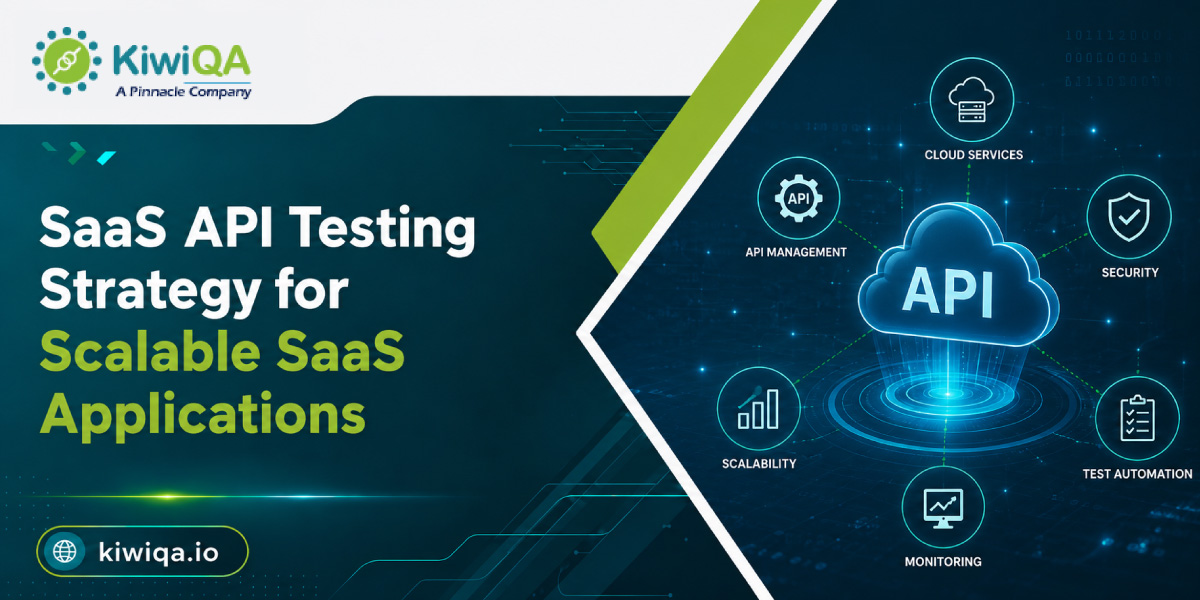
SaaS API Testing Strategy for Scalable SaaS Applications

Advanced SaaS apps rely on APIs to integrate the frontend interface with backend systems, microservices, 3rd-party platforms, and databases. APIs allow necessary functions like data exchange, authentication, payments, and integration across connected services. As SaaS platforms scale, API reliability becomes necessary because high user traffic and rising integration can expose performance, security, and integration errors. 30% more API demand is noticed, as per the report by Gartner.  82% of firms have relied on an API-first approach, based on research.

An organized SaaS API testing strategy allows firms to identify these risks early by verifying API performance, functionality, integration, security, and scalability through the development cycle. It also supports consistent app quality as new features, users, and services are introduced. Firms can use SaaS Testing Services to strengthen automated testing, improve API readability, validate crucial operations, and detect errors before production. A structured approach allows SaaS firms to manage stable app performance, safeguard sensitive data, reduce disruptions, and deliver a stable digital experience as the platform continues to grow. To learn about a well-organized API SaaS testing strategy, read the following sections.

What Is SaaS API Testing?

➥ How APIs Work in SaaS Applications

APIs allow communication and apps to exchange data and execute business functions. In SaaS environments, APIs also integrate 3rd-party platforms, support microservices communications, manage authentication, and allow secure data exchange. Testing these interactions supports requests, responses, integrations, and user management functions operating accurately across the app ecosystem.

➥ Why API Testing Is Important for SaaS Platforms

API testing allows SaaS firms to identify failures before they impact customers or production environments. SaaS testing company helps validate app stability by validating endpoint functionality, integrations, data exchanges, and performance. Frequent testing also supports identifying errors across connected services and reduces production errors. The structured practice ensures APIs remain stable, secure, responsive, and consistent as SaaS apps evolve.

What Is a SaaS API Testing Strategy?

API testing SaaS strategy describes what, when, and how APIs should be tested throughout the development lifecycle.  It establishes testing goals, environments, functional and integration testing, security and performance validation, automation, monitoring, and reporting processes. When integrated with SaaS application testing, the organized practice improves test coverage, identifies risks, and supports reliable SaaS deployment.

Why Scalable SaaS Applications Need a Strong API Testing Strategy

◈ Increasing Number of Users

APIs must manage growing traffic without experiencing performance problems as SaaS applications bring more users. Finding capacity limits, response-time issues, and possible delays is made easier by testing APIs under increasing workloads. As customer demand rises, regular scalability testing guarantees that crucial endpoints stay responsive and stable.

◈ Complex Third-Party Integrations

SaaS apps frequently rely on cloud services, CRM & payment gateways. These integrations are verified for reliable data exchange, authentication, error handling, and compatibility through API testing. This reduces the chance that crucial business processes or customer-facing features will be hampered by integration failures.

◈ Growing Microservices Architecture

SaaS automated testing is crucial for verifying service-to-service communication and dependencies as SaaS platforms grow their microservices architecture. Additionally, it helps in preventing failures that might have an impact on several business processes and application components.

◈ Frequent SaaS Product Updates

Regular SaaS releases may result in API modifications that impact current integrations and functionality. Validation of new releases, API version modifications, and updated workflows is supported by ongoing API testing. Automated regression testing ensures that current endpoints continue to function properly and allows quick product deployments.
Ready to Strengthen Your SaaS API Testing Strategy?

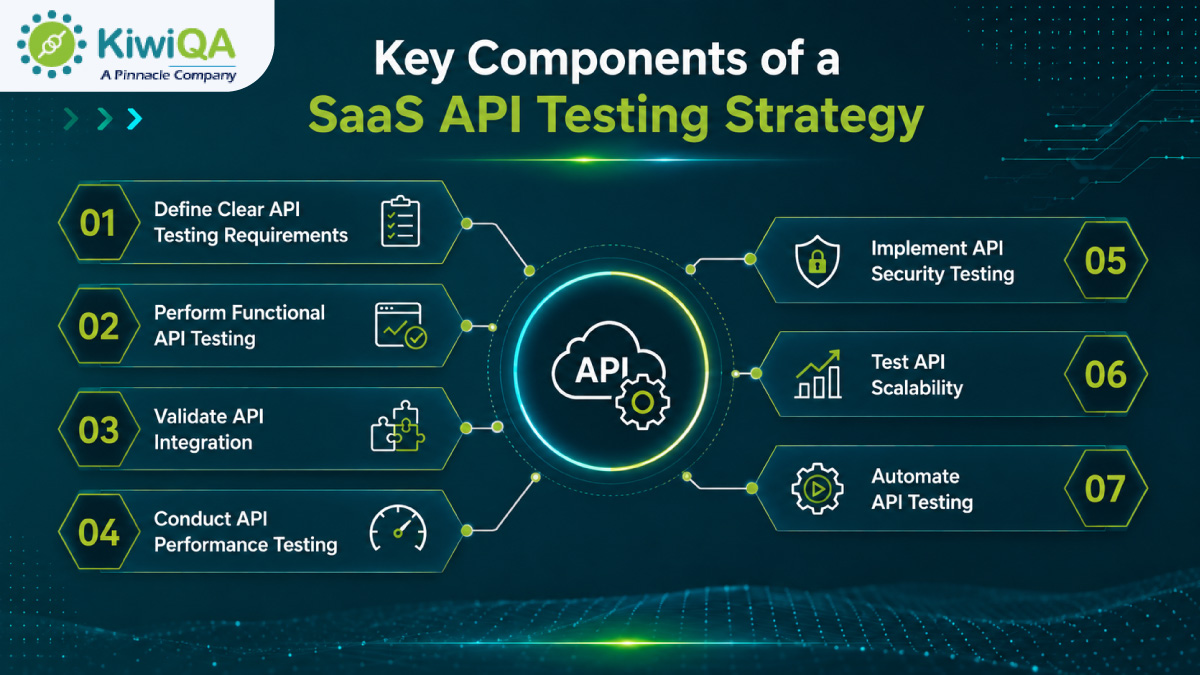
Key Components of a SaaS API Testing Strategy

1. Define Clear API Testing Requirements

Clearly defined testing requirements are the first step in a successful SaaS API testing strategy. Finding business-critical APIs that facilitate crucial application features and client workflows should be your first step. Describe each endpoint’s expected behavior, including response handling, error conditions, expected outputs, and acceptable inputs. 

To create uniform testing standards for development and quality assurance teams, document request and response formats. Based on business requirements, establish performance standards for response times. Early documentation of security requirements, including data protection, access controls, authorization, and authentication, is also important. For functional, performance, integration, security, and scalability testing, well-defined requirements offer a solid basis.

2. Perform Functional API Testing

Functional API testing confirms that APIs carry out their goals precisely and reliably. Test PUT or PATCH requests for updates, POST requests for resource creation, and GET requests to verify data retrieval. To guarantee that resources are appropriately deleted when necessary, DELETE requests should also be verified. 

Verify that APIs return the proper statuses for successful requests, client errors, and server failures by looking at HTTP response codes. Verify response data by comparing it to the expected formats, structures, and values. The proper content types, authentication details, and other necessary parameters should be checked in headers. Additionally, error messages should be examined to make sure they are consistent, accurate, and helpful.

Also Read : A Complete SaaS Testing Approach for Modern Businesses

3. Validate API Integration

Testing for API integration guarantees that APIs interact properly with linked systems and services throughout the SaaS environment. To ensure reliable data exchange and workflow execution, test interactions between internal services. Verify database connectivity to ensure data is updated, retrieved, and stored correctly. It is important to test third-party platform integrations for data consistency, error handling, and compatibility. 

Additional validation for transaction accuracy, failures, and secure processing is essential for payment system integrations. To ensure trustworthy identity verification and access control, authentication providers should be put to the test. In order to guarantee that APIs maintain consistent communication across distributed environments, cloud applications should also be included. Failures that could impact entire business workflows can be found with the help of integration testing.

4. Conduct API Performance Testing

API performance testing evaluates the performance of SaaS APIs under various traffic scenarios. Load testing helps teams assess whether response times are still acceptable by measuring API behavior under expected user and transaction volumes. In order to find breaking points and recovery behavior, stress testing pushes APIs beyond their typical capabilities. 

While endurance testing assesses performance over extended workloads, spike testing assesses how APIs react to unexpected spikes in traffic. Response-time testing helps in locating slow endpoints that could compromise user experience. Throughput testing determines how many requests an API can accept for a certain time period.  Teams can find performance issues before they affect customers by using these tests.

5. Implement API Security Testing

SaaS apps, client data, and interconnected systems are secured from common threats by API security testing. Verify that only valid users and applications are able to access protected endpoints by testing authentication methods. Testing for authorization guarantees that users can only access resources and functions that are authorized. 

Verify input validation, encryption methods, and API tokens to avoid malicious requests and illegal access. To reduce abuse and excessive traffic, rate limiting should be tested. Additionally, teams should examine APIs for sensitive data exposure in error messages, logs, or responses. To find vulnerabilities and improve overall application security, SaaS security testing should be incorporated throughout the API testing lifecycle.

6. Test API Scalability

The ability of SaaS APIs to manage growing traffic without experiencing significant performance degradation is ascertained through API scalability testing. Increase API traffic gradually to see how the system responds to an increase in users and requests. To find restrictions on processing power, connections, or shared resources, test concurrent requests. 

To find out when performance starts to slow down, measure response times at various traffic levels. It is also necessary to identify infrastructure barriers in servers, databases, networks, and supporting services. Verify auto-scaling behavior to make sure that cloud resources grow in response to demand. As customer usage grows, scalability testing helps SaaS companies maintain consistent API performance.
Key Components of a SaaS API Testing Strategy

7. Automate API Testing

Throughout the SaaS development lifecycle, API test automation increases testing coverage, speed, and consistency. Automate routine functional and validation tests so that QA teams can carry them out effectively without the need for human intervention. To find errors early in the development and deployment process, incorporate API tests into CI/CD pipelines. 

When new features, integrations, or code modifications are added, automated regression testing can confirm that the functionality of the API remains the same. To rapidly find unexpected issues, tests should also be conducted following significant code modifications. Automation lowers the possibility of human error and allows for regular testing across development environments. Faster releases are ultimately possible while preserving API quality and reliability thanks to a well-designed automation framework.

SaaS API Testing Strategy Across the Development Lifecycle

🢣 During Development

To find problems before they progress to later testing stages, API SaaS application testing should start during development. Testing individual endpoints, functions, and validation logic separately is known as unit-level API testing. Schema validation verifies that the specified structure, data types, and necessary fields are followed by API requests and responses. 

Early detection of functional defects, inaccurate answers, validation errors, and implementation problems is made possible by developer testing. Defects can be fixed later in the development lifecycle with less expense and effort if testing is performed at this stage. Additionally, it provides developers with instant feedback when API behavior differs from technical specifications. Reliable integrations and later testing activities are strengthened by early testing.

🢣 During Integration

Integration testing confirms that APIs function properly when associated with other platforms, services, and data sources. Service integration testing verifies that requests and responses flow properly between connected services and examines communication between internal application components. Third-party API validation ensures that external integrations correctly manage timeouts, failures, data formats, authentication, and response codes. 

Data flow testing confirms that data is accurately transferred between databases, applications, external systems, and APIs. Compatibility problems that might not show up during isolated endpoint testing are found with the help of these tests. Additionally, testing integrations prior to production lowers the possibility of inconsistent data, broken workflows, and failures across dependent SaaS services.

🢣 Before Production Release

APIs should go through extensive testing to make sure they are prepared for practical use before a SaaS application is released. Regression testing confirms that the functionality of the API has not been impacted by recent changes. Response times, throughput, and behavior under typical and peak workloads are all evaluated through performance testing. 

Authentication, authorization, data security, input validation, and other possible weaknesses are all examined during security testing. Complete business workflows across multiple linked services and endpoints are validated through end-to-end API testing. There is more assurance regarding the reliability and stability of the application when these testing tasks are combined. To reduce production risks, any major errors found during this phase should be fixed and retested prior to deployment.

🢣 After Production Deployment

After deployment, API testing should continue to ensure consistency and identify problems that might arise in real-world scenarios. Continuous visibility into endpoint availability, status, traffic patterns, and failures is made possible by API monitoring. Response-time tracking helps in identifying poor performance that may have an impact on linked apps or user experience. 

Error monitoring identifies recurrent endpoint issues, server problems, unexpected responses, and unsuccessful requests. Teams can identify unusual behavior and react swiftly to incidents with the help of ongoing monitoring. SaaS companies can maintain stable APIs and resolve production issues before they have a major impact on customers by combining monitoring with continuous validation.

Important Types of API Testing for SaaS Applications

❏ Functional API Testing

To make sure APIs function properly, functional API testing confirms endpoint behavior, request handling, response validation, business logic, and error handling.

❏ Integration API Testing

In order to verify secure data exchange, integration API testing verifies communication between databases, third-party platforms, internal services, and APIs.

❏ Regression Testing

Regression testing verifies that after code updates, bug fixes, new features, or integration modifications, the functionality of the current API remains stable.

❏ Performance Testing

Under various workload scenarios and usage levels, performance testing assesses API response times, throughput, resource consumption, and stability.

❏ Load Testing

To find performance limitations under peak traffic, load testing measures how an API behaves under expected traffic volumes and concurrent requests.

❏ Security Testing

Vulnerabilities related to authentication, authorization, encryption, input validation, rate limiting, and sensitive data exposure are found through SaaS security testing.

❏ Reliability Testing

API availability, stability, error recovery, fault tolerance, and consistent performance over long operating times are all evaluated by reliability testing.

❏ Compatibility Testing

Testing for compatibility ensures that APIs function consistently across various platforms, technologies, and versions of connected applications.

❏ Contract Testing

Contract testing confirms that agreed-upon schemas, formats, fields, and service integration requirements are met by API requests and responses.

❏ End-to-End Testing

To guarantee smooth application functionality, end-to-end SaaS automated testing verifies entire business processes across numerous APIs, services, databases, and integrations.

How to Build a Scalable SaaS API Testing Framework

☛ Identify Critical API Workflows

APIs that allow for crucial SaaS processes, such as user registration, login, payments, subscription management, data processing, and third-party integrations, should be given top priority. Issues that could have a direct impact on customer experience, revenue, security, and business operations can be found by testing these crucial workflows first.

☛ Create Reusable Test Cases

To increase testing consistency and reduce duplication, create reusable test cases. Establish shared validation rules, response checks, common authentication techniques, and standard request templates. Expanding test coverage, maintaining automation scripts, and modifying the framework as APIs and SaaS functionality change are all made easier by reusable components.

☛ Separate Test Data and Test Logic

For easier maintenance and scaling of the framework, keep test data and testing logic apart. Use reusable datasets and set up environment-specific variables for production and development. This method allows the same tests to run in different environments, streamlines updates, and lowers errors.

☛ Integrate API Testing with CI/CD

Continuous validation during development and deployment can be achieved by incorporating automated API tests into CI/CD pipelines. Code changes, pull requests, staging deployments, and production releases are all possible times for tests to run. As applications change, this helps teams identify API flaws early, avoid unstable releases, and maintain consistent quality.

SaaS API Testing Metrics Businesses Should Track

Organizations must monitor key SaaS API testing metrics to measure reliability, performance, and quality. API response time & latency describe how quickly endpoints respond, whereas API availability calculates accessibility and uptime. Error rate and failed request percentage allow you to identify recurring failures and unstable endpoints. 

Request throughput and concurrent user capacity showcase how effectively APIs manage traffic and rising demands. Test coverage measures functionality, whereas error detection rate shows the effectiveness of testing. Mean time to detect API failures allows the team to monitor production errors quickly and respond before they impact users.

Also Read : Best 11 SaaS Testing Companies in India (Edition 2026)

How SaaS API Testing Supports Application Scalability

▪ Support growing user bases- SaaS API testing validates that APIs can manage increasing users, transactions, and requests without performance errors.

▪ Maintain API response times– Testing identifies slow endpoints and performance errors before they affect users.

▪ Prevent service disruptions– It identifies capacity errors, failures, and unstable integrations before production release.

▪ Improve system reliability- Test API stability, error handling, and recovery under various conditions.

▪ Handle peak traffic– It evaluates API performance during peak traffic and high-demand periods.

▪ Support microservices expansion– QA ensures the API communicates reliably as businesses add integrations and app components.

▪ Reduce production defects– Automated testing catches integration, functional, security, and performance errors earlier.

▪ Improve customer experience– Reliable & responsive APIs allow delivering smooth application performance and consistency in user interactions.
Ready to Build a Scalable SaaS Testing Strategy?

Build a Reliable SaaS API Testing Strategy for Long-Term Scalability

Reliable API testing services for SaaS applications allow firms to prepare their apps for sustained growth and changing user demands. Identify security, performance, and integration errors before release to reduce production errors and service disruptions. It is good to develop a scalable testing process that aligns with rising SaaS architecture, improving users, integrations, and feature releases. Automated & continuous API testing allows reliability by validating crucial operations throughout development. 

Collaboration with a professional SaaS testing company can offer specialized expertise, performance validation, security assessment, and continuous quality assurance. With the following organized approaches, firms can strengthen API stability, support scalability, and deliver consistent app experiences as SaaS platforms expand.

A Complete SaaS Testing Approach for Modern Businesses

SaaS apps are necessary to modern business workflows. The requirement for premium, consistent software rises along with the desire for cloud-driven solutions. More than 40% of firms report losing more than $1 million annually due to poor software quality. SaaS testing measures that your service matches performance, functionality, and security. SaaS Testing Services makes sure your software is in optimal condition before release. Read the blog to know a structured approach for modern business.

What Is SaaS Testing?

The process of confirming that a Software-as-a-Service application operates accurately, efficiently, maintains security, and provides a consistent user experience is known as SaaS testing. SaaS testing company ensures the application satisfies business needs and customer expectations both before and after deployment.  The testing is required for validating features, integrations, scalability, and reliability across various devices, browsers, and user environments.

Why Modern Businesses Need a SaaS Testing Approach

➥ Ensure Consistent Application Performance

To guarantee quick response times and stability, a robust SaaS testing strategy verifies application performance under various workloads. It keeps a dependable experience even during periods of high traffic by assisting in the early detection of slow pages, resource bottlenecks, and performance problems.

➥ Protect Customer and Business Data

SaaS application testing assists in locating security flaws, confirming access controls across several tenants, and validating user permissions. Frequent testing lowers security risks, safeguards private client and company information, and guarantees adherence to data privacy laws and industry standards.

➥ Deliver a Reliable User Experience

Testing boosts customer satisfaction and enhances long-term user retention by early detection of usability problems, broken workflows, and navigation issues.

➥ Support Continuous Product Updates

Businesses can confidently release new features without affecting current functionality when they have a clear SaaS testing strategy. Automated and regression testing for continuous validation facilitates quicker deployments, enhances software quality, and lowers the possibility of production flaws following each update.

Ready to Strengthen Your SaaS Testing Strategy?

Key Challenges in SaaS Application Testing

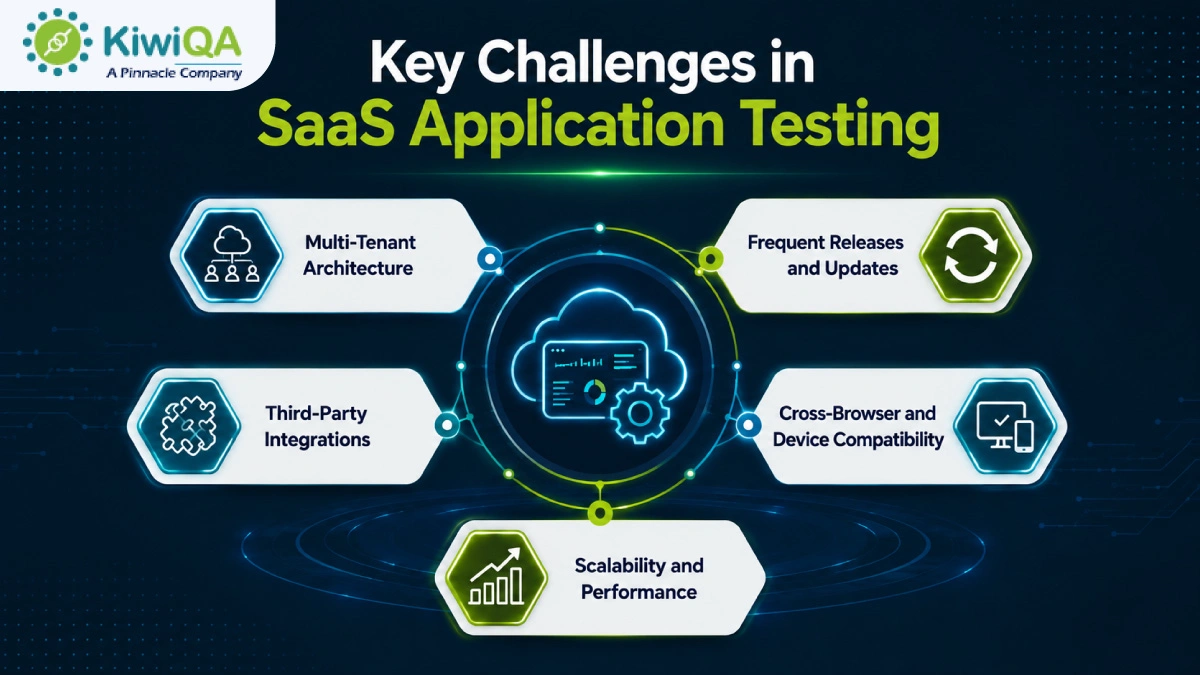
◈ Multi-Tenant Architecture

One of the most difficult aspects of SaaS security testing is multi-tenant architecture, which allows several clients to share an application while maintaining data isolation. To stop unwanted access, testing should confirm user permissions, secure data separation, and tenant-specific configurations. Additionally, QA teams must confirm that changes made do not impact other customers’ data, functionality, or performance.

◈ Frequent Releases and Updates

Continuous testing is crucial because SaaS applications are updated often. In order to prevent defects from being introduced by new features and bug fixes, QA teams must manage shorter testing cycles while maintaining thorough regression coverage. Automated testing is essential for swiftly validating changes without postponing releases. A carefully planned testing procedure helps in maintaining software quality.

◈ Third-Party Integrations

Third-party services like payment gateways, CRMs, analytics platforms, and communication tools are essential to the majority of SaaS applications. Validating APIs, data synchronization, authentication, and system responses in various scenarios are all part of testing these integrations. Additionally, QA teams need to assess how the application responds to slow or unavailable external services. Reliable integration testing guarantees continuous business operations and avoids data inconsistencies.

◈ Cross-Browser and Device Compatibility

Compatibility testing is crucial because users access SaaS applications from a variety of browsers, devices, and OS. QA teams should confirm that desktop, tablet, and mobile platforms all have consistent functionality, layout, and performance. Prior to release, testing various screen sizes, browser versions, and operating systems helps in identifying display and usability issues. This guarantees that every customer, regardless of device, will have a smooth experience.

Key Challenges in SaaS Application Testing

◈ Scalability and Performance

SaaS platforms must continue to provide quick performance as customer demand increases. To find bottlenecks before they impact production, SaaS application testing should mimic growing user traffic, massive datasets, and peak workloads. Assessing response times, resource usage, and infrastructure performance helps guarantee that the application scales effectively. Thorough scalability testing helps businesses expand while preserving a stable user experience.

A Step-by-Step SaaS Testing Approach

Step 1: Understand Business and User Requirements

Every effective SaaS testing approach procedure begins with a thorough comprehension of user expectations and business objectives. Determine the most important workflows in the application, examine various user roles and permissions, and specify the behavior of each feature. Pay attention to high-risk features that have an immediate effect on revenue or customers. This foundation assists QA teams in developing suitable test cases and guaranteeing that the application provides the anticipated business value.

Step 2: Define the SaaS Testing Strategy

A carefully thought-out testing strategy guarantees that each testing task is in line with the project’s goals. Determine which areas need automated or manual testing, specify testing environments, establish criteria for each testing phase, and set clear testing goals. Throughout the SDLC, an organized approach guarantees that the SaaS application is assessed consistently. It enhances collaboration and minimizes testing gaps.

Also Read : Best 11 SaaS Testing Companies in India (Edition 2026)

Step 3: Prepare the Test Environment

To produce accurate results, a trustworthy test environment should closely mimic the production setup. Before execution starts, set up test accounts, user roles, permissions, and realistic datasets. To properly validate application behavior, integrate all necessary testing tools and supporting systems. In addition to increasing testing accuracy and decreasing false failures, proper environment preparation helps in identifying environment-specific problems prior to deployment.

Step 4: Design Test Scenarios and Test Cases

Well-designed test scenarios incorporate edge-case scenarios to verify how the application behaves in various scenarios. Give customer-critical processes like data processing, account management, and payments top priority. Reusable test cases increase productivity, facilitate regression testing, and lessen the work required for upcoming software releases.

Step 5: Execute Functional Testing

Functional testing, the SaaS testing methodology, confirms that each feature operates in accordance with technical and business requirements. Verify critical features like billing, dashboards, reports, notifications, subscription management, user registration, and login. Verify that workflows work properly on various devices and user roles. Early detection of functional flaws increases application performance and guarantees that users encounter consistent, expected behavior across the platform.

Step 6: Perform Integration and API Testing

Both these factors make a strong impact in modern SaaS applications. Check that data exchanges between connected systems, authentication, and API requests and responses function properly. Verify data accuracy, error management, and recovery procedures in the event that integrations are unsuccessful. Extensive integration testing guarantees that external services operate smoothly within the application ecosystem. It avoids communication problems and preserves data consistency.

Step 7: Conduct Performance and Scalability Testing

Performance QA measures the app’s performance under traffic. To evaluate response times, resource usage, and system stability, conduct load, stress, and endurance testing. Determine whether the platform can effectively scale as customer demand rises and find issues with performance before they have an impact on users. This QA guarantees long-term business growth and steady performance.

Step 8: Perform Security Testing

Sensitive client and corporate data is protected from possible threats by security testing. Verify encryption, authorization, authentication, and safe data transfer throughout the application. Prior to release, identify potential attack points, misconfigurations, and vulnerabilities. Verify adherence to relevant industry rules and security guidelines. Frequent security testing lowers the possibility of expensive security incidents and increases customer trust.

Step 9: Test Usability and Accessibility

Testing for usability and accessibility guarantees that the SaaS application is user-friendly for every client. Examine forms, buttons, interactive elements, navigation, and interface consistency across devices. Enhancing usability promotes user adoption and retention, along with customer satisfaction.

Step 10: Automate Regression Testing

Regression testing makes sure that new updates don’t cause flaws in the functionality that already exists. To increase testing consistency and speed, automate high-priority and repetitive test cases. Include automated tests in CI/CD pipelines so that they run following each significant change to the code. Maintain automation scripts on a regular basis to keep them reliable, cut down on manual labor, and speed up software release cycles.

Step 11: Conduct User Acceptance Testing

Before the application is deployed, SaaS user acceptance testing verifies that it satisfies actual business needs. Test real-world scenarios and business workflows with key customers, stakeholders, and business users. Obtain useful input, identify usability issues, and verify that the program meets functional requirements. A successful UAT lowers the possibility of post-release problems and boosts deployment confidence.

Step 12: Monitor the Application After Release

To preserve application quality, testing should continue even after deployment. Use real-time monitoring tools to maintain system availability, performance, failed transactions, and application errors. Examine production incidents and customer feedback to find areas for improvement. Maintaining software reliability, raising customer satisfaction, and supporting continuous product improvements can be obtained by regularly updating test cases.

Essential Types of SaaS Testing

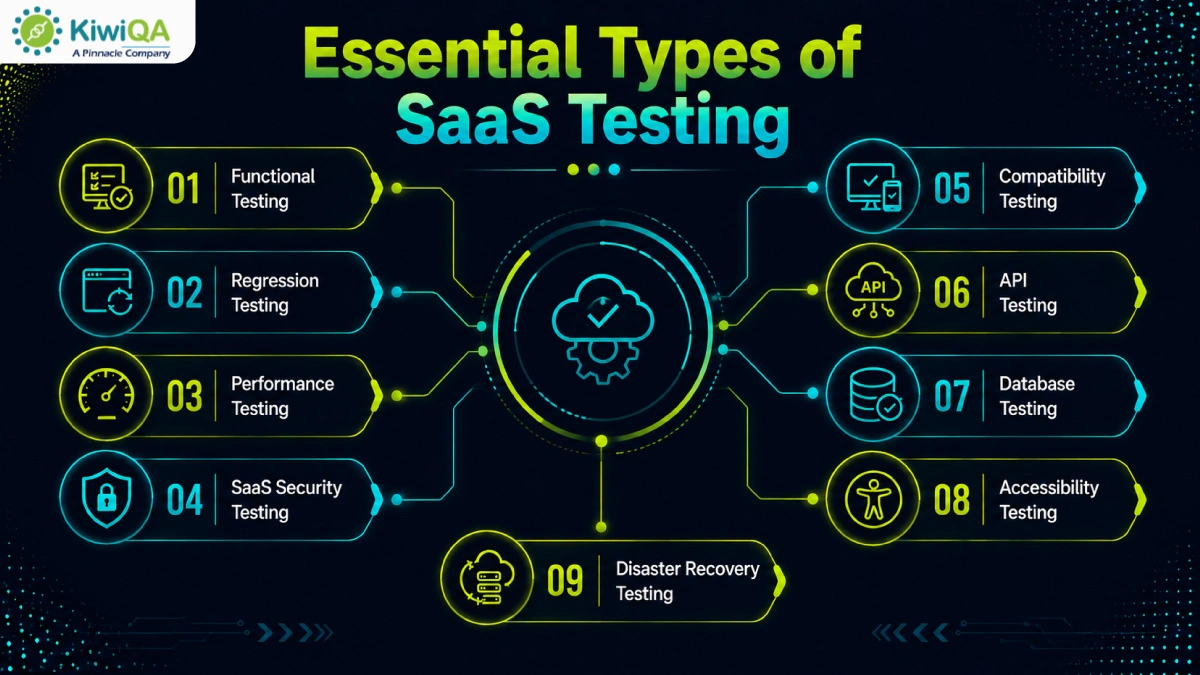
🢣 Functional Testing

Functional testing confirms that each feature of the application operates in accordance with the specified business requirements. To guarantee desired results, it assesses user workflows, system behavior, reports, and essential functionalities. This testing validates business logic across various scenarios and verifies that users can perform critical tasks without error. By guaranteeing consistent app performance, functional testing serves as the foundation of SaaS quality assurance.

🢣 Regression Testing

Regression testing makes sure that updates, bug fixes, and new features don’t interfere with existing functionality. After each code change, QA teams review crucial workflows to find unforeseen flaws. Regression tests are performed to increase consistency and speed. Frequent regression testing promotes quicker, faster software releases, lessens production problems, and maintains application stability.

Essential Types of SaaS Testing

🢣 Performance Testing

Performance testing evaluates a SaaS application’s responsiveness under various workloads. It assesses response times, throughput, resource usage, and general stability at high user traffic levels. In order to guarantee that the program can accommodate growing user numbers without experiencing performance issues, testing also confirms scalability. Early bottleneck identification contributes to a quicker and more responsive customer experience.

🢣 Security Testing

Vulnerabilities that may expose private company or client data are found through SaaS security testing. It verifies authorization, encryption, access controls, authentication, and protection against frequent online threats. Additionally, SaaS security testing guarantees adherence to industry standards. Frequent security evaluations lower risks, increase application resilience, and boost customer trust.

🢣 Compatibility Testing

Testing for compatibility guarantees that the SaaS application works reliably on a variety of devices, OS, browsers, and screen sizes. Before deployment, testing finds compatibility issues, display inconsistencies, and browser-specific problems. In a variety of user environments, this procedure enhances accessibility, usability, and customer satisfaction.

🢣 API Testing

API SaaS automated testing verifies the performance and functionality of application programming interfaces that link various systems. Additionally, API testing guarantees that integrations with third-party apps operate properly in various contexts. Early detection of API problems enhances system stability and avoids integration failures. It ensures accurate data exchange between linked services.

🢣 Database Testing

Database testing confirms that data is correctly processed, stored, and retrieved throughout the SaaS application. Database transactions, data consistency, integrity, and query performance are all validated. Additionally, testing verifies backup, restoration, and recovery protocols to safeguard vital business data. Reliable application operations are supported by efficient database testing, which lowers the risk of data loss.

🢣 Accessibility Testing

Accessibility testing guarantees that users of various abilities can utilize the application efficiently. In comparison to established accessibility standards, it assesses keyboard navigation, screen-reader compatibility, color contrast, content structure, and interactive elements. When necessary, this SaaS testing process supports legal compliance while enhancing usability for a wider audience.

🢣 Disaster Recovery Testing

The organization’s capacity to restore SaaS services following unanticipated disruptions is validated through disaster recovery testing. It confirms business continuity plans, recovery time goals, restoration protocols, and backup integrity. Frequent testing guarantees that vital systems and client data can be promptly restored with minimal downtime. An effective disaster recovery plan lessens the impact of unexpected events on business and increases operational resilience.

Also Read : Top 15 SaaS Testing Tools for Faster and Scalable QA in 2026

Manual Testing vs Automated Testing for SaaS Applications

❏ When to Use Manual Testing

For exploratory testing, usability evaluations, and the validation of recently created features, manual testing is the best option. It is especially helpful in complicated or dynamic workflows where human judgment is crucial. Usability problems, unexpected behaviors, and real-world user experience issues that automated scripts might find difficult to identify can be found through manual testing.

❏ When to Use Automated Testing

Regression testing, repeated test scenarios, cross-browser validation, API testing, performance testing, and CI/CD pipeline verification are the best uses for SaaS automated testing. Faster software releases and dependable validation following each code change are made possible by automation, which increases testing speed, consistency, and coverage while lowering manual labor.

❏ Building a Balanced Testing Model

Automation and manual testing are combined in an efficient model for SaaS testing strategy. Automate high-volume, repetitive, and stable test cases; for exploratory, usability, and customer-focused assessments, use manual testing. To maximize software quality, regularly assess automation coverage and match testing initiatives with business priorities.

Ready to Build a Reliable SaaS Testing Roadmap?

Build a Reliable SaaS Product with the Right Testing Approach

As the demand for SaaS apps is growing and the necessity for robust & comprehensive QA is rising. From validating scalability & security to optimizing performance and user experience, SaaS QA is integral to managing the quality & app integrity. By adopting these necessary practices, businesses can safeguard their app. Collaborate with a SaaS testing company to keep your app ready for 2026 and beyond.

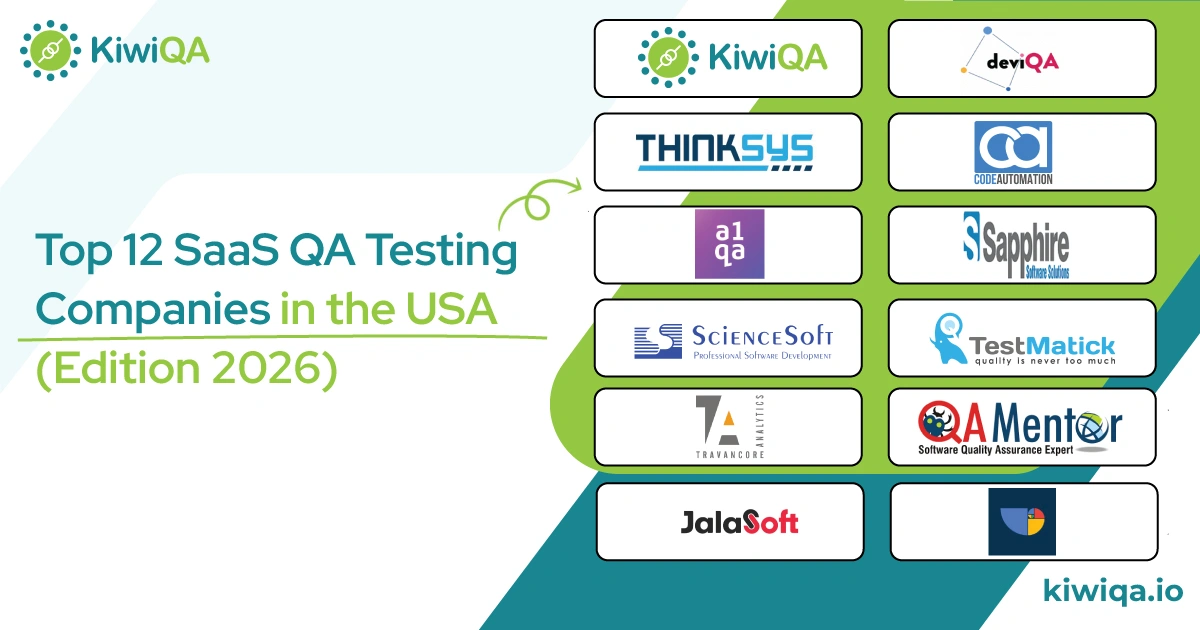
Top 12 SaaS QA Testing Companies in the USA (Edition 2026)

SaaS in 2026 will be defined by scale, speed, and evolution in leaps and bounds. The global SaaS market is expected to approach $465 billion by 2026, driven by increased cloud adoption and rapid AI integration. More than 90% of enterprises now use SaaS platforms as their primary system for essential business operations. This is a clear shift. SaaS is no longer a flexible option for businesses. Software development and delivery have achieved a new standard through the establishment of SaaS as the preferred method.

With this dependence, the margin for failure becomes incredibly small. SaaS products need to provide the same consistent functionality with the same updates for all users, on all devices, in all environments. This is also why software QA consulting services are critical. Modern QA goes beyond simply identifying bugs. QA is all about creating product consistency and a positive user experience for the entire product lifecycle.

QA also plays a critical role in customer retention for SaaS businesses. On average, SaaS companies experience monthly churn rates between 3% and 5%. Even small issues like performance slowdowns, downtime, or missing functionality can lead users to switch platforms, directly affecting subscription-based revenue. This is where reliable SaaS Testing Services become essential. Strong QA processes help identify and fix issues before they impact users, ensuring a stable, secure, and consistent product experience over time.

Many SaaS businesses are turning to SaaS QA Testing Companies in the USA as a practical and strategic solution. Building an in-house QA team with expertise in automation, cloud environments, and performance testing demands significant time and investment. By partnering with experienced providers, companies gain immediate access to skilled professionals and proven testing methodologies that can scale with upcoming releases. This allows product teams to stay focused on innovation while maintaining high standards of software quality.

The list of the best QA testing SaaS companies in the United States for 2026 was created through actual testing criteria evaluation. The assessment includes evaluation of technical skills, evaluation of SaaS experience, evaluation of system growth capabilities, assessment of client opinions, and evaluation of new testing methods, which include AI-powered automation. The companies showcased in this guide span several industries, such as enterprise SaaS, e-commerce, healthcare, and fintech. This means the guide is relevant to companies at various development phases, enhancing their QA processes.

Why SaaS QA Testing is Critical in 2026

SaaS QA testing in 2026 becomes vital because applications work in distributed environments that experience rapid changes, and minor defects create service outages, which can affect thousands of users and disrupt business operations, therefore requiring organizations to implement ongoing testing protocols.

◈ Increasing Complexity of SaaS Applications

➥ Microservices Architecture

Many modern SaaS platforms are built on microservices architecture, where multiple independent services communicate through APIs to deliver seamless functionality. While this approach improves scalability and flexibility, it also introduces multiple points of failure. Even a minor bug in one service can impact the entire system performance. A well-planned SaaS Testing Strategy is essential to ensure smooth service communication, accurate data consistency, reliable failure detection, and stable distributed system performance. Effective QA processes help engineering teams identify integration issues early and maintain a secure, high-performing SaaS platform.

➥ Cloud-Native Environments

SaaS applications at present use cloud-native infrastructures for their deployment through container-based systems and orchestration tools. The systems operate with constant changes because they need to adjust their capacity and system settings throughout the day. The testing process requires validation through multiple cloud environments, various network conditions, and different resource usage scenarios to achieve dependable performance results.

➥ Multi-Device Compatibility

The users of SaaS products use different devices and browsers along with different operating systems to access the software. The task of maintaining consistent functionality across different testing environments presents significant challenges. The QA team needs to test responsive design together with performance differences and feature operation on different platforms to stop users from experiencing fragmented product use, which leads to decreased engagement and product trust.

◈ Rise of AI & Automation in Testing

➥ AI-driven testing tools

AI-powered testing tools are changing how SaaS apps get validated. The tools assess user actions and risk areas and optimize testing. When software QA consulting services include these tools, businesses can error-proof and reduce manual testing, enabling them to focus on testing that has the greatest impact.

➥ Self-healing test automation

One major concern about test automation is the self-updating scripts. Due to the constant new changes to the UI, automation scripts require frequent updates. Self-healing automation assures a smooth and uninterrupted testing phase as the automation scripts update in accordance with the changes that occur to the application without needing the QA team to rewrite them.

➥ Faster release cycles

The development teams of SaaS companies need to implement DevOps and agile methodologies to deliver software updates at a fast pace. The automated system allows multiple tests to run at the same time while providing immediate results and connecting with CI/CD systems. The process enables teams to test new features rapidly without causing delays in deployment, which allows them to maintain their development speed while delivering consistent and trustworthy software updates.

◈ Business Impact

➥ Reduced production failures

Comprehensive QA strategies work to identify issues before deployment, and as a result, the risk of failures occurring in a live environment is significantly reduced. This becomes even more critical for SaaS platforms because a single error can cause an issue for thousands of users. A dependable SaaS testing company in the USA will ensure that testing is done to reduce the uncertainty of workflows and to mitigate the possible impact.

➥ Improved customer experience

Users have a higher expectation for SaaS-based products. If a product performs slowly, has bugs, or has unexpected behavior, it can result in the customers being unsatisfied. Quality Assurance will ensure that applications perform consistently, respond on time, and perform in a reliable manner. These factors will serve to increase customer satisfaction and retention and will increase the overall credibility of the company.

➥ Faster time-to-market

The development process becomes more efficient through effective QA methods, which detect defects early and decrease the need for rework. Through continuous testing, teams gain the ability to release new features with both confidence and regularity. SaaS businesses obtain a competitive edge because their fast response system enables them to meet market needs while delivering high-quality products.

Ready to Ensure Bug-Free SaaS Performance Now

Key Criteria for Selecting Top QA Companies

Choosing the best QA firms means evaluating beyond just the tools and the years of experience. This involves assessing their capacity to sync testing with the product’s architecture, release cycles, and the requirements of future growth, within the scenario of multi-tenant SaaS.

❏ Technical Expertise

🢣 Automation tools (Selenium, Playwright, etc.)

A hallmark of the best QA firms is a demonstrable, practical experience in the latest automation tools, Selenium, and Playwright. As with other automation tools, the firms’ real worth is determined by how they construct the tool around the automation framework. They develop automation suites that can scale and maintain their operations while integrating with continuous integration pipelines to achieve automated testing, which executes software testing and validation processes in complex SaaS environments that undergo multiple software releases.

🢣 API, performance, and security testing

The leading QA providers work beyond functional testing to validate APIs and system performance under load and application security. The team creates simulations of actual user traffic to assess endpoint reliability while conducting tests that discover security weaknesses at an early stage. The comprehensive approach maintains operational stability and system security and application responsiveness of SaaS platforms through extensive user testing and secure data operations.

❏ SaaS Domain Experience

🢣 Multi-tenant architecture testing

SaaS platforms operate using multi-tenant architectures, which enable multiple users to share a single system while their data remains protected from others. The QA team needs to test elements such as tenant separation, access control functions, and data protection measures. The testing process needs specialized methods to guarantee that one user can complete their tasks without disrupting the operations of other users, while the platform maintains its trustworthiness and compliance standards.

🢣 Cloud & DevOps integration

The experienced QA companies operate effectively in both cloud-based environments and DevOps-driven environments. They implement testing procedures throughout the CI/CD pipelines to achieve ongoing code change validation. The system provides rapid feedback to development teams while decreasing deployment hazards and enabling efficient teamwork between development personnel and QA personnel during rapid SaaS development cycles.

❏ Scalability & Flexibility

🢣 Dedicated QA teams

The top SaaS QA providers deliver dedicated teams that work together with in-house development units to create persistent operational connections and maintain product knowledge. The teams execute established testing procedures while they handle testing materials and synchronize their work with the sprint schedule. The dedicated system improves responsibility for tasks, which helps teams solve problems faster while they work on product development that requires extensive time for training new staff members.

🢣 On-demand testing models

SaaS companies use on-demand testing models to adjust their quality assurance testing procedures according to their product release schedules, software updates, and their periods of maximum operational capacity. The testing process requires a software testing consultant to evaluate testing needs and organize resources for testing purposes while achieving complete test coverage without incurring high costs for future operations.

❏ Client Reviews & Reputation

🢣 Ratings (Clutch, G2)

The client ratings on Clutch and G2 platforms provide essential information about a company’s trustworthiness and operational effectiveness. High ratings show that a business consistently delivers results while providing effective communication and demonstrating technical expertise. The platforms deliver complete feedback, which enables businesses to assess whether a QA company meets their specific needs and project requirements.

🢣 Case studies & testimonials

Case studies and client testimonials demonstrate how a company operates through its authentic proof of operational capabilities. The system shows actual problems that were solved through implemented solutions and produced measurable results. Businesses can use these examples to evaluate how a QA provider handles complex SaaS projects to determine whether the provider can achieve the same results in similar situations.

❏ Innovation & AI Adoption

🢣 AI-driven QA frameworks

Forward-thinking QA firms adopt AI-powered frameworks to improve testing speed and precision. The frameworks use their ability to analyze application behavior for test case prioritization and abnormality detection, which exceeds the speed of conventional testing methods. The approach improves testing efficiency because it decreases testing duration while increasing testing coverage, which makes it essential for testing fast-developing SaaS applications.

🢣 Shift-left testing approaches

Shift-left testing requires QA testing to begin during the initial development phase. The QA teams work together with the development team from the project start to find problems before they become major issues. The method decreases the need for rework while minimizing expenses and establishing product quality from the beginning instead of delaying its development.

Top SaaS QA Testing Companies in the USA (2026 List)

The list below shows the leading SaaS QA testing companies in the United States for 2026. They have been selected based on their proven expertise and SaaS domain experience, and their ability to scale and deliver results across complex software systems that operate at high growth.

1. KiwiQA

KiwiQA

The company delivers complete quality assurance services to software as a service, web, and mobile platforms while specializing in automated testing and ongoing test processes. The company emphasizes structured testing processes, reusable frameworks, and performance validation. SaaS companies can enhance their release quality and decrease defects while achieving system stability throughout their fast-changing application environments according to their methodology.

SR. No. Key Points Services Provided
1 Founded Year: 2009 SaaS QA testing
2 Number of Employees: 51-200 Mobile Testing
3 Location: India (Serving USA) Security Testing
4 LinkedIn: View Profile Functional Testing
5 Website: KiwiQA_IO Performance Testing

2. DeviQA

DeviQA

The company provides testing services through its intelligent automation system, which maintains testing operations for its customers. The company provides testing services for Software as a Service (SaaS) products through its complete testing process, which includes functional testing, API testing, and performance testing. The solution enables businesses to decrease their testing time while maintaining their product quality because it makes testing more efficient through automated processes.

SR. No. Key Points Services Provided
1 Founded Year: 2010 SaaS QA testing
2 Number of Employees: 201-500 Performance & Security Testing
3 Location: USA QA Consulting & Audit
4 LinkedIn: View Profile QA Outsourcing Models

3. ThinkSys

ThinkSys

ThinkSys provides complete quality assurance and automation solutions for software as a service and enterprise systems while demonstrating expertise in testing functional API and performance components. The company develops scalable testing systems that enable quality assurance integration with agile development processes. This company is one of the best software testing consulting companies that helps businesses enhance their product stability and build confidence through its services.

SR. No. Key Points Services Provided
1 Founded Year: 2012 SaaS QA testing
2 Number of Employees: 201-500 Test Automation & AI QA
3 Location: USA Performance & Security Testing
4 LinkedIn: View Profile QA Outsourcing

4. CodeAutomation.ai

CodeAutomation.ai

CodeAutomation.ai provides efficient quality assurance testing solutions that are designed for contemporary SAAS applications. The platform delivers automation-based testing solutions that work together with human testing processes to achieve testing accuracy during software releases. The company functions as a developing SaaS testing company in the USA, which enables fast product launches while sustaining product reliability and controlling regression risks.

SR. No. Key Points Services Provided
1 Founded Year: 2018 SaaS QA testing
2 Number of Employees: 11-50 Software Testing & QA
3 Location: USA AI & Test Automation
4 LinkedIn: View Profile Custom Software Development

5. a1qa

a1qa

The company a1qa offers its complete quality engineering services through its extensive knowledge of SaaS platforms and enterprise system operations. The company supports clients with managed testing, automation, and performance validation. The SaaS testing agency in the USA provides testing services that implement organized quality assurance methods to improve product reliability, scalability, and long-term supportability.

SR. No. Key Points Services Provided
1 Founded Year: 2003 SaaS QA testing
2 Number of Employees: 1,001-5,000 Test Automation & AI QA
3 Location: USA Performance & Security Testing
4 LinkedIn: View Profile QA Outsourcing Models

6. Sapphire Software Solutions

a1qa

Sapphire Software Solutions provides complete software development services to create dependable and expandable software applications. The company offers testing services through its quality assurance team, which conducts functional testing, automated testing, and performance testing for software-as-a-service platforms. The company operates in various sectors to assist organizations in maintaining their quality standards while they adjust to new technological advancements and changing customer requirements.

SR. No. Key Points Services Provided
1 Founded Year: 2002 SaaS QA testing
2 Number of Employees: 201-500 AI-Powered Software Development
3 Location: USA Mobile App Development
4 LinkedIn: View Profile QA & Testing Services

7. ScienceSoft

ScienceSoft

ScienceSoft provides complete QA and testing services to its clients who need solutions for their complicated software systems. The company provides structured testing solutions, which include testing automation, security testing, and performance testing to support SaaS applications. The company maintains a disciplined work method, which enables organizations to achieve dependable software releases that will maintain their performance throughout critical situations.

SR. No. Key Points Services Provided
1 Founded Year: 1989 SaaS QA testing
2 Number of Employees: 501-1,000 Software Testing & QA
3 Location: USA Test Automation & Continuous Testing
4 LinkedIn: View Profile Performance & Security Testing

8. TestMatick

TestMatick

TestMatick provides dedicated quality assurance services that deliver flexible testing capabilities through precise test execution methods. It provides support for SaaS applications through three testing methods, which include functional testing, regression testing, and usability testing. The company emphasizes clear communication, quick onboarding, and consistent delivery to assist businesses in maintaining their product quality and user satisfaction.

SR. No. Key Points Services Provided
1 Founded Year: 2009 SaaS QA testing
2 Number of Employees: 51-200 Software Testing & QA
3 Location: USA Performance & Security Testing
4 LinkedIn: View Profile QA Outsourcing Services

9. Travancore Analytics

Travancore Analytics

The company delivers engineering and quality assurance services to software-as-a-service and enterprise application clients, with particular expertise in automated testing and cloud-based testing methods. The teams implement testing procedures within development processes to maintain product quality throughout their development. The company develops solutions for advanced systems that require testing of scalability, performance, and creation of dependable user experiences.

SR. No. Key Points Services Provided
1 Founded Year: 2007 SaaS QA testing
2 Number of Employees: 201-500 QA & Testing Services
3 Location: USA AI / ML & Data Solutions
4 LinkedIn: View Profile DevOps & Cloud

10. QA Mentor

QA Mentor

QA Mentor provides various quality assurance testing services, which it customizes to meet the specific requirements of different projects. The company uses established testing procedures and adaptable testing methods to conduct its testing operations. The company helps software as a service platforms by increasing their testing capacity while decreasing service failures and maintaining system performance across different user levels.

SR. No. Key Points Services Provided
1 Founded Year: 2010 SaaS QA testing
2 Number of Employees: 201-500 Software Testing & QA
3 Location: USA Test Automation & Continuous Testing
4 LinkedIn: View Profile Performance & Security Testing

11. Jalasoft

Jalasoft

Jalasoft provides software development and quality assurance services that focus on building long-term partnerships with its clients while maintaining consistent technical standards. The company’s QA teams deliver support for SaaS products through their work in automation testing, performance evaluation, and continuous integration development. The company helps businesses achieve efficient scaling by delivering high-quality software maintenance that remains stable throughout their ongoing product development.

SR. No. Key Points Services Provided
1 Founded Year: 2001 SaaS QA testing
2 Number of Employees: 1,001-5,000 QA & Testing Services
3 Location: USA DevOps & Cloud Services
4 LinkedIn: View Profile Staff Augmentation

12. OnPath Testing

OnPath Testing

OnPath Testing focuses on delivering practical and adaptable QA solutions for SaaS applications. The company provides both manual testing and automated testing services, which meet agile testing requirements. The company helps businesses protect product reliability through its dedication to transparent communication, efficient work processes, and ongoing enhancements.

SR. No. Key Points Services Provided
1 Founded Year: 2009 SaaS QA testing
2 Number of Employees: 11-50 Software Testing & QA
3 Location: USA Test Automation
4 LinkedIn: View Profile Performance & Security Testing

Benefits of Hiring a SaaS QA Testing Company

The process of outsourcing QA testing services brings organizations advantages such as structured testing procedures, established testing methodologies, and professional testing teams who execute testing according to fast-paced SaaS development requirements. The solution enables organizations to sustain product quality while their teams continue to develop new features, which result in stable and scalable products that meet user needs in competitive digital markets.

☛ Faster product releases

The specialized SaaS Testing Company in the USA provides testing services that enable organizations to speed up their product release processes through test integration with their agile and CI/CD development systems. Development teams can validate their work through testing, which occurs simultaneously with their development process. The process enables teams to deliver updates while maintaining system stability and product performance because it helps them discover problems at an early stage and reduces production delays.

☛ Cost savings vs in-house teams

The expenses of running an in-house QA team, which include hiring costs, training expenses, infrastructure needs, and tool licensing fees, create financial burdens for organizations. The employment of a QA provider lets companies save all these operational expenses, while they gain instant access to the provider’s existing systems and equipment. The testing services remain under budget control for businesses because they pay only for essential testing services, which allow them to maintain quality standards throughout their developing SaaS products.

☛ Access to expert testers

The experienced testers in QA companies, who specialize in different testing areas, bring their expertise to testing work, which includes automation testing, performance testing, and security testing. The professionals possess knowledge about the specific challenges faced by SaaS platforms, which include multi-tenant environments and cloud-based systems. Their expertise enables quicker identification of concealed problems, while their testing strategies test development practices and actual operational conditions.

☛ Better test coverage

Structured QA teams are there to ensure that every application layer is covered completely by the various testing methodologies that are available. The testing cycle covers functional checks, integration validation, regression analysis, and usability evaluation. The team achieves defect detection through component testing, which helps them confirm product performance across different devices, environments, and user conditions.

☛ Continuous testing support

SaaS products require continuous testing because they need regular updates. The QA partners deliver 24-hour testing services, which they embed into the development pipelines. The system verifies every code change through immediate testing, which prevents problems from building up. Continuous testing improves release reliability while maintaining product stability and enabling long-term scalability without interrupting current development work.

Future Trends in SaaS QA Testing (2026 & Beyond)

SaaS QA testing now employs predictive data-based validation methods, which require ongoing testing updates that respond to changes in applications, user activities, and infrastructure operations. The teams have transitioned from using fixed testing schedules to implementing intelligent quality assessment systems that function continuously and progress with product development.

☢ AI-powered testing is becoming standard

Artificial intelligence technology now enables quality assurance processes to perform advanced decision-making tasks that extend beyond basic automation functions. The system uses historical defect patterns, user interaction data, and code modifications to forecast potential failure points.

Teams can focus on essential testing scenarios that need to be tested instead of conducting complete testing procedures. AI-based testing solutions enable SaaS platforms to achieve faster testing results while maintaining high testing precision and optimized resource usage through their entire product development cycle.

☢ Shift-left and shift-right testing

The testing process now spans all stages of development instead of being restricted to testing periods that occur before product launch. The shift-left approach stops defects from entering the system through testing that occurs during the design phase and developer testing activities.

The shift-right approach uses actual user information and system monitoring tools to validate systems that are running in production environments. This method helps organizations find testing gaps that were not found in pre-production tests while it strengthens system reliability and guarantees that SaaS products will function properly during actual usage and unexpected traffic spikes throughout their operational life.

☢ Continuous testing in CI/CD pipelines

The implementation of continuous testing throughout CI/CD pipelines leads to automated testing, which activates whenever developers submit new code. Modern systems use testing methods that prioritize testing based on the components that have been affected instead of running entire test suites.

The method enables execution time reduction through critical functionality coverage maintenance. The system provides developers with quick feedback while reducing integration problems and enabling fast, dependable software releases that maintain the operational security of SaaS systems in changing environments.

☢ Cloud-based QA environments

Cloud-based QA environments now replicate real production conditions rather than simplified test setups. Teams can simulate traffic spikes, regional usage differences, and infrastructure configurations with precision. This allows accurate validation of scalability, latency, and failover behavior. Cloud testing enables users to test software as a service through various real-world user scenarios without requiring physical infrastructure to operate.

☢ Autonomous testing systems

Adaptable frameworks are being used in autonomous testing systems to independently handle tasks such as the creation, execution, and maintenance of tests. They constantly improve coverage of tests by learning from user input, past test executions, and changes in the system.

The majority of software testing consulting services utilize these systems to automate and reduce system maintenance. When autonomous testing systems are used, QA teams are able to move away from repetitive tasks to the more complex tasks of validation, while ensuring that the testing systems are able to scale to the changes in the product.

Ready to Talk QA? Connect with Our Experts Today

Ready to Choose the Right SaaS QA Partner for 2026?

The role of QA in SaaS goes far beyond acting as a release checkpoint, as it continuously supports system uptime, scalability, performance, and customer trust. Modern SaaS platforms manage distributed applications and large volumes of user traffic, where even small issues can quickly turn into major operational problems. This is why SaaS QA Testing Companies and continuous QA processes are essential for identifying vulnerabilities, preventing data risks, and maintaining application stability. A strong testing approach helps businesses deliver secure, reliable, and high-performing SaaS experiences while protecting both user data and brand reputation.

The implementation of strong QA practices enables companies to deliver stable product performance while protecting sensitive information and executing new features without interruptions. It plays a key role in maintaining customer retention and protecting recurring revenue in subscription-driven SaaS business models today.

Leading software testing consulting companies have expertise that surpasses implementation. They analyze how products are built, design testing strategies based on risk, and integrate QA to match the pace of development. Their background with various SaaS structures enables them to spot deficiencies that team members miss. By offering a combination of deep technical and strategic counsel, they help companies create effective testing systems that evolve with the company’s product and continuously changing consumer needs.

The selection of an appropriate QA partner determines the speed at which defects will be detected and fixed. A competent partner provides testing services that extend beyond basic requirements while working with development teams and handling product updates. The system produces fewer operational problems, which lead to easier product launches and a dependable experience for all users.

The architectural design, target audience, and development stage of every SaaS product determine its specific requirements. Businesses should assess QA partners based on technical expertise, their ability to handle work demands, their communication skills, and their industry knowledge. A well-matched partner ensures testing strategies are tailored, practical, and aligned with both immediate goals and long-term product vision.