
A Practical Guide to Software Testing Trends 2026 for Businesses

The advanced software testing trends in 2026 prioritise frequent feedback and automation that balance speed with security. Around 72% of organisations now use test automation, while the global automation testing market is projected to grow at a 15% CAGR from 2026 to 2034, highlighting the rising demand for AI-driven testing, continuous quality assurance, and faster release cycles.

From AI-driven testing to shift-left QA strategies, the software testing consulting services allow teams to catch mistakes earlier and achieve a stable release. This comprehensive guide explores the top software trends shaping the software QA landscape in 2026.

Understanding the Importance of Software Testing in 2026

➥ Why Businesses Need Modern Testing Strategies

◈ Increasing complexity of applications

Advanced apps use cloud platforms, AI, API, and microservices to improve system complications. Modern software testing consulting services support firms to detect errors early, manage software stability, and verify seamless integration across various technologies.

◈ Rising customer expectations for performance and reliability

Users expect a secure, faster, and error-free virtual experience across platforms and devices. Advanced software qa consulting support firms enhance app performance, reliability, and usability while managing user satisfaction, trust, and strong brand loyalty.

◈ Faster release cycles with Agile and DevOps

Agile & DevOps demand rapid software release without hampering quality. Frequent software QA consulting services and automation support firms help monitor errors quickly. It limits risks during release, drives delivery cycles, and manages consistent software reliability.

➥ The Business Impact of Poor Software Quality

◈ Revenue loss due to software failures

Poor software can cause breakdowns, transaction mistakes, and disrupted business operations. These errors lead to financial loss, limited productivity, and user dissatisfaction, which directly hamper business growth.

◈ Security and compliance risks

Weak software QA can cause an app to be an easy target of cyber crimes. Security software testing consultancy supports organizations in safeguarding sensitive data, matching industry regulations, and limiting legal, financial, and reputational errors effectively.

◈ Negative customer experience and brand reputation damage

Poor software performance, continuous crashes, and usability errors frustrate customers and limit trust. Negative user experience can damage brand reputations, increase user churn, and hamper long-term business credibility & user retention.

➥ Key Goals of Modern Software Testing

◈ Improve software quality

Advanced software testing consulting companies support the identification of errors, performance gaps, and integration errors early in development. It enhances software stability, reliability, and functionality, and overall product quality.

◈ Speed up release cycles

Automated & frequent QA streamlines development operations and drives software release. The quick testing process allows firms to release updates quickly, limit release delays, and manage high-quality standards.

◈ Ensure security and compliance

Security & compliance software testing consultant safeguards the app from cyber threats and compliance violations. Organizations can safeguard crucial user data, match industry standards, and limit risk related to security errors and non-compliance errors.

◈ Deliver better user experiences

User experience current trends in software testing validate that apps are fast, easy to use, and responsive. Organizations can enhance user satisfaction, retention, and engagement by delivering a reliable virtual experience across web, cloud, and mobile platforms.
Ready to Future-Proof Your Software Testing Strategy?

Top Software Testing Trends Businesses Should Watch in 2026

🢣 AI-Powered Test Automation

By enhancing test case creation, error estimation, and defect analysis, AI in software testing trends are revolutionizing software testing. Intelligent automation techniques that decrease human testing efforts and increase accuracy can help businesses accelerate release cycles. Additionally, these software testing trends facilitate ongoing testing in DevOps and agile settings. In order to adopt AI-driven testing frameworks that increase productivity, shorten testing times, and improve software quality. This is why many businesses now rely on software QA consulting services.

🢣 Shift-Left and Shift-Right Testing

Organizations can monitor performance after deployment and identify problems early with the use of shift-left and shift-right, the latest trends in software testing. While shift-right guarantees real-time validation in production settings, shift-left concentrates on testing during development. This combination strategy expedites problem solving, lowers expensive errors, and enhances developer-QA team collaboration. By implementing these strategies, companies can sustain quicker software delivery cycles in cutthroat digital markets. It also improves user experience and increases software reliability.

🢣 Continuous Testing in DevOps

In DevOps-driven software development, continuous testing has become crucial. Businesses may maintain quick release cycles and find defects more rapidly by integrating automated testing into CI/CD pipelines. The software testing services trends guarantee constant software quality, lower deployment risks, and boost release trust. By facilitating quicker feedback loops and improved teamwork, continuous testing also promotes agile development. Businesses that invest in DevOps testing techniques can provide high-performing, secure, and stable applications with increased operational efficiency.

🢣 Cloud-Based Testing Environments

For modern enterprises, cloud-based testing environments offer scalable, adaptable, and affordable testing solutions. Without making significant investments in physical infrastructure, organizations can conduct cross-browser, cross-device, and remote testing. Additionally, cloud testing speeds up testing procedures and enhances communication between remote workers. Cloud-based testing helps businesses maintain software performance, dependability, and scalability while lowering operating costs. It validates quicker product releases across many platforms and environments as digital applications continue to expand.

🢣 Cybersecurity and Compliance Testing

As companies deal with increasing cyber threats and more stringent regulations, cybersecurity and compliance testing are becoming essential. Security testing helps in finding weaknesses, safeguarding private client information, and stopping illegal access. Applications are tested for compliance to ensure they comply. Companies that prioritize secure testing procedures can lower security risks, uphold customer confidence, and stay out of legal challenges while providing safe digital experiences.

Also Read : Top Software Testing Challenges for FinTech Platforms (and How to Solve Them)

🢣 Low-Code and No-Code Test Automation

Software testing is becoming easier for non-technical teams because of low-code and no-code test automation systems. These technologies increase testing efficiency and lessen reliance on developers by enabling quicker test script writing with little coding expertise. Businesses may increase productivity and minimize repetitive testing activities. With quicker and easier-to-access automation workflows, low-code testing systems help teams improve software quality and decrease manual errors.

🢣 Performance Engineering and User Experience Testing

Businesses can make sure apps function well in real-world scenarios by using performance engineering and user experience testing. In order to increase client satisfaction, these testing techniques assess speed, responsiveness, scalability, and general usability. Organizations can maximize application stability and dependability by modeling high user traffic and examining performance bottlenecks. Prioritizing performance testing can help businesses create smooth digital experiences, decrease downtime, and increase user retention.

🢣 API and Microservices Testing

Testing for microservices and APIs is becoming more and more crucial as companies use modern application designs. These testing procedures guarantee backend systems operate properly, enhance integration reliability, and validate communication between services. While microservices testing facilitates scalable and adaptable application development, API testing allows for quicker validation of crucial business operations. Numerous software testing consulting companies assist businesses in putting in place strong API testing procedures. It enhances program reliability, lowers integration errors, and accelerates digital transformation projects.

Emerging Technologies Influencing Software Testing
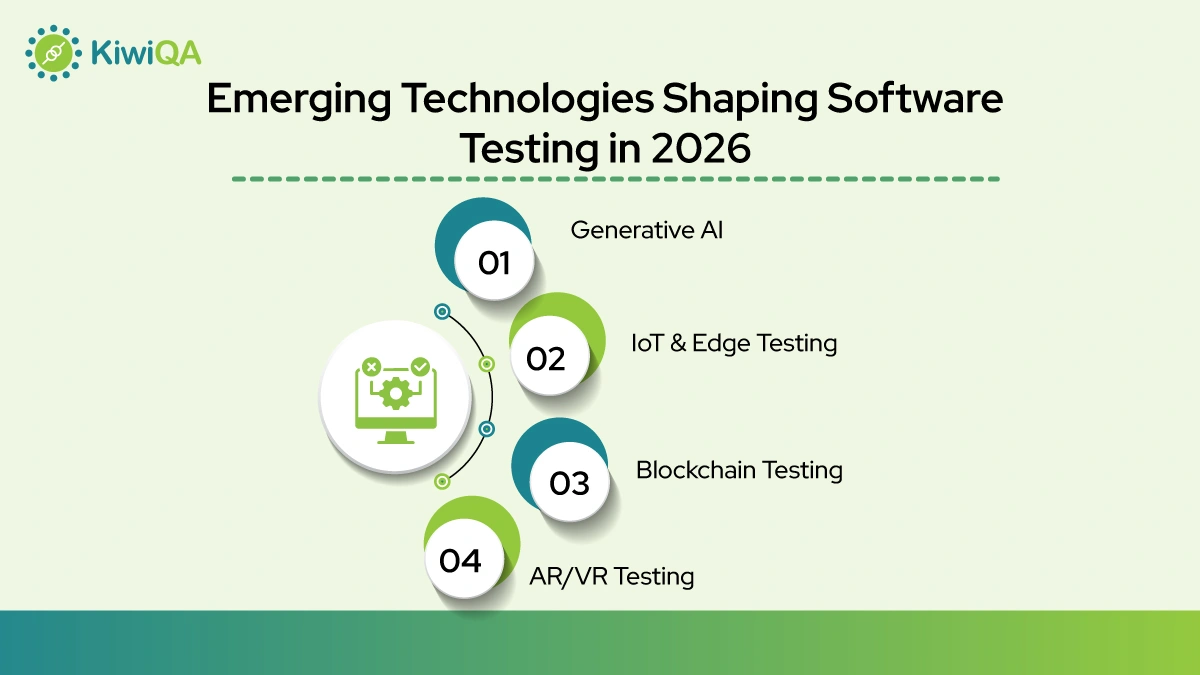
Emerging Technologies Influencing Software Testing

❏ Generative AI in Software Testing

Gen AI is revolutionizing software QA through automated test data generation, AI-driven reporting, and smart debugging. It also allows smart test maintenance by automating test cases, enhancing QA accuracy, limiting manual effort, and driving software delivery in Agile & DevOps environments for advanced virtual apps.

❏ IoT and Edge Device Testing

IoT & edge devices QA verify that the connected system performs impressively on every device. The organization uses real-time performance validation, device compatibility QA, and network testing to spot gaps early. It helps firms to enhance connectivity, strengthen security, and deliver a seamless user experience across smart devices and cloud infrastructure.

❏ Blockchain Application Testing

Blockchain app QA aims to validate security, functionality, and data integrity within a decentralized system. Organizations perform strong QA practices to avoid errors, validate transaction accuracy, and ensure blockchain apps operate securely and efficiently while managing compliance, trust, and reliability across fragmented virtual ecosystems.

❏ AR/VR Application Testing

AR & VR app testing verifies immersive apps deliver smooth performance, real-time interactions, and seamless user experience. QA involves validating user interactions, device compatibility, and performance optimization across various platforms to measure stable functionality. It limits latency errors and enhances engagement in augmented and virtual real-time environments.

Challenges Businesses May Face with Modern Testing Trends

☢ Managing Complex Testing Environments

Advanced organizations must manage QA across various devices, OS, browsers, and cloud environments. Hybrid cloud infrastructure adds additional challenges, making it challenging to manage consistent performance, compatibility, and security. Quality QA strategies support firms to streamline operations, limit QA gaps, and verify reliable app functionality across diverse virtual ecosystems.

☢ Lack of Skilled Testing Professionals

The rising adoption of automations & AI-driven QA has improved demand for skilled QA expertise. Organizations often face complexities in seeking professionals in test automation, AI testing, and DevOps practices. Frequent employee training and upskilling programs are necessary to manage QA efficiency, enhance quality, and support evolving technology demands.

☢ Balancing Speed and Quality

Quick software release cycles put pressure on the QA team to manage quality without delaying the release. Firms must balance frequent delivery with comprehensive QA to avoid errors and performance gaps. Test automation practices accelerate the QA process, enhancing accuracy, limiting manual effort, and verifying stable, quality software releases consistently.

☢ Test Data Privacy and Security Concerns

Advanced QA environments manage large volumes of crucial customer & business data, improving privacy and security concerns. Organizations must integrate secure QA approaches, safeguard crucial data, and comply with regulations to limit challenges related to data theft, unauthorized access, and compliance violations.

Also Read : Top Retail Software Testing Companies in the USA for Modern Retail Platforms

Best Practices for Adopting Software Testing Trends in 2026

☛ Build a Strong Test Automation Strategy

Organizations must identify QA tasks & automate them using scalable QA tools. Managing reusable test cases enhances efficiency, limits manual effort, and supports quick software release. The strong automation practices also drive QA accuracy across various platforms.

☛ Integrate Testing into DevOps Pipelines

Integrating QA into the DevOps pipeline allows for frequent QA throughout the SDLC. Automated regression QA supports identifying mistakes early, minimizing release risks, and enhancing release quality. The following practice strengthens collaboration between development and QA teams while improving release, software reliability, and delivery speed in advanced apps.

☛ Invest in AI-Driven Testing Tools

AI-driven QA tool supports business, accelerates test execution, automates error analysis, and enhances overall QA efficiency. These smart solutions limit manual workloads, optimize resource utilization, and minimize operational costs. AI-driven QA also drives accuracy, predicts potential errors, and supports frequent QA across complicated software development environments.

☛ Prioritize Security and Performance Testing

Firms must conduct frequent error assessment and track app performance to detect risks earlier. Security and performance QA help avoid cyber risks, drive stability, and validate that it fulfills industry regulations. Prioritize these QA practices to strengthen app reliability, safeguard crucial data, and enhance user trust and satisfaction.

☛ Focus on Real User Experience

QA across real devices, OS, and browser support firms delivers seamless user experiences. Measure user behavior patterns to uplift accessibility and app performance. Most of the firms depend on software QA consulting services to drive user-centric QA approaches that enhance user satisfaction and long-term digital product success.

Ready to Discuss Your Software Testing Requirements?

Ready to Modernize Your Testing Approach for 2026 and beyond?

The latest software testing trends we have mentioned above represent both the challenges and opportunities. When you have an expert QA team, you will achieve success. By consulting with software testing consulting companies, you can get access to a team that offers strategic approaches to enhance visibility and navigate complex QA activities. To reduce cost and enhance user trust, invest in these future-proof QA processes.


Top Software Testing Challenges for FinTech Platforms (and How to Solve Them)

The financial services industry is quickly moving towards digitization with the rise of mobile banking and data connectivity. In 2021, the fintech industry raised more than $120 billion. Entrepreneurs & executives of finance industries face unlimited FinTech challenges. They must safeguard customers’ valuable information from cybercriminals & fulfill regulatory demands. Additionally, FinTech software solutions should be crafted to stay confident under vast traffic & opt 3rd party integrations. 

Navigating these challenges of Fintech isn’t easy for startups, specifically. You may rank behind your competitors when you fail a test. The ideal software supports FinTech businesses to address these errors. Here in the blog, we’ll talk about complications in the Fintech industry and inspect the software testing consulting services to overcome them.

In Fintech & banking apps, every new release is far more than the previous software update. A single failure or software testing automation challenges can lead to financial loss. It can cause regulatory demands & reputational damage, which are impossible to navigate. When accessing any fintech product, trust is the foundation. 

Over 85% of customers stay loyal to apps they trust for secure data handling and error-free transactions. A single error can break customer confidence & impact negatively on business growth. This is why software testing isn’t an option but a necessity. Comprehensive testing safeguards sensitive data against cybersecurity threats and validates compliance with frameworks like GDPR and PCI DSS.  

It gives your customer confidence regarding the product & ensures it won’t fail. Quality testing in fintech involves each area addressing various risks & together they form the protective layer that drives your organization to innovation without losing stability. This blog explores the necessary testing areas that must be prioritized by fintech & banking companies. Check the necessity of testing, software testing challenges, & ways to navigate them.

Why is Software Testing Crucial for FinTech Platforms?

You can’t build trust among users through a successful release. Every transaction, login, & functionalities must be assumed. Fintech businesses may improve client connections, adhere to strict regulations, and achieve sustainable growth by seeing testing as a long-term investment.

Leaders face an issue of how to test strategically rather than whether to test at all. A thorough approach to software test automation challenges, supported by automation and ongoing enhancement, transforms testing into a competitive advantage. It guarantees scalability for expanding into new areas, lowers risks, and speeds up delivery.

➺ Rapid growth of FinTech demands reliable, secure platforms

With the introduction of intricate features, integrations, and user experiences, the FinTech industry is developing at a rapid pace. Despite frequent releases, large transaction volumes, and ongoing innovation, software testing makes sure platforms stay secure, scalable, and stable. It avoids expensive failures that might impact financial services or harm a brand’s reputation.

➺ Testing ensures trust, accuracy, compliance, and performance

FinTech apps manage transactions in real time, when even minor gaps can cause significant mistakes. Thorough software test consulting helps platforms gain user trust while adhering to stringent legal and financial requirements in many markets. Testing validates transaction accuracy, regulatory compliance, system performance, and secure procedures.

➺ Financial data sensitivity increases testing responsibility

FinTech platforms are particularly vulnerable to cyberattacks since they manage sensitive financial and confidential data. To ensure data confidentiality, fraud prevention, and compliance with data protection laws, a software test consultancy assists in identifying flaws before attackers do.

➺ Builds credibility with users, regulators, and stakeholders

Tested FinTech platforms indicate risk awareness and operational maturity. As users develop trust in the platform’s dependability, consultant software testing reassures partners, investors, and regulators that systems are trustworthy and compliant. It ultimately enhances brand credibility and long-term company viability.

Here’s why testing is especially critical in FinTech:

☢ Security threats are real: FinTech apps are frequently targets of fraud, data breaches, and hacking. Hidden vulnerabilities can still be exploited in the absence of comprehensive security and penetration testing. Frequent testing assists in locating configuration errors and insecure APIs before hackers can breach private financial information.

☢ Compliance is mandatory: FinTech platforms are subject to stringent laws, including PSD2, PCI-DSS, and GDPR. Compliance testing guarantees that procedures for data management, authentication, encryption, and reporting adhere to legal requirements. Constant validation lowers legal risks, prevents fines, and demonstrates to regulators that privacy and security safeguards are regularly implemented.

☢ Transactions must be accurate: Complete accuracy is required for financial transactions. A minor error, inaccuracy, or data discrepancy might result in financial loss or regulatory issues. By using managed software testing services, transaction records are kept accurate.

☢ User trust is everything: Consumers anticipate FinTech apps to be dependable, stable, and quick. Inaccurate information, delays, or crashes quickly diminish confidence. Platforms may better compete in a trust-driven financial environment, retain consumers, and safeguard their brand by implementing testing to guarantee consistent user experiences.

Ready to Secure Your FinTech App with Expert Testing

What Are the Top Software Testing Challenges in FinTech?

1. Regulatory Compliance: The key challenges of software testing are fulfilling regulatory demands. FinTech platforms are subject to strict, constantly changing rules that vary by country and geography. Testing teams must perform audit-ready validations, maintain documentation accuracy, and update test cases often to reflect new compliance needs. Significant time, knowledge, and collaboration with legal and compliance needs are required for this continuous effort.

2. Data Security and Privacy: FinTech apps are mostly targeted by cyberattacks since they manage crucial data. Advanced security, penetration, and encryption testing are necessary to guarantee zero data leakage. Both human and automated testing procedures are made more complex by the need for testers to verify data masking and access limits while adhering to privacy laws.

3. High Transaction Volumes: Large transaction volumes must be handled by FinTech systems with the least amount of latency possible, particularly during periods of high usage. Stability must be guaranteed by performance, load, and testing in real-life scenarios. It takes a strong infrastructure, specialized tools, and ongoing performance monitoring to correctly simulate thousands of concurrent transactions.

Also Read : How Can A Tester Coordinate Manual And Automated Testing?

4. Integration with Legacy Systems and APIs: Numerous FinTech platforms rely on interfaces with third-party APIs, payment gateways, and conventional banking systems, some of which may be unreliable or out-of-date. The complications of failures across interrelated financial operations are increased by the difficulty of testing these integrations because of uneven data formats, little documentation, and frequent API changes.

5. Frequent Release Cycles: FinTech teams are pushed towards quick, frequent releases by agile and DevOps methodologies. Fintech testing services need to keep up without hampering safety, regulatory, and quality. High automation coverage, continuous testing in CI/CD pipelines, and close cooperation between the IT teams are necessary to achieve this balance.

6. Cross-Platform Compatibility: FinTech consumers use a variety of devices and operating systems, including tablets, online browsers, and mobile apps, to access services. Comprehensive compatibility testing, which increases test scope, execution time, and maintenance effort, is necessary to guarantee consistent functionality, performance, and security across platforms.

7. Complex Test Data Management: Strict data protection regulations cause testing AI software challenges to create realistic test data that replicates real financial situations. Data preparation, storage, and reuse across many testing environments become more complicated when test teams are required to provide synthetic data that preserves accuracy without disclosing sensitive information.

How Can FinTech Companies Overcome These Challenges?

To overcome testing challenges in software testing, a proactive, planned strategy is needed. FinTech teams can increase the efficacy of their testing in the following ways:

1. Adopt Test Automation: For FinTech businesses looking to grow rapidly without sacrificing quality, test automation is crucial. Automated test suites speed up regression testing, minimize manual labor, and guarantee reliable validation of crucial financial processes. Organizations can use industry-specific frameworks to automate functional, regression, API, and performance tests by utilizing fintech testing services. 

Additionally, automation enhances test coverage, reduces human error, and facilitates the quick releases required by Agile and DevOps models. Teams can concentrate on intricate situations like fraud detection, compliance validation, and security testing as it gradually reduces testing expenses while enhancing reliability.

2. Implement Continuous Testing in CI/CD: Defects are found early rather than after deployment thanks to continuous testing, which incorporates quality checks across the CI/CD pipeline. This method verifies transaction correctness, performance, and compliance for FinTech platforms across the whole development process. 

Every code commit triggers automated testing, which lowers release risks and avoids expensive production failures. Additionally, faster feedback loops between QA and development teams are made possible by continuous testing, which enhances cooperation and release trust. This strategy is particularly useful in the FinTech industry, where regular upgrades must adhere to stringent security and regulatory requirements without impeding innovation.

3. Use Security-Focused Tools and Practices: Continuous testing, which integrates quality checks across the CI/CD workflow, helps identify defects early rather than after deployment. Throughout the whole development process, this approach confirms the accuracy, performance, and compliance of transactions for FinTech platforms. Automated testing is started with each code commit, reducing release risks and preventing costly production failures. 

Continuous testing also facilitates quicker feedback loops between QA and development teams, and software testing consulting services improve collaboration and foster trust. In the FinTech sector, where frequent updates must meet strict security and regulatory requirements without stifling innovation, this approach is especially helpful.

Also Read : The Future of QA Outsourcing: Meeting Industry-Specific Needs with KiwiQA Expertise

4. Leverage Cloud-Based Testing Platforms: Platforms for cloud-based testing provide flexible, scalable environments that are perfect for FinTech testing requirements. Without spending a lot of money on costly infrastructure, they enable teams to replicate real-world loads, various locations, and a variety of devices. 

Performance, load, and stress testing during periods of high transaction volume are supported by cloud testing. Additionally, it makes it possible for distant teams to collaborate more easily, scale resources on demand, and execute tests more quickly. Cloud platforms guarantee that testing environments closely resemble production systems for FinTech organizations, increasing accuracy while cutting setup time and operating expenses.

5. Focus on Risk-Based Testing: Workflows for payment processing, authentication, and compliance are among the areas with the potential impact that are given priority in risk-based testing. Teams concentrate on features that are more likely to fail or result in financial and reputational harm rather than testing everything equally. 

This method maximizes testing, particularly when there are short release dates. Risk-based testing guarantees that crucial features undergo more thorough validation, enhancing overall product quality. It ensures confidence while operating in the FinTech industry, where mistakes can lead to monetary loss or regulatory penalties.

6. Regularly Update Test Suites for Compliance: FinTech regulations are always changing, which eventually renders static test cases useless. Continuous adherence to standards such as GDPR, PCI-DSS, and PSD2 is ensured by routinely upgrading test suites. Data management, audit trails, reporting accuracy, and security procedures must all be verified via compliance testing. 

Organizations may remain audit-ready by incorporating automated compliance verification into the testing methodologies. This proactive strategy shows regulatory accountability to stakeholders and governing bodies while lowering legal risks and avoiding penalties.

7. Utilize Synthetic Test Data: FinTech businesses can test realistic financial scenarios using synthetic test data without disclosing private client information. This method preserves test accuracy while guaranteeing adherence to data privacy laws. At scale, synthetic data can mimic the behavior of users, transactional patterns, and edge cases. 

Additionally, it makes testing across teams and contexts safer. FinTech companies may enhance test reliability, lower data security risks, and enable continuous testing without raising privacy or regulatory issues by utilizing well-structured synthetic data.

Ready to Talk? Let’s Solve Your FinTech Testing Challenges

Ready to Overcome Your FinTech Testing Challenges with Confidence?

In the fintech industry, trust is an important factor for product success. Customers place their confidence in apps that are easily accessible, manage their savings, payments & valuable information. Regulatory practice demands strict compliance with the legal framework, and investors demand stability before committing to any deal. 

The fintech industry is quickly evolving toward the virtual future. It introduces new testing challenges for financial firms. Challenges in testing for web-based software in the Fintech sector are dynamic & multifaceted. However, the accurate software solutions can revolutionize the biggest loopholes into opportunities for growth.

Solving the challenges in automation in software testing for Fintech software is an ongoing task. It demands strategic approaches by the experts. Fintech software development faces constant challenges such as cybersecurity threats, regulatory complexities & integration of legacy systems. It is necessary to solve problems in Fintech software development to accelerate financial innovation, enhancing access and promoting economic growth. 

To successfully navigate the errors, it is necessary to combine strategic technology, agile approaches, and industry collaboration. By following the right practices, businesses can pave the way to a safer & effective financial future. To achieve valuable outcomes, get support from a software test consultancy.