Software Testing Process: Why Every Business Should Prioritize Quality

In the virtual age, software is the only resource that can reach a larger audience. It drives business opportunities & contributes to the enhancement of living standards. Organizations that want to offer services to a huge audience within a short period of time build their own software. When building software, it is necessary to have flawless & reliable operations when developing a program. One single gap in software can ruin a business. That’s why software testing consulting is necessary. The worldwide software testing services market is projected to grow by $27.6 billion between 2026 and 2030, expanding at a CAGR of 11.7%.

Businesses must perform software testing to ensure the software is functioning accurately and provides user satisfaction. The QA team’s role is to ensure the software functionality by using various approaches. The developers & QA team both search for faults to find the ideal way to enhance the accuracy, efficiency, and usability of the app. This blog presents the structured software testing process and the role of software testing consulting in modern business.

What Is the Software Testing Process?

Software testing consulting services are the crucial step that involves an analysis that allows testers to evaluate and measure the app. It determines whether the app that is being developed meets those business demands. The process is a continuous step that is referred to as STLC.

It’s a part of software development.

In the testing software process, the team tests each step and analyzes the app’s performance. Software testing can help to enhance the functions and accessibility of the app. Through various testing techniques, software development companies test the software and ensure it is safe for customers.

The QA team runs both testing types: manual and automated QA. Manual software QA consulting follows traditional tools to address the bugs. In automated testing, the QA team uses automated technologies to identify gaps. This QA type is performed to test the app and verify performance to ensure accuracy.

Why Software Testing Matters for Every Business

🢣 Protects Brand Reputation

Failures, defects, and service interruptions that may damage client confidence are reduced with accurate software. Regular software QA consulting services enhance brand credibility and long-term client confidence by assisting companies in providing robust digital experiences.

🢣 Reduces Long-Term Development Costs

Early defect detection and correction are considerably more cost-effective than post-release defect correction. Rework, maintenance costs, and expensive production problems can all be decreased by investing in software quality assurance consultancy.

🢣 Improves Customer Experience

Applications that have undergone extensive testing offer consistent accuracy, intuitive functionality, and seamless performance. A satisfying user experience boosts customer satisfaction, promotes retention, and fosters stronger business growth by boosting user confidence.

🢣 Supports Security and Compliance

Software QA consulting finds weaknesses and confirms that the quality meets the regulations. Robust quality assurance lowers security threats, safeguards confidential company information, and helps in regulatory compliance.
Ready to Build Better Software with Expert Testing?

Key Stages of the Software Testing Process

1. Requirement Analysis

The software testing consultancy process starts with understanding the project’s goal and the organization’s expectations. The QA team will review functional & technical needs to evaluate what needs to be validated. The team reviews crucial features, user workflows, and potential risks while aligning testing goals with organizational priorities. The initial stage verifies criteria for success, limits misunderstanding, and develops a strong foundation for effective testing throughout the SDLC.

2. Test Planning

Test planning describes how QA will be carried out from start to finish. The team establishes the QA scope, timelines, required tools, resources, and team responsibilities. They also decide the testing type, such as performance, functional, security, and usability testing, required based on project needs. The well-structured testing plan supports enhancing efficiency, managing risk, and ensuring quality goals are obtained within the project schedules.

3. Test Case Design

In the following software testing process, the QA team creates structured test cases that validate every necessary feature and business process. Each scenario involves expected outcomes for both valid and invalid user actions. It helps to track potential errors before release. Comprehensive test case design enhances testing accuracy, drives requirement coverage, and ensures all crucial functionalities are measured under various usage conditions for reliable software quality.

4. Test Environment Setup

A reliable test environment is designed by configuring devices, OS, networks, browsers, and realistic test data that closely match production conditions. It enables QA to reflect actual user experience and uncover environment-specific gaps early. Collaborating with a skilled software testing consultancy helps the firm to establish stable QA environments, limit delays, and obtain accurate and reliable QA outcomes.

5. Test Execution

Test execution includes running prepared test cases to validate software performance, security, functionality, and overall user experience. The QA team compares actual results with expected outcomes while documenting errors or unexpected behavior. Every error is recorded for further analysis and resolution. The following stage offers valuable metrics on software quality. It ensures that features perform consistently across various scenarios and user conditions.

Also Read : A Practical Guide to Software Testing Trends 2026 for Businesses

6. Defect Reporting and Tracking

When gaps are identified, they are documented with full details. Errors are addressed and resolved based on priority rankings. Frequent tracking ensures errors are addressed. The organized defect management process enhances collaboration & drives software quality improvements before release.

7. Retesting and Regression Testing

After developers resolve reported gaps, QA performs retesting to validate that each error has been successfully resolved. Regression testing is then performed to validate that recent code changes haven’t introduced new errors. This stage safeguards software stability, manages consistent app performance, and limits the risk of unexpected failure.

8. Final Test Closure

The final software testing process optimization determines the complete QA process. The team validates that release criteria have been fulfilled and the app is ready to release. Detailed QA reports are shared with stakeholders, offering transparency into software quality. Test closure also captures lessons learned to enhance future testing projects.

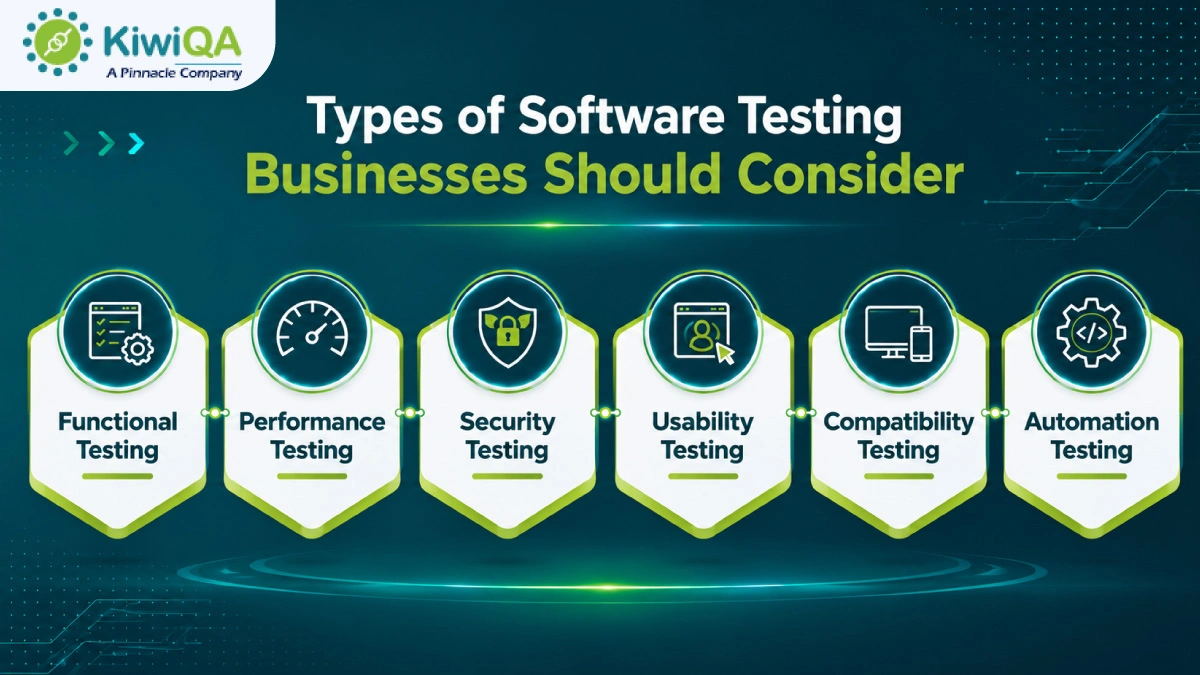
Types of Software Testing Businesses Should Consider

◈ Functional Testing

The QA approach is necessary to validate that the app features are working as per the goal. Testers verify workflows, user interactions, seamless integrations, and system responses under various conditions. This QA supports identifying functionality errors before release, ensuring a good customer experience and stable performance. The testing verifies that organizations can limit operational risks & deliver software that matches user expectations.  

◈ Performance Testing

Performance QA measures how well software performs under various workloads, involving high user traffic & organizational activities. It determines response time, system stability, scalability, and resource utilization to track gaps before users do. The testing validates app speed and reliability under access traffic. It helps businesses manage customer satisfaction, avoid downtime, and support future growth without hampering performance.

◈ Security Testing

This testing tracks errors that could expose crucial business or customer data to cyber threats. The QA team evaluates authorization, authentication, encryption, and data preparation to measure security gaps. Addressing these gaps before release helps firms to strengthen compliance, limit the chances of cybercrimes, and build customer trust. It allows businesses to validate that their app is secure & safeguarded in a virtual experience.
Types of Software Testing Businesses Should Consider

◈ Usability Testing

Usability QA determines how easily users can navigate & interact with an app. It measures interface design, navigation, accessibility, and overall user experience. The QA team performs this testing by observing real user behavior and identifies areas that require modifications. The insights gained help enhance customer satisfaction, limit user frustrations, and improve engagement by making software efficient, intuitive, and aligned with user expectations.

◈ Compatibility Testing

This testing verifies software functions consistently across various web browsers, OS, devices, and network demands. It helps businesses identify platform-specific errors that could impact user experience and app performance. By validating software across multiple environments, firms can offer a stable experience for all users while limiting support requests and compatibility gaps before release.

◈ Automation Testing

In automation testing, the team uses specialized tools to execute repetitive test cases quickly and accurately, enhancing QA speed & consistency. It is especially valuable for regression testing, continuous integration, and large-scale apps that require frequent updates. Collaborating with a software QA consulting services provider helps businesses implement the right automation strategy. The QA team is responsible for improving test coverage, limiting manual effort, and driving software delivery without hampering quality.

Also Read : Top Retail Software Testing Companies in the USA for Modern Retail Platforms

How to Build an Effective Software Testing Strategy

❏ Start testing early in the development lifecycle

For an effective software testing strategy, start testing during the requirements and design phase instead of waiting until development is complete. Every test helps to detect errors sooner, limit rework costs, accelerate delivery, and enhance software quality throughout the development cycle.

❏ Define clear quality goals

Establish measurable quality goals based on business needs, customer expectations, compliance requirements, and performance goals. Clear goals support the testing team’s focus on crucial outcomes, measure progress effectively, and validate that the software matches the defined success criteria.

❏ Choose the right mix of manual and automated testing

Utilize manual testing for usability and complicated user scenarios while automating repetitive and regression tests. The perfect balance enhances efficiency, drives test coverage, limits execution time, and supports the speed of software release.

❏ Prioritize testing based on business risk

It is suggested by a software testing consultant to focus on business-critical features, sensitive data, and payment systems. The risk-based QA support allocation allocates resources effectively, limits potential business disruptions, and ensures the necessary functionalities receive maximum attention.

❏ Use real user scenarios

Design test cases depending on actual customer behavior, organization operations, and common usage patterns. Testing realistic scenarios uncovers practical errors that scripted tests may overlook, resulting in a smooth & reliable user experience.

❏ Track defects with proper reporting

Manage detailed defect reports that involve reproduction steps, priority, screenshots, and resolution status. Clear reporting enhances collaboration between the QA & development teams while managing faster issue resolution and visibility improvement.

❏ Continuously improve the QA process

The software testing consulting services providers suggest frequently reviewing the testing metrics, defect trends, and team feedback to redefine QA practices. Regular improvements enhance efficiency, strengthen the QA process, and support long-term software reliability and business success.

Ready to Make Software Quality Your Business Priority?

Start Your Software Testing Process with the Right QA Partner

After concluding the blog, the significance of software testing is emphasized in the field of software development. Software testing is a smart process that guarantees product quality. Testing offers improved usability, functionality, and safety to decrease maintenance costs. To all business owners, testing isn’t an optional step but a necessity. To follow the above-discussed structured steps, hire software testing consulting companies that prioritize software security.

A Practical Guide to Software Testing Trends 2026 for Businesses

The advanced software testing trends in 2026 prioritise frequent feedback and automation that balance speed with security. Around 72% of organisations now use test automation, while the global automation testing market is projected to grow at a 15% CAGR from 2026 to 2034, highlighting the rising demand for AI-driven testing, continuous quality assurance, and faster release cycles.

From AI-driven testing to shift-left QA strategies, the software testing consulting services allow teams to catch mistakes earlier and achieve a stable release. This comprehensive guide explores the top software trends shaping the software QA landscape in 2026.

Understanding the Importance of Software Testing in 2026

➥ Why Businesses Need Modern Testing Strategies

◈ Increasing complexity of applications

Advanced apps use cloud platforms, AI, API, and microservices to improve system complications. Modern software testing consulting services support firms to detect errors early, manage software stability, and verify seamless integration across various technologies.

◈ Rising customer expectations for performance and reliability

Users expect a secure, faster, and error-free virtual experience across platforms and devices. Advanced software qa consulting support firms enhance app performance, reliability, and usability while managing user satisfaction, trust, and strong brand loyalty.

◈ Faster release cycles with Agile and DevOps

Agile & DevOps demand rapid software release without hampering quality. Frequent software QA consulting services and automation support firms help monitor errors quickly. It limits risks during release, drives delivery cycles, and manages consistent software reliability.

➥ The Business Impact of Poor Software Quality

◈ Revenue loss due to software failures

Poor software can cause breakdowns, transaction mistakes, and disrupted business operations. These errors lead to financial loss, limited productivity, and user dissatisfaction, which directly hamper business growth.

◈ Security and compliance risks

Weak software QA can cause an app to be an easy target of cyber crimes. Security software testing consultancy supports organizations in safeguarding sensitive data, matching industry regulations, and limiting legal, financial, and reputational errors effectively.

◈ Negative customer experience and brand reputation damage

Poor software performance, continuous crashes, and usability errors frustrate customers and limit trust. Negative user experience can damage brand reputations, increase user churn, and hamper long-term business credibility & user retention.

➥ Key Goals of Modern Software Testing

◈ Improve software quality

Advanced software testing consulting companies support the identification of errors, performance gaps, and integration errors early in development. It enhances software stability, reliability, and functionality, and overall product quality.

◈ Speed up release cycles

Automated & frequent QA streamlines development operations and drives software release. The quick testing process allows firms to release updates quickly, limit release delays, and manage high-quality standards.

◈ Ensure security and compliance

Security & compliance software testing consultant safeguards the app from cyber threats and compliance violations. Organizations can safeguard crucial user data, match industry standards, and limit risk related to security errors and non-compliance errors.

◈ Deliver better user experiences

User experience current trends in software testing validate that apps are fast, easy to use, and responsive. Organizations can enhance user satisfaction, retention, and engagement by delivering a reliable virtual experience across web, cloud, and mobile platforms.

Ready to Future-Proof Your Software Testing Strategy?

Top Software Testing Trends Businesses Should Watch in 2026

🢣 AI-Powered Test Automation

By enhancing test case creation, error estimation, and defect analysis, AI in software testing trends are revolutionizing software testing. Intelligent automation techniques that decrease human testing efforts and increase accuracy can help businesses accelerate release cycles. Additionally, these software testing trends facilitate ongoing testing in DevOps and agile settings. In order to adopt AI-driven testing frameworks that increase productivity, shorten testing times, and improve software quality. This is why many businesses now rely on software QA consulting services.

🢣 Shift-Left and Shift-Right Testing

Organizations can monitor performance after deployment and identify problems early with the use of shift-left and shift-right, the latest trends in software testing. While shift-right guarantees real-time validation in production settings, shift-left concentrates on testing during development. This combination strategy expedites problem solving, lowers expensive errors, and enhances developer-QA team collaboration. By implementing these strategies, companies can sustain quicker software delivery cycles in cutthroat digital markets. It also improves user experience and increases software reliability.

🢣 Continuous Testing in DevOps

In DevOps-driven software development, continuous testing has become crucial. Businesses may maintain quick release cycles and find defects more rapidly by integrating automated testing into CI/CD pipelines. The software testing services trends guarantee constant software quality, lower deployment risks, and boost release trust. By facilitating quicker feedback loops and improved teamwork, continuous testing also promotes agile development. Businesses that invest in DevOps testing techniques can provide high-performing, secure, and stable applications with increased operational efficiency.

🢣 Cloud-Based Testing Environments

For modern enterprises, cloud-based testing environments offer scalable, adaptable, and affordable testing solutions. Without making significant investments in physical infrastructure, organizations can conduct cross-browser, cross-device, and remote testing. Additionally, cloud testing speeds up testing procedures and enhances communication between remote workers. Cloud-based testing helps businesses maintain software performance, dependability, and scalability while lowering operating costs. It validates quicker product releases across many platforms and environments as digital applications continue to expand.

🢣 Cybersecurity and Compliance Testing

As companies deal with increasing cyber threats and more stringent regulations, cybersecurity and compliance testing are becoming essential. Security testing helps in finding weaknesses, safeguarding private client information, and stopping illegal access. Applications are tested for compliance to ensure they comply. Companies that prioritize secure testing procedures can lower security risks, uphold customer confidence, and stay out of legal challenges while providing safe digital experiences.

Also Read : Top Software Testing Challenges for FinTech Platforms (and How to Solve Them)

🢣 Low-Code and No-Code Test Automation

Software testing is becoming easier for non-technical teams because of low-code and no-code test automation systems. These technologies increase testing efficiency and lessen reliance on developers by enabling quicker test script writing with little coding expertise. Businesses may increase productivity and minimize repetitive testing activities. With quicker and easier-to-access automation workflows, low-code testing systems help teams improve software quality and decrease manual errors.

🢣 Performance Engineering and User Experience Testing

Businesses can make sure apps function well in real-world scenarios by using performance engineering and user experience testing. In order to increase client satisfaction, these testing techniques assess speed, responsiveness, scalability, and general usability. Organizations can maximize application stability and dependability by modeling high user traffic and examining performance bottlenecks. Prioritizing performance testing can help businesses create smooth digital experiences, decrease downtime, and increase user retention.

🢣 API and Microservices Testing

Testing for microservices and APIs is becoming more and more crucial as companies use modern application designs. These testing procedures guarantee backend systems operate properly, enhance integration reliability, and validate communication between services. While microservices testing facilitates scalable and adaptable application development, API testing allows for quicker validation of crucial business operations. Numerous software testing consulting companies assist businesses in putting in place strong API testing procedures. It enhances program reliability, lowers integration errors, and accelerates digital transformation projects.

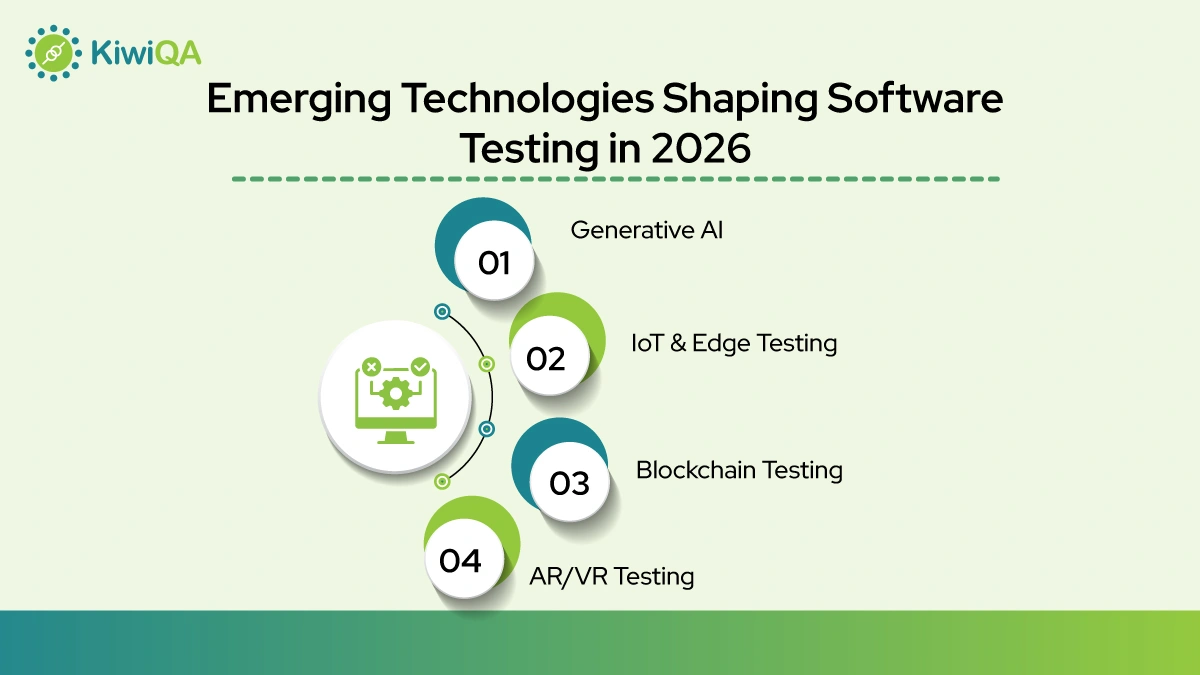
Emerging Technologies Influencing Software Testing

Emerging Technologies Influencing Software Testing

❏ Generative AI in Software Testing

Gen AI is revolutionizing software QA through automated test data generation, AI-driven reporting, and smart debugging. It also allows smart test maintenance by automating test cases, enhancing QA accuracy, limiting manual effort, and driving software delivery in Agile & DevOps environments for advanced virtual apps.

❏ IoT and Edge Device Testing

IoT & edge devices QA verify that the connected system performs impressively on every device. The organization uses real-time performance validation, device compatibility QA, and network testing to spot gaps early. It helps firms to enhance connectivity, strengthen security, and deliver a seamless user experience across smart devices and cloud infrastructure.

❏ Blockchain Application Testing

Blockchain app QA aims to validate security, functionality, and data integrity within a decentralized system. Organizations perform strong QA practices to avoid errors, validate transaction accuracy, and ensure blockchain apps operate securely and efficiently while managing compliance, trust, and reliability across fragmented virtual ecosystems.

❏ AR/VR Application Testing

AR & VR app testing verifies immersive apps deliver smooth performance, real-time interactions, and seamless user experience. QA involves validating user interactions, device compatibility, and performance optimization across various platforms to measure stable functionality. It limits latency errors and enhances engagement in augmented and virtual real-time environments.

Challenges Businesses May Face with Modern Testing Trends

☢ Managing Complex Testing Environments

Advanced organizations must manage QA across various devices, OS, browsers, and cloud environments. Hybrid cloud infrastructure adds additional challenges, making it challenging to manage consistent performance, compatibility, and security. Quality QA strategies support firms to streamline operations, limit QA gaps, and verify reliable app functionality across diverse virtual ecosystems.

☢ Lack of Skilled Testing Professionals

The rising adoption of automations & AI-driven QA has improved demand for skilled QA expertise. Organizations often face complexities in seeking professionals in test automation, AI testing, and DevOps practices. Frequent employee training and upskilling programs are necessary to manage QA efficiency, enhance quality, and support evolving technology demands.

☢ Balancing Speed and Quality

Quick software release cycles put pressure on the QA team to manage quality without delaying the release. Firms must balance frequent delivery with comprehensive QA to avoid errors and performance gaps. Test automation practices accelerate the QA process, enhancing accuracy, limiting manual effort, and verifying stable, quality software releases consistently.

☢ Test Data Privacy and Security Concerns

Advanced QA environments manage large volumes of crucial customer & business data, improving privacy and security concerns. Organizations must integrate secure QA approaches, safeguard crucial data, and comply with regulations to limit challenges related to data theft, unauthorized access, and compliance violations.

Also Read : Top Retail Software Testing Companies in the USA for Modern Retail Platforms

Best Practices for Adopting Software Testing Trends in 2026

☛ Build a Strong Test Automation Strategy

Organizations must identify QA tasks & automate them using scalable QA tools. Managing reusable test cases enhances efficiency, limits manual effort, and supports quick software release. The strong automation practices also drive QA accuracy across various platforms.

☛ Integrate Testing into DevOps Pipelines

Integrating QA into the DevOps pipeline allows for frequent QA throughout the SDLC. Automated regression QA supports identifying mistakes early, minimizing release risks, and enhancing release quality. The following practice strengthens collaboration between development and QA teams while improving release, software reliability, and delivery speed in advanced apps.

☛ Invest in AI-Driven Testing Tools

AI-driven QA tool supports business, accelerates test execution, automates error analysis, and enhances overall QA efficiency. These smart solutions limit manual workloads, optimize resource utilization, and minimize operational costs. AI-driven QA also drives accuracy, predicts potential errors, and supports frequent QA across complicated software development environments.

☛ Prioritize Security and Performance Testing

Firms must conduct frequent error assessment and track app performance to detect risks earlier. Security and performance QA help avoid cyber risks, drive stability, and validate that it fulfills industry regulations. Prioritize these QA practices to strengthen app reliability, safeguard crucial data, and enhance user trust and satisfaction.

☛ Focus on Real User Experience

QA across real devices, OS, and browser support firms delivers seamless user experiences. Measure user behavior patterns to uplift accessibility and app performance. Most of the firms depend on software QA consulting services to drive user-centric QA approaches that enhance user satisfaction and long-term digital product success.

Ready to Discuss Your Software Testing Requirements?

Ready to Modernize Your Testing Approach for 2026 and beyond?

The latest software testing trends we have mentioned above represent both the challenges and opportunities. When you have an expert QA team, you will achieve success. By consulting with software testing consulting companies, you can get access to a team that offers strategic approaches to enhance visibility and navigate complex QA activities. To reduce cost and enhance user trust, invest in these future-proof QA processes.