The fintech sector has revolutionized the ways in which individuals handle their finances, execute payments, transfer money, and obtain banking services. Since millions of users depend on digital banking daily, fintech firms need to produce secure, fast, dependable, and user-friendly application offerings. That is why skilled mobile testing services have turned into a necessity to verify the functionality of banking apps capable of managing increased user traffic and complicated financial transactions.
Today’s banking apps manage sensitive data, real-time transactions, and third-party integrations. Fintech Mobile App Testing helps identify security, performance, and usability issues before they impact users. With customers expecting seamless experiences across devices and networks, thorough testing is essential for high-performance banking apps.
To build customer trust and support business growth, companies should invest in mobile app testing for performance, security, functionality, usability, and compliance. With 53% of users leaving slow mobile pages and 88% less likely to return after poor UX, working with a reliable mobile app testing company helps ensure secure, stable, and high-performing apps.
This article provides insight into the finest testing methods for fintech software and highlights performance testing, security testing, automation testing, API validation, compliance testing, and mobile-targeted testing approaches as means to help enterprises develop safe and efficient banking solutions.
Understanding the Unique Testing Requirements of Fintech Mobile Apps
◈ Why Fintech Apps Demand Specialized Testing
Since fintech software is used in highly sensitive and tightly regulated settings, banking apps have a very different set of needs than ordinary apps in handling secure financial transactions, safeguarding user data, and providing uninterrupted service.
🢣 Handling Sensitive Financial Data
Mobile banking solutions usually deal with users’ sensitive financial information, such as:
▪ Account numbers
▪ Cards details
▪ Records of transactions
▪ Personal data
Thus, conducting security testing for mobile apps is an indispensable part of fintech app development.
🢣 High User Expectations for Speed and Reliability
Users expect:
▪ The instantaneous processing of transactions
▪ The minimum time for logging in
▪ The delivery of notifications in real-time
▪ The uninterrupted availability of the app
Even a second of delay or failure of the system can harm the perception of customers and the reputation of a company.
🢣 Regulatory and Compliance Obligations
Financial apps are subject to audits and must adhere to different standards set by regulators. Proper compliance through testing can help meet these requirements and also ensure the security of data.
🢣 Risks Associated with Downtime and Transaction Failures
System downtime can cause:
▪ Incomplete transactions
▪ Decrease in revenue
▪ Unhappy customers
▪ Regulatory fines
Because of this, businesses are using fintech-specific app testing techniques and seeking the assistance of a mobile testing company.
◈ Key Challenges in Banking App Testing
Testing fintech apps comes with a lot of difficulties on a technical and operational level.
🢣 Real-Time Transaction Processing
Apps need to handle transaction processing without any delay or error at all.
🢣 Integration with Multiple Third-Party Services
Most banking apps are integrated with:
▪ Payment processors
▪ Banking APIs
▪ Credit scoring agencies
▪ Fraud detection tools
🢣 Device and OS Fragmentation
The apps should offer a consistent user experience and functionality, no matter if the user is on:
▪ Android phones
▪ iPhones
▪ Tablets
▪ Different OS versions
🢣 Security Threats and Fraud Prevention
Security tests are done to:
▪ Prevent data breaches
▪ Mitigate account takeover risks
▪ Detect and remove malware
▪ Secure APIs
🢣 Scalability During Peak Transaction Periods
An app must be resilient during the large inflow of users around the time of payday, holidays, and special offers.
In order to successfully address these issues through the ongoing development of testing frameworks and quality assurance practices, top app testing firms, mobile application testing company providers, and solutions pool their experience.
Core Testing Types for High-Performance Banking Apps
1. Functional Testing
Functional testing is focused on whether the particular functions that have been developed within the banking app do exactly what the business and users expect from them.
❏ User Registration and Authentication
Verification is done for:
▪ User registration process
▪ OTP verification
▪ Multi-factor authentication
▪ Biometric login cases
❏ Account Management Features
Checking includes:
▪ Checking account balance
▪ Updating user profile
▪ Adding beneficiaries
▪ Downloading bank statements
❏ Fund Transfers and Payments
Test cases cover:
▪ Wire transfers between banks
▪ UPI Transactions
▪ Card Payment Transactions
▪ Utility Bill Payments
❏ Transaction History and Notifications
It is necessary that the applications show the right transaction history, and that notifications should be sent in a timely manner as well.
❏ Bill Payment and Card Management Functions
Testing ensures that:
▪ Users can manage credit cards
▪ Loan payments can be made
▪ Utility bills are processed
▪ Cards can be activated
Top-tier mobile app testing services have the means to thoroughly test every banking workflow in order to deliver robust and error-free operations within their respective applications.
2. Performance Testing
Performance testing focuses on how an application reacts when the number of users grows or when the network conditions change.
❏ Load Testing for Normal Traffic Conditions
This type of testing measures what happens under normal usage conditions.
❏ Stress Testing Under Peak Usage
When the system is under a significant strain, stress testing is done.
❏ Endurance Testing for Long-Term Stability
Applications are usually run for extended periods to assess any memory leaks or gradual reductions in performance.
❏ Scalability Testing for Growing User Bases
After scopes have been expanded, scaling tests are run in order to verify whether or not the app is capable of handling it.
❏ Key Metrics to Monitor:
The largest performance indicators are listed below:
▪ Time to respond
▪ Speed of transaction processing
▪ API latency
▪ Throughput
▪ Resource usage
Automated mobile app testing frameworks are the tool of choice for monitoring the metrics in a time-efficient manner.
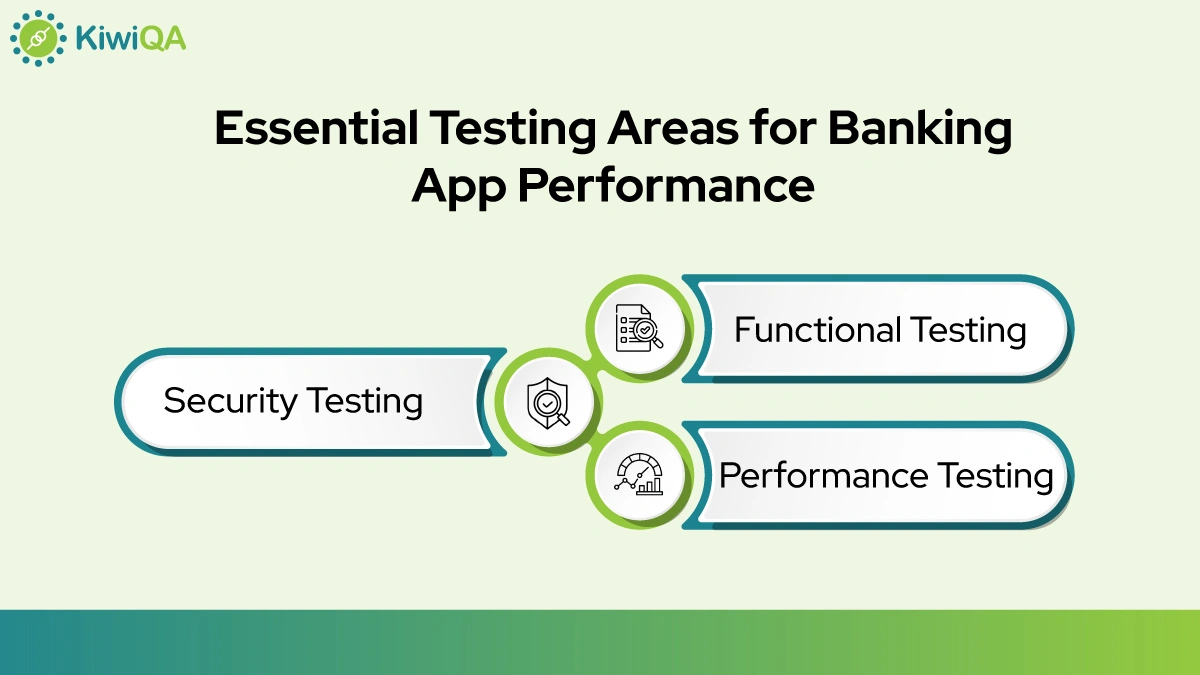
3. Security Testing
The safety of a fintech application is the most essential area of its development and testing.
❏ Vulnerability Assessment
Testing detects vulnerabilities in the platform.
❏ Penetration Testing
Penetration testing uses hacking techniques to find vulnerabilities in the app.
❏ Authentication and Authorization Validation
Testing is done for robust access control with minimum permission features.
❏ Data Encryption Verification
Any sensitive financial data, both in transit and at rest, must be encrypted.
❏ Secure API Testing
APIs are the biggest risk area for unauthorized access and data leakage.
❏ Common Security Risks
▪ Data Breach/Privacy Violation Risk
▪ Account Takeover Risk
▪ API Security Weaknesses
▪ Session Hijacking
▪ Malware
▪ Phishing
Top fintech mobile app testing services and mobile app security testing providers assist fintech companies in improving application security and minimizing the possibility of fraud.
Also Read : Top Mobile App Testing Company in India
Mobile-Specific Testing Strategies
☢ Device Compatibility Testing
To be successful, fintech apps need to offer a unified user experience irrespective of the user’s device or platform.
☛ Testing Across Android and iOS Devices
A range of devices is used to test apps.
☛ Different Screen Sizes and Resolutions
Tests ensure that the application is represented and operates properly on all screen sizes.
☛ OS Version Compatibility
Apps that target multiple operating system versions
☛ Hardware-Specific Functionality
Examples of such tests include validation of:
▪ Camera
▪ Fingerprint scanner
▪ GPS
▪ NFC payment support
Most mobile testing companies make use of real-device test labs for enhanced testing accuracy.
☢ Network Condition Testing
Banking app users come through different network settings
☛ 5G, 4G, 3G, and Wi-Fi Environments
Apps are put under different network conditions to see how cameras perform.
☛ Low-Bandwidth Scenarios
Even if the device’s internet connection is slow, the app should continue to function.
☛ Network Interruptions and Recovery
Even if a network cuts out in mid-transaction, the test car’s only transaction should be saved, with no loss or duplication.
☛ Offline Functionality Testing
APPs provide limited functionalities even when the internet is not available.
☢ Usability and User Experience Testing
A bank app has to be simple, clear, and user-friendly.
☛ Intuitive Navigation
A good app allows users to complete what they need to do without making them feel lost at any point.
☛ Accessibility Compliance
Making sure that apps are usable to people with disabilities
☛ Transaction Flow Optimization
Identify and cut out any unnecessary steps in the flow.
☛ User Feedback Analysis
Feedback collection to identify users’ needs and better meet them mobile QA services providers that can be relied upon put a strong emphasis on user experience improvement.
Automation Testing for Fintech Applications
➥ Benefits of Test Automation
The rapid pace of fintech innovation means quality assurance can only be achieved with the support of automated testing tools.
Some of the benefits:
▪ Shorter time-to-market
▪ More thorough testing
▪ Less manual work
▪ Test runs are geared to be highly reproducible
▪ Economic efficiency in scaling the testing efforts
Professional mobile QA testing company teams resort to automation to not only raise productivity but also lessen the duration required for testing.
➥ What to Automate
☛ Regression Testing
When an application is updated, automated tests are used to check if the rest of the functionalities still work.
☛ API Testing
Scripting is done to automate the verification of APIs.
☛ Smoke Testing
Smoke testing validates the core app functions in a time-efficient manner.
☛ Critical User Journeys
These user paths, such as login and payment processing, are the first test cases that get automated.
☛ Cross-Platform Testing
Automation can aid in providing uniform test execution on handheld devices running Android and iOS.
➥ Recommended Automation Tools
Some automation tools are very common and popular with testers:
▪ Appium
▪ Selenium
▪ Espresso
▪ XCUITest
▪ TestComplete
Mobile QA services providers use these tools to speed up the testing timelines for fintech apps.
API and Integration Testing
➥ Importance of API Testing in Banking Apps
A modern mobile application testing company cannot do without APIs, as they provide the main channels to the core banking systems and other third-party financial services.
◈ Core Banking System Integrations
API testing makes sure that an app can communicate with the core banking system securely and without failure.
◈ Payment Gateway Validation
Testing is carried out to make sure that payment-related operations are executed smoothly and securely.
◈ Third-Party Financial Service Integrations
Besides the core system, the majority of the apps are integrated with:
▪ Credit bureaus
▪ Fraud detection services
▪ Investment platforms
◈ Open Banking API Testing
Testing makes sure that open banking functionalities are secure, compliant with regulations, and transparent.
➥ Critical API Test Scenarios
Some key API test cases include:
▪ Transaction initiation
▪ Authentication
▪ Handling errors properly
▪ Rate limiting
▪ Ensuring data remains consistent
Collaborating with a reliable mobile application testing company is a great way for organizations to secure their API integrations extensively and maintain a seamless and secure interchange of information.
Compliance and Regulatory Testing
➺ Key Financial Regulations
Fintech development is regulated and certified by multiple authorities requiring full compliance with law and standards.
● PCI DSS
A security standard dealing with protecting payment card data.
● GDPR
Provisions for ensuring the confidentiality of user data.
● PSD2
An initiative that facilitates digitally secure payment processes.
● SOC 2
Used for assessing security and operational controls.
● Regional Banking Regulations
Putting into compliance the operations of the application with relevant local laws.
➺ Compliance Testing Best Practices
● Data Privacy Validation
Testing that is aimed at securing the privacy of users’ data
● Audit Trail Verification
The software should feature detailed and accurate logs.
● Consent Management Testing
Providing the option to users to decide over their personal data usage.
● Security Control Assessment
Efforts to verify and validate security features and compliance mechanisms through testing.
Top mobile testing companies lend their clients a helping hand in keeping regulatory compliance and mitigating legal risks.
Also Read : Top 10 SAP Testing Company in US Delivering End-to-End SAP Quality Assurance
Best Practices for High-Performance Banking App Testing
Creating a banking application that is secure, fast, and reliable needs a whole lot more than just basic functional testing. Fintech applications manage highly sensitive financial data, enable real-time transactions, and support a vast number of users daily. Even a minor problem can damage a customer’s faith, damage the business image, and cause the stoppage of work.
This is the very reason why organizations should abide by solid testing methodologies at each step of the application lifecycle. Using adequate testing methodologies will give a business the ability to enhance the performance of its app, tighten security, minimize the effect of risks, and provide a seamless experience for the end users, regardless of the device and platform.
1. Focus on Security from Day One
Embedding security-oriented development and testing into the process from the start is among the major methodologies of fintech applications. Since banking apps come with highly confidential customer and financial data, they are one of the main targets of hackers and fraudsters.
✦ Secure-by-Design Principles
Security-focused architecture should be the base layer of any application, right from the development phase. Instead of tacking on security later, IT organizations should bake secure coding, authentication, and encryption right into their applications.
Main security actions are:
▪ Multifactor authentication
▪ Secure API communication
▪ Data encryption
▪ Session management controls
▪ Role-based access permissions
✦ Early Vulnerability Detection
Consistent security testing can pinpoint flaws before the software is released. Security risk is substantially reduced by early detection, and the cost of fixing the faults is also kept at a minimum.
Security testing activities can cover:
▪ Vulnerability scanning
▪ Penetration testing
▪ API security validation
▪ Authentication testing
▪ Malware risk assessment
Mobile app security testing services that are professional and thorough are one of the best instruments for improving risk management and safe banking operations.
2. Test Real-World User Scenarios
The testing process is required to mimic what users actually do with the banking app rather than just checking if individual functions of the system work, as these scenarios do not involve the user’s environment at all. Testing under real-world conditions is able to reveal usability, performance, and unexpected failure issues that may occur when the software runs under actual operating conditions.
✦ High-Volume Transactions
Almost all the time, banking apps are used to make several thousand transactions, at the same time, without the users experiencing any slowdown or failure. The application should be tested under conditions of heavy transaction loads to ensure that it remains stable and that transactions remain accurate.
Some examples of transactional testing are:
▪ Salary-day peak transaction scenarios
▪ Multiple transfers of funds
▪ Simultaneous payment requests
▪ Bulk transaction processing
✦ Multi-Device Access
Most people nowadays access banking apps through various devices such as smartphones, tablets, and desktops. The application is expected to give a consistently good user experience on all platforms and operating systems.
Testing should include:
▪ Android and iOS devices
▪ Different screen sizes
▪ Various OS versions
▪ Device-specific features
✦ Peak Traffic Simulations
During times of high traffic, such as holidays, sales events, or tax submission, the apps should still perform flawlessly. Performance testing at peak times helps to identify bottlenecks and capacity problems that could affect the customers without any warning.
Professional mobile app testing services give companies a chance to validate the real-world banking scenarios and increase the reliability of the apps.
3. Use Production-Like Test Environments
The effectiveness of testing is greatly strengthened if it is carried out on computer systems that are very close to the ones used by the customers. Production-like environments are good at pointing out infrastructure, integration, and configuration problems that would not become visible in the usual testing environments.
✦ Realistic Datasets
By using realistic customer and transaction data, a business can do more accurate testing and also be convinced that the application supports the actual business processes.
Advantages of using realistic datasets:
▪ Better transaction validation
▪ Accurate reporting verification
▪ Improved workflow testing
▪ Enhanced user behavior simulation
✦ Accurate Infrastructure Configurations
The testing environment should range from server class to node class, with the corresponding aspects of applications and network configurations. The risk of the appearance of hidden defects in production post-deployment is significantly decreased by environments that are similar.
The test should reproduce:
▪ Production-like server hardware setups
▪ API integrations
▪ Database structures
▪ Security settings
▪ Network conditions
✦ Third-Party Integration Simulations
In some cases, banking applications may be linked with an external payment system, a core banking system, an analytics tool, and a fraud detection system, etc. Third-party integration testing guarantees that all the third-party services operate harmoniously within the bank application ecosystem.
Testing should cover:
▪ Component-level validation
▪ End-to-end workflow testing
▪ API communication verification
▪ Payment gateway testing
▪ Error-handling validation
Partnering with a mobile app testing service provider who is professional and knowledgeable can be of help to businesses in making believable test environments and enhancing the quality of deployments.
4. Monitor Performance Continuously
Testing and preparing for deployment are not enough. To help maintain the quality of applications, detect faults quickly, and improve the performance over the longer term, continuous monitoring is required. Reliability will be one of the main factors keeping the customers’ faith and ensuring uninterrupted operations when it comes to fintech applications.
✦ Real-Time Monitoring Tools
Monitoring and diagnostics tools help teams detect performance issues, crashes, and unusual activity in real time. Businesses gain time to act and avoid customer impact thanks to early detection of trouble spots.
Monitor can measure:
▪ Server health and performance
▪ API response time
▪ Transaction failure rate
▪ App crash statistics
▪User engagement patterns
✦ User Experience Metrics
The analysis of user experience parameters makes it possible for businesses to see how customers interact with the software and where they encounter issues, plus areas that can be improved upon.
Main metrics monitored:
▪ The time it takes to load an app
▪ Speed in completing a transaction
▪ The duration of a user session in the app
▪ The rate at which users return
▪ Feedback scores from customers
✦ Incident Response Planning
Planning for incidents that will guarantee that technical problems are resolved effectively and promptly. Organizations must establish clear processes for identifying, reporting, and resolving technical problems.
A good response plan should cover:
▪ Issues escalation routes
▪ Recovery procedures
▪ Planning of communication
▪ Root cause analysis
▪ Measures of preventive improvement
Practices such as continuous testing, monitoring, and implementing quality assurance measures for banking applications are usually carried out through engagements with various mobile app testing service providers, trusted mobile QA services, or experienced mobile app QA companies.

Ready to Build a Secure and High-Performing Banking App?
Providing only basic functionality to a fintech app is far from enough. It would also need to be in a position to deliver secure transactions, speedy performance, reliable user experience, and be available at all times on different devices and platforms. Thorough fintech mobile app testing and professional fintech mobile app testing services are indispensable for guaranteeing customer trust, operational continuity, and sustained business success.
Strong quality assurance combined with a well-thought-out testing strategy can help businesses reduce risks, improve application reliability, and accelerate digital transformation through functional testing, performance testing, security validation, API testing, compliance assessments, and automated mobile app testing practices.
Engaging with a seasoned mobile testing company, a trusted mobile app testing company, or a professional mobile app QA testing company can enable organizations to build secure, scalable, and high-performing banking applications that are in line with the changing needs of customers and the regulations of the industry.
As the use of fintech continues to spread, companies that focus on thorough testing, high-level mobile testing services, and advanced mobile app security testing will be the ones able to consistently deliver reliable banking experiences and maintain their competitiveness in the digital financial market.