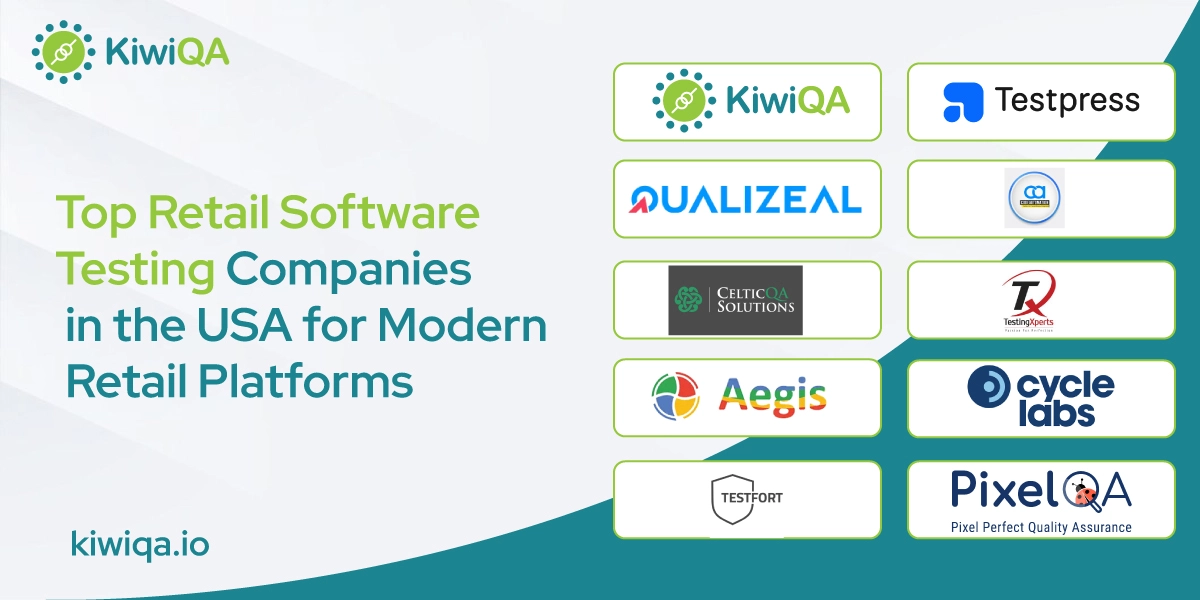
Top Retail Software Testing Companies in the USA for Modern Retail Platforms

The retail industry is changing at a speed that no other industry has demonstrated throughout its history. Retailers now transform their business operations and customer interactions because digital innovation, shifts in consumer behavior, and omnichannel commerce have become major forces. Modern retail platforms deliver fast service, customized experiences, and easy access to customers through their AI-based recommendation systems and instant inventory monitoring systems.

The successful operation of a business depends on its digital systems maintaining reliable performance. Customers now expect businesses to deliver complete customer service experiences. Shoppers demand that websites load quickly, while mobile apps operate intuitively, and checkout processes function without any obstacles. The platform needs retail testing services because they will verify that every user interaction functions perfectly across all operational scenarios.

The significance of effective software testing in retail is continually increasing. Issues like page loading speed and payment processing errors, no matter how small, can lead to customers abandoning their carts and businesses losing money. In research related to poor usability, it has been found that about 88% of online shoppers will not return to a website. This research emphasizes how important error-free retail websites are during peak shopping events and extreme traffic times.

As retail ecosystems become more sophisticated, the need for specialized QA testing firms has grown substantially. Retail businesses face a myriad of challenges during peak shopping events that must be addressed through expert partnerships, including load management, secure payment processing, and regulatory compliance.

This article discusses leading retail software testing companies in the USA that utilize the latest retail software testing technologies to help contemporary retailers achieve high performance, security, and customer-oriented applications.

Why Software Testing is Critical for Modern Retail Platforms

➥ Increasing Complexity of Retail Ecosystems

The current retail systems are interconnected with one another and are rapidly changing. In omnichannel systems, customers can switch between online stores, mobile applications, and physical stores. In order to create consistency, these systems need to be integrated with back-end systems, such as an Enterprise Resource Planning (ERP), Point Of Sales (POS), Customer Relationship Management (CRM), and eCommerce systems.

Furthermore, mobile retail applications create cloud and application alternatives and new challenges for systems, such as scalability, compatibility, and real-time data synchronization. Without sophisticated retail software testing, these challenges create greater complexity and a higher risk of failures, along with a greater inconsistency of experiences for the user.

➥ Customer Experience Expectations

Users expect and demand reliability, speed, and convenience at every interaction. Websites and mobile apps must load quickly and perform reliably, even with peak traffic. To build trust and encourage repeat purchases, secure transactions are a must. Successful retail application testing allows payment systems, user journeys, and checkout flows to be completed without any errors. The checkout process should be free of bugs and obstacles, as each small issue will drive cart abandonment, directly impacting revenue and the satisfaction of customers.

➥ Security and Compliance Requirements

The retail platforms need to protect their customer and payment data, which they handle as their main security requirement. Retail industry operators must comply with PCI DSS standards to protect data and process transactions securely. Customer data must be handled and stored in a manner that is consistent with data privacy laws, adding to the challenge.

Also, fraud prevention systems must be proven effective in identifying and blocking fraud and other related activities. By performing robust retail testing services, a business can mitigate risks and vulnerabilities, remain compliant, and shield its platforms against cyber attack risks, thus protecting its business and its customers’ privacy.
Ready to upgrade your retail testing strategy today

Key Types of Testing Required for Retail Platforms

❏ Functional Testing

Functional testing guarantees that the fundamental aspects of a retail platform operate as intended. This includes testing the shopping cart so customers can add, modify, or delete items with no problems. It is also important to validate that the checkout process functions correctly with respect to price calculations, discounts, payment, and order management.

Additionally, the workflows pertaining to order management should also be tested to facilitate the effortless retrieval, tracking, and return of orders. Strong retail application testing services help to detect and fix functional defects beforehand, allowing for a reliable and seamless user experience throughout the platform.

❏ Performance Testing

Performance testing evaluates how well a retail platform performs under different conditions, especially during high-demand periods. Load testing simulates user traffic during major sales events to ensure stability. Stress testing evaluates system performance by testing systems under extreme conditions until system failures occur and system restoration capabilities are assessed.

The testing process confirms that both websites and mobile applications maintain their responsiveness when system resources face heavy demands. Retail software performance testing becomes effective when it prevents all slowdowns and crashes while maintaining consistent system performance during peak shopping periods.

❏ Security Testing

Security testing is designed to help retail platforms guard against possible attacks as well as provide a secure means to conduct transactions. Validating how secure payment gateways are to avoid access and perpetrate financial fraud is essential. Assessing vulnerabilities is performed to assess gaps in the systems and exploitable weaknesses.

Safeguarding systems from cyber risks like data breaches, malicious software, and unauthorized access is critical. Comprehensive retail application testing services, cyber threats, malware infections, and hacking attempts. Comprehensive services help businesses retain customer trust and comply with rules and regulations.

❏ Mobile Application Testing

As a considerable amount of retail transactions are performed on mobile phones, mobile application testing becomes critical. Testing for cross-device compatibility makes sure that apps function efficiently on different screen sizes, different OS, and different devices. The entire mobile checkout process should be quick and easy to use.

If not, users may leave before completing the process. App performance testing looks into load time, responsiveness, and stability with regard to performance variations. The use of effective retail app testing services assures consistent performance and optimal user experience across all mobile platforms.

❏ Automation Testing

Automation testing is essential for the agility of the retail software development life cycle. It speeds up regression testing by automatically checking for new updates that may break current functionalities. When automation testing is coupled with a CI/CD pipeline, testing is done continuously, during every stage of the software development life cycle, which allows defects to be identified and addressed in a timely fashion.

Automation reduces the amount of manual effort and time spent testing while increasing testing accuracy. Incorporating top-tier retail application testing services results in automation that allows for testing to be done in a way that supports the rapid and frequent releases of software while maintaining the quality and performance of the software.

Also Read: Top Software Testing Challenges for FinTech Platforms (and How to Solve Them)

Top Retail Software Testing Companies in the USA

1. KiwiQA_IO
KiwiQA_IO


KiwiQA_IO offers a full suite of QA and software testing services, including testing automation, performance, and security. The company has extensive experience in the retail and eCommerce sectors and works with clients to improve the quality of their applications, mitigate risks, and speed up release cycles.

SR. No. Key Points Services Provided
1 Founded Year: 2009 Security Testing
2 Number of Employees: 51-200 Functional Testing
3 Location: India (Serving USA) Retail Software Testing
4 LinkedIn: View Profile Performance Testing
5 Website: KiwiQA_IO Game Testing

2. TestPros

TestPros

TestPros is a US-based software testing, QA, and cybersecurity services company. TestPros has services for both the government and enterprise sectors, providing reliable testing services oriented towards compliance, systems performance, and the stability of systems over long periods.

SR. No. Key Points Services Provided
1 Founded Year: 1988 Software Testing
2 Number of Employees: 51-200 Test Automation
3 Location: USA Configuration Management
4 LinkedIn: View Profile Consulting

3. QualiZeal

QualiZeal

QualiZeal focuses on next-generation quality engineering with a particular focus on automation and AI-based testing. The company aids organizations in optimizing the quality of their software, expediting the software release processes, and ensuring performance that scales within intricate digital ecosystems.

SR. No. Key Points Services Provided
1 Founded Year: 2023 Software Testing
2 Number of Employees: 501-1000 Functional Testing
3 Location: USA Performance Testing
4 LinkedIn: View Profile Security Testing

4. Code Automation

Code Automation

Code Automation provides modern application testing services through its advanced QA automation and software testing capabilities. The company develops testing solutions that use technology to help businesses scale their operations while maintaining product quality and development efficiency.

SR. No. Key Points Services Provided
1 Founded Year: 2018 Software Testing
2 Number of Employees: 11-50 Mobile App Development
3 Location: USA Design Services
4 LinkedIn: View Profile QA Testing

5. CelticQa

CelticQa

CelticQA provides complete quality assurance services through its highly experienced QA testing and software testing services. The business provides testing services with automation and QA consulting to help clients achieve better product reliability and delivery of high-quality software.

SR. No. Key Points Services Provided
1 Founded Year: 2005 Software Testing
2 Number of Employees: 11-50 Functional Testing
3 Location: USA Manual Testing
4 LinkedIn: View Profile Performance Testing

6. TestingXperts

TestingXperts

TestingXperts is a worldwide quality engineering company that provides sophisticated testing services and digital assurance solutions. The company enables its clients to improve software performance through its automation-based method, which accelerates product releases and achieves a uniform user experience across multiple platforms.

SR. No. Key Points Services Provided
1 Founded Year: 2013 Retail & Ecommerce
2 Number of Employees: 1001-5000 Software Testing
3 Location: USA Cloud Consulting
4 LinkedIn: View Profile AI Consulting

7. Aegis Softtech

Aegis Softtech


Aegis Softtech delivers complete software testing and quality assurance services, which it supports with its extensive industry experience. The company provides testing solutions that help organizations achieve better application quality and performance improvements and handle increased development needs.

SR. No. Key Points Services Provided
1 Founded Year: 2003 Software Testing
2 Number of Employees: 51-200 AI Development
3 Location: USA Data Science
4 LinkedIn: View Profile App Development

8. Cycle Labs

Cycle Labs

Cycle Labs provides testing automation and continuous testing solutions that work with complex enterprise systems. It helps organizations streamline testing processes while increasing release speed and maintaining consistent quality through its scalable automation solutions.

SR. No. Key Points Services Provided
1 Founded Year: 2021 Retail Service
2 Number of Employees: 11-50 ERP
3 Location: USA Manufacturing
4 LinkedIn: View Profile Regression Testing

9. TestFort

TestFort

TestFort provides complete quality assurance and software testing services, which include functional testing, performance testing, and security testing. The company helps businesses ensure stable applications through its testing services, which detect defects and verify performance across different digital environments.

SR. No. Key Points Services Provided
1 Founded Year: 2001 Manual Testing
2 Number of Employees: 51-200 Functional Testing
3 Location: USA Integration Testing
4 LinkedIn: View Profile Social Media Branding

10. PixelQa

PixelQa

PixelQA offers software testing services, including manual, automated, and performance testing. The company helps businesses to enhance application quality and boost system performance while delivering seamless user experiences across different platforms.

SR. No. Key Points Services Provided
1 Founded Year: 2021 API Testing
2 Number of Employees: 11-50 Load Testing
3 Location: USA Performance Testing
4 LinkedIn: View Profile Security Testing

Benefits of Hiring Specialized Retail Software Testing Companies

Working with specialized retail software testing firms brings quantifiable benefits to contemporary businesses functioning in fast-paced online marketplaces.

Increased confidence in platform stability and reliability contributes to retail applications working uniformly across every touchpoint. Each stage of testing uncovers and resolves defects to minimize total system failure and operational downtime during peak user activity.

Faster time-to-market enables retailers to introduce new features and updates, and entire platforms to the market without sacrificing their product quality. The development process becomes more efficient through testing processes, which help to decrease project delays.

Customers benefit from improved user experience, which comes from improved site layout and ease of navigation. Secure and reliable site transactions and interactions also aid in improved user experience. With improved retail application testing services, user interaction and overall experience are improved.

Maintaining revenue and brand equity during major sales periods can be achieved and sustained by improving downtime during testing. Testing will improve systems and decrease the chance of systems crashing or lagging.

Increased peace of mind and confidence from clients can be achieved by improving the way their sensitive information is handled. Firm and effective policies can help maintain industry standards, which in turn will improve and maintain trust.

Also Read: Complete List of AI Testing Services for AI-Powered Platforms

How to Choose the Right Retail Software Testing Company

➩ Industry Experience

It is vital to test partner providers who can demonstrate strong industry expertise. Companies that have worked with retail platforms understand complex workflows, including seasonal spikes, omnichannel, and cross-channel merges. Proven knowledge in retail software testing will ensure proper validation of critical functions, including inventory sync, checkout, and order management systems. Additionally, knowledge in ecommerce technology will lead to quicker resolutions to problems and better testing methods in line with real-world retail challenges.

➩ Technology Expertise

A testing partner must demonstrate strong technological skills in all aspects of modern retail. Knowledge of automation framework testing helps improve testing speed and accuracy in iterative testing throughout different phases of production releases. Tools that utilize AI to perform testing, such as AI testing platforms, allow for improved defect discovery and more accurate predictive analyses of defects.

Cloud-based testing of applications can be performed in a variety of different systems and environments, without developer infrastructure limitations. Selecting a partner in testing who has advanced knowledge in all of these areas will ensure that you have efficient, effective, and adaptable testing in modern retail solutions.

➩ Scalability and Flexibility

Retail businesses experience their highest demand periods during seasonal sales and product introduction times. The testing partner has to deliver testing teams that can be adjusted to fit the needs of their projects. The development process requires continuous testing, which needs support from both agile development and all other testing activities. The system’s adaptability enables teams to deliver their work faster while using resources efficiently and maintaining quality standards throughout their work, even when demand for development work is at its highest.

➩ Client Portfolio and Reviews

A company’s past work evaluation delivers essential information about its operational abilities and dependable performance. The company demonstrates its ability to resolve actual business challenges through its retail case studies. Client testimonials reflect satisfaction levels and service quality. Industry recognition, certifications, and awards establish the company’s credibility. A strong portfolio combined with positive reviews indicates a trustworthy partner capable of delivering consistent results in complex retail software testing projects.
Ready to discuss your retail testing requirements

Ready to Elevate Your Retail Platform? Partner with the Right Testing Experts

The modern retail environment changes rapidly. It requires considerable software testing to ensure consistent performance, functionality, and secure transactions across all digital touchpoints. As operational complexities increase, specialized testing firms become vital to quality control and risk mitigation.

The most seasoned retail app testing services providers have the experience, infrastructure, and methodologies to develop retail applications that are highly reliable and efficient. They reduce issues and enhance performance and user experiences on all applications across the retail vertical.

Prioritizing partnerships with experts in quality assurance who are familiar with the intricacies in the retail vertical helps retailers become better operationally and earn customer loyalty, profitability, and satisfaction in the long term. It also strengthens user confidence and boosts overall operational performance.
API Testing for Retail Systems: Ensuring Seamless Backend Interactions

In the ever-growing retail world, technology remains the backbone. Whether it’s an online store or a point of sale system, delivering a smooth customer experience is the key to success. Mobile e-commerce is emerging as the dominant force, expected to reach $856 billion by 2027. However, to achieve complete quality assurance, there are significant logistical & financial complexities that cause hurdles.

80% of users abandon a retail app after a bad experience. Retailers frequently face hurdles against 3rd party services like supply chain, payment gateways, etc. This is when retailers look for an advanced approach to broaden the coverage, limit the cost, while boosting the position. API testing emerges as the best solution to reshape the value chain.

API retail testing services play a key role in facilitating seamless communication with diverse platforms. API empowers retailers across various organizational operations. API enables real-time connectivity between the front-end & backend database. API testing drives the customer experience & streamlines the internal process of order fulfillment & inventory management. API allows retailers to make strategic approaches with 3rd party services. Through APIs, retailers can foster adaptability & agility. Performing API testing for retail apps is emerging as the key to unlock new possibilities & drive the retail business to achieve new heights!

The following blog highlights the necessity of API testing for retail systems, retail testing services, challenges & best practices.

Why API Testing is Critical for Retail Systems?

API testing for a retail business validates the safety and robustness of the retail app. API testing and retail testing services have become fundamental testing for a software product. It acts as a game-changer for retail businesses, empowering a seamless shopping experience across various channels.

Without API testing, your application might be vulnerable to hackers, which can lead to financial loss, data breaches & system outages. A small performance error can diminish your brand value & cause immense loss. Retail app testing is functional & offers a user satisfaction that drives the success rate.

By adopting API retail software testing services approaches, businesses can address the performance errors, usability issues & functional app issues before releasing. This comprehensive strategy fosters client loyalty & builds trust. Mobile API testing is critical for the retail system to preserve the security & integrity of the retail app.

A well-conducted retail software testing matches the standards & regulations of retail security laws. Retail forms can boost confidence, drive consumer data & accelerate the long-term success in the digital marketplace.

Also Read: Salesforce CRM Testing Checklist: What Enterprises Must Cover Before Go-Live

Common Backend Interactions in Retail Systems

❑ Inventory Management APIs

Now, inventory systems are interconnected through APIs, most of which are undocumented, misconfigured & poorly secured. With the assistance of inventory management software, retailers can gain more control over their stocks. To cover these responsibilities, inventory software must accept informed data. Most inventory management software integrates with other apps via API.

Real-time stock updates- Developers may modify the quantity of stocks for a particular product or potential variations of this kind.

Integration with suppliers and warehouses- To offer accurate data, inventory management systems integrate best with the suppliers & warehouses.

Synchronizing online and offline inventory- These APIs give developers the ability to track product stock levels across several websites, track the fluctuations of goods, and more.

❑ Payment Processing APIs

In the evolving, fast-paced world, the digital-driven organization landscape is a necessary aspect that significantly impacts the success & effectiveness of an organization. Seamless integration of payment is necessary for managing transactions & financial processes. By automating the payment processing system, businesses can drive the customer experience, boost operational effectiveness & stay current with the industry standards.

Secure transaction processing- Security plays a great role in winning the trust of users. The payment API enables multiple payment-related tasks, like secure fund collection & online payment.

Integration with multiple payment gateways- The integration enables organizations to accept payments from customers & clients through multiple channels like mobile apps, online stores & in-person transactions.

Handling failed or declined payments gracefully- Payment processing APIs ensure that the errors are handled gracefully. If payment transactions fail, it displays an error message on the screen & guides users about what went wrong & asks for a retry.

❑ Customer Relationship Management (CRM) APIs

CRM APIs in the retail industry facilitate the backend interactions by allowing multiple apps to communicate & exchange data with the CRM platform.

The following integration enables a unified view of customer information & streamlines the retail operation. CRM APIs are the approach to engage CRM tools for retail software testing services to design profitable sales. It involves monitoring customer data, offering personalized service & responding to quick inquiries, and building trust.

Personalized customer interactions- Retail APIs enable creation, updating & deletion of customer records, including contact information, purchase data, preferences & interactions, ensuring consistency across the systems.

Loyalty programs and customer insights- CRM APIs are responsible for collecting & analyzing data on customer behavior within loyalty programs. These data, when combined with the CRM data, offer deeper customer insights for strategic decisions.

Real-time customer support integrations- Thanks to CRM APIs that allow real-time customer support integration by allowing quick response to user queries. Businesses can respond quickly through channels like phone calls, mail support, live chat facilities, etc.

❑ Order Management APIs

A modern tool for software testing for retail, designed specifically for an online shop or CRM system, an order management system supports sales tasks, including order follow-up, data input, stock access, inventory management, and shipment management, which are part of the actual order fulfilment process.

Order placement, updates, and tracking- The following feature is crucial for enabling instant updates to order status. The system tracks order placement, updates &, & documents them to offer real-time data.

Integration with shipping providers- With this system, retailers can seamlessly integrate with the shipping providers. They can facilitate the order management system & fulfill order management automation to stay at the top of the rank.

Automated notifications for order statuses- By integrating order management APIs, businesses can deliver fully scalable & automated notifications to consumers for their order status.

Key Benefits of API Testing in Retail Systems

● Early detection of integration issues

Adopting API testing practices allows early identification & resolution of issues at a basic level, minimizing the cost & efforts. The retail API testing is performed earlier in the SDLC, before the completion of the user interface. Retailers can minimize the cost & efforts later & achieve rapid feedback to the development workflow. Retail systems rely on integration with external systems such as shipping providers, payment processes & marketing platforms. Testing ensures seamless data exchange with 3rd party APIs.

● Enhanced security and compliance

API testing for retail apps uncovers vulnerabilities like weak authentication, authorization flaws, data breaches, etc. By identifying & mitigating these errors, API testing can safeguard sensitive customer data, involving payment information, personal details, and login credentials. API testing is responsible for ensuring a secure & configured system adheres to all the regulatory standards.

● Improved customer experience through faster response times

API testing drives customer experience by enhancing reliability & performance. It ensures that an application is functional, reliable & effective. Additionally, seamless integration, quick detection of errors, faster resolution, and enhanced security make this testing a key to satisfying & driving customer experience. When users witness a consistent experience across various channels, they reach the store more frequently.

● Reduced downtime and disruptions

API security testing in retail ensures that the protocols are matched with smart industry aspects. It minimizes vulnerabilities and cyberattacks to reduce downtime. Eliminate human errors & improve test coverage by performing API testing.

 Want Smooth Integrations? Try Our API QA Experts

Essential API Tests for Retail Systems

❑ Functional Testing

Functional testing is a crucial part of retail application testing, which aims to confirm that each feature has been implemented appropriately in terms of functionality. Functional testing assesses how well API endpoints work. It verifies that the API function calls handle the input parameters correctly and produce the intended results. This would involve verifying the whole checkout procedure to ensure successful transactions and accurate order placement. It can explore merchandise and guarantee that product details are shown precisely.

❑ Load and Performance Testing

Load software testing in retail looks at the response duration and efficiency of an API under traffic scenarios. It evaluates how well an API performs and manages load by simulating user demands. To find performance bottlenecks and make sure the API can manage real-world usage situations, load testing is crucial.

It measures how fast an application reacts to user input, examines how long it takes for pages and requests to load, and ensures that the program won’t crash when there are too many users. Performance-related maintenance prevents application malfunctions, lags, and other issues that impact the user experience or the company as a whole.

❑ Security Testing

Security software testing in retail aims at addressing & resolving errors in APIs. The testing type ensures that APIs are protected against threats like SQL injection & unauthorized access attempts. Security testing is crucial to safeguard the user data & manage retail app integrity. Before your retail app errors have adverse effects on your brand integrity & user trust, run retail security testing.

The testing involves evaluation, vulnerability scans (SQL injection, XSS), and penetration testing to trace the app architecture. The testing is necessary for your retail app to manage the loopholes, authentication mechanisms, and complete security protocol for the application. Now retail owners can comply with industry norms & compliance like PCI DSS, GDPR while maintaining client data through quick identification & resolution.

❑ Integration Testing

Testing for end-to-end integration examines how databases, APIs, and other linked systems interact with one another. It guarantees that integrations work as intended and confirms that data moves between various components without delays. Additionally, this kind of automated testing ensures functionality across the software ecosystem. This confirms the behavior of APIs inside a whole system process. E2E testing is particularly important in composite applications or microservices settings where several APIs communicate with one another.

API Testing Tools Retail Businesses Should Leverage

There are multitudes of retail app testing tools for retail software testing services available for both commercial & open-source. The type of testing tool you use depends on the testing process and your project requirements.

1. Postman

postman

Postman is a tool used for retail API testing procedures, offering a user interface for sending requests. This comprehensive tool simplifies creation, testing & documentation of APIs. The tool delivers a streamlined UI that enables developers to design and test APIs.

Postman supports collaboration among team members & enables them to share API version control. Postman supports collaboration with team members & enables them to share their API test collection. The necessity of API testing ensures reliability & drives consumers’ trust.

The early issue detection & automation resources enable the team to focus on innovation. Integrating this tool with CI/CD pipelines allows continuous release & iteration with limited error risks. The tool allows developers to design & implement HTTP requests & responses for testing the API.

2. JMeter

JMeter

The tool is perfect for accessing performance & load testing of retail applications. The tool is recognized as the first choice of the QA team for testing. API testing isn’t limited to JMeter, but it can simulate the traffic & evaluate the performance of the API under multiple scenarios.

The following tool is good to integrate with other tools. Among testing technologies, Apache JMeter is unique, particularly in the area of API testing. Although its flexibility and versatility for performance testing are widely known, its prowess in automating API tests is particularly noteworthy.

JMeter benefits from ongoing improvement by a committed community since it is open-source. Creating reusable test scripts is one of its sophisticated capabilities as a performance testing tool. JMeter provides both a wide and in-depth insight into automated testing when combined with

its extensive reporting features. JMeter plugins, which provide improved visualization, more robust reporting, and support for protocols outside the core capabilities, can be used to further expand its capabilities.

3. SoapUI

SoapUI

Both SOAP and REST API testing are supported by the testing tool SoapUI. It has tools for performance/security assessment. Furthermore, SoapUI facilitates API test automation and permits scripting for test scenarios. The open-source testing tool is utilized for testing & debugging web services & APIs.

The tool is specifically designed for testing the web services that operate within client/server architecture. The tool is recognized as the leading API testing tool because of its wide range of features. It delivers comprehensive API support & enables testers to use a single tool for multiple testing cases.

It acts as a versatile tool for testing teams dealing with multiple API types. The graphical user interface of SoapUI is intuitive & user-friendly. The tool limits the learning curve for new users & ensures the app is performing as expected. With this tool, retailers can integrate data-driven testing approaches to improve their reliability & test coverage.

4. Swagger/OpenAPI

open api

Swagger offers a framework for creating, recording, and carrying out tests, which streamlines the process of testing APIs. It produces documentation that helps testers comprehend parameters, anticipated replies, and API endpoints. Some common features that make this tool a go-to choice are interactive documentation, cURL command generation, seamless integration with other tools, etc.

5. Cypress or REST-assured

Cypress-or-REST-assured

This is still popular in 2025 because of its streamlined workflows and fast backend functionality. Integration with CI/CD for automated testing is quick and more stable in the testing environment. The tool is popular because of speed & reliability. The retail software testing tool can execute GET, POST, and DELETE requests.

Also Read: Understanding the QA Outsourcing Model: Types, Costs, and Use Cases

Best Practices for Effective API Testing in Retail

❑ Automate repetitive API test cases

The following approaches reduce mistakes and save time by automating repeated test procedures. Including API testing in your CI/CD pipelines is also essential. By ensuring that automated tests are conducted on a regular basis, this integration offers prompt feedback on the stability and performance of the product. Automating these tests boosts productivity and facilitates quicker, more dependable software deployments.

❑ Regularly update API test suites to match changes in backend systems

Updating frequent API test suites is necessary to meet changes in backend systems. It ensures better accuracy & test relevance. In a dynamic retail environment, business logic and backend systems frequently evolve, so regular updates are a must.

❑ Monitor API performance continuously with real-time alerts

Frequent monitoring of API performance is highly recommended. Integrating monitoring tools enables the team to perform API monitoring. The QA team can comprehensively resolve the errors by integrating performance measures and receive alerts for anomalies.

❑ Foster collaboration between development, testing, and operations teams

It’s necessary to share the testing strategies & results with the team through peer reviews. Collaborating with the end users enables us to achieve real-world insights & align the testing efforts with the requirements. Collaboration fosters teamwork & enhances the test comprehensiveness.

Common API Testing Challenges (and How to Overcome Them)

● Handling evolving API requirements

It presents significant challenges for retailers & QA teams, such as complexities to manage test suite relevance, verifying the backward compatibility, test data management, and errors in scalability & performance of the retail app. Changes in the API also impact documentation and architectural changes. To overcome this challenge, ask the QA team for the URI and query parameter versioning.

● Ensuring accurate test data creation and maintenance

It creates challenges like data dependencies, relationships, volume & data variation, maintainability, reusability, environment consistency, data security errors & privacy, etc. To resolve the automation challenges, automate test data generation, check consistency & quality of data, improve data security & compliance, etc.

● Managing API version control

It presents various challenges, such as backward compatibility, changes in communication effectively, streamlining the deployment process, etc. To overcome the challenges, choose consistent versioning approaches, give priority to backward compatibility, and integrate robust communication.

● Ensuring adequate test coverage

This is a challenge in retail app testing, but it can be addressed by integrating a robust testing approach. It prioritizes the risks, leverages automation, and integrates a testing approach. The key strategies include defining clear goals, integrating test coverage, giving priority to high-risk areas & automating repetitive tests.

Need API Testing Help? Let’s Talk Today!

Why Investing in API Testing is Crucial for Retail Growth?

This ever-changing digital retail world has made it more challenging for retailers to launch their apps than before. To consistently launch the app, the retailers must adopt the API testing practices. It could result in faster iterations, early bug detection & more. By leveraging retail application testing, businesses can improve the user experience and limit costly errors.

It can optimize system performance and offer a seamless customer experience. In the retail industry, a small glitch can make a big impact and cause significant loss & brand reputational damage. Retail technology evolves quickly; therefore, with robust retail software testing services, businesses can stay ahead of the competition. If you want long-term success, prioritize API testing to ensure long-term retail success.