SAP Testing Process: A Complete Step-by-Step Guide for 2026

SAP systems support complex business operations across industries. As organizations adopt SAP S/4HANA, cloud platforms, and connected apps, testing becomes crucial for managing reliable business processes and data flows. Inadequate testing can lead to integration failures, incorrect data, performance errors, and costly production errors. The recent survey by Gartner shows 75% of ERP strategies aren’t strongly aligned with overall business strategy, leading to confusion.

A structured SAP Testing Process led by an experienced SAP testing company helps firms identify risks during implementation, migration, and upgrades before they impact production. Learn in this blog where we explain the testing types, key stages, metrics, automation trends, and effective SAP testing services.

What Is SAP Testing?

The process of verifying that SAP applications, configurations, custom developments, integrations, and business workflows function as intended is known as SAP testing. SAP testing places a strong emphasis on integrating enterprise processes and data flows, in contrast to traditional software testing. SAP testing companies assist organizations in confirming that SAP supports precise, dependable, and continuous business operations by verifying entire business scenarios across modules and external systems.

➥ Why Is SAP Testing Important?

SAP testing solutions assist companies in maintaining data accuracy, reducing production defects, validating integrations, safeguarding business-critical processes, and improving system reliability. By identifying functional, data, performance, and integration issues prior to go-live, it also lowers the risks associated with SAP implementations, upgrades, and migrations. Businesses are more confident that SAP processes will function properly and support continuous daily operations when they undergo thorough testing.
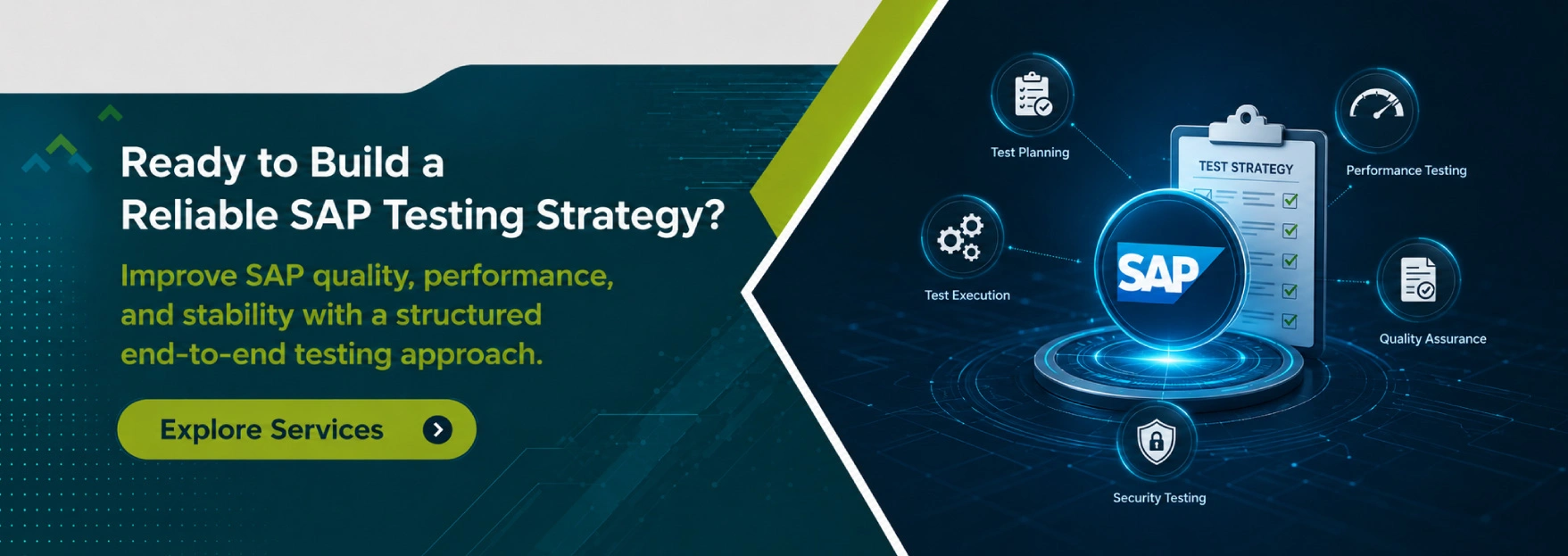
Ready to Build a Reliable SAP Testing Strategy?

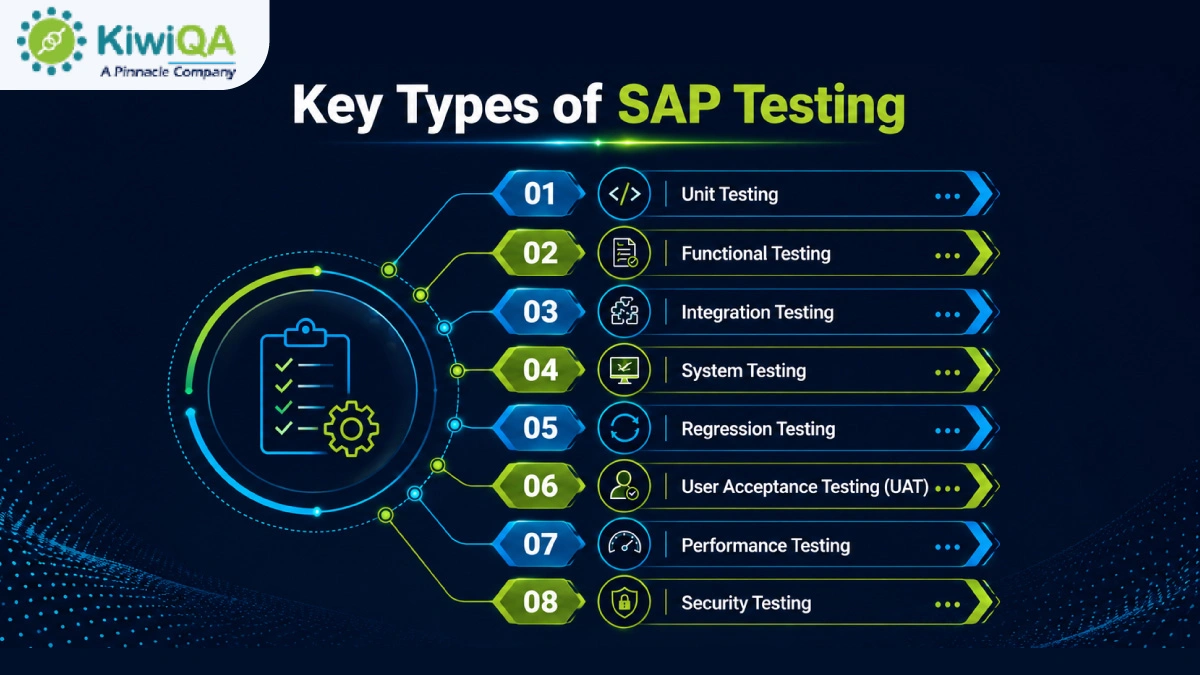
Key Types of SAP Testing

🢣 Unit Testing

Before they are integrated with other components, individual SAP configurations, developments, custom code, reports, interfaces, or objects are the focus of unit testing. Developers or testers confirm that every component operates according to its technical specifications and produces the desired outcomes. Finding flaws early on reduces the amount of work needed during subsequent testing stages. It helps to stop minor coding or configuration problems from impacting more significant business processes.

🢣 Functional Testing

Functional SAP testing services assess whether SAP modules and functions operate according to specified business requirements. Based on anticipated business rules and results, testers verify procedures. This testing verifies that configured SAP functionality supports intended operations and appropriately manages various business conditions. It assists in identifying gaps between the documented functional requirements and the implemented solution.

🢣 Integration Testing

Integration testing of SAP solutions confirms that information is correctly exchanged between SAP modules and related applications. In addition to external systems, APIs, middleware, and third-party applications, testers verify data flows between departments like sales, finance, procurement, and inventory. The goal is to verify that dependent processes function as intended and that transactions flow across system boundaries with accuracy. This helps in identifying problems with interfaces, mapping, synchronization, and data transfer.

🢣 System Testing

Instead of testing individual components separately, system testing assesses the SAP environment as a whole. In compliance with specified requirements, testers verify integrated functionality, configurations, interfaces, workflows, and system behavior. To determine whether various components function properly under realistic circumstances, end-to-end business scenarios are performed.

🢣 Regression Testing

Regression testing verifies that SAP’s current functionality is still functional following upgrades, patches, configuration updates, and custom code changes. To find unexpected effects on established business processes, testers rerun suitable scenarios. Particular attention should be given to critical workflows and frequently used transactions. Particularly in large SAP environments with frequent releases and interconnected processes, automating repetitive regression scenarios can increase execution speed and consistency.

🢣 User Acceptance Testing (UAT)

From the viewpoint of its intended users, user acceptance testing establishes whether SAP satisfies realistic business requirements. Business teams test whether the system supports anticipated results by running realistic scenarios similar to their everyday operations. Users record process problems, functional gaps, and other issues so they can be fixed.

🢣 Performance Testing

Performance SAP automation testing company assesses how SAP reacts to various workload scenarios and whether the system maintains stability as transaction volumes rise. Response times, throughput, resource usage, and system behavior under typical, peak, and stressful circumstances are all measured by testers. High-volume procedures and crucial transactions should be given priority. Teams can increase reliability for production users by using performance testing to find errors prior to deployment.

🢣 Security Testing

Security testing evaluates how well SAP protects business data and limits system access based on roles and authorizations. While searching for possible security flaws, testers confirm user permissions, access controls, and authentication procedures. Testing should also take into account whether users have access to features or data that are outside of their control. Prior to production deployment, comprehensive SAP testing solutions assist organizations in identifying access risks and improving SAP security.
Key Types of SAP Testing

SAP Testing Process: Step-by-Step Guide

Step 1 – Understand Business Requirements

The first step is to go through the business and functional requirements that specify how the SAP solution must function. Determine which SAP business processes are essential, such as workflows that have a direct impact on revenue, customers, finance, the supply chain, or employees. 

To comprehend possible testing impacts, examine integrations and dependencies with other SAP modules and external applications. Clearly define the acceptance criteria and anticipated business results. This foundation ensures that test activities stay in line with organizational goals, helps testing teams concentrate on business-critical functionality, and minimizes coverage gaps.

Step 2 – Define the SAP Testing Scope

Before creating complex test activities, clearly define the testing scope. Determine which SAP modules, applications, and business functions need to be validated in accordance with project goals and risk levels. Identify the essential workflows that must function properly in all integrated processes. 

Incorporate middleware, interfaces, APIs, and external systems that communicate with SAP. To avoid misunderstandings during execution, the team should clearly document both in-scope and out-of-scope areas. Teams can prioritize high-risk functionality, allocate resources efficiently, and maintain consistency throughout the SAP project with the support of a clearly defined scope.

Step 3 – Develop an SAP Test Strategy

An SAP testing process outlines how the testing procedure will be carried out and managed during the project. Determine testing goals first, taking into account project requirements, system complexity, and business risks. Select the best QA types that are functional, integration, performance, and security. 

Environments, automation opportunities, roles, entry and exit requirements, and defect-management protocols should all be specified in the strategy. Teams can prioritize high-risk procedures, make effective use of resources, and maintain uniform testing coverage across SAP modules and integrations with the support of a clear strategy.

Also Read : Top 10 SAP Testing Company in US Delivering End-to-End SAP Quality Assurance

Step 4 – Create the SAP Test Plan

The SAP business process automation testing strategy is converted into a workable schedule of responsibilities and tasks by the SAP test plan. It should outline what will be tested, when testing will take place, who will carry out each task, and what environments or tools will be required.

Dependencies between SAP modules, integrations, test data, and business users should all be taken into consideration in the plan. Incorporate risk-management and reporting protocols so that interested parties can keep an eye on developments and address any delays or serious flaws. A thorough test plan offers a methodical way to organize testing from planning to final validation.

Step 5 – Prepare the SAP Testing Environment

The configuration and integrations that the system will use in production should be closely mirrored in the SAP testing environment. Before execution starts, testers set up the necessary SAP modules, interfaces, databases, middleware, and related apps. To make sure data can transfer between SAP and external systems properly, system connectivity needs to be verified.

Incorrect permissions can prevent valid test execution or reveal security flaws, so user roles and authorizations must also be verified. Early environment preparation helps in differentiating issues resulting from configuration, connectivity, access, or infrastructure from actual application flaws.

Step 6 – Prepare SAP Test Data

The business conditions that users will face in production should be accurately reflected in SAP test data. For procedures like order management, procurement, finance, and inventory, testers create master data, transactional records, and scenario-specific datasets. To confirm how SAP manages expected and exception conditions, both valid and invalid data should be included. Regression testing can be made quicker and more reliable by using an SAP automation testing company to automate the creation of test data for repetitive scenarios.

Step 7 – Design SAP Test Cases and Scenarios

SAP test cases should convert business requirements into verifiable, executable conditions. Create end-to-end scenarios that represent entire business processes after beginning with individual functions. Every test case should specify the requirements, test data, execution procedures, and anticipated outcomes. Additionally, traceability, which enables teams to assess whether crucial business functionality has been sufficiently tested, is provided by connecting test cases to requirements.

Step 8 – Execute SAP Tests

Testers run authorized scenarios against the configured SAP environment during test execution, comparing actual system behavior with expected outcomes. According to the project’s reporting guidelines, each test should be marked as passed, failed, blocked, or something else. Testers should record relevant documentation, such as screenshots, transaction details, logs, or error messages, whenever a failure happens. The planned scope and timeline should be used to monitor testing progress. Failures are simpler to recreate, look into, and share with developers, SAP consultants, and business stakeholders thanks to this methodical approach.

Step 9 – Identify and Manage Defects

Defects in SAP should be recorded so that technical teams can comprehend and reproduce the issue. The impacted process, test results, steps to reproduce the problem, expected behavior, actual behavior, and supporting documentation should all be included in a defect record. Then, defects can be categorized based on business priority and severity. 

Determining whether a problem comes from configuration, custom development, integrations, master data, authorizations, or another component is made easier with the help of root-cause analysis. By monitoring every defect through retesting and closure, unresolved problems are kept from being missed prior to deployment.

Step 10 – Perform Regression Testing

Regression testing confirms that SAP modifications have not unexpectedly impacted current functionality. Following configuration modifications, patches, updates to custom code, integrations, or defect fixes, it becomes especially crucial. Before rerunning relevant test cases, testers should determine which processes might be impacted by the change. 

Changes involving interconnected modules should also incorporate critical end-to-end workflows. Regression scenarios that are frequently repeated can be automated to save human labor. Teams can find unexpected behavior before it reaches production by comparing current results with those from prior test cycles.

Step 11 – Conduct User Acceptance Testing

The purpose of user acceptance testing is to determine whether SAP meets the expectations and real business processes of its intended users. Using procedures and data that mirror daily operations, business representatives carry out realistic scenarios. 

For example, supply-chain teams might test inventory procedures, while finance users might verify financial postings and reporting. Users document usability issues, process problems, or functional gaps that might not be found by technical testing alone. Before stakeholders formally accept and approve the system for production use, critical issues should be fixed and retested.

Step 12 – Validate Performance and Security

Additionally, SAP testing should verify that users can only use data that aligns with their roles and that the system maintains responsiveness under anticipated workloads. Response times under typical, peak, and high-volume circumstances can be assessed through performance testing, especially for crucial transactions and interfaces. 

User roles, authorizations, access controls, and potential vulnerabilities should all be examined during security testing. By testing these areas, issues that might not show up during functional validation can be found. Before the system is deemed ready for deployment, performance and security results should be compared to specified requirements.

Step 13 – Prepare SAP Testing Reports

SAP testing reports combine execution results into data that stakeholders can use to evaluate go-live readiness and quality. In addition to defect counts and severity, reports usually display the number of test cases that were executed, passed, failed, blocked, and pending. 

They should also highlight unresolved problems or risks and show that important business processes are covered. Teams should explain whether remaining defects could impact business operations instead of just reporting test-case numbers. It is easy for the stakeholders and project managers to evaluate whether the SAP solution is prepared for implementation.

Step 14 – Complete Final Sign-Off and Go-Live Validation

Final sign-off confirms the SAP system’s compliance with the established testing and business acceptance standards. Stakeholders should examine any agreed-upon workarounds, critical-process outcomes, unresolved defects, and outstanding risks prior to approval. 

Smoke testing should confirm crucial transactions, integrations, user access, and other crucial operations in the production environment after the system goes live. Performance problems can then be found through post-deployment monitoring. An extra layer of protection between successful pre-production testing and stable SAP operations following deployment is offered by this final validation.

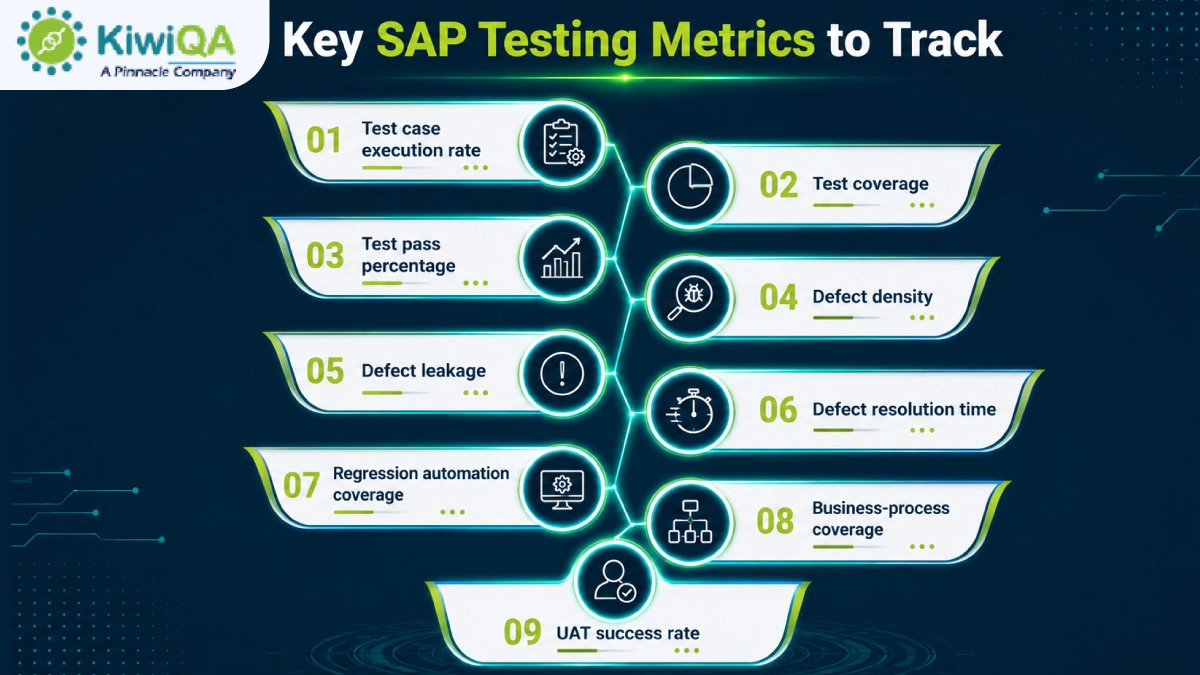
Key SAP Testing Metrics to Track

🢣 Test case execution rate- It calculates the number of planned test cases that have been run during a given testing period.

🢣 Test coverage- It demonstrates the extent to which the specified SAP features, specifications, or business procedures have been tested.

🢣 Test pass percentage- It shows the proportion of test cases that are successfully completed and produce the desired outcomes.

🢣 Defect density- It counts the number of flaws found in a particular SAP function, module, or testing area.

🢣 Defect leakage- It monitors flaws found in production or after release that were overlooked during testing.

🢣 Defect resolution time- It calculates the typical time needed to look into, correct, retest, and close reported defects.
Key SAP Testing Metrics to Track

🢣 Regression automation coverage- It displays the percentage of regression test cases that are repeatable and automated.

🢣 Business-process coverage- It evaluates the degree to which crucial end-to-end business processes have been verified during SAP testing.

🢣 UAT success rate- It shows the proportion of user acceptance tests that business users have successfully approved.

How Automation and AI Are Changing SAP Testing in 2026

◈ AI-Assisted Test Case Generation

AI can recommend appropriate test cases and scenarios by analyzing SAP requirements, business rules, and current documentation. This reduces manual tasks, increases coverage, and helps testers find missed conditions. AI-generated cases can then be reviewed and improved by human testers prior to execution.

◈ Intelligent Regression Testing

Intelligent regression testing determines which SAP functions are most likely to be impacted by updates. Teams can prioritize high-risk scenarios rather than running every test that is available. This keeps coverage of crucial business processes while reducing unnecessary execution.

◈ Self-Healing Test Automation

Self-healing automation can automatically modify test scripts to continue running when it detects specific changes in SAP interfaces or application components. When object properties or user interfaces change, this can reduce maintenance work.

◈ Predictive Defect Analysis

To find SAP areas that might have a higher defect risk, predictive defect analysis uses past testing data, change patterns, and defect trends. These insights can be used by teams to prioritize testing resources, concentrate reviews on vulnerable stages, and conduct research into possible problems earlier in the testing lifecycle.

Also Read : A Complete SaaS Testing Approach for Modern Businesses

How to Choose the Right SAP Testing Partner

☢ SAP domain expertise- Select a partner who has demonstrated expertise with SAP modules, business procedures, configurations, and testing techniques.

☢ S/4HANA testing experience– Check if they have tested custom developments, migrations, upgrades, and S/4HANA implementations.

☢ Test automation capabilities– To increase testing efficiency, find out if they can automate regression, high-volume, and repetitive test scenarios.

☢ Industry knowledge- Choose a partner who is knowledgeable about the operational procedures, business priorities, compliance requirements, and industry workflows.

☢ Integration testing expertise– Make sure they are able to test dependencies and data flows between SAP modules, middleware, APIs, and external apps.

☢ Performance and security testing capabilities- Look for knowledge of SAP performance, scalability, user access, authorization, and security control validation.

☢ Test framework maturity– Determine whether the partner makes use of defined procedures, reusable resources, structured testing frameworks, and measurable quality standards.

☢ Reporting and governance approach- Select a partner who offers regular stakeholder communication, risk visibility, test metrics, defect reporting, and clear dashboards.

☢ Ability to support continuous testing– Give preference to partners who can support continuous validation across SAP releases, updates, and modifications and incorporate testing into CI/CD pipelines.

Ready to Discuss Your SAP Testing Requirements?

Ready to Strengthen Your SAP Testing Process?

SAP performance depends on testing, which continues throughout the system lifecycle. SAP testing acts as the continuous business-risk validation process rather than final delivery. A structured SAP business process testing approach helps to protect critical processes, integrations, and user experience. Whether implementing, upgrading, or migrating SAP, choosing a skilled SAP testing company helps to establish scalable quality practices, minimize disruptions, and ensure the system remains reliable with changing business needs.

Top 10 SAP Testing Company in US Delivering End-to-End SAP Quality Assurance

Are SAP issues in your applications, system breakdowns, or new deployment problems hindering your business operations? To a large extent, organizations rely on SAP platforms for the management of their critical business functionalities. Hence, selecting the top SAP testing company to ensure the reliability, safety, and performance of these complex systems is vital.

Typically, SAP ecosystems are quite complex and may encompass various modules, integrations, and business workflows. Lack of proper testing can lead to disruptions that incur great costs, non-compliance risks, and the delivery of poor user experiences. Therefore, SAP quality assurance by a professional is considered one of the main success factors that lead to SAP go-lives and system upgrades.

The adoption of SAP S/4HANA, SAP ERP, cloud-based SAP applications, as well as the particular use of automated business processes, has significantly escalated the requirement for dedicated SAP testing services. According to industry reports, over 70% of enterprises prioritise end-to-end testing to minimise production defects and improve application reliability before go-live.

In this article, you will get an idea about the criteria used to evaluate the top SAP testing companies, find out the top 10 SAP testing companies in the US, get an overview of the main SAP testing services they provide, and learn how to pick the most suitable partner for your SAP quality assurance needs.

How We Evaluated the Top SAP Testing Companies

➥ SAP Testing Expertise

Effective SAP testing requires an intimate understanding of SAP technology and experience in a particular domain.

◈ SAP S/4HANA Testing Capabilities

Besides a great track record of migration to SAP S/4HANA and testing its validation and upgrade, the teams of the top providers are capable of dealing with the specific issues of modern SAP environments.

◈ Functional and Regression Testing Experience

Leading companies carry out thorough testing to make sure that business processes are still valid even after the introduction of system changes, updates, or customizations.

◈ Industry-Specific SAP Testing Knowledge

Top SAP testing companies even have the deep market knowledge necessary to understand specific industry workflows, regulations, and challenges.

Typically supported industries include:

▪ Manufacturing

▪ Healthcare

▪ Retail

▪ Banking

▪ Financial Services

➥ Automation & Testing Tools

The use of state-of-the-art automation techniques is required due to the complexity of current SAP projects.

◈ SAP Test Automation Frameworks

Top organizations employ automation frameworks in order to make testing cycles shorter and raise test coverage levels.

◈ Integration with Modern QA Tools

Don’t forget that testing environments will have to allow for easy integration of DevOps, CI/CD pipelines, and enterprise QA tools.

◈ AI-Driven Testing Capabilities

Sophisticated SAP automation testing features rely on AI for risk detection, test case optimization, and enhancement of defect discovery.

➥ Industry Experience

One of the major evaluation factors for SAP testing expertise is a company’s experience with various industries.

◈ Manufacturing

Validation of production planning, inventory management, and supply chain processes.

◈ Healthcare

Testing of patient data systems, compliance workflows, and healthcare operations.

◈ Retail

Verification of order management, customer experience, and inventory workflows.

◈ Finance and Banking

Testing financial transactions, reporting systems, and regulatory compliance processes.

➥ Client Reviews & Market Reputation

The reputation of a testing provider often reflects the quality of its services.

Evaluation criteria include:

▪ Customer feedback

▪ Project success stories

▪ Long-term client relationships

▪ Industry recognition

▪ Proven delivery capabilities

➥ Scalability & Delivery Model

Large SAP testing services often require flexible delivery approaches.

◈ Onshore and Offshore Support

Leading companies provide globally distributed delivery models to cater to project requirements and budgets.

◈ Dedicated QA Teams

An effective SAP testing service will have dedicated testers who deal with SAP quality assurance full-time.

◈ Enterprise-Scale Project Handling

Top SAP testing vendors have the necessary toolkit, experience, and expertise to handle multinational, multi-location SAP implementation projects.

Ready to Strengthen Your SAP Testing Strategy?

Top 10 SAP Testing Company in US Delivering End-to-End SAP Quality Assurance

1. KiwiQA.io

KiwiQA IO

KiwiQA IO is a well-known software testing and QA firm that provides deep SAP testing capabilities to companies from various industry sectors. The company assists enterprises in enhancing the quality of their SAP applications, lessening the risk of deployment, and maintaining business efficiency through thorough testing strategies.

Their SAP testing knowledge covers functional, automation, integration, performance testing, as well as SAP S/4HANA validation. Coupled with industry best practices and advanced testing toolsets, KiwiQA IO helps businesses detect defects early, enhance system reliability, and realize the goal of successful SAP implementation.

❏ Reasons to Choose Them

▪ Consistent SAP testing capability

▪ Strong in automation testing

▪ Well-tuned testing strategies

▪ Expert SAP testing professionals

▪ Flexible engagement models

SR. No. Key Points Services Provided
1 Founded Year: 2009 SAP Testing
2 Number of Employees: 51-200 Mobile Testing
3 Location: India (Serving USA) Security Testing
4 LinkedIn: View Profile Functional Testing
5 Website: KiwiQA_IO Performance Testing


2. Qualitest

Qualitest

Qualitest is a big player in the world of quality engineering, offering a very wide range of SAP testing services for enterprise applications. They can support businesses all the way through SAP roll-out, migration, and upgrade projects to guarantee application stability, performance, and security.

The way they do it is by merging manual testing skills with leading-edge automation technologies to extend test coverage, improve product quality, and speed up delivery timelines. They also put emphasis on adopting continuous quality engineering resources that enable organizations to have reliable SAP environments while also growing their business.

❏ Reasons to Choose Them

▪ Worldwide SAP testing experience

▪ Advanced automation frameworks

▪ Enterprise-scale project support

▪ Continuous testing capabilities

▪ Strong industry reputation

SR. No. Key Points Services Provided
1 Founded Year: 1997 SAP Testing
2 Number of Employees: 5,001-10,000 Software Testing
3 Location: USA AI & Digital Assurance
4 LinkedIn: View Profile Security Testing


3. DeviQA

DeviQA

DeviQA is a niche software delivery quality partner offering SAP-centric testing services aimed at making software and business operations more efficient and sustainable. They offer support to their customers through SAP functional testing, regression testing, automation, and performance validation of very complex SAP environments.

Their tested teams specialize in bringing about early defect discovery, smaller project risks, and seamless SAP deployments. DeviQA’s well-organized procedural approach to testing can help clients not only maintain quality standards but also increase operational efficiency.

❏ Reasons to Choose Them

▪ All-round SAP testing

▪ Highly qualified testing staff

▪ In-depth regression

▪ Flexible testing solutions

▪ Emphasis on improvement in software quality

SR. No. Key Points Services Provided
1 Founded Year: 2010 SAP Testing
2 Number of Employees: 201-500 Core QA & Testing Services
3 Location: USA Test Automation
4 LinkedIn: View Profile QA Consulting & Managed Services


4. QASource

QASource

QASource is a quality assurance company working in the field of software testing that dedicates quality assurance professionals to enterprises for the purpose of optimizing SAP applications’ performance and delivery reliability. The company regularly supports businesses with their SAP ERP, SAP S/4HANA, and all-in-one business systems testing.

Its tested methodologies put management of defects and continual quality monitoring on an equal footing with risk reduction. Developing the tailor-made testing strategy QASource provides facilitates performance improvement and better user experience.

❏ Reasons to Choose Them

▪ Exclusive SAP testing specialists

▪ Strong quality assurance processes

▪ Flexible delivery models

▪ Early defect identification

▪ Reliable testing support

SR. No. Key Points Services Provided
1 Founded Year: 2000 SAP Testing
2 Number of Employees: 1,001-5,000 QA & Software Testing
3 Location: USA Test Automation
4 LinkedIn: View Profile AI & Advanced Testing


Also Read : A Practical Guide to Software Testing Trends 2026 for Businesses

5. TestingXperts

TestingXperts

TestingXperts provides comprehensive SAP Quality Assurance services, enabling enterprises to maintain and improve the performance aspects, security, and stability of business processes. They provide assistance to the organizations via SAP implementation, migration, and optimization projects.

Automation testing, performance testing, security testing, and SAP migration validation are among the company’s competencies. In TestingXperts, businesses have a partner capable of quickening their release cycles while at the same time keeping the highest-quality standards.

❏ Reasons to Choose Them

▪ End-to-end SAP QA services

▪ Automation and performance testing expertise

▪ Faster testing cycles

▪ Strong quality engineering practices

▪ Industry-focused solutions

SR. No. Key Points Services Provided
1 Founded Year: 2013 SAP Testing
2 Number of Employees: 1,001-5,000 Functional Testing
3 Location: USA Automation Testing
4 LinkedIn: View Profile AI & Advanced Testing


6. BugRaptors

BugRaptors

BugRaptors is an established provider of SAP testing services that ensure the quality and smooth performance of software. The company’s offering scope is SAP applications, integrations, and enterprise workflows testing.

Its team concentrates on uncovering vulnerabilities, validating business processes, and mitigating deployment risks. A combination of manual and automated testing approaches provides BugRaptors’ clients with better software quality and, consequently, better operational results.

❏ Reasons to Choose Them

▪ Full-cycle SAP testing solutions

▪ Security and performance testing experts

▪ Bespoke QA strategies

▪ Derisking implementation

▪ Veteran testing teams

SR. No. Key Points Services Provided
1 Founded Year: 2016 SAP Testing
2 Number of Employees: 501-1,000 Performance & Security Testing
3 Location: USA Test Automation
4 LinkedIn: View Profile QA & Software Testing


7. Quinnox

Quinnox

The SAP testing services of Quinnox are not isolated as standalone offerings, but rather, are integrated within their digital transformation and technology solutions portfolio. Quinnox’s solutions assist organizations in auditing critical SAP processes, enhancing system performance, and securing operational continuity.

Quinnox can perform functional, automation, integration, and continuous quality assurance testing. Also, the company collaborates with its clients closely to create test plans that support the fulfillment of business goals and the execution of digital transformation initiatives.

❏ Reasons to Choose Them

▪ Mastery of digital transformation

▪ Overall SAP work validation

▪ Strong automation abilities

▪ Industry-specific knowledge

▪ Focus on business continuity

SR. No. Key Points Services Provided
1 Founded Year: 2002 SAP Testing
2 Number of Employees: 1,001-5,000 Performance Testing
3 Location: USA AI-Driven Testing
4 LinkedIn: View Profile Continuous Testing


8. ImpactQA

ImpactQA

ImpactQA is an enterprise-focused quality assurance company that offers comprehensive SAP testing services for modern business environments. The company helps organizations improve software reliability, reduce risks, and maintain system performance through structured testing processes.

Automation testing, functional validation, integration testing, security testing, and performance evaluations are among its services. The quality assurance model of ImpactQA backs organizations not just at the SAP implementation stage but also throughout the SAP lifecycle.

❏ Reasons to Choose Them

▪ World-class testing services

▪ Full-range QA coverage

▪ Flexible engagement models

▪ Leading automation expertise

▪ Consistent project delivery

SR. No. Key Points Services Provided
1 Founded Year: 2012 SAP Testing
2 Number of Employees: 201-500 Quality Engineering & Testing
3 Location: USA Test Automation
4 LinkedIn: View Profile Performance & Security


9. Opkey

Opkey

Opkey specializes in SAP automation testing and is widely recognized for its ability to improve the efficiency of SAP testing processes and contribute to raising the quality of software applications. It provides a no-code testing platform that simplifies SAP test automation and simultaneously reduces manual effort.

Their solutions are appropriate for continuous testing, regression testing, upgrade validation, and functional testing. Opkey enables organizations to speed up releases by improving testing efficiency and coverage, all the while maintaining the reliability of applications.

❏ Reasons to Choose Them

▪ SAP dedicated automation platform

▪ Capabilities of no-code testing

▪ Faster test execution

▪ Better test coverage

▪ Continuous testing facilitation

SR. No. Key Points Services Provided
1 Founded Year: 2015 SAP Testing
2 Number of Employees: 201-500 ERP & Enterprise Application Testing
3 Location: USA Test Automation & Quality Engineering
4 LinkedIn: View Profile Enterprise Application Lifecycle Management


10. Tricentis

Tricentis

With a deep pool of expertise in SAP testing, Tricentis leads the way in delivering software testing and automation solutions at the enterprise level. The company is helping organizations undergoing large-scale SAP transformations, cloud migrations, and digital modernization enablement through SAP testing.

Automation testing, risk-based testing, performance validation, and continuous testing are among their SAP testing skills. Tricentis helps businesses improve release quality, reduce testing effort, and accelerate innovation by utilizing intelligent testing technologies.

❏ Reasons to Choose Them

▪ Advanced SAP testing capabilities

▪ Industry-leading automation tools

▪ Risk-based testing approach

▪ Enterprise-scale project expertise

▪ Continuous testing and quality assurance

SR. No. Key Points Services Provided
1 Founded Year: 2007 SAP Testing
2 Number of Employees: 1,001-5,000 Quality Engineering
3 Location: USA Enterprise Application Testing
4 LinkedIn: View Profile AI & DevOps


Core SAP Testing Services Offered by Leading SAP Testing Companies

☢ SAP Functional Testing

SAP function testing is software verification of business processes to confirm that they’re working properly across different SAP modules and workflows.

Major activities include:

▪ Performing business process validation

▪ Checking workflows

▪ Compliance with requirements

▪ Test transactions

▪ Providing support for user acceptance testing

Top suppliers usually employ sophisticated SAP testing solutions to ensure that the SAP applications are aligned properly with the business goals and desired results.

☢ SAP Automation Testing

Today, automation is a must-have feature in SAP environments.

Benefit examples:

▪ Decrease turnaround time for tests

▪ Minimize resources spent on testing

▪ Test more areas in less time

▪ Enable continuous testing

▪ Speed up product releases

It is common for companies to partner with an SAP automation testing company to implement automated testing, which will drive efficiency and help them lower the operational cost in the long run.

☢ SAP Integration Testing

SAP systems are rarely isolated. They connect to various third-party systems and other enterprise software. Integration testing is a process to make sure that all systems talk to each other properly.

Major activities involve:

▪ Validating third-party systems

▪ Verifying data flows

▪ Testing APIs

▪ Testing end-to-end processes

Top-notch SAP testing services help in identifying the integration problems well ahead of time so that they do not interfere with regular business operations.

☢ SAP Performance Testing

Performance testing is conducted to analyze SAP applications’ behavior under different workloads and business scenarios.

Testing focuses on areas such as:

▪ Load testing

▪ Stress testing

▪ Scalability testing

▪ Response time analysis

▪ System stability analysis

Professional testing of SAP solutions plays a big role in assisting companies with maintaining an uncompromised performance and keeping users satisfied.

☢ SAP Security Testing

Security testing provides the technical defense for companies to safeguard their secret business information and meet compliance standards.

Main areas of work are:

▪ Validating user permissions

▪ Checking compliance

▪ Finding vulnerabilities

▪ Testing authorizations

▪ Validating data protection

Top SAP testing providers will conduct security audits to identify and mitigate risks and reinforce SAP environments.

☢ SAP S/4HANA Testing

Testing for SAP S/4HANA ensures that implementation, migration, and upgrade projects are completed successfully.

Core services include:

▪ Migration testing

▪ Upgrade testing

▪ Functional validation

▪ Performance verification

▪ Post-deployment validation

With the help of powerful SAP automation testing technologies, businesses can ensure that their moves to S/4HANA remain as disruption-free as possible.

Benefits of Hiring a SAP Testing Company in US

Going for an expert SAP testing company can make a great difference in the positive outcome of SAP implementation, migration, and upgrade projects. Skilled testing professionals uncover and resolve issues prior to the disruption of the business process, which has a mammoth effect on operation and is usually quite costly.

1. Improved Business Continuity

For companies that have their whole chain of business processes linked to SAP, one of the major concerns is keeping business continuity unhampered at all times.

🢣 Minimize Production Issues

Thorough testing can uncover the bugs that have remained hidden till now through other means and might pose a threat during deployment to the production environment.

🢣 Ensure Stable SAP Operations

SAP testing standards have been maintained at a very high level, especially by the top SAP testing companies that regularly monitor SAP application performance so that they remain stable and functional as per expectations, both post-implementation and after every update.

Some of the benefits are:

▪ Less downtime

▪ Fewer interruptions to the business

▪ More efficient operations

▪ Greater reliability of systems

2. Faster SAP Implementations

Testing is one of the most important factors in speeding up projects.

🢣 Accelerate Deployment Cycles

By testing thoroughly, you ensure that you catch problems early in the game and, hence, are able to clear the way for the rest of the project to proceed more smoothly.

🢣 Reduce Go-Live Risks

Expert SAP testing services will have tested and re-tested all the major business processes so that the need to take risks with the go-live event is limited to the absolute minimum.

Those companies that take the time and dedicate resources to testing at the onset of their projects not only witness faster time to deployment but also smoother project execution overall.

3. Enhanced User Experience

How users perceive the applications has a high bearing on how productive they will be and thereby, ultimately, how well the business performs.

🢣 Reliable Workflows

Testing guarantees that all the workflows perform as expected, ending user dissatisfaction and operational delays.

🢣 Better System Performance

Testing makes the system responsive and high-performance oriented, which means that the user’s experience is enhanced.

Some of the benefits:

▪ Fast transaction processing.

▪ Workflow efficiency is improved.

▪ Employee productivity goes up.

▪ User satisfaction has increased.

4. Reduced Operational Costs

Making testing one of the first things that the project will execute will save a lot of money during the entire lifecycle of operation.

🢣 Early Defect Detection

Tackling issues during the testing phase costs considerably less than fixing the issues post-production-release.

🢣 Lower Maintenance Expenses

Good testing of SAP solutions can reduce the number of support requirements and hence lead to a decrease in ongoing maintenance costs.

Examples of cost-saving:

▪ Rework reduction

▪ Reduced the number of production incidents

▪ Lower support costs

▪ Better resource utilization

5. Regulatory Compliance Support

It goes without saying that a lot of the industries are under regulations by compliance and security requirements.

🢣 Industry-Specific Compliance Validation

Testing enables SAP systems to comply with various regulatory requirements and industry standards.

🢣 Security and Audit Readiness

One of the best SAP testing service providers is characterized by its focus on security controls, access permissions, and auditing requirements, all of which are validated.

Industries include:

▪ Healthcare

▪ Banking

▪ Insurance

▪ Manufacturing

▪ Retail

Key Factors to Consider When Choosing a SAP Testing Partner

Picking the appropriate SAP testing associate will have a direct influence on the project’s success, system performance, and business results.

1. SAP Technology Expertise

A steady and trustworthy quality assurance provider/handsontesters must have demonstrated their SAP technology diversification through the implementation of projects under their belt.

☛ SAP ECC

Testing skills for SAP ERP, being the backbone of many companies, are still in demand by quite a few organizations.

☛ SAP S/4HANA

Having the cutting-edge knowledge of the new architecture, migration testing, and performance validation is one of the requirements of modern-day SAP projects.

☛ SAP SuccessFactors

Providers who undertake the HR testing should also be able to handle SAP workforce management testing.

SAP testing service providers should have a history of projects and successful delivery for multiple SAP platforms.

2. Automation Capabilities

Automation has become a trigger point of enterprises’ SAP testing requirements with the advent and ubiquity of digital transformation.

☛  Test Automation Frameworks

The major key players in the testing market have in-house developed test automation tools to fall back on as required.

☛ AI-Powered Testing Solutions

Some of the intelligent management systems that brought about a paradigm shift in SAP automation testing solutions are the ones that utilize artificial intelligence to the fullest.

Automation still meets the need for the following:

▪ Enhanced test coverage

▪ Reduced manual effort

▪ Improved defect detection

▪ Frequently released code

3. Industry-Specific Experience

Industry knowledge is one of the great tools testers have to precisely understand the peculiarities of workflows and constraints imposed by the regulatory requirements.

☛ Manufacturing

Test supply chain operations, inventory control, and production scheduling.

☛ Retail

Make sure that the sales process, inventory systems, and customer experience are all up to par.

☛ Healthcare

Deliver compliance, patient data security, and operational accuracy.

☛ Banking

Cover financial transactions, regulatory requirements, and security controls in the tests. Different SAP testing companies strive to outdo each other by highlighting their profound knowledge of the industry as well as their testing skills.

4. Team Scalability

Very often, big SAP projects happen to have a very tight schedule or some work-specific remote requirements that make it necessary for the project teams to be able to flex the resources they have.

☛ Dedicated Testing Teams

A dedicated QA resource will allow the testers’ involvement with the project to be comprehensive, from the planning through to the closure of the entire testing process.

☛ Flexible Engagement Models

The organization experiences better results of its projects when the service models chosen for delivery are flexible and have good alignment with budget and project requirements.

An esteemed SAP testing service provider will be capable of supplying the IT resources needed for both project-based and enterprise long-term engagements.

5. Support & Maintenance Services

Testing shouldn’t be viewed as an isolated incident.

☛ Continuous Testing

As applications continue to change and evolve, ongoing testing ensures system quality is maintained.

☛ Ongoing QA Support

Continuous validation is necessary to make certain that new updates and changes do not lead to the introduction of unexpected issues.

Actual long-term support enables companies to leverage the best of their SAP investments.

Also Read : Top 15 SaaS Testing Tools for Faster and Scalable QA in 2026

Future Trends in SAP Quality Assurance

New technologies and digital transformation projects are constantly changing the SAP testing environment.

1. AI-Powered SAP Testing

Modern SAP automation testing solutions use artificial intelligence to optimize testing coverage, improve accuracy, and accelerate execution.

➥ Predictive Defect Detection

With the help of the accumulated data from previous testing, AI would be able to pinpoint the defect locations and forecast the areas of risk.

➥ Intelligent Test Execution

The capabilities of an AI-powered system also extend to the ability to schedule and direct the execution of test cases in order to enhance the overall efficiency of testing.

Benefits are as follows:

▪ Shorter testing cycles

▪ Reduction of errors

▪ Better management of project risks

▪ Wider coverage

2. Continuous SAP Testing

Continuous testing, a practice that is gaining momentum in agile software development and DevOps, is a key focus area for SAP quality assurance.

➥ CI/CD Integration

Issues are discovered much earlier with continuous testing integrated into the software development lifecycle.

➥ Faster Release Cycles

Without compromising quality, automated validation facilitates frequent releases.

Forward-thinking SAP testing providers also extend their offering with continuous testing platforms that cater to today’s rapid software delivery.

3. Cloud-Based SAP Testing

Steadily growing numbers of cloud users prompt more and more companies to redirect their attention to cloud testing in order to adopt new means and methods.

➥ SAP Cloud Application Validation

Make sure that cloud-based SAP applications deliver the expected result wherever and whenever needed.

➥ Hybrid Environment Testing

Since there exist organizations that use the combination of cloud and on-premises, the comprehensive validation is mandatory for a successful user experience.

Cloud testing to the rescue of businesses:

▪ Gaining scalability.

▪ Getting better performance.

▪ Lessening risks associated with infrastructure.

▪ Being aligned with digital transformation initiatives.

4. Test Automation Expansion

As the quality assurance of SAP software is given more and more attention, automation is a growing area among SAP quality assurance strategies.

Increased Automation Coverage

Not only is testing being automated, but more types of testing are being automated, including those that cover functional, regression, and integration testing.

Reduced Manual Effort

Testing service providers have manifested their desire to help testing teams have the time left free for strategic activities and devote it to quality assurance rather than spending time doing repetitive tasks of testing.

Being equipped with the latest technologies of automation, businesses are set to reach and beat their goals in the areas of efficiency, speed of delivery, and quality of testing.

Ready to Discuss Your SAP Testing Requirements?

Looking for a Reliable SAP Testing Partner?

The success of SAP solutions, i.e., availability, performance, and security, depends largely on the quality of SAP applications. An experienced SAP automation testing company helps businesses reduce the risk, improve the quality of software, and support the successful implementation, migration, and upgrade of SAP.

In order to facilitate early problem discovery, system improvement, and seamless business operations, a leading SAP testing company should be a one-stop for all quality assurance services, including SAP functional testing, automation, integration, security, performance, and S/4HANA testing.

By integrating technical skills, domain knowledge, and SAP automation testing capabilities, the best SAP testing company delivers accurate and quick testing results. Thus, by utilizing professional SAP testing services and engaging a trustworthy SAP testing service provider, organizations will enhance the user experience, cut down operational costs, and succeed in the long run with their SAP ecosystem.