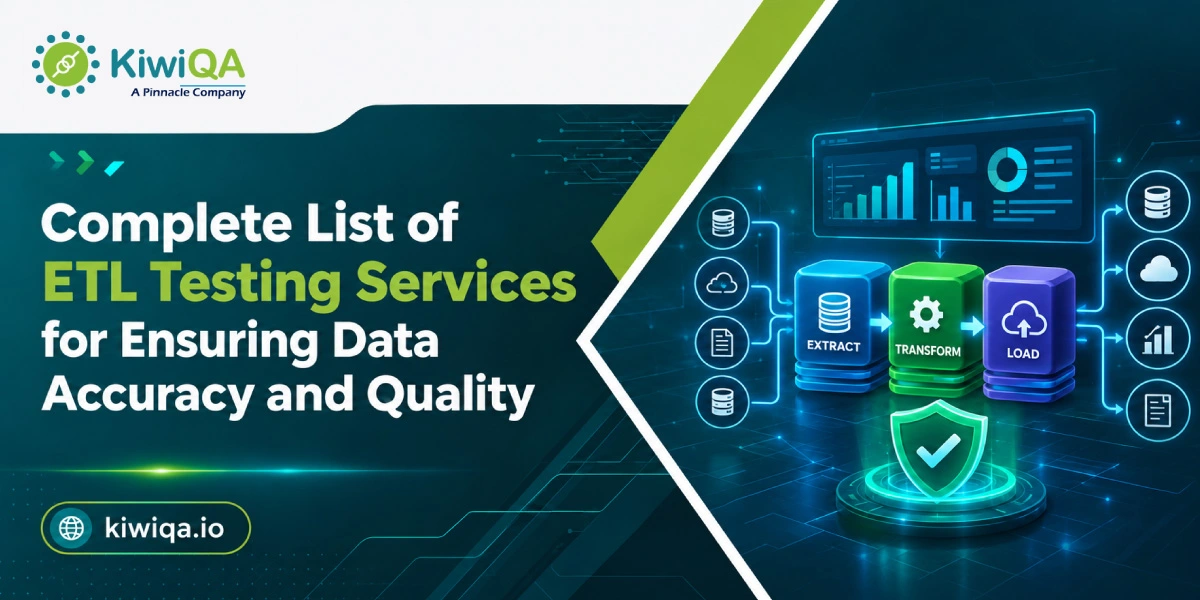
Complete List of ETL Testing Services for Ensuring Data Accuracy and Quality

Today’s companies depend on accurate data to manage operations, reporting, and decision-making. However, poor data quality can have a significant financial impact. More than 25% of organisations estimate annual losses of over $5 million due to poor data quality, while 43% of chief operations officers identify data quality as a top data priority. Data quality testing helps identify errors before they affect downstream systems, analytics, and business metrics.

Working with a trusted ETL testing firm ensures that data pipelines are thoroughly validated. Professional ETL testing services can help detect data loss, formatting errors, calculation issues, and integration problems, supporting more accurate and reliable business insights.

What Is ETL Testing?

➥ Understanding the ETL Process

ETL stands for Extract, Transform, and Load. It is a process that gathers raw data from various data sources, cleans and sorts these data, and loads them into a centralized application like a data warehouse.

Extract is the process of gathering data from legacy databases, third-party applications, flat files, or APIs. Cleans, filters, joins and applies business rules to prepare data. Load loads the processed data into the target database or cloud data warehouse.

ETL testing verifies the process from the source to the destination, making sure that data is not corrupted, changed unexpectedly, lost, or processed incorrectly.

➥ Why Is ETL Testing Important?

Data accuracy, consistency and completeness are provided by reliable ETL software testing. It can identify missing data, erroneous calculations, duplicate data, and formatting problems early, ensuring the accuracy of reporting and aiding in making sound business decisions.
Why Choose Professional ETL Testing Services

Complete List of ETL Testing Services

1. Data Extraction Testing Services

Data extraction testing confirms data accuracy from databases, CRM systems, ERP applications, APIs, flat files and legacy systems. Those conducting the test verify that there is no missing, duplicate, or incorrectly captured data by comparing them with the data that has been extracted. They also check the connections and files to the source, file formats, record counts, field mappings, and schema structures to ensure reliable extraction processes.

2. Data Transformation Testing Services

Data transformation testing validates the data to ensure that the data is clean and ready to feed into the target system. Defines business rules, data mappings, joins, lookups, calculations, aggregations, filters, sorting logic and data type conversions. Testing also validates that the values transformed are as expected, and that during transformation, there is no loss or alteration of valid information.

3. Data Loading Testing Services

Data loading testing ensures that data is loaded correctly into databases, data warehouses, and cloud platforms. Testers verify record counts, field values, duplicate records, missing data, truncation, rejected records, and load failures. They also validate full and incremental loads to ensure that new and updated records reach the target system accurately. ETL automation testing services help streamline these validation processes, reduce manual effort, and improve data reliability.

4. Data Quality Testing Services

Data quality testing verifies that enterprise data is accurate, complete, consistent, valid, and in a proper format. It detects inconsistencies between systems, writing or formatting errors, nulls, not defined fields, incorrect values, and duplicate records. Continuous quality checking enables organisations to have consistent data sets for business reporting, for customer management, for business analytics and operations.

5. Data Warehouse Testing Services

Data warehouse testing verifies the integrity of the data warehouse structure, relationships and the information contained in it. It deals with fact tables, dimension tables, schemas, keys, relationships, historical records and aggregation logic. Testers perform warehouse-to-source system data integrity testing to ensure information is transferred correctly, and that dashboards, reports, and analytical queries are accurate.

6. ETL Migration Testing Services

ETL migration testing ensures that the data is correct when switching from legacy systems to new databases, cloud warehouses, or applications. Testers match the source and target environments to determine if there are missing, duplicated, changed or corrupted records in either. The process also validates the data types, row counts, the business rules, the checksums, historical information, and the transformation logic, to ensure a smooth migration.

7. Database Testing Services

Database testing is the process of checking the reliability, security and functionality of databases employed in an ETL environment. Validates SQL queries, stored procedures, views, triggers, indexes, constraints, relationships and transactions. Performance testing can also uncover slow queries, database constraints, storage shortages, and data consistency issues, among other things, when run under new workloads.

8. Big Data ETL Testing Services

Big data ETL testing is designed for structured, semi-structured and unstructured data processing environments. It validates data ingestion, distributed processing, partitioning, aggregation, batch jobs and streaming workflows. Testing can include technologies like Hadoop and Spark to guarantee accurate processing of large datasets without performance or data quality problems.

9. Cloud ETL Testing Services

Cloud ETL testing is used to validate data pipelines deployed on platforms like AWS, Microsoft Azure, and Snowflake. It monitors data transfers, event triggers, data pipelines, pipelines dependencies, automated workflows, APIs, integration, and cloud storage. Testing can also help ensure good data movement between hybrid and multi-cloud setups and detect configuration or integration problems.

10. ETL Performance Testing Services

ETL performance testing is used to assess the efficiency of pipelines in processing, transforming and transferring data. Processes performance in terms of processing time, throughput, query response, CPU, memory and database performance. Testers find bottlenecks, inefficient queries, resource shortages and slow processes which may cause the batch jobs to be delayed or impact timely reporting.

11. ETL Automation Testing Services

Scripts, frameworks and automated tools for repetitive validation activities are used in automated testing for ETL. Automated tests can compare source and target records, validate transformation rules, check record counts, and run regression testing whenever there are changes to the pipeline. The benefits of automation are that it cuts down on manual work, increases test coverage, and lets teams identify data problems earlier.

12. Data Pipeline Testing Services

Data pipeline testing ensures that data flows from the source systems, through the data extraction and transformation processes, to the final systems (such as data warehouse, application, or reporting layer). It verifies pipeline dependancy, scheduling, data flow, error handling, retry, failure recovery, etc. End-to-end testing can help prevent data gaps or downstream analytics failures if individual pipeline failures occur and go unnoticed.

Also Read : Types of ETL Testing and Their Role in Data Quality
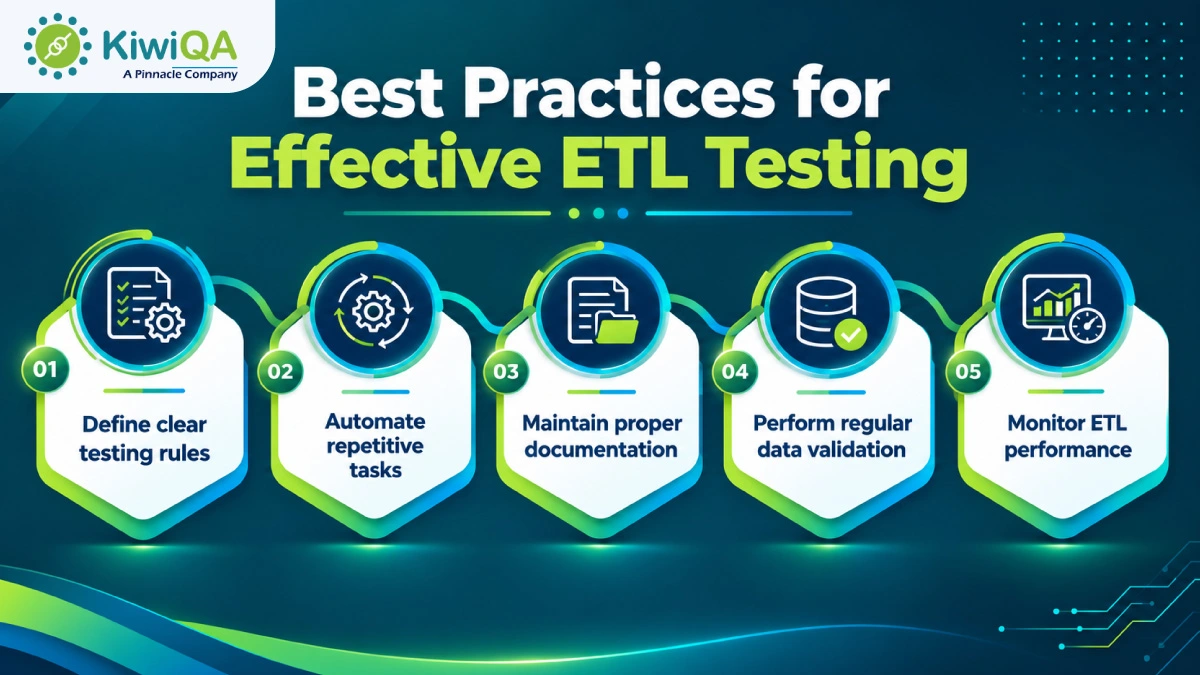
Best Practices for Effective ETL Testing

Best Practices for Effective ETL Testing

Creating a scalable testing methodology is a matter of planning, methodology discipline and the right kind of software tools. An ETL testing solution based on the industry best practices results in consistently clean data.

Create Clear Testing Rules: Document and define the requirements for moving the sources to their target before executing test passes with explicit acceptance criteria.

Automate Repetitive Tasks: Use continuous ETL automation testing services to count rows, test schema, and run tests for your entire day automatically.

Update Documentation: Update and maintain current mapping logic, custom transformation and historical test scripts.
Do Regular Data Validation: Ensure that a robust ETL testing services solution is used to execute regular audit scripts on real-time production feeds.

Monitor ETL Performance: Follow the pipeline run time against time, and resolve the slowdowns in the pipeline to avoid impacting business operations.

Popular ETL Testing Tools

➥ Common ETL Testing Tools

Informatica Data Validation Option enables automated data validation at Informatica level in Informatica workflows. Talend Data Quality supports profiling, standardising and detecting potential data issues in the source data. QuerySurge performs source-to-target testing in data warehouses and big data environments. Apache Spark testing frameworks enable a team to validate large batch and streaming datasets, and SQL-based custom frameworks enable a team to directly compare datasets in the database with their own custom queries.

➥ How to Choose the Right ETL Testing Tool?

Select an ETL testing tool that integrates seamlessly with existing databases, cloud platforms, data warehouses, and CI/CD pipelines. Automated test creation, scheduling and notifications can significantly minimize repetitive testing with strong automation features. It should appropriately scale with the size of the data and offer simple and readable reports that assist technical and business teams to interpret the testing outcome.

How ETL Testing Services Improve Data Quality

By performing systematic data validation, you can get immediate measurable enhancements throughout your organization’s digital ecosystem.

➥ Ensure Accurate Data Validation

When using a top-notch ETL testing company, records will be matched 100% to meet target requirements. Advanced validation routines verify data that checks multiple databases for missing fields, truncations, or corrupted characters, preventing them from affecting operations.

➥ Improve Reporting and Analytics Reliability

Clean pipelines deliver clean analytics. If business intelligence dashboards leverage records that have been verified by powerful ETL testing services, executives can be confident in the numbers they are seeing to evaluate their monthly performance metrics, without having to second-guess the reports.

➥ Reduce Data Errors and Inconsistencies

Continuous ETL automation testing service implementations catch mapping flaws early in development environments. Early detection prevents costly emergency repairs and helps eliminate redundant or corrupted data from live systems.

Why Choose Professional ETL Testing Services?

➥ Access Experienced ETL Testing Experts

Professional ETL testing services give access to proficient testing experts with a knowledge of intricate data workflows. They provide industry-specific solutions to meet the specific needs of the business and the data.

➥ Use Advanced Testing Methodologies

To enhance accuracy and efficiency, experienced teams employ the latest testing methods and automation tools. These strategies allow data problems to be identified quicker, and repetitive manual testing reduced.

➥ Support Complex Data Environments

Professional testing teams are able to test several databases, applications, APIs, cloud platforms and data warehouses. They assist in validating data over complex enterprise environments and integration points.

➥ Ensure Scalable Data Testing Solutions

Scalable ETL testing solutions can grow with the volume of data, new integrations, and evolving business needs. They facilitate ongoing testing and assist in maintaining data quality as systems expand.

Also Read : Business Guide to ETL Testing Tools 2026 for Better Data AccuracyReady to Improve Your Data Quality with Reliable ETL Testing Services
Ready to Improve Your Data Quality with Reliable ETL Testing Services?

Data is your organization’s most precious strategic asset, but only when it’s accurate. Faulty pipelines result in incorrect reports, lost developer time and dangerous business decisions. Using a good ETL software testing tool safeguards your data ecosystem, guarantees full pipeline protection, and boosts confidence in every business-dashboard you use.

Data teams in enterprises can utilize expert validation strategies to construct pipelines that are reliable and error-free, and that provide business value every day.
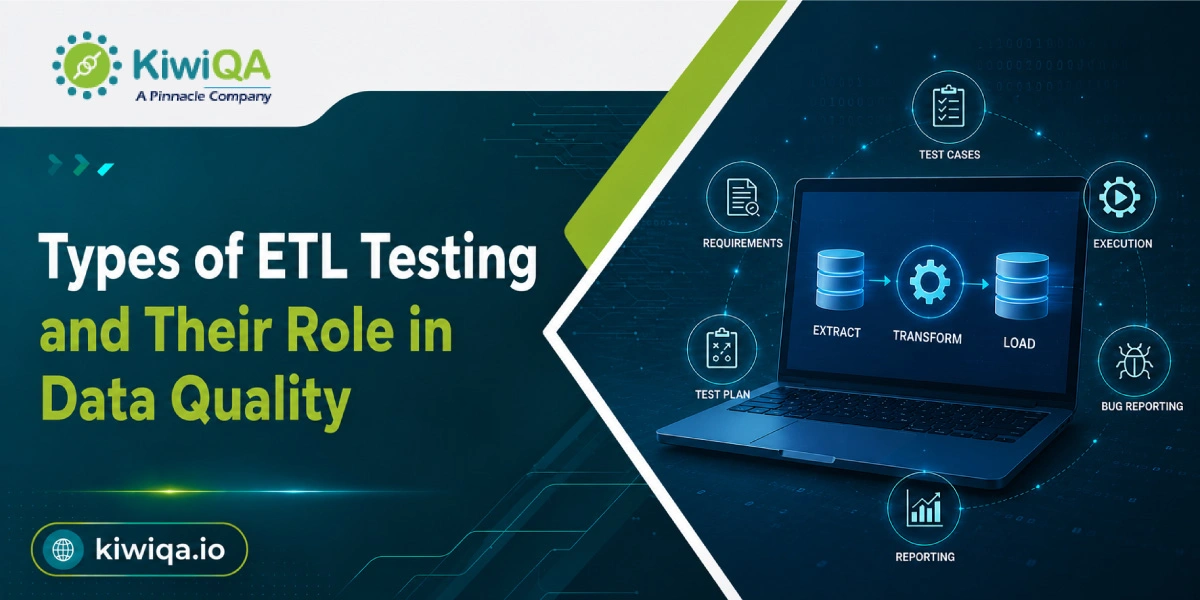
Types of ETL Testing and Their Role in Data Quality

Imagine spending significant time and resources migrating data to a new system, only to discover that the information is inaccurate or incomplete. Such errors can increase project costs and lead to poor business decisions. This is a common challenge during the ETL process. Understanding the different types of ETL testing helps businesses validate data accuracy, completeness, transformation logic and system performance. When integrating or migrating data to an advanced platform, ETL testing services are essential for reducing risks and ensuring reliable data.

The global ETL software market is valued at $10.24 billion and is expected to exceed $21 billion within seven years, representing over 105% growth ETL testing ensures data accuracy and reliability. ETL testing services can be challenging because of the data volumes and the layer of complexity they add. However, with the ideal tools, even beginners can get started with ETL testing in no time. This blog presents the information you must know about ETL testing, process, types, and best practices.

What Is ETL Testing?

➥ Understanding ETL (Extract, Transform, Load)

ETL testing is the process of validating the reliability & accuracy of information in the ETL process. In software and data engineering, ETL testing services solutions play a critical role in data quality and assurance. It supports decision-making by verifying that data has been accurately transferred and loaded into the target systems.

➥ Why ETL Testing Is Important

ETL testing plays a crucial role in managing high-quality data throughout the data integration process. ETL testing tools avoid data loss, enhance data accuracy, & validates that transformations and business rules are accurately applied. Effective ETL testing also ensures reliable BI, supports regulatory compliance, and ensures data governance. It allows firms to make data-driven decisions.

Ready to Strengthen Data Quality with ETL Testing?

Why Data Quality Depends on ETL Testing

🢣 Accurate reporting and analytics

ETL testing guarantees that dashboards and reports are based on reliable, validated, and consistent data. Automating data validation, confirming transformations, and spotting inconsistencies before they affect analytics are all made possible by advanced ETL testing tools.

🢣 Better business decision-making

Making wise business decisions requires high-quality data. Before data is sent to reporting systems, ETL testing confirms that it is correct, complete, and consistent. Organizations may confidently use analytics to promote long-term company growth and strategic planning by removing data inconsistencies.

🢣 Reduced operational risks

ETL testing stops incorrect information from impacting crucial business processes by identifying problems with data quality early in the pipeline. Organizations may minimize financial risks, minimize operational disruptions, and avoid expensive repairs once data reaches production environments.

🢣 Improved customer experience

ETL testing reduces errors that could affect service quality by ensuring that customer data is consistent across systems. Organizations may strengthen their relationships with customers and increase customer satisfaction and retention by using reliable data.

🢣 Higher trust in enterprise data

ETL testing produces reliable datasets that stakeholders can rely on by verifying data accuracy, consistency, and integrity throughout the pipeline. Improved organizational performance and broader adoption of analytics are supported by increased trust in enterprise data.

Also Read : Business Guide to ETL Testing Tools 2026 for Better Data Accuracy

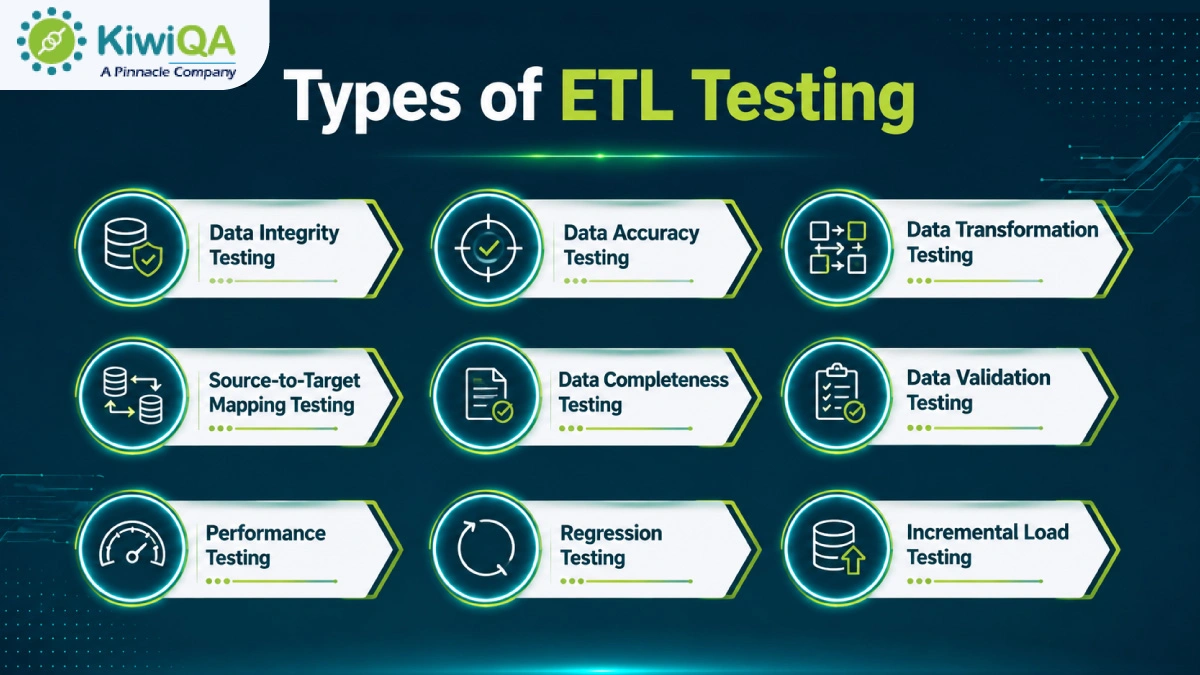
Types of ETL Testing

❏ Data Integrity Testing

Throughout the types of ETL testing, data integrity testing guarantees the accuracy of the connections between datasets. After each ETL execution, this testing ensures that business applications, analytics platforms, and reporting systems function with reliable and consistent data across databases.

❏ Data Accuracy Testing

Data accuracy testing confirms that, following extraction, transformation, and loading, data values stay accurate. It verifies calculations, validates transformation outcomes, and ensures that business rules are implemented appropriately. This procedure finds inaccurate values before they have an impact on reporting or decision-making.

❏ Data Transformation Testing

Among the different types of ETL testing, data transformation testing verifies that, during ETL execution, transformation logic functions precisely as expected. This testing validates that the organization’s demands are satisfied. Inconsistencies are reduced, and high-quality, analytics-ready data can be obtained through this.

❏ Source-to-Target Mapping Testing

Every source field is accurately mapped to its proper location in the target system, according to source-to-target mapping tests. It makes sure data is loaded into the right tables and columns, verifies field mappings, and checks data type compatibility. This testing stops mapping errors that can lead to inefficient reports or unsuccessful ETL procedures.

❏ Data Completeness Testing

Testing for data completeness guarantees that all necessary records are correctly imported into the target database from the source system. It checks that no data is lost during ETL execution, compares source and target record counts, and finds duplicate or missing records. This testing enhances reporting accuracy and ensures thorough data migration.

Types of ETL Testing

❏ Data Validation Testing

Data validation testing verifies that loaded data conforms with established quality standards and business regulations. It ensures that only correct and useful data enters the target system by confirming required fields, validating formats, and enforcing business restrictions. This testing lowers data quality problems and increases confidence in reports, dashboards, and operational decision-making.

❏ Performance Testing

Performance QA measures ETL operations’ scalability and efficiency under various workloads. This testing offers faster reporting and increased operational efficiency. It also helps to optimize ETL pipelines and guarantee consistent performance with rising data volumes.

❏ Regression Testing

Regression testing guarantees that improvements, or code modifications, won’t negatively impact current ETL procedures. Frequent regression testing lowers deployment risks, protects against unexpected failures, and guarantees accuracy.

❏ Incremental Load Testing

During ETL execution, incremental load testing verifies that only newly created or updated records are processed. It guarantees the accuracy of incremental loads, avoids duplicate records, and confirms that changes are implemented effectively without impacting existing data.

ETL Testing Process: Step-by-Step

◈ Requirement Analysis

Requirement analysis is the first step in the ETL testing process. In this phase, the testers examine data flow specifications, transformation rules, source-to-target mapping documents, and business needs. This phase confirms that the ETL process satisfies functional and data quality requirements. The process ensures that the testing plan is in line with business objectives.

◈ Test Planning

The testing team establishes the scope, goals, resources, schedule, testing methodology, and necessary tools during test preparation. A well-organized test plan guarantees effective implementation, reduces delays, and offers precise instructions for verifying ETL processes while preserving project quality.

◈ Test Case Design

In order to validate data extraction, transformation, loading, validation, and business rules, test case design involves creating comprehensive test scenarios. Test cases that are well-designed enhance error identification, verify expected results, and guarantee that the ETL pipeline operates correctly.

◈ Test Environment Setup

Setting up source systems, target databases, ETL tools, and representative test data creates a dedicated test environment. Accurate validation of ETL workflows is ensured by proper setup, which also reduces configuration-related problems and offers a reliable platform for carrying out thorough testing operations.

◈ Test Execution

Testers run the prepared test cases, verify business rules, compare source and target outcomes, and validate extracted and transformed data. This stage verifies whether the ETL process operates as intended and satisfies the specified performance, accuracy, and quality standards.

◈ Defect Reporting

Effective defect reporting facilitates the accurate identification and resolution of issues by developers. Clear documentation guarantees that all ETL defects are tracked until they are closed, enhances teamwork, and drives problem-solving.

◈ Retesting and Validation

Validation guarantees that all requirements for data quality, mappings, transformations, and business rules are satisfied. This last stage confirms that the ETL pipeline is stable and prepared for implementation in a production setting.

The Role of ETL Testing in Data Quality

☢ Ensures Data Accuracy

ETL automation testing services check computations, transformation logic, and business rules for mistakes. ETL automation testing services further increase accuracy by automating validations, minimizing human labor, and guaranteeing accurate results.

☢ Maintains Data Completeness

Every necessary record is correctly moved from source to target thanks to ETL testing. It creates entire datasets for reporting, analytics, and operational procedures by identifying missing data and ensuring that no important information is lost during extraction, transformation, or loading.

☢ Improves Data Consistency

ETL testing removes errors between source and target databases by evaluating data across several systems. It guarantees that departments operate with consistent, correct data and provide reliable reports throughout the company.

☢ Preserves Data Integrity

By confirming linkages between records, avoiding orphan records, and maintaining referential integrity, ETL testing protects data integrity. In order to produce reliable data that supports business operations, analytics, compliance, and long-term data reliability, it ensures linked datasets stay accurate throughout the ETL process.

☢ Supports Better Business Decisions

Reliable ETL testing lowers the possibility that incomplete or out-of-date data may affect business choices. Organizations gain more trust in analytics, forecasting, and strategic planning by providing validated and high-quality datasets.

☢ Enhances Regulatory Compliance

Organizations can keep reliable and auditable data along the pipeline with the use of ETL testing. It lowers the risk of reporting errors, audit failures, and regulatory violations while supporting adherence to industry laws and governance standards.

☢ Boosts Operational Efficiency

AI-driven ETL testing services prevent expensive errors by identifying problems with data quality early in the pipeline. Early detection minimizes manual corrections, lowers rework, increases workflow efficiency, and speeds up data availability. It allows teams to concentrate on providing crucial insights rather than resolving data issues.

Best Practices for Effective ETL Testing

🢣 Automate repetitive tests

ETL automation testing services guarantee consistent validation across several data loads, increase testing performance, and minimize manual labor. Automated testing reduces human error, drives frequent integration & release. Additionally, it makes it possible for teams to effectively carry out repeating test cases while preserving excellent data quality throughout the ETL lifecycle.

🢣 Validate source-to-target mappings

Every field from the source system is accurately mapped to the target database thanks to source-to-target mapping validation. Precise mapping validation guarantees dependable reporting and business intelligence results, removes migration problems, and enhances data consistency.

🢣 Test with real-world datasets

Validating ETL procedures under practical circumstances is helped by the use of production-like datasets. To find hidden problems, utilize various ETL testing types with big data volumes, various formats, null values, duplicate records, and edge cases. Real-world testing guarantees correct data processing and boosts confidence in ETL performance.

🢣 Include data quality checks

To ensure accuracy, consistency, uniqueness, and integrity, data quality checks should be incorporated throughout the ETL process. Before they affect downstream systems, these validations assist in locating inaccurate records.

🢣 Monitor ETL jobs continuously

ETL execution, task errors, processing time, system resource utilization, and data quality parameters are all monitored continuously. Teams can identify bottlenecks and fix problems before they hamper firm workflows, with the support of proactive assessment.

🢣 Perform regression testing regularly

Regression testing should be carried out following any ETL improvement, bug correction, or configuration modification. It detects unexpected problems brought about by updates and verifies transformations, mappings, and loading procedures. Frequent regression testing preserves overall data quality and pipeline stability.

🢣 Maintain detailed test documentation

Test cases, execution outcomes, source-to-target mappings, validation reports, flaws, and fixes should all be included in thorough documentation. Maintaining documentation makes troubleshooting easier, facilitates compliance audits, and enhances development and QA team collaboration.

Also Read : Best 11 SaaS Testing Companies in India (Edition 2026)

Why Businesses Should Invest in ETL Testing

☛ Improve decision-making

ETL testing guarantees consistent and correct data at every stage of extraction, transformation, and loading. Leaders can make quicker, more informed decisions that promote corporate expansion and operational effectiveness when they have access to high-quality data.

☛ Reduce costly data errors

Financial losses, business interruptions, and unsatisfactory customer experiences can all be caused by data inaccuracies. ETL testing reduces the need for costly human adjustments and rework by identifying problems before data reaches production systems. Early defect detection reduces business risks and contributes to error-free, seamless data processes.

☛ Increase reporting accuracy

Clean and verified data is necessary to generate accurate reports. To make sure reports contain accurate business data, ETL testing confirms computations, transformations, and source-to-target mappings. This increases trust in business information, dashboards, and performance measures, allowing stakeholders to rely on data for operational and strategic planning choices.

☛ Support compliance requirements

Strict data governance and regulatory requirements must be met by numerous sectors. Throughout the pipeline, ETL testing helps guarantee that data is correct, comprehensive, traceable, and auditable. Businesses can lower compliance risks, streamline audits, and more confidently comply with industry rules by maintaining excellent data quality.

☛ Build reliable data warehouses

Only when a data warehouse has reliable and consistent data can it be considered valuable. Every step of data transfer is validated by ETL testing to guarantee that records are loaded and transformed correctly. Reliable testing builds reliable data warehouses that facilitate long-term business intelligence projects, analytics, and enterprise reporting.

☛ Enable scalable analytics

ETL testing ensures that pipelines continue to process data correctly and effectively as data quantities increase. It enables businesses to confidently scale analytics platforms by validating performance, data quality, and transformation logic across big datasets.

Ready to Discuss Your ETL Testing Requirements?

Ready to Improve Your Data Quality with ETL Testing?

In the current world, data integrity is necessary to maintain. A single error report can hamper user trust and lead to failure. ETL testing services are not a QA step but a strategic necessity. To verify your data transfers flawlessly, choose an ETL testing services solution.

Business Guide to ETL Testing Tools 2026 for Better Data Accuracy

Modern businesses know that data means success. Companies can use valuable, up-to-the-minute data with systems that harness artificial intelligence, handle data in real-time, run reports on demand, and implement them in the cloud. Regardless of how advanced the AI is, if the data is poor, the reports can lead to compliance issues, operational issues, strategic failures, and ultimately a big loss for the company.

Modern businesses collect data from multiple sources, like CRM systems, ERP platforms, phones and mobile apps, cloud databases, APIs, and even IoT devices. As this information moves through the extraction, conversion, and loading stages, the risk of duplicates, blank values, transformation errors, and data corruption tends to rise significantly. Studies suggest that poor-quality data costs U.S. businesses nearly $3.1 trillion annually. In addition, organizations estimate that around 30% of their data is inaccurate, leading to costly errors, inefficient operations, and unreliable business decisions.

As businesses become more data-focused, ETL testing tools becomes more important and should be added to company operations. ETL testing not only checks to ensure data is appropriately extracted from the source system, modified to fit the requirements of the business, and accurately inserted into the appropriate database or warehouse, but also checks for consistency and reliability throughout every step of the data pipeline.

Today, data is used in business practices beyond simple reporting and statistics. Advanced analysis, predictive modeling, artificial intelligence, data-based machine learning, and many more sophisticated systems rely heavily on validated, clean data. If messy, unvalidated data finds its way into one of these systems, the organization will gain unexpected foresight with the wrong customer insights and faulty artificial intelligence. In many business practices, such as healthcare, banking, retailing, and insurance, bad data can also create a lot of problems and costly fines for not complying with regulations.

Organizations often end up dealing with a bunch of hurdles when managing modern data pipelines. Hybrid cloud environments, legacy infrastructure, and high-volume data processing, plus business requirements that keep changing fast, make manual testing clunky, inefficient, and easy to mess up. Traditional validation methods have trouble catching up with large-scale enterprise data operations, especially when teams want continuous integration and real-time analytics at the same time.

More advanced ETL testing tools help by automating data validation, spotting anomalies early, boosting the overall testing accuracy, and cutting down manual work across those complicated data pipelines.

Professional ETL testing services actually help elevate data reliability by mixing automation approaches with domain knowledge and a more structured validation routine, not just a quick check. In practice, these services can surface defects before they start disrupting operations. That keeps things stable, makes scaling less painful, and gives teams more confident, trustworthy data pipelines.

This guide explains how ETL testing tools improve data accuracy, operational efficiency, and reliable business decision-making in 2026.

Understanding ETL Testing

➥ What is ETL?

❏ Definition of Extract, Transform, Load

ETL means Extract, Transform, and Load, and it is a workflow that helps teams pull data from multiple places, reshape it into a common form, then move it into central systems. In practice, this is often used as a structured pipeline so data can get organized, and it supports analytics, day-to-day operations, reporting, and enterprise decisions. So the idea is to extract the relevant information, transform it, and load it, even if the sources are scattered, each time.

❏ Role of ETL in data warehousing and business intelligence

ETL plays a foundational role in data warehousing by integrating information from different sources into one unified repository. In the end, it lets business intelligence tools create more accurate dashboards, forecasts, and even sharper insights. Many organizations also depend on ETL testing services to keep data consistency across more complex enterprise workflows, because the pipeline can get messy when you do not check it often.

❏ Difference between ETL and ELT

ETL is basically where data gets transformed first, before it is loaded into the destination system, while ELT is the opposite approach: it loads the raw data first, then does the transformations afterward, inside the target environment. You see ELT a lot in cloud-based setups that handle high-volume processing, scale more easily, and allow quicker analytics across today’s business ecosystems.

➥ What is ETL Testing?

❏ Validating data extraction, transformation, and loading processes

ETL testing checks that the steps of data extraction, transformation, and loading are completed and compliant with business needs. ETL testing verifies the integrity of data while ensuring the transformation logic and processing accuracy function correctly. With the advancement of top ETL testing tools, companies are starting to automate the validations to complete ETL testing on large data sets.

❏ Ensuring consistency between source and target systems

The main aim of ETL testing is to keep data consistent and dependable, basically making sure it transfers well between the source systems and the target platforms. ETL testers conduct record, schema, and transformation comparisons to find discrepancies. Data consistency ensures businesses have reliable reports and accurate analytics to run data operationally across a business unit and across the entire organization.

❏ Detecting data loss, duplication, and transformation errors

ETL testing helps organizations identify data loss, duplicate records, mismatched mappings, and transformation hiccups before that information really reaches reporting systems. Catching issues early stops inaccurate business insights and operational trouble later on. Continuous testing also makes pipeline stability better, plus it supports compliance readiness and keeps data long-term reliable across enterprise environments.

➥ Why ETL Testing Matters in 2026

❏ Increased dependence on cloud data ecosystems

By 2026, most companies will use a combination of cloud-native and hybrid infrastructures as the foundation of their managed operations and analytics. Data will be dispersed across multiple cloud applications and storage systems. ETL testing will be necessary to integrate disparate cloud systems, validate if data is in sync, and keep data available for decision-making.

❏ AI and machine learning require clean data

Artificial Intelligence and Machine Learning systems need accurate, structured, and unbiased data to make reliable predictions and derive insights. Minor inconsistencies and omissions impact the performance and accuracy of the model. An excellent ETL testing services solution enables organizations to identify quality and accuracy issues and eliminate anomalies to ensure the integrity of data to support AI and ML.

❏ Regulatory requirements for data governance

Contemporary frameworks and regulations require organizations to manage data integrity, traceability, and privacy within their digital systems. The finance, healthcare, and retail sectors face mounting compliance obligations. ETL testing helps fulfill governance needs by providing the integrity and quality assurance for data as it moves through countless transformations and maintains accurate records throughout complex enterprise ecosystems.

❏ Rising costs of inaccurate business reporting

Inaccurate business reports can lead to bad strategic decisions, financial losses, and operational disruptions, and also damage customers’ trust. As organizations increasingly rely on real-time dashboards and predictive analytics, even a tiny reporting error can turn into a big business risk. ETL testing helps lower that risk by spotting inconsistencies early and then makes the overall reporting reliability more solid and accurate.

Ready to Improve Data Accuracy with Smarter ETL Testing?

Key Benefits of ETL Testing Tools

◈ Improved Data Accuracy

The latest ETL testing tools pinpoint specific data problems by identifying gaps between the source and the target system, allowing problems to be corrected before impacting the business. The tools verify the transformation logic, monitor the integrity of the data, and identify duplicate or missing data during or after the execution of the pipeline. ETL validation allows trustworthy analytics and cleaner datasets and enhances confidence in enterprise reporting.

◈ Faster Data Validation

With ETL automation testing services, validating ETL batches and transformations happens much faster. This enables the business to shorten the time required to complete a full release as well as to incorporate better ETL validations into the CI/CD process. Continuous, real-time validation helps maintain performance and reporting within the business unaffected and allows the agile and DevOps teams to deliver data updates as needed.

◈ Enhanced Business Decision-Making

ETL testing enhances the reliability of dashboards and reports for operational and analytical decision-making activities across many business units. Improved business-level data leads to greater confidence and accuracy in forecasts, analyses, and strategies. Well-managed ETL processes improve impact and performance measurement and facilitate more accurate business decisions.

◈ Cost and Risk Reduction

ETL testing helps businesses cut down operational and financial risks by spotting pipeline problems before they mess up production environments or annoy end users. When transformation mistakes, integration failures, and inconsistent records get noticed early, it reduces unplanned downtime, boosts reporting accuracy, and trims down recovery costs. Also, solid ETL validation procedures back up regulatory compliance, and they protect the organization from penalties tied to untrustworthy or incomplete business data.

Also Read : Top 15 SaaS Testing Tools for Faster and Scalable QA in 2026

Essential Features to Look for in ETL Testing Tools

🢣 Automation Capabilities

The latest ETL testing solutions come with increased automation capabilities to address large-scale data set application validation redundancies. Automation regression testing, scheduled validation workflows, and continuous testing capabilities directly lead to faster releases and stable data pipelines. Moreover, advanced ETL testing automation tools support faster iteration and deployment in agile and DevOps environments.

🢣 Data Validation and Reconciliation

ETL testing tools should enable source-to-target comparisons to ensure data remains intact at all stages of a pipeline. Key capabilities include schema validation, transformation verification, and data completeness, which can help surface routing issues before data analytics. Strong reconciliation features help businesses ensure the accuracy of reporting, reduce operational risk, and consistently increase confidence in enterprise data management.

🢣 AI-Powered Testing Features

Utilizing ETL testing with AI technology can find errors that other testing methods can’t, thus improving both reliability and efficiency. Intelligent anomaly detection and other methods of predictive anomaly detection reduce data pipeline issues. As a result, companies can use AI tools for ETL testing to help transform automation and improve the long-term reliability of data pipelines.

🢣 Cloud and Big Data Support

ETL testing services should support modern architectures and large data environments, and should not suffer from performance limitations. Integrating with Snowflake, Databricks, BigQuery, and Amazon Redshift, among other enterprises, is essential. Companies also need adaptable testing infrastructures that can manage combined cloud networks and continuously flow enterprise data.

🢣 Reporting and Visualization

Extensive reporting and visualization features help teams keep track of ETL performance and pinpoint problems early in the testing cycles. With centralized logging and error tracking, and real-time dashboards, the visual representation of your workload is paramount. The reporting features assist you in preparing compliance documents and analyzing performance, and help the testers, developers, analysts, and business users collaborate on time.

🢣 Integration Capabilities

The ETL testing tool seamlessly integrates with CI/CD pipelines, ETL platforms, application programming interfaces, and corporate governance systems. Enterprises that utilize ETL automation testing services prefer tools that foster collaboration, enable automated deployment verification, and provide centralized monitoring. Seamless integration balances testing efficiency and effective data quality management in enterprise technology systems.

Top ETL Testing Tools in 2026

1. QuerySurge

QuerySurge

▪ Key Features

QuerySurge offers automated ETL validation, data warehouse testing, CI/CD integrations, and cross-platform data comparison to help companies that need to manage complex analytics and enterprise reporting workflows.

▪ Pros

As one of the best ETL testing tools for enterprise, QuerySurge is a leader for testing automation, has flexible validation, wide-ranging platform compatibility, and superior testing for large-scale enterprises.

▪ Cons

QuerySurge may have upper-tier integration and licensing prices that may be cost-prohibitive for smaller testing needs or smaller companies that have limited technology budgets and tool resources.

2. Informatica Data Validation

Informatica Data Validation

▪ Key Features

Informatica Data Validation gives you AI-powered testing and automated reconciliation, plus enterprise integration support, and also those scalable validation abilities that help handle really complex ETL workflows across modern cloud-based infrastructures.

▪ Best For

Large enterprise environments dealing with high-volume data pipelines, multi-source integrations, and regulatory reporting needs can really benefit from Informatica’s smart automation and enterprise-grade ETL validation features. It helps a lot when teams need strict consistency, faster orchestration, and reliable checks, especially across complicated data flows, sometimes messy ones.

3. Talend Data Quality

Talend Data Quality

▪ Key Features

Talend Data Quality provides data profiling, cloud native connections, open-source flexibility, and automatic cleansing tools that help keep data more consistent across enterprise analytics and operational reporting systems, effectively.

▪ Advantages

Among widely adopted ETL testing automation tools, Talend stands out for its user-friendly interface, broad ecosystem compatibility, and flexible connection support across hybrid enterprise environments, which is pretty useful if you’re dealing with multiple platforms.

4. Great Expectations

Great Expectations

▪ Key Features

Great Expectations offers an open-source validation framework, automated data documentation, Python-based testing, and flexible rule creation for modern analytics and engineering environments, in a way that feels smooth, efficient, and reliable.

▪ Ideal Use Cases

Among popular ETL tools for testing, Great Expectations is pretty suitable for data engineering teams who are handling modern data stacks, cloud warehouses, and automated transformation workflows every day.

5. Apache Griffin

Apache Griffin

▪ Key Features

Apache Griffin has been developed to provide the ability to track the quality of big data, validate in real-time, and integrate seamlessly in the Hadoop ecosystem. It allows for the periodic and ongoing assessment of big data and helps create and maintain an enterprise-grade big data processing system.

▪ Limitations

Apache Griffin has a sharp learning curve and requires a fair degree of technical expertise for configuration and maintenance of the system, which may deter small to medium enterprises having little in the way of engineering resources.

6. CloverDX

CloverDX

▪ Key Features

CloverDX has been developed especially to provide enterprise-grade data transformation, workflow design and automation, enterprise-grade integration, and the ability to be deployed in the cloud for the purpose of managing the complexities of ETL processes in varied business environments.

▪ Pros

CloverDX offers a high degree of flexibility in its deployment, a high degree of scalability for growth, and reliable enterprise-grade data integration for processing workflows.

▪ Cons

For a beginner, CloverDX may present a steeper learning curve, as an understanding of the fundamentals of ETL processes, an understanding of how to design advanced workflows, and how to manage and configure automation of workflows is necessary.

7. Microsoft SQL Server Integration Services (SSIS)

Microsoft SQL Server Integration Services (SSIS)

▪ Key Features

SSIS provides a complete set of ETL workflows, data migration and transformation capabilities, and tight integration with Microsoft technologies for business intelligence and reporting.

▪ Advantages

The platform works well within SQL Server environments, enabling Microsoft-centric organizations and technical teams to easily manage data transformation, reporting, and enterprise business intelligence.

▪ Best For

SSIS is most appropriate for Microsoft-based infrastructures that need robust ETL, reporting, structured data migration, and enterprise-scaled analytics systems.

8. Apache NiFi

Apache NiFi

▪ Key Features

Apache NiFi gives you real-time data flow automation, plus secure routing, drag-and-drop style workflow design, and a solid set of transformation features. It is built to move, process, and adapt streaming as well as batch data across distributed enterprise environments, in a way that feels dependable.

▪ Pros

Among widely used ETL testing tools, Apache NiFi supports streaming plus batch processing, along with visual monitoring, flow tracing, and a more simplified handling of enterprise data movement operations efficiently, which helps in day-to-day workflows.

▪ Limitations

Apache NiFi can feel a bit resource-heavy when you run massive loads or when the workflows get too complex, so it starts demanding careful infrastructure planning, along with performance tuning, if you want it to stay stable in the long run for enterprise deployment setups.

9. Pentaho Data Integration (Kettle)

Pentaho Data Integration (Kettle)

▪ Key Features

Pentaho Data Integration has an open-source ETL environment, plus graphical workflow design, and very strong support when it comes to big data integration. It is used for analytics, reporting, and enterprise data transformation processes, like you know, the whole thing from start to finish.

▪ Advantages

The platform delivers fairly cost-effective ETL features, gives you flexible ways of deployment, and offers wide compatibility with existing enterprise systems, so it becomes practical to implement for businesses that juggle different operational as well as analytical workloads.

▪ Ideal Use Cases

Pentaho works really well for mid-sized companies and analytics teams that are looking for affordable yet scalable and customizable ETL approaches, especially for handling reporting, system integration, and business intelligence tasks. It tends to fit nicely when you want to run everything efficiently without a big budget, and still keep some control over how the workflows are shaped

10. Datagaps ETL Validator

Datagaps ETL Validator

▪ Key Features

Datagaps ETL Validator supports automated ETL testing, plus reconciliation processes, cross-platform validation, and enterprise data warehouse testing. All of this helps improve data consistency, and it also cuts down operational validation complexity significantly.

▪ Pros

Recognized among the best ETL testing automation tools, Datagaps ETL Validator helps cut down manual testing efforts a lot while still handling intricate ETL workflows and enterprise-scale data matching needs in an efficient way.

▪ Best For

Datagaps ETL Validator is suited for QA teams who are focused on automated ETL checking, enterprise data reconciliation, and continuous oversight of business-critical data pipelines and workflow. It helps keep things in line, so pipelines don’t drift quietly over time.

Also Read : Top AI Testing Tools Decision Makers Should Invest in 2026

How to Choose the Right ETL Testing Tool

☢ Assess Your Business Requirements

Picking the proper ETL testing tool starts with figuring out what your organization needs, on a day-to-day basis, both operationally and technically. Most teams should look at data volume, transformation complexity, and any compliance duties, plus what kinds of reporting they actually demand. Also, the internal technical know-how matters a lot because some platforms ask for fairly advanced configuration skills, while others offer simpler automation and low-code testing environments for enterprise teams. In the end, you want the fit to feel natural, not forced.

☢ Consider Your Infrastructure

Infrastructure compatibility is essential when choosing an ETL testing platform for long-term operational efficiency. When you pick an ETL testing platform for day-to-day operations long term, compatibility matters a lot. You need to check if your setup is cloud-based, on-premises, or hybrid before you actually roll anything out. Also, look closely at your existing ETL systems, the integration requirements, and whether the API layer works the way your business workflows expect, or not. A dependable ETL testing services solution then supports smooth, almost frictionless, integration across today’s enterprise data landscape and the different platforms involved.

☢ Evaluate Scalability

Scalability should stay a key concern, because enterprise data volumes are growing really fast across many industries. Companies need ETL testing tools that can keep up with what comes next, including future growth, many-source integrations, and big transformation runs, all without noticeable performance drop-offs. Looking at how different platforms manage high workloads, run parallel processing, and keep working as datasets expand helps organizations dodge operational bottlenecks and preserve steady long-term testing results in different environments.

☢ Compare Pricing Models

When you compare pricing models, businesses can choose ETL testing solutions that fit their day-to-day budgets as well as future technology plans. Organizations should look closely at subscription-based pricing, perpetual licensing options, setup or implementation expenses, and also at those hidden upkeep costs that quietly show up later. It’s also important to estimate the expected return on investment, particularly when you are balancing automation advantages, less testing workload, better data accuracy, and the need for enterprise-scale capability in a clean way.

☢ Conduct a Proof of Concept (POC)

A proof of concept lets organizations try ETL testing tools in real-life business scenarios before they do a full-scale rollout. In practice, teams usually want to check workflow compatibility, the automation strength, day-to-day usability, and also how it performs when everything is actually running. Collecting input from technical teams, analysts, and stakeholders helps surface hidden constraints early, while at the same time confirming the chosen platform will back long-term enterprise data validation needs properly.

Ready to Discuss Your ETL Testing Requirements?

Ready to Improve Your Data Accuracy with the Right ETL Testing Tool?

ETL testing tools help companies keep their data correct, coherent, and dependable across reporting systems, analytics platforms, and day-to-day operational contexts, all the time.

Automation, together with artificial intelligence, is reshaping data quality management too, boosting test velocity, cutting down on manual labor, and spotting unseen pipeline inconsistencies before they become a problem, more proactively.

Choosing the right ETL testing platform is about aligning business objectives with what your infrastructure can handle, plus thinking ahead for future scalability and those long-term enterprise data management plans that never quite end.

Modern AI-driven ETL testing services help with validation accuracy, automate the workflows, catch anomalies early, and end up strengthening enterprise data reliability across complex digital ecosystems.